The Kac determinant tells us when a Virasoro module develops null states. Minimal models are the theories where this mechanism becomes so strong that only finitely many primary fields remain.
This is one of the most striking lessons of two-dimensional CFT: in special theories, symmetry plus null-vector decoupling can determine correlation functions almost completely. The same contour methods are also the everyday technology of string perturbation theory, where scattering amplitudes are worldsheet correlators of vertex operators.
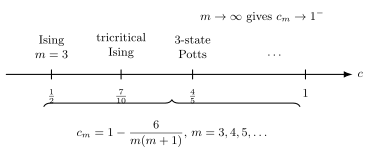
The unitary minimal models have central charges
c m = 1 − 6 m ( m + 1 ) , m = 3 , 4 , 5 , … . c_m=1-\frac{6}{m(m+1)},
\qquad
m=3,4,5,\ldots. c m = 1 − m ( m + 1 ) 6 , m = 3 , 4 , 5 , … . Their primary fields are labeled by pairs of integers
( r , s ) , 1 ≤ r ≤ m − 1 , 1 ≤ s ≤ m , (r,s),
\qquad
1\leq r\leq m-1,
\qquad
1\leq s\leq m, ( r , s ) , 1 ≤ r ≤ m − 1 , 1 ≤ s ≤ m , with weights
h r , s = ( ( m + 1 ) r − m s ) 2 − 1 4 m ( m + 1 ) . h_{r,s}
=
\frac{\left((m+1)r-ms\right)^2-1}{4m(m+1)}. h r , s = 4 m ( m + 1 ) ( ( m + 1 ) r − m s ) 2 − 1 . The labels satisfy the reflection identification
( r , s ) ∼ ( m − r , m + 1 − s ) . (r,s)\sim(m-r,m+1-s). ( r , s ) ∼ ( m − r , m + 1 − s ) . Therefore the number of distinct primaries is
m ( m − 1 ) 2 . \frac{m(m-1)}{2}. 2 m ( m − 1 ) .
The unitary minimal models form a discrete series with c m < 1 c_m<1 c m < 1 c m → 1 c_m\to1 c m → 1 m → ∞ m\to\infty m → ∞
The first few examples are famous:
m c m model 3 1 2 critical Ising 4 7 10 tricritical Ising 5 4 5 three-state Potts \begin{array}{c|c|c}
m & c_m & \text{model}\\
\hline
3 & \frac12 & \text{critical Ising}\\[2pt]
4 & \frac{7}{10} & \text{tricritical Ising}\\[2pt]
5 & \frac45 & \text{three-state Potts}
\end{array} m 3 4 5 c m 2 1 10 7 5 4 model critical Ising tricritical Ising three-state Potts For m = 3 m=3 m = 3
c = 1 2 , h r , s = ( 4 r − 3 s ) 2 − 1 48 . c=\frac12,
\qquad
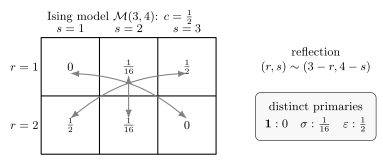
h_{r,s}=\frac{(4r-3s)^2-1}{48}. c = 2 1 , h r , s = 48 ( 4 r − 3 s ) 2 − 1 . The allowed labels are r = 1 , 2 r=1,2 r = 1 , 2 s = 1 , 2 , 3 s=1,2,3 s = 1 , 2 , 3
1 : h = 0 , σ : h = 1 16 , ε : h = 1 2 . \mathbf 1: h=0,
\qquad
\sigma: h=\frac{1}{16},
\qquad
\varepsilon: h=\frac12. 1 : h = 0 , σ : h = 16 1 , ε : h = 2 1 .
The Ising Kac table contains six labels but only three independent primary weights after the reflection identification.
The field σ \sigma σ ε \varepsilon ε
A null state is a statement in the Hilbert space. The state-operator correspondence converts it into a local operator identity inside correlation functions.
For a primary field ϕ ( z ) \phi(z) ϕ ( z ) h h h
∣ h ⟩ ⟷ ϕ ( 0 ) ∣ 0 ⟩ . |h\rangle\longleftrightarrow \phi(0)|0\rangle. ∣ h ⟩ ⟷ ϕ ( 0 ) ∣0 ⟩ . The descendant L − 1 ∣ h ⟩ L_{-1}|h\rangle L − 1 ∣ h ⟩
∂ ϕ ( 0 ) . \partial\phi(0). ∂ ϕ ( 0 ) . More generally,
( L − n ϕ ) ( z ) = 1 2 π i ∮ z d w ( w − z ) 1 − n T ( w ) ϕ ( z ) , n ≥ 1. (L_{-n}\phi)(z)
=
\frac{1}{2\pi i}
\oint_z dw\,(w-z)^{1-n}T(w)\phi(z),
\qquad n\geq1. ( L − n ϕ ) ( z ) = 2 πi 1 ∮ z d w ( w − z ) 1 − n T ( w ) ϕ ( z ) , n ≥ 1. For n = 2 n=2 n = 2
( L − 2 ϕ ) ( z ) = lim w → z [ T ( w ) ϕ ( z ) − h ( w − z ) 2 ϕ ( z ) − 1 w − z ∂ ϕ ( z ) ] . (L_{-2}\phi)(z)
=
\lim_{w\to z}
\left[
T(w)\phi(z)
-
\frac{h}{(w-z)^2}\phi(z)
-
\frac{1}{w-z}\partial\phi(z)
\right]. ( L − 2 ϕ ) ( z ) = w → z lim [ T ( w ) ϕ ( z ) − ( w − z ) 2 h ϕ ( z ) − w − z 1 ∂ ϕ ( z ) ] . If the state has a level-two null vector,
( L − 2 − 3 2 ( 2 h + 1 ) L − 1 2 ) ∣ h ⟩ = 0 , \left(
L_{-2}-\frac{3}{2(2h+1)}L_{-1}^2
\right)|h\rangle=0, ( L − 2 − 2 ( 2 h + 1 ) 3 L − 1 2 ) ∣ h ⟩ = 0 , then the corresponding field satisfies
( L − 2 ϕ − 3 2 ( 2 h + 1 ) ∂ 2 ϕ ) ( z ) = 0 \left(
L_{-2}\phi
-
\frac{3}{2(2h+1)}\partial^2\phi
\right)(z)=0 ( L − 2 ϕ − 2 ( 2 h + 1 ) 3 ∂ 2 ϕ ) ( z ) = 0 inside every correlator.
A null state becomes a null field under the state-operator correspondence. The Ward identity then turns the null-field relation into a differential equation for correlators.
Let ϕ i ( z i , z ˉ i ) \phi_i(z_i,\bar z_i) ϕ i ( z i , z ˉ i ) h i h_i h i
T ( w ) ϕ i ( z i , z ˉ i ) ∼ h i ( w − z i ) 2 ϕ i ( z i , z ˉ i ) + 1 w − z i ∂ z i ϕ i ( z i , z ˉ i ) . T(w)\phi_i(z_i,\bar z_i)
\sim
\frac{h_i}{(w-z_i)^2}\phi_i(z_i,\bar z_i)
+
\frac{1}{w-z_i}\partial_{z_i}\phi_i(z_i,\bar z_i). T ( w ) ϕ i ( z i , z ˉ i ) ∼ ( w − z i ) 2 h i ϕ i ( z i , z ˉ i ) + w − z i 1 ∂ z i ϕ i ( z i , z ˉ i ) . Insert T ( w ) T(w) T ( w )
G ( z i , z ˉ i ) = ⟨ ∏ i = 1 n ϕ i ( z i , z ˉ i ) ⟩ . G(z_i,\bar z_i)
=
\left\langle\prod_{i=1}^n\phi_i(z_i,\bar z_i)\right\rangle. G ( z i , z ˉ i ) = ⟨ i = 1 ∏ n ϕ i ( z i , z ˉ i ) ⟩ . The OPE gives the Ward identity
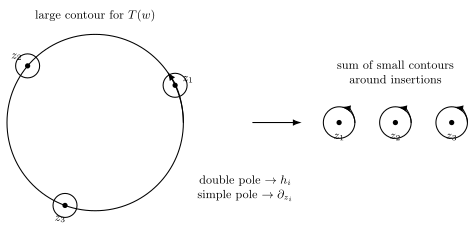
⟨ T ( w ) ∏ i ϕ i ( z i , z ˉ i ) ⟩ = ∑ i ( h i ( w − z i ) 2 + 1 w − z i ∂ z i ) G . \left\langle T(w)\prod_i\phi_i(z_i,\bar z_i)\right\rangle
=
\sum_i
\left(
\frac{h_i}{(w-z_i)^2}
+
\frac{1}{w-z_i}\partial_{z_i}
\right)G. ⟨ T ( w ) i ∏ ϕ i ( z i , z ˉ i ) ⟩ = i ∑ ( ( w − z i ) 2 h i + w − z i 1 ∂ z i ) G .
The Ward identity follows by deforming a stress-tensor contour. Double poles measure conformal weights; simple poles generate derivatives with respect to insertion points.
This identity is the workhorse of two-dimensional CFT. It says that an insertion of T T T
For a descendant field ( L − n ϕ ) ( z ) (L_{-n}\phi)(z) ( L − n ϕ ) ( z ) z z z n ≥ 2 n\geq2 n ≥ 2
⟨ ( L − n ϕ ) ( z ) ∏ i ϕ i ( z i ) ⟩ = ∑ i [ ( n − 1 ) h i ( z i − z ) n − 1 ( z i − z ) n − 1 ∂ z i ] ⟨ ϕ ( z ) ∏ i ϕ i ( z i ) ⟩ . \left\langle (L_{-n}\phi)(z)\prod_i\phi_i(z_i)\right\rangle
=
\sum_i
\left[
\frac{(n-1)h_i}{(z_i-z)^n}
-
\frac{1}{(z_i-z)^{n-1}}\partial_{z_i}
\right]
\left\langle\phi(z)\prod_i\phi_i(z_i)\right\rangle. ⟨ ( L − n ϕ ) ( z ) i ∏ ϕ i ( z i ) ⟩ = i ∑ [ ( z i − z ) n ( n − 1 ) h i − ( z i − z ) n − 1 1 ∂ z i ] ⟨ ϕ ( z ) i ∏ ϕ i ( z i ) ⟩ . For n = 2 n=2 n = 2
⟨ ( L − 2 ϕ ) ( z ) ∏ i ϕ i ( z i ) ⟩ = ∑ i [ h i ( z i − z ) 2 − 1 z i − z ∂ z i ] ⟨ ϕ ( z ) ∏ i ϕ i ( z i ) ⟩ . \left\langle (L_{-2}\phi)(z)\prod_i\phi_i(z_i)\right\rangle
=
\sum_i
\left[
\frac{h_i}{(z_i-z)^2}
-
\frac{1}{z_i-z}\partial_{z_i}
\right]
\left\langle\phi(z)\prod_i\phi_i(z_i)\right\rangle. ⟨ ( L − 2 ϕ ) ( z ) i ∏ ϕ i ( z i ) ⟩ = i ∑ [ ( z i − z ) 2 h i − z i − z 1 ∂ z i ] ⟨ ϕ ( z ) i ∏ ϕ i ( z i ) ⟩ . Combining this with the level-two null-field relation gives the BPZ equation
[ ∑ i ( h i ( z i − z ) 2 − 1 z i − z ∂ z i ) − 3 2 ( 2 h + 1 ) ∂ z 2 ] ⟨ ϕ ( z ) ∏ i ϕ i ( z i ) ⟩ = 0. \left[
\sum_i
\left(
\frac{h_i}{(z_i-z)^2}
-
\frac{1}{z_i-z}\partial_{z_i}
\right)
-
\frac{3}{2(2h+1)}\partial_z^2
\right]
\left\langle\phi(z)\prod_i\phi_i(z_i)\right\rangle
=0. [ i ∑ ( ( z i − z ) 2 h i − z i − z 1 ∂ z i ) − 2 ( 2 h + 1 ) 3 ∂ z 2 ] ⟨ ϕ ( z ) i ∏ ϕ i ( z i ) ⟩ = 0. Here ϕ ( z ) \phi(z) ϕ ( z )
This is the Belavin-Polyakov-Zamolodchikov mechanism: representation-theoretic null states become differential equations for correlation functions.
Before using null states, global conformal invariance already fixes much of the coordinate dependence of low-point functions.
For primary fields, the two-point function is fixed up to normalization:
⟨ ϕ i ( z 1 , z ˉ 1 ) ϕ j ( z 2 , z ˉ 2 ) ⟩ = C i j δ h i , h j δ h ˉ i , h ˉ j z 12 2 h i z ˉ 12 2 h ˉ i , \left\langle
\phi_i(z_1,\bar z_1)\phi_j(z_2,\bar z_2)
\right\rangle
=
\frac{C_{ij}\,\delta_{h_i,h_j}\delta_{\bar h_i,\bar h_j}}
{z_{12}^{2h_i}\bar z_{12}^{2\bar h_i}}, ⟨ ϕ i ( z 1 , z ˉ 1 ) ϕ j ( z 2 , z ˉ 2 ) ⟩ = z 12 2 h i z ˉ 12 2 h ˉ i C ij δ h i , h j δ h ˉ i , h ˉ j , where
z i j = z i − z j . z_{ij}=z_i-z_j. z ij = z i − z j . The three-point function is also fixed up to constants:
⟨ ϕ 1 ( z 1 ) ϕ 2 ( z 2 ) ϕ 3 ( z 3 ) ⟩ = C 123 z 12 h 1 + h 2 − h 3 z 13 h 1 + h 3 − h 2 z 23 h 2 + h 3 − h 1 , \left\langle
\phi_1(z_1)\phi_2(z_2)\phi_3(z_3)
\right\rangle
=
\frac{C_{123}}
{z_{12}^{h_1+h_2-h_3}
z_{13}^{h_1+h_3-h_2}
z_{23}^{h_2+h_3-h_1}}, ⟨ ϕ 1 ( z 1 ) ϕ 2 ( z 2 ) ϕ 3 ( z 3 ) ⟩ = z 12 h 1 + h 2 − h 3 z 13 h 1 + h 3 − h 2 z 23 h 2 + h 3 − h 1 C 123 , times the analogous antiholomorphic factor. The constants C 123 C_{123} C 123
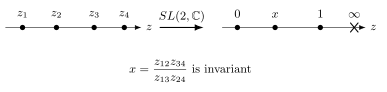
Four-point functions are the first place where nontrivial functions appear. The group S L ( 2 , C ) SL(2,\mathbb C) S L ( 2 , C )
( z 1 , z 2 , z 3 , z 4 ) ⟼ ( 0 , x , 1 , ∞ ) , (z_1,z_2,z_3,z_4)
\longmapsto
(0,x,1,\infty), ( z 1 , z 2 , z 3 , z 4 ) ⟼ ( 0 , x , 1 , ∞ ) , leaving the cross-ratio
x = z 12 z 34 z 13 z 24 , x ˉ = z ˉ 12 z ˉ 34 z ˉ 13 z ˉ 24 . x=\frac{z_{12}z_{34}}{z_{13}z_{24}},
\qquad
\bar x=\frac{\bar z_{12}\bar z_{34}}{\bar z_{13}\bar z_{24}}. x = z 13 z 24 z 12 z 34 , x ˉ = z ˉ 13 z ˉ 24 z ˉ 12 z ˉ 34 .
Four marked points on the sphere leave one complex invariant, the cross-ratio x x x
For identical scalar primaries of scaling dimension Δ = h + h ˉ \Delta=h+\bar h Δ = h + h ˉ
⟨ ϕ ( z 1 ) ϕ ( z 2 ) ϕ ( z 3 ) ϕ ( z 4 ) ⟩ = 1 ∣ z 12 ∣ 2 Δ ∣ z 34 ∣ 2 Δ G ( x , x ˉ ) . \left\langle
\phi(z_1)\phi(z_2)\phi(z_3)\phi(z_4)
\right\rangle
=
\frac{1}{|z_{12}|^{2\Delta}|z_{34}|^{2\Delta}}
\mathcal G(x,\bar x). ⟨ ϕ ( z 1 ) ϕ ( z 2 ) ϕ ( z 3 ) ϕ ( z 4 ) ⟩ = ∣ z 12 ∣ 2Δ ∣ z 34 ∣ 2Δ 1 G ( x , x ˉ ) . The function G ( x , x ˉ ) \mathcal G(x,\bar x) G ( x , x ˉ )
The operator product expansion has the schematic form
ϕ i ( z , z ˉ ) ϕ j ( 0 , 0 ) = ∑ k C i j i j k z h k − h i − h j z ˉ h ˉ k − h ˉ i − h ˉ j [ ϕ k ( 0 , 0 ) + descendants ] . \phi_i(z,\bar z)\phi_j(0,0)
=
\sum_k C_{ij}^{\phantom{ij}k}
z^{h_k-h_i-h_j}\bar z^{\bar h_k-\bar h_i-\bar h_j}
\left[\phi_k(0,0)+\text{descendants}\right]. ϕ i ( z , z ˉ ) ϕ j ( 0 , 0 ) = k ∑ C ij ij k z h k − h i − h j z ˉ h ˉ k − h ˉ i − h ˉ j [ ϕ k ( 0 , 0 ) + descendants ] . In a four-point function, expanding in the 12 → 34 12\to34 12 → 34 13 → 24 13\to24 13 → 24 crossing symmetry .
String amplitudes will use the same logic in a different guise. When vertex operators approach one another on the worldsheet, the OPE reveals which intermediate string states propagate. Factorization of amplitudes is the spacetime interpretation of this local worldsheet statement.
For m = 3 m=3 m = 3 0 0 0 1 / 16 1/16 1/16 1 / 2 1/2 1/2
Solution For m = 3 m=3 m = 3
h r , s = ( 4 r − 3 s ) 2 − 1 48 . h_{r,s}=\frac{(4r-3s)^2-1}{48}. h r , s = 48 ( 4 r − 3 s ) 2 − 1 . The six labels give
s = 1 s = 2 s = 3 r = 1 0 1 16 1 2 r = 2 1 2 1 16 0 \begin{array}{c|ccc}
& s=1 & s=2 & s=3\\
\hline
r=1 & 0 & \frac{1}{16} & \frac12\\[2pt]
r=2 & \frac12 & \frac{1}{16} & 0
\end{array} r = 1 r = 2 s = 1 0 2 1 s = 2 16 1 16 1 s = 3 2 1 0 The identification ( r , s ) ∼ ( 3 − r , 4 − s ) (r,s)\sim(3-r,4-s) ( r , s ) ∼ ( 3 − r , 4 − s )
0 , 1 16 , 1 2 . 0,
\qquad
\frac{1}{16},
\qquad
\frac12. 0 , 16 1 , 2 1 .
Use the OPE T ( w ) ϕ i ( z i ) ∼ h i ϕ i / ( w − z i ) 2 + ∂ i ϕ i / ( w − z i ) T(w)\phi_i(z_i)\sim h_i\phi_i/(w-z_i)^2+\partial_i\phi_i/(w-z_i) T ( w ) ϕ i ( z i ) ∼ h i ϕ i / ( w − z i ) 2 + ∂ i ϕ i / ( w − z i ) ⟨ T ( w ) ∏ i ϕ i ( z i ) ⟩ \langle T(w)\prod_i\phi_i(z_i)\rangle ⟨ T ( w ) ∏ i ϕ i ( z i )⟩
Solution The correlator as a function of w w w w = z i w=z_i w = z i
T ( w ) ϕ i ( z i ) ∼ h i ( w − z i ) 2 ϕ i ( z i ) + 1 w − z i ∂ z i ϕ i ( z i ) . T(w)\phi_i(z_i)
\sim
\frac{h_i}{(w-z_i)^2}\phi_i(z_i)
+
\frac{1}{w-z_i}\partial_{z_i}\phi_i(z_i). T ( w ) ϕ i ( z i ) ∼ ( w − z i ) 2 h i ϕ i ( z i ) + w − z i 1 ∂ z i ϕ i ( z i ) . Summing the singular behavior around all insertions gives
⟨ T ( w ) ∏ i ϕ i ( z i ) ⟩ = ∑ i ( h i ( w − z i ) 2 + 1 w − z i ∂ z i ) ⟨ ∏ i ϕ i ( z i ) ⟩ , \left\langle T(w)\prod_i\phi_i(z_i)\right\rangle
=
\sum_i
\left(
\frac{h_i}{(w-z_i)^2}
+
\frac{1}{w-z_i}\partial_{z_i}
\right)
\left\langle\prod_i\phi_i(z_i)\right\rangle, ⟨ T ( w ) i ∏ ϕ i ( z i ) ⟩ = i ∑ ( ( w − z i ) 2 h i + w − z i 1 ∂ z i ) ⟨ i ∏ ϕ i ( z i ) ⟩ , assuming no additional singularity at infinity.
Starting from the level-two null-field relation
( L − 2 ϕ − a ∂ 2 ϕ ) ( z ) = 0 , a = 3 2 ( 2 h + 1 ) , \left(L_{-2}\phi-a\partial^2\phi\right)(z)=0,
\qquad
a=\frac{3}{2(2h+1)}, ( L − 2 ϕ − a ∂ 2 ϕ ) ( z ) = 0 , a = 2 ( 2 h + 1 ) 3 , derive the second-order BPZ equation for ⟨ ϕ ( z ) ∏ i ϕ i ( z i ) ⟩ \langle\phi(z)\prod_i\phi_i(z_i)\rangle ⟨ ϕ ( z ) ∏ i ϕ i ( z i )⟩
Solution Insert the null field into the correlator:
⟨ ( L − 2 ϕ ) ( z ) ∏ i ϕ i ( z i ) ⟩ − a ∂ z 2 ⟨ ϕ ( z ) ∏ i ϕ i ( z i ) ⟩ = 0. \left\langle(L_{-2}\phi)(z)\prod_i\phi_i(z_i)\right\rangle
-
a\partial_z^2
\left\langle\phi(z)\prod_i\phi_i(z_i)\right\rangle
=0. ⟨ ( L − 2 ϕ ) ( z ) i ∏ ϕ i ( z i ) ⟩ − a ∂ z 2 ⟨ ϕ ( z ) i ∏ ϕ i ( z i ) ⟩ = 0. Contour deformation gives
⟨ ( L − 2 ϕ ) ( z ) ∏ i ϕ i ( z i ) ⟩ = ∑ i [ h i ( z i − z ) 2 − 1 z i − z ∂ z i ] ⟨ ϕ ( z ) ∏ i ϕ i ( z i ) ⟩ . \left\langle(L_{-2}\phi)(z)\prod_i\phi_i(z_i)\right\rangle
=
\sum_i
\left[
\frac{h_i}{(z_i-z)^2}
-
\frac{1}{z_i-z}\partial_{z_i}
\right]
\left\langle\phi(z)\prod_i\phi_i(z_i)\right\rangle. ⟨ ( L − 2 ϕ ) ( z ) i ∏ ϕ i ( z i ) ⟩ = i ∑ [ ( z i − z ) 2 h i − z i − z 1 ∂ z i ] ⟨ ϕ ( z ) i ∏ ϕ i ( z i ) ⟩ . Substituting this expression and a = 3 / [ 2 ( 2 h + 1 ) ] a=3/[2(2h+1)] a = 3/ [ 2 ( 2 h + 1 )]
Show that
x = z 12 z 34 z 13 z 24 x=\frac{z_{12}z_{34}}{z_{13}z_{24}} x = z 13 z 24 z 12 z 34 is invariant under the Möbius transformation z ↦ f ( z ) = ( a z + b ) / ( c z + d ) z\mapsto f(z)=(az+b)/(cz+d) z ↦ f ( z ) = ( a z + b ) / ( cz + d )
Solution For f ( z ) = ( a z + b ) / ( c z + d ) f(z)=(az+b)/(cz+d) f ( z ) = ( a z + b ) / ( cz + d )
f ( z i ) − f ( z j ) = ( a d − b c ) ( z i − z j ) ( c z i + d ) ( c z j + d ) . f(z_i)-f(z_j)
=
\frac{(ad-bc)(z_i-z_j)}{(cz_i+d)(cz_j+d)}. f ( z i ) − f ( z j ) = ( c z i + d ) ( c z j + d ) ( a d − b c ) ( z i − z j ) . Substituting this into
f ( z 1 ) − f ( z 2 ) f ( z 1 ) − f ( z 3 ) f ( z 3 ) − f ( z 4 ) f ( z 2 ) − f ( z 4 ) \frac{f(z_1)-f(z_2)}{f(z_1)-f(z_3)}
\frac{f(z_3)-f(z_4)}{f(z_2)-f(z_4)} f ( z 1 ) − f ( z 3 ) f ( z 1 ) − f ( z 2 ) f ( z 2 ) − f ( z 4 ) f ( z 3 ) − f ( z 4 ) shows that every factor of a d − b c ad-bc a d − b c c z i + d cz_i+d c z i + d x x x
Use scaling and translation invariance to show that the holomorphic three-point function has the form
⟨ ϕ 1 ( z 1 ) ϕ 2 ( z 2 ) ϕ 3 ( z 3 ) ⟩ = C 123 z 12 a z 13 b z 23 c , \langle\phi_1(z_1)\phi_2(z_2)\phi_3(z_3)\rangle
=
\frac{C_{123}}
{z_{12}^{a}z_{13}^{b}z_{23}^{c}}, ⟨ ϕ 1 ( z 1 ) ϕ 2 ( z 2 ) ϕ 3 ( z 3 )⟩ = z 12 a z 13 b z 23 c C 123 , with
a = h 1 + h 2 − h 3 , b = h 1 + h 3 − h 2 , c = h 2 + h 3 − h 1 . a=h_1+h_2-h_3,
\qquad
b=h_1+h_3-h_2,
\qquad
c=h_2+h_3-h_1. a = h 1 + h 2 − h 3 , b = h 1 + h 3 − h 2 , c = h 2 + h 3 − h 1 .
Solution Translation invariance implies dependence only on differences z i j z_{ij} z ij z i ↦ λ z i z_i\mapsto\lambda z_i z i ↦ λ z i
λ − ( h 1 + h 2 + h 3 ) . \lambda^{-(h_1+h_2+h_3)}. λ − ( h 1 + h 2 + h 3 ) . The ansatz scales as λ − ( a + b + c ) \lambda^{-(a+b+c)} λ − ( a + b + c ) a + b + c = h 1 + h 2 + h 3 a+b+c=h_1+h_2+h_3 a + b + c = h 1 + h 2 + h 3
Now demand the correct scaling when one point is moved while the others are fixed, equivalently impose covariance under the global conformal generators L 0 L_0 L 0 L 1 L_1 L 1
a + b = 2 h 1 , a + c = 2 h 2 , b + c = 2 h 3 . a+b=2h_1,
\qquad
a+c=2h_2,
\qquad
b+c=2h_3. a + b = 2 h 1 , a + c = 2 h 2 , b + c = 2 h 3 . Solving them gives
a = h 1 + h 2 − h 3 , b = h 1 + h 3 − h 2 , c = h 2 + h 3 − h 1 . a=h_1+h_2-h_3,
\quad
b=h_1+h_3-h_2,
\quad
c=h_2+h_3-h_1. a = h 1 + h 2 − h 3 , b = h 1 + h 3 − h 2 , c = h 2 + h 3 − h 1 .