
17. Nonequilibrium Holographic Quantum Matter
Equilibrium physics asks which state minimizes a free energy. Linear response asks how that state reacts to an infinitesimal perturbation. Nonequilibrium physics asks the harder question: what happens when the perturbation is large, fast, spatially structured, or continuously applied?
This is where holography becomes unusually powerful. In weakly coupled matter, nonequilibrium dynamics is often described by kinetic theory: particles are accelerated, scatter, and eventually relax. In much of holographic quantum matter, there are no long-lived quasiparticles to track. The natural dual description is instead a time-dependent gravitational problem. Sources at the boundary drive the system; energy and charge flow into the bulk; horizons form, grow, or settle; and boundary observables relax through quasinormal ringing, hydrodynamic modes, order-parameter dynamics, or nonlinear cascades.
The basic translation is
That sentence is compact, but it is not a slogan. It is a calculational prescription. A time-dependent source fixes boundary conditions. An initial density matrix fixes bulk initial data. The bulk equations determine the time evolution. Near-boundary coefficients give one-point functions. Infalling regularity at horizons encodes dissipation.
This page assumes the standard AdS/CFT dictionary and the previous quantum-matter pages. The goal is to build a practical conceptual map of nonequilibrium holographic quantum matter: quenches, thermalization, hydrodynamization, driven steady states, nonlinear response, Kibble-Zurek scaling, time-dependent superconductors, spatial fronts, and turbulence.
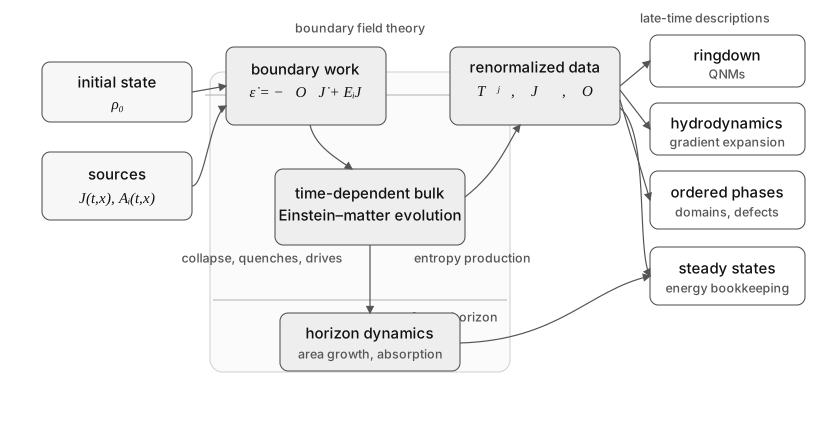
A nonequilibrium holographic calculation is an initial-boundary value problem. Boundary sources and initial data determine bulk evolution. Horizons encode dissipation and entropy production. Near-boundary data then yield one-point functions, correlators, order-parameter dynamics, entanglement growth, chaos diagnostics, or late-time hydrodynamic behavior.
1. What counts as nonequilibrium?
Section titled “1. What counts as nonequilibrium?”The word nonequilibrium covers several different physical situations. They should not be lumped together.
A quench changes a Hamiltonian parameter in time. A source coupled to an operator might be turned on, turned off, or ramped across a critical point. In holography this means changing the boundary condition of the dual bulk field.
A drive continually injects energy, charge, or momentum. Examples include an applied electric field, a periodic source, or time-dependent strain. In holography this typically produces a time-dependent bulk geometry, a nonequilibrium steady state, or a horizon with ongoing entropy production.
A spatial quench or front creates gradients. A source may be localized in space, or a domain wall may be prepared between two regions with different temperatures, chemical potentials, or order-parameter values. In holography this becomes a genuinely spacetime-dependent bulk evolution problem.
A relaxation problem starts from a prepared excited state and asks how it returns toward equilibrium. A black brane perturbed away from stationarity rings down through quasinormal modes; an ordered phase may relax through amplitude and phase modes; a turbulent state may redistribute energy among scales.
A nonequilibrium steady state is not static in microscopic detail, but macroscopic observables become time-independent. For example, a constant electric field can continuously inject energy while dissipation carries it into a horizon. The boundary may reach a steady current even though entropy is still being produced.
These cases share a common structure, but they differ in the equations one solves and in the meaning of late time:
| Situation | Boundary description | Bulk description | Typical late-time behavior |
|---|---|---|---|
| Small perturbation | linear response | linearized field on fixed background | quasinormal ringing |
| Homogeneous quench | time-dependent coupling | infalling shell or scalar collapse | thermal black brane |
| Critical ramp | parameter crosses instability | time-dependent condensate formation | Kibble-Zurek scaling, domains |
| Constant drive | source injects energy or charge | driven horizon, steady flux | steady current or heating |
| Spatial quench | localized source or gradient | PDE evolution in bulk | diffusion, fronts, hydrodynamics |
| Large-gradient dynamics | nonlinear mode coupling | gravitational or superfluid turbulence | cascades, scaling regimes |
A common mistake is to call all late-time relaxation “thermalization.” Holographically, several different notions are visible and they need not occur at the same time.
2. The holographic initial-boundary value problem
Section titled “2. The holographic initial-boundary value problem”Let the boundary theory be deformed by time-dependent sources:
The sources might include scalar couplings, external gauge fields, or the boundary metric:
The bulk fields have corresponding near-boundary behavior. Schematically,
where the first coefficient is fixed as a boundary condition and the response coefficient determines after renormalization.
A nonequilibrium holographic calculation therefore requires four ingredients:
- A bulk model. This may be Einstein gravity, Einstein-Maxwell theory, Einstein-Maxwell-dilaton theory, an Abelian-Higgs model, a probe-brane DBI system, or a top-down truncation.
- Boundary sources. These are the time-dependent or space-dependent deformations.
- Initial data. These encode the initial state. For example, an equilibrium black brane at temperature can be used as initial data before a quench.
- Regularity conditions. In Lorentzian signature, physical evolution is regular at the future horizon and infalling for dissipative perturbations.
In contrast with equilibrium black-brane thermodynamics, the bulk problem is usually not an ordinary differential equation. A homogeneous quench may reduce the problem to partial differential equations in time and the radial coordinate. A spatial quench requires time, radial position, and one or more boundary spatial directions. Fully nonlinear dynamics can therefore become computationally demanding.
A useful conceptual division is
Linear response is the infinitesimal version of nonequilibrium holography. It is solved by linearized bulk equations on a fixed background. Large quenches and nonlinear drives require the background itself to evolve.
3. Energy injection from a time-dependent source
Section titled “3. Energy injection from a time-dependent source”A time-dependent coupling does work on the system. To fix signs, take a Hamiltonian convention
Then the instantaneous energy changes as
For a local source , the energy-density Ward identity contains the same structure:
This formula is one of the simplest ways to understand holographic quenches. The boundary source injects energy. In the bulk, that energy falls inward. If enough energy is injected, a larger horizon forms. The final temperature is fixed by energy conservation once the source is switched off and the system settles.
For a gauge field source, the familiar work term appears. An electric field coupled to a current gives
The right-hand side is Joule heating. In the bulk it is encoded by energy flux into the horizon.
4. Homogeneous quenches and Vaidya geometries
Section titled “4. Homogeneous quenches and Vaidya geometries”The simplest nonequilibrium holographic model is a homogeneous energy injection. A commonly used idealization is an AdS-Vaidya geometry,
with
Here is an ingoing time coordinate. The function interpolates between an initial and final mass density. If changes rapidly, the geometry describes a thin shell of null energy falling from the boundary into the bulk. If changes slowly, it approximates a smooth injection.
For constant , the horizon location is
and the final temperature scales as
Vaidya models are useful because they make several lessons transparent:
- local observables can relax before nonlocal observables;
- UV probes equilibrate faster than IR probes;
- entanglement entropy can grow through a geometric extremal-surface transition;
- causal propagation in the bulk constrains boundary equilibration;
- late-time relaxation is governed by the final black brane’s quasinormal modes.
But Vaidya is also an idealization. A real scalar quench solves coupled Einstein-scalar equations, not an arbitrary prescribed mass function. Vaidya is best thought of as a controlled toy model for energy injection, not a universal geometry for all quenches.
5. Thermalization, isotropization, and hydrodynamization
Section titled “5. Thermalization, isotropization, and hydrodynamization”Three words are often confused.
Thermalization means that the system is well described by a thermal density matrix, at least for the observables being considered.
Isotropization means that directional pressure anisotropies have decayed. A stress tensor of the form
is isotropic when
Hydrodynamization means that the stress tensor is accurately described by hydrodynamics, even if the system is not fully isotropic or fully equilibrated in a stronger microscopic sense.
This distinction is crucial. Strongly coupled holographic plasmas can hydrodynamize before all nonhydrodynamic modes have become negligible in every observable. In practice one checks whether
with controlled residuals.
The late-time approach to equilibrium is often a sum over quasinormal modes:
If the lowest nonhydrodynamic frequency has
then its contribution decays as . This gives a characteristic relaxation time
Hydrodynamic modes behave differently. Their frequencies vanish at small momentum, for example diffusion has
so long-wavelength perturbations relax slowly even at strong coupling.
6. Entanglement growth after a quench
Section titled “6. Entanglement growth after a quench”Nonlocal probes can reveal aspects of nonequilibrium dynamics that one-point functions miss. Entanglement entropy is especially useful. After a homogeneous global quench, the entropy of a region often shows three qualitative stages:
- early growth controlled by local energy injection and UV physics;
- approximately linear growth for sufficiently large regions;
- saturation to the thermal entropy of the final state.
A schematic form for large regions is
before saturation. Here is the final equilibrium entropy density and is an entanglement-growth velocity. This velocity is not the same as the butterfly velocity from chaos, nor the sound speed, nor a diffusion constant. It is a diagnostic of extremal-surface growth.
For a strip of width , the saturation time often scales as
up to geometry-dependent corrections. The formula is useful as an organizing estimate, not as a universal theorem.
A key lesson is that local equilibration can be faster than entanglement equilibration over large regions. A local stress tensor may look thermal while the entanglement entropy of a large region is still evolving. Holography makes this distinction geometrical: local one-point functions depend on near-boundary data, while entanglement surfaces probe deep into the bulk.
7. Driven systems and nonlinear response
Section titled “7. Driven systems and nonlinear response”A quench has a beginning and usually an end. A drive can persist. Examples include
A constant electric field at finite density is a particularly important case. In a closed quantum system, a constant field injects energy continuously:
If there is no mechanism to remove energy, the system heats. In holography, the horizon can absorb the injected energy. Depending on the setup, one may describe a transient heating process, a steady current sustained by a probe sector, or a nonequilibrium steady state with a stationary bulk flux.
Nonlinear response asks for the current beyond the infinitesimal conductivity:
In systems with inversion symmetry, the quadratic term may vanish. In DBI probe-brane systems, nonlinear response is often natural because the action is nonlinear in the field strength:
The important lesson is that nonequilibrium response is not just “linear response with a larger source.” Once the geometry or worldvolume horizon changes with the drive, the response can reorganize qualitatively.
8. Periodic driving and Floquet-like questions
Section titled “8. Periodic driving and Floquet-like questions”Periodic driving introduces a new scale, the drive frequency . The boundary Hamiltonian is periodic:
In ordinary weakly coupled systems one often uses Floquet theory. In strongly coupled holographic systems, the dual problem is a periodically driven gravitational or probe-brane system. Depending on the model, the system may
- heat indefinitely;
- approach a time-periodic steady state;
- generate harmonics of the driving frequency;
- undergo a dynamical instability;
- display synchronization of an order parameter;
- produce effective dissipation through a worldvolume or spacetime horizon.
One must be careful with the phrase “Floquet state.” A large- holographic system with a classical horizon can dissipate energy efficiently. The late-time state may be periodic in some observables, but the full system may still have entropy production. The correct question is not merely whether the source is periodic, but whether the driven dynamics reaches a controlled repeating macroscopic regime.
9. Order-parameter dynamics and holographic superconductors
Section titled “9. Order-parameter dynamics and holographic superconductors”Nonequilibrium symmetry breaking is one of the most useful applications of holographic quantum matter. Consider an ordered phase with an operator and a condensate
In the bulk, the condensate is represented by a scalar profile. A quench may rapidly change the temperature, chemical potential, scalar mass, double-trace coupling, or charge density. If the final equilibrium state is ordered, the system may dynamically form scalar hair.
Several modes can appear:
- Amplitude relaxation: the magnitude relaxes toward its final value.
- Phase dynamics: a Goldstone mode appears when a global is spontaneously broken.
- Critical slowing down: near , relaxation times grow.
- Domain formation: if the quench is spatially extended, different regions may choose different phases.
- Vortex dynamics: in a superfluid, defects can form and move.
Near a continuous transition, an order parameter may be approximated by a time-dependent Landau-Ginzburg equation,
where
Holography gives a strongly coupled realization of this dynamics, including the full coupling to charge and energy transport.
10. Kibble-Zurek scaling
Section titled “10. Kibble-Zurek scaling”Suppose a control parameter crosses a continuous transition at a finite rate. Define the reduced distance from criticality
For a linear ramp,
Equilibrium critical scaling gives
The system falls out of equilibrium when the relaxation time becomes comparable to the time remaining to the transition:
For a linear ramp this gives the freeze-out scales
The resulting defect density scales as
where depends on the dimension and type of defect. Holographic superconductors and superfluids give a controlled setting where this scaling can be studied far from weak coupling.
The important caveat is that mean-field exponents often appear at leading large . Fluctuations that would modify exponents in finite- systems can be suppressed. Thus holography can strongly test Kibble-Zurek logic, but one must understand the universality class being modeled.
11. Spatial quenches and fronts
Section titled “11. Spatial quenches and fronts”A spatial quench varies in both time and space:
Such a source can create fronts, expanding domains, local heating, or shock-like structures. In holography the bulk problem now depends on at least . This is much harder than homogeneous quench dynamics, but it is also more directly related to realistic nonequilibrium matter.
Several physical regimes can occur.
If the gradients are long-wavelength, hydrodynamics should describe late-time evolution. Energy and charge densities obey conservation equations, with constitutive relations corrected by gradients.
If the source creates an ordered region inside a disordered background, an order-parameter front can propagate. The front velocity is not generically equal to a hydrodynamic sound speed. It depends on instability growth, dissipation, and nonlinear saturation.
If a quench crosses a transition non-uniformly, defects can form in a way modified by causal propagation. A region that has already selected an order-parameter phase can bias a neighboring region before it independently chooses a phase.
If gradients are large, the system can excite nonhydrodynamic modes and nonlinear cascades. Then no local equilibrium description is available until late times, if at all.
12. Turbulence and cascades
Section titled “12. Turbulence and cascades”Turbulence is nonequilibrium dynamics with energy transfer among scales. Holographically, turbulence can appear in several ways:
- turbulent boundary fluid flow dual to long-wavelength black-brane dynamics;
- superfluid turbulence involving vortices in holographic superfluids;
- gravitational turbulence in confined AdS-like geometries;
- nonlinear cascades among quasinormal or normal modes;
- turbulent relaxation after strong spatial perturbations.
The most conservative statement is this:
This does not mean every turbulent boundary flow has a simple gravitational interpretation. The regime matters. Long-wavelength relativistic turbulence may be captured by fluid/gravity ideas. Superfluid turbulence requires order-parameter and gauge-field dynamics. Confined geometries can exhibit weakly turbulent cascades because energy reflects from the boundary and repeatedly interacts.
Turbulence also illustrates the limits of overly simple “horizon equals dissipation” intuition. Some geometries dissipate efficiently into horizons. Others, especially horizonless or reflecting setups, can transfer energy among modes before collapse or equilibration. The boundary interpretation depends on the state and ensemble.
13. Numerical formulations: why coordinates matter
Section titled “13. Numerical formulations: why coordinates matter”Nonequilibrium holography is often computational. The most common choice for evolution toward a future horizon is ingoing Eddington-Finkelstein-type coordinates. A schematic metric ansatz for homogeneous isotropization might be
with an ingoing time coordinate. The advantage is that infalling null geodesics are simple and the future horizon is regular.
A typical numerical evolution has the following structure:
- choose initial bulk data satisfying the constraint equations;
- impose boundary sources and asymptotic AdS behavior;
- solve radial constraint equations on each time slice;
- evolve the dynamical fields forward in time;
- extract near-boundary coefficients and compute renormalized one-point functions;
- monitor horizon area, constraints, and convergence.
This is not merely a coding issue. Coordinate choices determine whether the horizon is regular, whether the equations are stable, and whether the extracted observables are trustworthy. A bad coordinate system can make a physically smooth process look singular.
14. A worked example: energy injection and final temperature
Section titled “14. A worked example: energy injection and final temperature”Consider a homogeneous neutral CFT in spatial dimensions. A short source pulse injects energy density into an initial thermal state with energy density . After the source is turned off, assume the system relaxes to a homogeneous thermal state with energy density
For a conformal plasma,
where is a theory-dependent constant proportional to the number of degrees of freedom. Therefore
In the dual planar black-brane geometry,
Energy injection therefore moves the horizon inward in :
This simple calculation captures the geometric picture of a homogeneous heating quench: the final black brane is hotter, and its horizon lies closer to the boundary in Poincare coordinates.
15. Common pitfalls
Section titled “15. Common pitfalls”| Pitfall | Better statement |
|---|---|
| “Thermalization means every observable becomes thermal at the same time.” | Different observables can equilibrate on different timescales. Local one-point functions, correlators, and entanglement can behave differently. |
| “Hydrodynamization equals full thermal equilibrium.” | Hydrodynamics can apply before full isotropization or before all nonhydrodynamic modes disappear. |
| “Vaidya is the generic holographic quench.” | Vaidya is a useful model of homogeneous energy injection, but many quenches require solving coupled Einstein-matter equations. |
| “A periodic source automatically gives a Floquet equilibrium state.” | Holographic systems can heat, dissipate, synchronize, or settle into nonequilibrium steady states depending on the model. |
| “Kibble-Zurek exponents are automatically those of the real material.” | Leading large- holographic models often have mean-field-like critical behavior unless fluctuations are included. |
| “A horizon always means complete loss of information in the boundary theory.” | The boundary evolution is unitary in the full theory; the classical horizon describes coarse-grained large- dissipation. |
| “Turbulence is just hydrodynamics.” | Some turbulent regimes are hydrodynamic, but others involve order parameters, vortices, gravitational mode cascades, or nonhydrodynamic dynamics. |
16. Minimal checklist for a nonequilibrium holographic calculation
Section titled “16. Minimal checklist for a nonequilibrium holographic calculation”Before trusting a nonequilibrium result, ask:
- What is the boundary protocol: quench, ramp, periodic drive, spatial source, or steady forcing?
- What is the initial state, and what bulk initial data represent it?
- Are the constraints satisfied at the initial time and during evolution?
- Are the boundary sources and vevs separated cleanly in the near-boundary expansion?
- Is the future horizon regular in the chosen coordinates?
- Is energy or charge injection consistent with Ward identities?
- Are late-time observables fitted to hydrodynamic or quasinormal behavior only in their domain of validity?
- Are nonlocal observables, if used, probing deeper bulk regions than one-point functions?
- Is the result sensitive to large-, probe-limit, or bottom-up model assumptions?
- Are numerical convergence and constraint violations checked?
For a website that aims to be authoritative, this checklist matters as much as the formulas. Nonequilibrium holography is powerful precisely because it can compute beyond linear response, but that power comes with model and numerical responsibilities.
Exercises
Section titled “Exercises”Exercise 1. Energy injection by a source
Section titled “Exercise 1. Energy injection by a source”Take a Hamiltonian
Show that
Explain why the sign would change if the deformation were written with the opposite sign.
Solution
The energy expectation value is
For unitary time evolution generated by ,
because the commutator contribution is . Since
we find
If instead one defines , the result is
The physics is not changed; the sign convention for the source has changed.
Exercise 2. Apparent horizon in an AdS-Vaidya model
Section titled “Exercise 2. Apparent horizon in an AdS-Vaidya model”Consider
Use the static black-brane intuition to estimate the instantaneous horizon position.
Solution
For constant , the horizon is located where
Therefore
so
For a slowly varying , a natural quasi-static estimate is
For a rapidly varying shell, this is only an estimate of an apparent-horizon-like scale. The event horizon is teleological: it depends on the future evolution of the spacetime.
Exercise 3. Hydrodynamization without isotropization
Section titled “Exercise 3. Hydrodynamization without isotropization”Suppose a homogeneous but anisotropic state has pressures and . Explain how hydrodynamics could become accurate before .
Solution
Hydrodynamics is not the statement that all pressures are equal. It is the statement that the stress tensor can be expressed in terms of hydrodynamic variables and their gradients. In a boost-invariant or anisotropically expanding system, viscous corrections can be large enough to make
while still being accurately described by viscous hydrodynamics. Hydrodynamization means
not necessarily
Isotropization is a stronger condition. It occurs only when anisotropic stresses have sufficiently decayed.
Exercise 4. Kibble-Zurek freeze-out scales
Section titled “Exercise 4. Kibble-Zurek freeze-out scales”Assume
Derive the scaling of the freeze-out time and length with .
Solution
The freeze-out condition is
Using gives
Thus
so, up to constants,
The freeze-out correlation length is
Substituting the scaling of gives
Exercise 5. Why nonlocal probes thermalize later
Section titled “Exercise 5. Why nonlocal probes thermalize later”Explain why a large-region entanglement entropy can continue evolving after local one-point functions have approximately equilibrated.
Solution
Local one-point functions are extracted from near-boundary coefficients in the bulk fields. They can become close to their final thermal values once the near-boundary region has settled.
Entanglement entropy of a large region is computed by a bulk extremal surface that extends deep into the geometry. For a large region, the surface can probe regions near the evolving shell or near the growing horizon. Therefore it can remain sensitive to bulk interior dynamics after near-boundary data already look thermal.
This is why local equilibration and entanglement equilibration are different diagnostics. Holographically, they probe different radial depths.
Summary
Section titled “Summary”Nonequilibrium holographic quantum matter is the study of strongly coupled many-body dynamics through time-dependent bulk geometry. Boundary sources and initial states define an initial-boundary value problem. The bulk evolves through horizons, shells, fields, and nonlinear gravitational dynamics. The boundary diagnosis comes from one-point functions, correlators, transport coefficients, order parameters, entanglement, chaos, and late-time hydrodynamics.
The core lessons are:
- linear response is only the infinitesimal corner of nonequilibrium dynamics;
- quenches inject energy through time-dependent sources;
- horizons encode dissipation and entropy production at leading large ;
- hydrodynamization, isotropization, and thermalization are distinct;
- nonlocal probes can equilibrate later than local observables;
- driven systems can heat, settle into steady states, or become unstable;
- critical ramps show Kibble-Zurek scaling when the relevant assumptions hold;
- spatial dynamics and turbulence require genuine bulk PDE evolution;
- trustworthy nonequilibrium holography requires careful Ward identities, boundary conditions, horizon regularity, and numerical checks.
Further reading
Section titled “Further reading”For broader context, see Hartnoll, Lucas, and Sachdev, Holographic Quantum Matter, especially the discussions of out-of-equilibrium quenches and turbulence. For condensed-matter-oriented holographic dynamics, see Zaanen, Liu, Sun, and Schalm, Holographic Duality in Condensed Matter Physics. For holographic entanglement growth, see Rangamani and Takayanagi, Holographic Entanglement Entropy. For numerical time-dependent holography, see reviews and lecture notes on characteristic evolution, holographic thermalization, and numerical relativity in asymptotically AdS spacetimes.