
N=4 SYM Fields and Symmetries
The previous module explained why a large- CFT can behave like a weakly coupled theory of particles in AdS. We now turn to the central example:
This page introduces the CFT side of this correspondence. The aim is not to teach every detail of the Lagrangian, but to organize the facts that are essential for AdS/CFT:
The slogan is simple but powerful:
It is interacting for general coupling, yet exactly conformal. It has enough symmetry to be sharply constrained, but enough dynamics to contain quantum gravity, strings, black holes, integrability, thermal physics, entanglement, and strong-coupling phenomena. That combination is why it became the canonical laboratory for AdS/CFT.
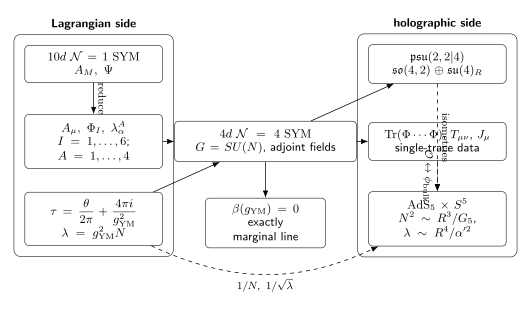
The basic structure of SYM. The fields , , and are all in the adjoint of . The global symmetry is the superconformal group , whose bosonic part matches the isometries of . The parameters and control the bulk genus and stringy corrections.
Field content
Section titled “Field content”Take gauge group . One may also start with , as in the D3-brane construction, but the overall sector is a decoupled free multiplet. The interacting holographic theory is the part.
All elementary fields are valued in the adjoint representation of . In four-dimensional notation, the fields are:
| field | notation | Lorentz representation | representation | engineering dimension |
|---|---|---|---|---|
| gauge field | vector | singlet | ||
| real scalars | , | scalar | vector of | |
| Weyl fermions | , | left Weyl spinor | fundamental of | |
| conjugate fermions | right Weyl spinor | of |
The six scalars are one of the first hints of the string-theory geometry. In the D3-brane picture, a stack of branes fills four spacetime directions. The six real scalars describe transverse fluctuations of the branes in the remaining six directions. The rotation group of those transverse directions is
which becomes the -symmetry of the four-dimensional theory. In the bulk dual, the same is the isometry group of .
A compact way to remember the field content is to begin from ten-dimensional super Yang-Mills and dimensionally reduce to four dimensions. The ten-dimensional gauge field decomposes as
The ten-dimensional Majorana-Weyl fermion becomes four Weyl fermions in four dimensions. This is the quickest way to see why the field content is so rigid: maximal supersymmetry leaves essentially no room to change it.
The action
Section titled “The action”Let and be
and
for an adjoint field . Suppressing the detailed spinor index contractions, the Lorentzian action has the schematic form
Here
Different books use slightly different sign conventions for Hermitian versus anti-Hermitian generators and for Lorentzian signature. The structural facts do not depend on those choices:
- the gauge field has the usual Yang-Mills kinetic term;
- there are six adjoint scalars with covariant kinetic terms;
- the scalar potential is fixed by commutators ;
- the fermions have Yukawa couplings fixed by supersymmetry;
- the same coupling multiplies all interaction terms.
The scalar potential vanishes precisely when the scalars commute:
This condition describes the Coulomb branch of vacua. In the conformal vacuum usually used for AdS/CFT, we sit at the origin of this branch,
so the full gauge symmetry and symmetry remain unbroken.
Couplings and the conformal manifold
Section titled “Couplings and the conformal manifold”The gauge coupling is dimensionless in four dimensions:
The theta angle combines with it into the complexified coupling
The parameter most useful in the large- limit is the ‘t Hooft coupling
The AdS/CFT limits are organized as follows:
| CFT limit | bulk interpretation |
|---|---|
| with fixed | planar limit, string loops suppressed |
| , | classical type IIB supergravity regime |
| finite large | stringy corrections |
| finite large | quantum gravity/string loop corrections |
With the common convention , the string-frame radius relation is
so large means
That is the condition that the AdS curvature radius is large compared with the string length. In that regime, the stringy tower is heavy and the low-energy bulk description becomes supergravity.
The central large- relation is
This is the gravitational version of the statement that the CFT has order matrix degrees of freedom.
Why the beta function vanishes
Section titled “Why the beta function vanishes”The theory is conformal for every value of . At one loop, the cancellation is already visible. For a four-dimensional gauge theory with Weyl fermions and real scalars in the adjoint representation, the one-loop beta-function coefficient is proportional to
For SYM,
Therefore
Maximal supersymmetry strengthens this one-loop cancellation to exact conformality. The coupling is exactly marginal. Thus SYM is not one CFT, but a family of CFTs connected by an exactly marginal deformation.
This point is crucial. The theory is not free except at . As changes, unprotected scaling dimensions and OPE coefficients change. The stress tensor, currents, and BPS data are constrained by symmetry, but the full theory remains dynamical.
Global symmetry
Section titled “Global symmetry”The bosonic global symmetry of flat-space SYM is
or equivalently
The first factor is the four-dimensional conformal group. The second factor is the -symmetry rotating the six scalars and the four supercharges.
The full superconformal group is
Its bosonic subalgebra is
The fermionic generators are the Poincare supercharges and conformal supercharges:
There are Poincare supercharges and conformal supercharges. Their schematic anticommutators are
This is exactly the symmetry expected from type IIB string theory on :
and the supersymmetric completion is .
This symmetry match is not a decorative feature. It is the first sharp test of the duality. The CFT conformal group becomes the AdS isometry group; the CFT -symmetry becomes the sphere isometry group; the CFT supercharges become the Killing spinor symmetries of the background.
Representations of
Section titled “Representations of SU(4)RSU(4)_RSU(4)R”Because
one may label -symmetry representations either by language or by Dynkin labels .
The most important identifications are
and
The scalars may be packaged as antisymmetric tensors
with a reality condition relating to . This antisymmetric representation has dimension , matching the six real scalars .
For later AdS/CFT applications, the half-BPS scalar operators are especially important:
They transform in the representation
and have protected scaling dimension
The case is the bottom component of the stress-tensor multiplet. It is one of the central operators in precision tests of AdS/CFT.
Local operators
Section titled “Local operators”The elementary fields , , and are not themselves physical gauge-invariant local operators. The local operators of the CFT are gauge-invariant composites, such as single traces:
At large , single-trace operators are the CFT analogues of single-particle bulk fields. Multi-trace operators are the analogues of multi-particle states.
Important examples include:
| CFT operator | role |
|---|---|
| stress tensor; dual to the graviton in | |
| current; dual to gauge fields from isometries | |
| exactly marginal operator paired with the dilaton source | |
| paired with the axion source | |
| half-BPS chiral primary; dual to Kaluza-Klein modes on | |
| Konishi operator; unprotected long multiplet |
The contrast between BPS operators and long-multiplet operators is one of the main lessons of the theory. BPS dimensions are fixed by representation theory. Long-multiplet dimensions are dynamical functions of .
For example, the Konishi operator has classical dimension , but its exact dimension is not protected:
At weak coupling, can be computed perturbatively. At strong coupling, the Konishi operator is associated with a genuinely stringy excitation, not a light supergravity field.
Central charges and large
Section titled “Central charges and large NNN”For SYM, the conformal anomaly coefficients are
The equality is a strong supersymmetric constraint. The scaling
is what matters most for holography. It says that the number of effective degrees of freedom is of order the number of matrix components in the adjoint representation.
In the bulk, the same scaling appears as
Thus the classical gravity limit is a large-central-charge limit. This is the same idea developed in the large- module, now realized in a concrete CFT.
The SYM dictionary preview
Section titled “The N=4\mathcal N=4N=4 SYM dictionary preview”The basic AdS/CFT dictionary for this theory is:
The parameter dictionary is:
These relations are the reason SYM is not merely an example of a CFT. It is a controlled nonperturbative definition of a quantum gravity theory in asymptotically spacetime.
Common pitfalls
Section titled “Common pitfalls”First, SYM is conformal but not generally free. The free point is only one point on the conformal manifold. At strong coupling, the theory is deeply interacting.
Second, the fields in the Lagrangian are not the same thing as CFT observables. Gauge-invariant local operators are traces and products of traces. The bulk dictionary is written in terms of such operators, not bare gauge-dependent fields.
Third, is not a flavor symmetry in the ordinary sense. It rotates supercharges and sits inside the superconformal algebra. In the bulk it becomes an isometry of the internal space .
Fourth, the large- and large- limits are logically distinct. Large suppresses quantum gravity loops. Large suppresses stringy curvature corrections. Classical Einstein gravity needs both.
AdS/CFT checkpoint
Section titled “AdS/CFT checkpoint”After this page, the key facts to remember are:
Its bosonic symmetry matches the geometry
Its large- single-trace operators behave like bulk single-particle states. Its BPS operators give a protected window into the supergravity spectrum. Its unprotected long operators encode the genuinely stringy, strongly coupled dynamics.
That is exactly the CFT structure needed for the AdS/CFT correspondence.
Exercises
Section titled “Exercises”Exercise 1: One-loop beta-function cancellation
Section titled “Exercise 1: One-loop beta-function cancellation”Use the one-loop coefficient
for a gauge theory with adjoint Weyl fermions and adjoint real scalars. Show that for SYM.
Solution
For SYM,
Therefore
Thus . This is only the one-loop check; maximal supersymmetry implies exact conformality.
Exercise 2: Counting on-shell degrees of freedom
Section titled “Exercise 2: Counting on-shell degrees of freedom”Show that the elementary fields of SYM have equal bosonic and fermionic on-shell degrees of freedom in each adjoint color component.
Solution
A massless gauge field in four dimensions has physical polarizations. The six real scalars contribute bosonic degrees of freedom. Thus the bosonic count is
A massless Weyl fermion has on-shell real degrees of freedom. There are four Weyl fermions, so the fermionic count is
Thus the multiplet has bosonic and fermionic on-shell degrees of freedom per adjoint generator.
Exercise 3: Why large is not the same as strong coupling
Section titled “Exercise 3: Why large NNN is not the same as strong coupling”Explain the different bulk meanings of and .
Solution
Large controls the bulk loop expansion. Since
the limit makes Newton’s constant small in AdS units and suppresses quantum gravity loops.
Large controls stringy curvature corrections. Since
the limit makes the AdS radius large compared with the string length. This suppresses corrections and allows a low-energy supergravity description.
Classical Einstein gravity requires both limits: and .
Exercise 4: Protected and unprotected dimensions
Section titled “Exercise 4: Protected and unprotected dimensions”Why can a half-BPS operator have a coupling-independent dimension while the Konishi operator does not?
Solution
A half-BPS operator belongs to a shortened representation of the superconformal algebra. Shortening imposes an algebraic relation between its scaling dimension and its -symmetry quantum numbers. For the operators
this gives
The Konishi operator is in a long multiplet. Long multiplets have no shortening condition fixing . Therefore their dimensions can receive anomalous corrections:
In the bulk, protected operators can remain light supergravity modes, while long unprotected operators can become heavy string states at strong coupling.
Exercise 5: Symmetry matching
Section titled “Exercise 5: Symmetry matching”Match each CFT symmetry factor to its geometric origin in the dual background.
Solution
The CFT conformal group is
which is the isometry group of . The -symmetry group is
which is the isometry group of . Together, these give the bosonic symmetry
Including the Poincare and conformal supercharges gives the full superconformal group
matching the supersymmetry of type IIB string theory on .
Further reading
Section titled “Further reading”For the original AdS/CFT construction, read Maldacena’s paper on the large- limit of superconformal field theories and supergravity. For the GKPW prescription, read Gubser-Klebanov-Polyakov and Witten. For field-theory details of SYM, useful sources include standard supersymmetry textbooks, reviews of SYM, and integrability-focused introductions.
The next page studies the protected half-BPS operators more carefully and explains why their representation theory is the first precise bridge to the Kaluza-Klein spectrum on .