
Fluid/Gravity Correspondence
The main idea
Section titled “The main idea”Hydrodynamics is the universal long-wavelength effective theory of conserved densities. In a relativistic CFT with no conserved charges besides energy and momentum, the only local hydrodynamic fields are the temperature and the velocity , normalized by
The fluid/gravity correspondence says that, for a holographic CFT at large and strong coupling, every sufficiently slow fluid configuration has a dual long-wavelength black-brane geometry. Conversely, the long-wavelength Einstein equations for asymptotically AdS black branes reduce to the relativistic Navier-Stokes equations of the boundary theory.
The slogan is therefore not merely
The stronger statement is
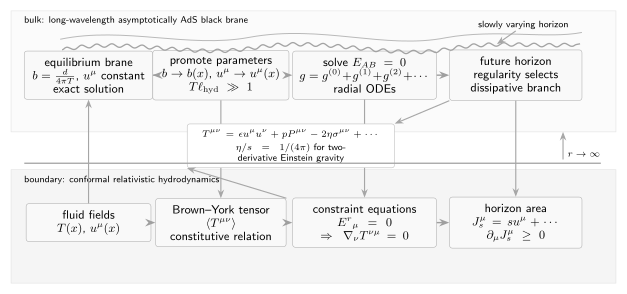
The fluid/gravity map promotes the equilibrium black-brane parameters and to slowly varying boundary fields. The radial Einstein equations determine derivative corrections to the metric; the constraint equations impose . Horizon regularity fixes dissipative transport such as in two-derivative Einstein gravity.
This page is the nonlinear counterpart of the Kubo-formula pages. Linear response extracts transport coefficients from small perturbations around equilibrium. Fluid/gravity reconstructs an entire asymptotically AdS spacetime dual to a nonlinear hydrodynamic flow, order by order in boundary derivatives.
The equilibrium seed: a boosted black brane
Section titled “The equilibrium seed: a boosted black brane”Work in bulk dimensions and set the AdS radius for most formulas in this page. The planar AdS black brane in ingoing Eddington-Finkelstein coordinates can be written in a manifestly boosted form:
where
The parameter sets the temperature,
and the horizon is at
When and are constant, this is just the uniform thermal state seen in a moving frame. The dual stress tensor has the ideal conformal-fluid form
Equivalently,
For the two-derivative Einstein-AdS action with flat boundary metric,
The equation of state is conformal because the boundary theory has no intrinsic scale. The trace vanishes:
The word “seed” is important. A uniform boosted brane is an exact solution. The fluid/gravity construction begins by allowing its parameters to become slowly varying fields.
Promoting parameters to fields
Section titled “Promoting parameters to fields”Take
with the normalization . The naive metric obtained by substituting and into the boosted brane is no longer an exact solution of Einstein’s equations. Derivatives of and generate errors.
The derivative expansion assumes that these errors are small in units of the local temperature:
Equivalently, if is the boundary length scale over which the fluid varies, then
The metric is corrected order by order:
where contains boundary derivatives. The construction is local in boundary derivatives but nonlocal in the radial direction: at each order, one solves ordinary differential equations in whose sources are built from derivatives of and .
The usual boundary conditions are:
- the metric is asymptotically AdS with a specified boundary metric;
- the future horizon is regular in ingoing coordinates;
- no unwanted non-normalizable modes are added;
- a hydrodynamic frame is chosen, often the Landau frame.
The last point is not cosmetic. Redefinitions of and by derivative terms change the decomposition of into “ideal” and “dissipative” parts. Transport coefficients are meaningful only after the frame convention has been fixed.
Hydrodynamic stress tensor
Section titled “Hydrodynamic stress tensor”For a neutral relativistic fluid, the stress tensor is expanded in derivatives:
In the Landau frame,
At first order,
where
is the expansion and
is the shear tensor. For a conformal fluid in flat space,
so the first viscous correction is simply
Fluid/gravity gives the Einstein-gravity value
This is the same coefficient obtained from the shear-channel Kubo formula, but now it appears inside a nonlinear stress tensor that solves hydrodynamics, rather than merely inside a two-point function.
Einstein equations: constraints versus radial dynamics
Section titled “Einstein equations: constraints versus radial dynamics”The bulk equations are
again with . In a radial decomposition, they split into two conceptual types.
The dynamical radial equations determine the derivative corrections once lower-order data are known. They are radial ordinary differential equations whose sources are boundary derivative structures such as , , acceleration, vorticity, and curvature terms if the boundary is curved.
The constraint equations contain one radial index. Schematically,
These equations do not determine new radial profiles. Instead, they impose equations on the boundary fields and . Precisely, they become
in flat boundary space, or
for a curved boundary metric .
This is the central structural fact of fluid/gravity:
The correspondence is not a metaphor. The conservation of the holographic stress tensor follows from the radial gravitational constraints, just as Ward identities follow from bulk gauge invariance and diffeomorphism invariance.
Ideal hydrodynamics from conservation
Section titled “Ideal hydrodynamics from conservation”At zeroth order, the stress tensor is
It is useful to decompose conservation into parts parallel and orthogonal to . Define
The longitudinal projection gives energy conservation:
Using and , this becomes
The transverse projection gives the relativistic Euler equation:
Since and , this becomes
These are exactly the equations imposed by the first nontrivial gravitational constraints on the promoted black-brane seed. At the next order, adding the shear term produces relativistic Navier-Stokes.
The first-order metric correction
Section titled “The first-order metric correction”The full first-order metric is gauge-dependent, but its physical role is simple. The promoted seed metric produces derivative errors. The tensor-sector error proportional to is cancelled by a radial correction of the form
where is a dimensionless radial profile fixed by the radial Einstein equation and by regularity at the future horizon. A common representation is
The important facts are:
- decays near the boundary in the way required by asymptotic AdS boundary conditions;
- is regular at , the horizon;
- the coefficient of the normalizable part determines the shear contribution to the boundary stress tensor.
The result is the first-order constitutive relation
with
The appearance of the same ratio as in the Kubo calculation is a strong consistency check. Fluid/gravity does not produce a different transport coefficient; it embeds that coefficient into the nonlinear evolution of a dynamical horizon.
Horizon regularity and dissipation
Section titled “Horizon regularity and dissipation”Dissipation in the boundary fluid is tied to regularity at the future horizon. In Lorentzian signature, the retarded prescription selects infalling behavior near the horizon for linear perturbations. Fluid/gravity uses the nonlinear analogue: the metric must be smooth on the future horizon in ingoing coordinates.
This condition removes unphysical solutions of the radial equations and fixes dissipative coefficients. In particular, the shear viscosity is not arbitrary once the bulk action and boundary conditions are chosen.
The entropy current gives a beautiful geometric interpretation. In hydrodynamics, the entropy current has the leading form
Using the first-order stress tensor and the conservation equations, one finds
provided . On the gravity side, the entropy current is obtained by pulling the horizon area form back to the boundary. The local second law of the fluid is the boundary image of the classical area increase theorem, order by order in derivatives.
There is a subtlety here. The event horizon is teleological: its exact location depends on the future. In the derivative expansion, however, the horizon and its area form can be constructed locally order by order. Apparent-horizon constructions can give different entropy currents beyond leading order, but the physical entropy production is constrained by the same regularity and area-increase logic.
Second-order transport
Section titled “Second-order transport”First-order hydrodynamics captures shear diffusion, but relativistic dissipative equations truncated at first order have well-known causality and stability issues outside their strict derivative regime. A controlled hydrodynamic effective theory includes higher gradients.
For a conformal fluid in four boundary dimensions, the second-order stress tensor contains structures such as
where is the vorticity and angle brackets denote the symmetric, transverse, traceless projection. The coefficients multiplying these terms are second-order transport coefficients.
For strongly coupled large- SYM in the two-derivative supergravity limit, some standard values are
These numbers are not universal in the same sense as for two-derivative Einstein gravity. They depend on the microscopic theory and on the bulk action. Higher-derivative corrections, finite coupling, extra matter fields, conserved charges, anomalies, and broken translations all modify the hydrodynamic data.
Weyl covariance and conformal fluids
Section titled “Weyl covariance and conformal fluids”A CFT on a curved background has a stress tensor that transforms covariantly under Weyl transformations, up to anomalies in even dimensions. This makes Weyl-covariant notation natural in fluid/gravity.
Under a local Weyl rescaling,
the local temperature and velocity scale as
The black-brane radial coordinate scales oppositely to boundary lengths, reflecting the UV/IR relation. In Weyl-covariant language, the derivative expansion organizes itself into tensors with definite Weyl weight. This is more than a formal elegance: it keeps the gravitational expansion aligned with the conformal symmetry of the boundary theory.
For a first pass through the subject, ordinary flat-space notation is enough. For research calculations involving curved boundaries, anomalies, charged fluids, or higher-order transport, Weyl covariance becomes a powerful bookkeeping device.
Relation to the membrane paradigm
Section titled “Relation to the membrane paradigm”The membrane paradigm says that certain low-frequency transport coefficients can be computed from data at the horizon. The previous pages used this logic for conductivity and shear viscosity. Fluid/gravity is broader.
The membrane paradigm typically answers a question like:
Fluid/gravity answers a more ambitious question:
It therefore includes the membrane-paradigm horizon intuition, but also constructs the full exterior geometry, the boundary stress tensor, the entropy current, and nonlinear hydrodynamic evolution.
In practice, the two viewpoints are complementary. Horizon regularity and horizon fluxes explain why transport is often controlled by the black-brane horizon. The derivative expansion explains how the horizon is embedded in a full asymptotically AdS solution whose boundary data are the hydrodynamic fields.
What the correspondence does and does not say
Section titled “What the correspondence does and does not say”Fluid/gravity is one of the cleanest demonstrations that Einstein dynamics contains dissipative many-body physics. Still, its domain of validity is sharply limited.
It requires a hydrodynamic regime:
It requires a state locally close to thermal equilibrium. A far-from-equilibrium geometry can evolve toward hydrodynamics, but it is not itself described by the derivative expansion until gradients are small enough and nonhydrodynamic quasinormal modes have decayed.
It is also a classical gravity construction unless corrections are added. Finite gives bulk quantum-loop corrections. Finite ‘t Hooft coupling gives stringy corrections. Extra light fields or higher-derivative terms modify transport. Charged fluids require gauge fields; superfluids require scalar hair; fluids with broken translations require additional order parameters or sources.
The safest statement is:
This is already a remarkably strong statement. It shows that hydrodynamics is not an analogy imposed on gravity from the outside; it is the effective theory of certain black-hole horizons viewed through holography.
A compact dictionary
Section titled “A compact dictionary”| Boundary hydrodynamics | Bulk geometry |
|---|---|
| local temperature | local horizon radius |
| velocity | local boost of the black brane |
| stress tensor | renormalized Brown-York tensor |
| radial Einstein constraint equations | |
| shear tensor | first derivative tensor metric correction |
| shear viscosity | normalizable coefficient fixed by horizon regularity |
| entropy current | horizon area form pulled to the boundary |
| entropy production | horizon area increase |
| second-order transport | second-order derivative corrections to the metric |
| breakdown of hydrodynamics | gradients comparable to or long-lived nonhydrodynamic modes |
Common mistakes
Section titled “Common mistakes”Mistake 1: confusing fluid/gravity with linear response. Linear response computes correlators around equilibrium. Fluid/gravity constructs nonlinear long-wavelength geometries. They agree on transport coefficients where their domains overlap.
Mistake 2: treating and as arbitrary functions. They are arbitrary only before imposing the constraint equations. A regular asymptotically AdS solution exists order by order only if the fields obey hydrodynamic conservation equations.
Mistake 3: forgetting the frame choice. The variables and can be redefined by derivative corrections. The Landau frame is common, but not compulsory. Comparing formulas from different papers requires checking the frame.
Mistake 4: calling every black-hole spacetime a fluid. A black brane with gradients small compared with has a hydrodynamic description. A generic black-hole geometry need not.
Mistake 5: overextending universality. The value is universal for a large class of two-derivative Einstein-gravity duals, not for all holographic theories and not for all quantum field theories.
Exercises
Section titled “Exercises”Exercise 1: Ideal conformal hydrodynamics from conservation
Section titled “Exercise 1: Ideal conformal hydrodynamics from conservation”Let
with , , and . Derive
Solution
Start from
Contract with . Using and , one obtains
where and . Since and ,
Also . Hence
so
Next project orthogonally with . The result is
Since ,
Using gives
Exercise 2: Thermodynamics of the boosted brane
Section titled “Exercise 2: Thermodynamics of the boosted brane”For the neutral AdS black brane, take
Show that
Solution
Conformal invariance in boundary spacetime dimensions requires
so
Then
Using the expression for ,
Meanwhile,
Therefore
Exercise 3: Entropy production from shear viscosity
Section titled “Exercise 3: Entropy production from shear viscosity”For a conformal fluid with
show, to leading dissipative order, that the canonical entropy current obeys
Solution
Use the local thermodynamic identity
and . Contract stress-tensor conservation with . To first viscous order,
The left-hand side can be written as
Therefore
For , this is nonnegative. In holography, this nonnegative divergence is the boundary expression of horizon area increase.
Exercise 4: Why the constraint equations are hydrodynamics
Section titled “Exercise 4: Why the constraint equations are hydrodynamics”Explain why promoting and to slowly varying fields cannot give a solution for arbitrary functions and . What role do the equations play?
Solution
The promoted black-brane metric is a local ansatz built from boundary fields. Once derivatives of and are present, Einstein’s equations produce terms proportional to those derivatives. Some components of the equations can be solved by adding radial metric corrections .
However, the radial constraint equations do not determine independent radial profiles. They impose consistency conditions on the boundary data. In the holographic dictionary, these consistency conditions are precisely conservation of the renormalized boundary stress tensor:
Thus and are not arbitrary. They must satisfy the hydrodynamic equations. When they do, the remaining radial equations determine the bulk geometry order by order in derivatives, subject to asymptotic AdS boundary conditions and future-horizon regularity.
Further reading
Section titled “Further reading”- S. Bhattacharyya, V. E. Hubeny, S. Minwalla, and M. Rangamani, “Nonlinear Fluid Dynamics from Gravity”, the foundational construction promoting black-brane temperature and velocity to boundary fields.
- V. E. Hubeny, S. Minwalla, and M. Rangamani, “The fluid/gravity correspondence”, a broad review of the map between Einstein equations and relativistic hydrodynamics.
- M. Rangamani, “Gravity and Hydrodynamics: Lectures on the fluid-gravity correspondence”, pedagogical lectures with useful details on the derivative expansion.
- R. Baier, P. Romatschke, D. T. Son, A. O. Starinets, and M. A. Stephanov, “Relativistic viscous hydrodynamics, conformal invariance, and holography”, a standard reference for second-order conformal hydrodynamics.
- S. Bhattacharyya et al., “Local Fluid Dynamical Entropy from Gravity”, for the horizon-area construction of the boundary entropy current.