
Flavor Branes, Chiral Symmetry, and Mesons
The main idea
Section titled “The main idea”The previous pages studied confinement and mass gaps mostly through the adjoint sector: closed-string fields, glueball-like normal modes, and fundamental strings used as external probes. Real QCD-like physics also contains dynamical quarks, flavor currents, chiral symmetry, pions, vector mesons, and baryons. In holography these ingredients usually enter through open strings and flavor branes.
The guiding dictionary is simple but powerful:
| Gauge theory | Holographic description |
|---|---|
| color degrees of freedom | background geometry sourced by color branes |
| fundamental quarks | strings stretched between color and flavor branes |
| global flavor symmetry | gauge symmetry on flavor branes, evaluated at the boundary |
| quark mass | asymptotic separation or boundary datum of a flavor-brane embedding |
| chiral condensate | subleading embedding datum or bifundamental scalar vev |
| mesons | normalizable fluctuations of fields living on flavor branes |
| chiral symmetry breaking | brane joining, tachyon condensation, or bifundamental scalar profile |
The essential large- lesson is also simple. In the usual probe limit,
flavor branes affect correlation functions of flavor-sector operators, but their backreaction on the background is suppressed by . This is the holographic version of quenched flavor. It captures meson spectra and flavor-current correlators at leading order in , but it does not capture quark-loop effects on the gluon dynamics unless one goes beyond the probe approximation.
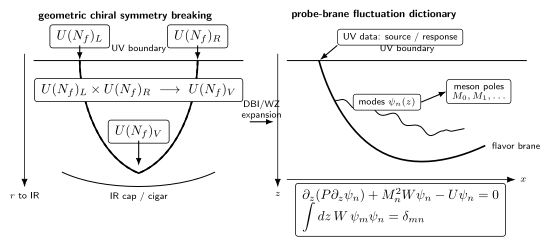
Two common flavor-brane mechanisms. In geometric chiral symmetry breaking, separated UV flavor branes join in the IR, realizing . More generally, the DBI/WZ action on a probe brane gives radial Sturm-Liouville problems whose normalizable modes are mesons.
The slogan “flavor branes give quarks” is correct, but it hides three important distinctions.
First, a flavor-brane gauge field is not a new dynamical gauge field in the boundary theory. Its boundary value sources a global flavor current. The bulk gauge redundancy becomes a global symmetry after specifying boundary conditions.
Second, a probe brane is not QCD with fully dynamical quarks. Probe flavor is closer to the quenched large- limit. In the Veneziano limit, where is fixed, flavor branes backreact and the geometry itself changes.
Third, there is no single universal holographic model of chiral symmetry breaking. Top-down D3/D7 models, Sakai-Sugimoto-type D4/D8 models, hard-wall AdS/QCD, soft-wall AdS/QCD, tachyon-DBI models, and fully backreacted flavor solutions all realize different pieces of QCD-like physics with different assumptions.
This page explains the common structure that survives across these models.
Field-theory target: large- flavor physics
Section titled “Field-theory target: large-NcN_cNc flavor physics”Consider an gauge theory with fundamental Dirac fermions , where . In the massless limit, the classical flavor symmetry is roughly
with the usual caveat that is anomalous in QCD-like theories. The most important gauge-invariant flavor operators include
A quark mass deformation has the schematic form
where transforms as a bifundamental spurion under . A chiral condensate
spontaneously breaks the chiral symmetry to the vector subgroup,
producing Goldstone bosons when the symmetry is exact.
Large- counting is one of the reasons flavor branes are useful. With fixed as ,
| Quantity | Large- scaling |
|---|---|
| gluonic free energy | |
| flavor contribution to free energy | |
| meson masses | |
| meson decay constants squared | |
| cubic meson couplings | after canonical normalization |
| meson widths | |
| baryon masses |
This pattern appears naturally in holography. The closed-string background has action of order , while a probe flavor-brane action is of order . Fluctuations on the probe brane are therefore weakly coupled at large , and the leading meson spectrum consists of stable normal modes.
Why flavor means open strings
Section titled “Why flavor means open strings”In large- double-line notation, pure adjoint gauge theory generates closed two-dimensional surfaces. Adding fundamental matter introduces boundaries on these surfaces. That is the perturbative hint that flavor is associated with open strings.
In a brane construction, color branes generate the gauge theory and, after the near-horizon limit, generate the gravitational background. Flavor branes are added so that open strings stretched between color and flavor branes produce fields in the fundamental representation of the color gauge group.
The clean schematic picture is:
The flavor brane has a worldvolume action of Dirac-Born-Infeld plus Wess-Zumino type,
Here denotes pullback to the brane worldvolume, is the flavor-brane gauge-field strength, and the Wess-Zumino term encodes couplings to Ramond-Ramond potentials. At quadratic order this action produces ordinary kinetic terms for worldvolume fields; at higher order it produces interactions among mesons.
The scaling of this action is the probe-brane version of large- flavor counting. In the D3/D7 example, for instance,
Therefore
When , flavor branes can be treated as probes in a fixed geometry. When is finite, their stress tensor and charge sources must be included in the bulk equations.
The D3/D7 model: the cleanest probe-flavor laboratory
Section titled “The D3/D7 model: the cleanest probe-flavor laboratory”The canonical probe-flavor model adds D7-branes to the D3-brane system. Before the near-horizon limit, the brane array is schematically
The D3-branes produce four-dimensional SYM. The D3-D7 strings add hypermultiplets in the fundamental representation. In the near-horizon limit, the D7-branes wrap an submanifold of when the quark mass vanishes.
Let be the asymptotic separation between the D3 and D7 branes in the two transverse directions not shared by the D7. A string stretched between them has mass
This is the bare quark mass. In the near-horizon geometry, the D7 embedding is usually described by a transverse scalar profile. A convenient radial coordinate splits the six transverse D3 directions as
where the D7 wraps the inside the directions and sits at in the remaining transverse plane. Near the boundary,
The leading coefficient is the quark-mass source, while the subleading coefficient is related, after holographic renormalization, to the condensate . In the supersymmetric zero-temperature D3/D7 model, the regular embedding has : a nonzero mass does not induce spontaneous chiral symmetry breaking.
That last sentence is important. D3/D7 is an exceptionally clean meson laboratory, but it is not a model of ordinary QCD chiral symmetry breaking. Its matter is supersymmetric, the adjoint sector remains conformal, and the global symmetry is not the same as QCD’s chiral symmetry.
Mesons as normalizable probe-brane fluctuations
Section titled “Mesons as normalizable probe-brane fluctuations”The D7-brane worldvolume fields include
where is the flavor gauge field and are transverse embedding fluctuations. Expanding the DBI action to quadratic order gives linear equations on the induced brane geometry. After separating variables,
one obtains a radial eigenvalue problem. Normalizable solutions give a discrete meson spectrum when the brane caps off smoothly or the effective radial potential confines the mode.
The general structure is a Sturm-Liouville problem,
with normalizability condition
For the supersymmetric D3/D7 model with massive fundamentals, the meson spectrum can be found analytically. For one common normalization, scalar and vector mesons have masses of the form
The precise numerical coefficient depends on conventions for and , but the parametric lesson is robust:
At strong coupling, the meson binding energy is of the same order as the quark mass. This is not a weakly bound constituent-quark model.
The flavor-current two-point function follows from the same brane gauge field. If is the boundary source for a flavor current , then the on-shell quadratic D7 action gives
The poles of this correlator occur at the meson masses:
Thus the same calculation simultaneously gives normal-mode spectra, decay constants, and current-current correlators.
Flavor currents from brane gauge fields
Section titled “Flavor currents from brane gauge fields”The worldvolume gauge field on a stack of flavor branes has gauge group in the bulk. Near the AdS boundary, its boundary value sources a global flavor current:
The variation of the renormalized brane action gives
A common misconception is to say that the boundary theory has acquired a dynamical gauge field. It has not. The boundary value of is a source unless one changes the boundary conditions and explicitly gauges the symmetry in the boundary theory. With the standard Dirichlet boundary condition, the flavor symmetry is global.
Vector and axial flavor currents are often described using left and right gauge fields,
or equivalently
In QCD-like theories, the vector subgroup remains unbroken and axial symmetries are broken spontaneously, explicitly, or anomalously. Holographic models implement this pattern in several different ways.
Chiral symmetry in bottom-up hard-wall models
Section titled “Chiral symmetry in bottom-up hard-wall models”The hard-wall AdS/QCD model represents chiral symmetry by introducing five-dimensional gauge fields
plus a bifundamental scalar field
For a four-dimensional operator of dimension , the scalar mass in AdS is
Near the boundary, the scalar behaves as
up to normalization conventions. The coefficient sources the quark mass operator, while is related to the chiral condensate .
The vector and axial gauge fields obey different radial equations because the profile gives the axial field an effective mass. Pions arise from the phase of mixed with the longitudinal component of the axial gauge field. At low energy this structure reproduces the standard chiral effective field theory pattern:
The hard-wall model is useful because it makes the dictionary extremely explicit:
| QCD-like object | Hard-wall holographic field |
|---|---|
| boundary value of | |
| boundary value of | |
| bifundamental scalar | |
| vector mesons | normalizable modes of |
| axial mesons | normalizable modes of |
| pions | phase of mixed with or longitudinal |
| chiral condensate | subleading coefficient of |
But there is a conceptual price. In the simplest hard-wall model, and appear as independent near-boundary coefficients because the IR physics is imposed phenomenologically. In a complete top-down solution, the condensate should be fixed by regularity and dynamics once the source and state are specified.
Geometric chiral symmetry breaking: the Sakai-Sugimoto pattern
Section titled “Geometric chiral symmetry breaking: the Sakai-Sugimoto pattern”The Sakai-Sugimoto construction gives a geometrically elegant realization of chiral symmetry breaking. The color sector comes from D4-branes compactified on a circle with antiperiodic fermion boundary conditions, producing a confining non-supersymmetric infrared theory. Flavor is added by D8-branes and anti-D8-branes.
In the ultraviolet, the D8 and anti-D8 stacks are separated and carry independent gauge symmetries,
In the infrared, the compact direction forms a smooth cigar geometry. The D8 and anti-D8 branes join smoothly. After they join, there is only one connected flavor brane, and the symmetry is geometrically reduced to the diagonal subgroup,
This is a beautiful holographic image of spontaneous chiral symmetry breaking. The pion is the zero mode of the gauge field component along the holographic direction. Vector and axial-vector mesons are higher normalizable modes of the same higher-dimensional gauge field on the connected D8-brane.
After expanding the D8 DBI action, one obtains a five-dimensional flavor gauge theory of the schematic form
where is the radial coordinate along the joined brane. Normalizable eigenmodes of this five-dimensional gauge field give the tower of vector and axial-vector mesons. The Chern-Simons term encodes anomalies and produces the Wess-Zumino-Witten term in the chiral Lagrangian.
A schematic mode expansion is
with radial equation
The four-dimensional meson masses are proportional to the eigenvalues,
This construction captures several qualitative features of low-energy QCD: confinement, chiral symmetry breaking, massless pions in the chiral limit, vector meson dominance-like structures, baryons as solitons or brane instantons, and anomaly terms. It is not literally QCD: it contains Kaluza-Klein states at the same scale as the hadrons unless parameters are pushed beyond the controlled supergravity regime.
How chiral symmetry breaking appears in embeddings
Section titled “How chiral symmetry breaking appears in embeddings”In probe-brane models, chiral symmetry breaking often appears as a nontrivial embedding. The embedding function is a bulk scalar from the brane perspective. Its leading boundary behavior is the source; its subleading behavior is the response.
A useful schematic expansion is
where is related to a quark mass and to a condensate. The precise powers and normalizations depend on the model and on which scalar fluctuation is being used.
Dynamical chiral symmetry breaking requires more than a nonzero condensate at nonzero mass. A genuine spontaneous condensate means
in a symmetry-breaking state. In holography this can happen because a regular embedding avoids a singularity, because brane and antibrane join, because a tachyon condenses, or because an IR boundary condition selects a condensate even with zero source.
At finite temperature, flavor embeddings can undergo additional transitions. A probe brane may either close off above the horizon or enter the horizon. These are often called Minkowski and black-hole embeddings. In the former case, stable discrete mesons can persist; in the latter, mesons acquire thermal widths and the spectral function becomes dissipative. This is a holographic model of meson melting, not a universal statement about QCD.
The universal meson calculation
Section titled “The universal meson calculation”Most holographic meson computations follow the same algorithm.
-
Choose the background. This may be AdS, a confining geometry, a black brane, a hard wall, a soft wall, or a top-down brane background.
-
Choose the flavor sector. This may be a D7-brane, a D8-brane, a brane-antibrane pair, a tachyon-DBI system, or bottom-up flavor gauge fields.
-
Solve the embedding. The embedding encodes quark masses, condensates, and possible chiral symmetry breaking.
-
Expand the flavor action. At quadratic order, fluctuations obey linear radial equations. At cubic and quartic order, overlap integrals determine meson interactions.
-
Impose boundary conditions. Normalizable UV behavior and IR regularity give a discrete spectrum in confining or capped geometries. In black-hole geometries, infalling boundary conditions produce quasinormal modes.
-
Normalize modes. The radial inner product fixes four-dimensional kinetic terms.
-
Extract observables. Poles give masses, residues give decay constants, and overlap integrals give couplings.
The quadratic action typically reduces to
With
the radial modes obey
The normalization condition
ensures canonical four-dimensional kinetic terms. A cubic term in the brane action gives couplings such as
with a model-dependent weight . Large- scaling then follows from the overall normalization in the flavor sector: canonically normalized cubic meson couplings scale as .
Probe flavor versus unquenched flavor
Section titled “Probe flavor versus unquenched flavor”Probe flavor is useful precisely because it simplifies the problem. But the simplification should be stated honestly.
In the probe approximation,
so flavor branes move in a fixed background. The boundary theory contains fundamental matter, but quark loops do not significantly alter the gluonic dynamics at leading order in .
In the Veneziano limit,
flavor backreaction is leading. Then the bulk problem must include the flavor-brane stress tensor and charge sources. In this regime one may model running couplings, flavor contributions to thermodynamics, flavor-modified RG flows, and more realistic phase diagrams, but at the cost of a substantially harder gravitational problem.
The distinction is especially important in QCD-like discussions. Real QCD has not very small. Large- quenched intuition is still valuable, but it is not the same as a quantitatively controlled model of three-color QCD.
Baryons in flavor-brane models
Section titled “Baryons in flavor-brane models”Baryons are naturally heavier than mesons at large . In top-down holography they often appear as wrapped branes, solitons, or instantons in the flavor-brane gauge theory.
In the Sakai-Sugimoto model, for example, baryons are instanton solitons of the five-dimensional flavor gauge field on the D8-brane. This is closely related to the Skyrmion description in the four-dimensional chiral Lagrangian. The scaling
matches the large- expectation.
This connects to the baryon-vertex page in the previous module. A baryon can be described as a wrapped brane with strings attached, or in a flavor-brane effective theory as a soliton carrying baryon number. These descriptions are different limits of the same large- physics.
A practical dictionary
Section titled “A practical dictionary”| Question | Holographic object | Main caveat |
|---|---|---|
| What is the quark mass? | leading brane embedding coefficient or bifundamental scalar source | normalization is model-dependent |
| What is ? | subleading embedding coefficient or response | must renormalize and separate source effects |
| What is a vector meson? | normalizable mode of flavor gauge field | spectrum depends strongly on IR model |
| What is an axial meson? | normalizable mode of affected by chiral breaking | requires a chiral symmetry implementation |
| What is a pion? | Goldstone mode from brane joining, , or phase of | exact only in chiral limit |
| What is a flavor current? | boundary value of brane gauge field sources it | global, not dynamical, unless gauged by boundary conditions |
| What is a baryon? | wrapped brane, instanton, or soliton | mass is and model-dependent |
| Are quarks fully dynamical? | only if flavor backreacts | probe limit is quenched at leading order |
This dictionary is one of the strongest practical parts of holographic QCD-like modeling. It converts a difficult strongly coupled spectroscopy problem into geometry, boundary conditions, and Sturm-Liouville theory.
Common mistakes
Section titled “Common mistakes”Mistake 1: Confusing probe flavor with full QCD
Section titled “Mistake 1: Confusing probe flavor with full QCD”Probe branes add fundamental matter, but in the strict probe limit they do not include leading quark-loop backreaction on the gluonic background. This is a feature, not a bug, but it must be stated.
Mistake 2: Treating a flavor-brane gauge symmetry as a boundary gauge symmetry
Section titled “Mistake 2: Treating a flavor-brane gauge symmetry as a boundary gauge symmetry”The bulk flavor-brane gauge field is dual to a boundary global current with standard Dirichlet boundary conditions. Gauging the flavor symmetry in the boundary theory requires changing the boundary setup.
Mistake 3: Assuming all D7 models break chiral symmetry
Section titled “Mistake 3: Assuming all D7 models break chiral symmetry”The supersymmetric D3/D7 model with zero temperature and ordinary embeddings does not spontaneously break chiral symmetry in the QCD sense. Chiral breaking requires additional structure: deformed backgrounds, brane-antibrane joining, tachyon condensation, IR boundary conditions, or other dynamics.
Mistake 4: Identifying any discrete meson spectrum with confinement
Section titled “Mistake 4: Identifying any discrete meson spectrum with confinement”A D7-brane can cap off and produce a discrete meson spectrum even when the adjoint sector is conformal. Discrete flavor bound states are not by themselves proof of Wilson-loop confinement.
Mistake 5: Forgetting holographic renormalization of flavor branes
Section titled “Mistake 5: Forgetting holographic renormalization of flavor branes”The on-shell DBI action has UV divergences, and embedding coefficients can mix under counterterms. Condensates and current one-point functions should be extracted from a renormalized variational problem.
Mistake 6: Overfitting bottom-up spectra
Section titled “Mistake 6: Overfitting bottom-up spectra”Hard-wall and soft-wall models can fit some hadronic data surprisingly well, but their IR boundary conditions and potentials are phenomenological. A successful fit is not the same as a derivation from QCD.
Exercises
Section titled “Exercises”Exercise 1: Probe flavor and large- counting
Section titled “Exercise 1: Probe flavor and large-NcN_cNc counting”Suppose a holographic color background has an action scaling as , while flavor branes have total action scaling as . Explain why the probe approximation corresponds to . What does this imply about quark-loop effects?
Solution
The relative strength of the flavor stress tensor compared with the color-sector gravitational background is controlled by
When , the flavor branes can be treated as probes: their embeddings and worldvolume fields are solved in a fixed geometry. In the boundary theory this is the large- quenched-flavor limit. Flavor operators and mesons exist, but quark loops do not modify the leading gluonic dynamics.
Exercise 2: The D3/D7 quark mass
Section titled “Exercise 2: The D3/D7 quark mass”A string stretched a distance between a D3-brane stack and a D7-brane has tension . Show that the corresponding bare quark mass is
Why does this become a boundary condition for the D7 embedding after the near-horizon limit?
Solution
The energy of a static string of length and tension is
This energy is the mass of the lightest D3-D7 open string, hence the bare fundamental-quark mass.
After the near-horizon limit, the D7-brane is described by an embedding function in the transverse directions. Its asymptotic separation from the D3 stack is the leading UV coefficient of that embedding. Since leading coefficients are sources in holography, this coefficient is interpreted as the quark-mass source.
Exercise 3: The hard-wall scalar mass
Section titled “Exercise 3: The hard-wall scalar mass”In AdS, the scalar dual to has operator dimension . Use the scalar mass-dimension relation
with to compute .
Solution
Substituting and gives
Thus the bifundamental scalar in the simplest hard-wall model has
Near the boundary its two independent behaviors are and , corresponding to the quark-mass source and the condensate response.
Exercise 4: Meson normalization from a radial action
Section titled “Exercise 4: Meson normalization from a radial action”Consider a quadratic probe-brane action
Let
What normalization condition on gives canonical four-dimensional kinetic terms for ?
Solution
The four-dimensional kinetic term becomes
Canonical diagonal kinetic terms require
With this normalization, the eigenvalues of the radial Sturm-Liouville problem become the four-dimensional meson masses.
Exercise 5: Geometric chiral symmetry breaking
Section titled “Exercise 5: Geometric chiral symmetry breaking”In a model with separated D8 and anti-D8 flavor branes in the UV, explain why the UV symmetry is . Then explain why smooth joining of the two stacks in the IR leaves only .
Solution
If the D8 and anti-D8 stacks are disconnected near the boundary, gauge transformations on the two stacks approach independent boundary transformations. These are interpreted as independent global flavor symmetries:
If the branes join smoothly in the interior, there is only one connected worldvolume. A gauge transformation must be a single smooth transformation on that connected brane. Therefore the independent UV transformations are restricted in the infrared to the diagonal subgroup,
This geometric joining realizes spontaneous chiral symmetry breaking. The Goldstone mode arises from the zero mode of the flavor gauge field along the holographic direction.
Further reading
Section titled “Further reading”- Andreas Karch and Emanuel Katz, “Adding flavor to AdS/CFT”. The classic probe-brane flavor paper.
- Martin Kruczenski, David Mateos, Robert C. Myers, and David J. Winters, “Meson Spectroscopy in AdS/CFT with Flavour”. The standard analytic D3/D7 meson-spectrum computation.
- Joshua Erdmenger, Nick Evans, Ingo Kirsch, and Ed Threlfall, “Mesons in Gauge/Gravity Duals — A Review”. A useful review of holographic meson physics.
- Tadakatsu Sakai and Shigeki Sugimoto, “Low Energy Hadron Physics in Holographic QCD”. The canonical D4/D8 model of geometric chiral symmetry breaking.
- J. Babington, J. Erdmenger, N. Evans, Z. Guralnik, and I. Kirsch, “Chiral Symmetry Breaking and Pions in Non-Supersymmetric Gauge/Gravity Duals”. A representative top-down-inspired study of D7 embeddings and chiral condensates.