
Conformal Transformations in d Dimensions
A conformal field theory is not merely a scale-invariant theory with nice power laws. It is a theory whose local observables transform covariantly under the full conformal group. Before studying the conformal algebra, Ward identities, representations, correlation functions, and the AdS/CFT dictionary, we need a precise geometric answer to one question:
What are the spacetime transformations that preserve angles but not necessarily distances?
This page develops that answer in flat -dimensional spacetime. The punchline is simple but extremely powerful:
The corresponding finite-dimensional group is locally in Euclidean signature and in Lorentzian signature. The Lorentzian version is the same group that appears as the isometry group of . This is the first reason CFT is the correct boundary language for AdS/CFT.
Conformal transformations: the metric definition
Section titled “Conformal transformations: the metric definition”Work first in flat Euclidean space with metric
A coordinate transformation
is called conformal if it rescales the metric by a position-dependent positive factor:
Equivalently,
The function is the local scale factor or Weyl factor induced by the transformation. This equation says that the Jacobian matrix of the transformation is, at each point, an orthogonal transformation times a scale:
Therefore infinitesimal vectors at the same point have their lengths rescaled by the same factor, while the angle between them is unchanged.
In Lorentzian signature, replace by
or by the opposite convention. The defining condition becomes
The local linear transformation is then a Lorentz transformation times a scale.
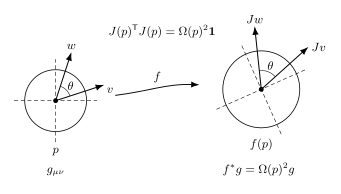
A conformal transformation has Jacobian satisfying . Thus two tangent vectors are mapped to with the same angle , while all local lengths are multiplied by the same factor . In Lorentzian signature, the analogous statement is that null directions are preserved.
A warning is worth making early: a conformal transformation is a coordinate transformation that induces a Weyl rescaling of the metric. A Weyl transformation is a direct rescaling of the metric at fixed coordinates,
These are related but not identical. In flat-space CFT, conformal transformations are special diffeomorphisms that preserve the flat metric up to Weyl rescaling. In curved-space CFT, Weyl transformations become independent background transformations and lead to the Weyl anomaly in even dimensions.
The conformal Killing equation
Section titled “The conformal Killing equation”To find the allowed conformal transformations, start infinitesimally:
The Jacobian is
Keeping only first order terms in , the transformed metric is
A conformal transformation requires this to equal
to first order. Hence
Taking the trace gives
so
Therefore the infinitesimal conformal transformation is governed by the conformal Killing equation
In Lorentzian signature the same equation holds with replaced by :
This equation is the infinitesimal version of angle preservation. It says that the symmetric part of is pure trace. The antisymmetric part is a local rotation; the trace is a local scale transformation; no shear is allowed.
Solving the conformal Killing equation for
Section titled “Solving the conformal Killing equation for d≥3d\ge 3d≥3”The conformal Killing equation is highly restrictive in dimensions . To see this, define
Then
Differentiate and combine cyclic permutations of the indices. One obtains
Taking traces then implies, for ,
Thus is at most linear in the coordinates, and is at most quadratic. The most general solution is
Here
The four terms have distinct geometric meanings:
Counting parameters gives
This is the dimension of in Euclidean signature, or in Lorentzian signature.
This finite-dimensionality is a major distinction between and . In two dimensions, the conformal Killing equation becomes the Cauchy-Riemann equation, and every holomorphic map is locally conformal. That infinite-dimensional enhancement is why two-dimensional CFT has Virasoro symmetry. In this course, however, AdS/CFT preparation requires us first to understand the finite-dimensional conformal group in arbitrary .
The finite transformations
Section titled “The finite transformations”The infinitesimal solution exponentiates to four basic finite transformations.
Translations
Section titled “Translations”A translation is
It has
Translations preserve all distances and angles. They are part of the Poincare group.
Rotations and Lorentz transformations
Section titled “Rotations and Lorentz transformations”In Euclidean signature,
In Lorentzian signature,
Again,
These transformations preserve the metric exactly.
Dilatations
Section titled “Dilatations”A dilatation is
It rescales the line element by
so
Scale invariance alone would mean invariance under these transformations, together with translations and rotations or Lorentz transformations. Conformal invariance further includes the special conformal transformations.
Inversion
Section titled “Inversion”The inversion is
It is not connected continuously to the identity, but it is the simplest way to construct the finite special conformal transformations.
Let
Then
The matrix in parentheses is a reflection in the direction of , so it is orthogonal. Therefore
and
in Euclidean signature. The inversion maps short distances near the origin to large distances near infinity. Thus global conformal transformations are most naturally defined not on alone, but on its conformal compactification.
Special conformal transformations
Section titled “Special conformal transformations”A special conformal transformation, abbreviated SCT, is
Define
Then
The induced scale factor is
To first order in ,
so
This matches the quadratic term in the conformal Killing vector.
The most transparent construction of an SCT is
where
Indeed, after the first inversion,
After translation,
After the second inversion,
This formula is worth remembering. Many calculations with SCTs become simple if you think of them as inversion-translation-inversion.
How distances transform
Section titled “How distances transform”The most useful practical formula is the transformation of squared distances.
For an inversion,
one finds
For a special conformal transformation,
one obtains
This identity is central in the derivation of CFT two- and three-point functions. It tells us that the distance between two points is not invariant, but transforms by a product of local scale factors:
for the convention .
This product structure is the miracle. Because a primary operator transforms with a local power of , two-point and three-point functions can be covariant even though ordinary distances are not invariant.
Active and passive viewpoints
Section titled “Active and passive viewpoints”There are two common ways to describe the same transformation.
In the passive viewpoint, we change coordinates but describe the same physical insertion. In the active viewpoint, we move the operator insertion from to in the same coordinate system. Both are useful. Confusion often comes from mixing conventions.
For a scalar primary operator of scaling dimension , the active transformation law is usually written as
For a dilatation , this becomes
which is the familiar scaling law.
For an operator with spin, the local orthogonal or Lorentz rotation in the Jacobian also acts on the operator indices. Schematically,
where is the appropriate finite-dimensional spin representation. The local rotation factor is harmless for scalar operators but essential for currents, stress tensors, spinors, and general spinning primaries.
A first consequence: the scalar two-point function
Section titled “A first consequence: the scalar two-point function”The full derivation of conformal correlation functions comes later, but the two-point function is simple enough to preview now.
Let and be scalar primary operators with dimensions and . Translation and rotation invariance imply
Scale covariance implies
so
Special conformal covariance then requires
unless the coefficient vanishes. Thus
up to operator mixing among primaries with the same quantum numbers. In an orthonormal basis, one usually chooses
This is the first sign that conformal symmetry is far stronger than scale invariance alone.
Global issues and conformal compactification
Section titled “Global issues and conformal compactification”The formulas above are local transformations on flat space. Some of them are singular on ordinary . For example, inversion is singular at , and an SCT is singular where
This is not a pathology of the conformal group. It is telling us that flat is not the natural global space on which conformal transformations act. The natural space is the conformal compactification.
In Euclidean signature, the compactification is the sphere
Flat space is obtained from by removing one point, just as the complex plane is obtained from the Riemann sphere by removing the point at infinity. Global conformal transformations act smoothly on .
In Lorentzian signature, the conformal compactification is related to
with appropriate global identifications. This will become important in radial quantization and in the state-operator correspondence, where dilatations on become time translations on the cylinder.
Why is special
Section titled “Why d=2d=2d=2 is special”For , the conformal Killing equation forces to be at most quadratic in . That is why the group is finite-dimensional.
For , introduce complex coordinates
The conformal Killing equation becomes the statement that
is locally conformal whenever is holomorphic. Since a holomorphic function has infinitely many Taylor coefficients, the local conformal symmetry becomes infinite-dimensional.
The globally well-defined conformal transformations on the Riemann sphere are only the Mobius transformations
But local conformal transformations are much larger. Quantum mechanically, this leads to the Virasoro algebra, central charge, minimal models, modular invariance, and all the exact two-dimensional CFT technology. For AdS/CFT in general dimension, however, the finite-dimensional structure remains the essential starting point.
AdS/CFT checkpoint
Section titled “AdS/CFT checkpoint”The conformal group of a Lorentzian -dimensional CFT is
The isometry group of is also
This equality is not decorative. It is the kinematic backbone of AdS/CFT.
In Poincare coordinates, Euclidean has metric
A boundary dilatation
extends into the bulk as
The metric is unchanged:
A boundary SCT extends to a bulk isometry as
At the boundary , this reduces to the CFT special conformal transformation
So the bulk isometry acts on the boundary precisely as a conformal transformation. This is why a bulk scalar field of mass is associated with a boundary primary operator of dimension , and why the relation between and is fixed by representation theory rather than by a dynamical accident.
The slogan is:
Common pitfalls
Section titled “Common pitfalls”The first common mistake is to identify conformal transformations with arbitrary local rescalings of coordinates. They are not arbitrary. For , the conformal Killing equation is so restrictive that only finitely many transformations are allowed.
The second mistake is to confuse conformal transformations with Weyl transformations. A conformal transformation is a diffeomorphism whose pullback rescales the metric. A Weyl transformation rescales the metric directly. A curved-space CFT cares about both, but their roles are conceptually different.
The third mistake is to omit special conformal transformations. Scale invariance plus Poincare invariance is weaker than conformal invariance. In many unitary relativistic QFTs, scale invariance is expected or known under suitable assumptions to enhance to conformal invariance, but the logical distinction matters.
The fourth mistake is to treat inversion as an ordinary small transformation. Inversion is not connected to the identity, but it is extremely useful because it generates SCTs by conjugating translations.
Summary
Section titled “Summary”A conformal transformation rescales the flat metric locally:
Infinitesimally, it is generated by a conformal Killing vector satisfying
For , the general solution is
The finite transformations are translations, rotations or Lorentz transformations, dilatations, and special conformal transformations:
In Lorentzian signature, these transformations generate , the same group as the isometry group of . This is the first structural bridge from CFT to AdS/CFT.
Exercises
Section titled “Exercises”Exercise 1: Derive the conformal Killing equation
Section titled “Exercise 1: Derive the conformal Killing equation”Let
Starting from
show that, to first order in ,
Solution
The Jacobian is
Therefore
Write
Then
Taking the trace gives
so
Substitution gives the conformal Killing equation.
Exercise 2: Show that inversion is conformal
Section titled “Exercise 2: Show that inversion is conformal”For
show that
Solution
Compute the Jacobian:
Define
This is a reflection matrix. It obeys
Thus
Therefore inversion is conformal with
Exercise 3: Verify the infinitesimal SCT
Section titled “Exercise 3: Verify the infinitesimal SCT”Start from the finite transformation
Expand to first order in and show that
Solution
To first order in ,
Therefore
Keeping first order terms,
Hence
Exercise 4: Derive the distance transformation under an SCT
Section titled “Exercise 4: Derive the distance transformation under an SCT”Let
Show that
Solution
The cleanest proof uses
Translations do not change distances. Inversion transforms distances as
After the first inversion and translation, define
Then
The second inversion gives
But
Therefore
Exercise 5: Use SCT covariance to fix scalar two-point functions
Section titled “Exercise 5: Use SCT covariance to fix scalar two-point functions”Assume that two scalar primary operators have a two-point function
Using special conformal covariance, show that this can be nonzero only if
Solution
Under an SCT,
Thus
The transformed functional form gives
On the other hand, primary covariance gives one local factor per operator. Since
we get
For consistency at arbitrary , the powers of and must match:
Hence
Exercise 6: Boundary limit of the bulk SCT
Section titled “Exercise 6: Boundary limit of the bulk SCT”Consider the transformation
Show that its boundary limit as is the CFT special conformal transformation.
Solution
As ,
and
Therefore
which is exactly the flat-space SCT on the boundary. Also,
so the boundary maps to itself.
Further reading
Section titled “Further reading”For the global conformal group and the basic Ward-identity consequences, read the global conformal invariance chapter of Di Francesco, Mathieu, and Senechal. For this course, the most important next step is not yet Virasoro symmetry, but the higher-dimensional conformal algebra: , , , and .