
Highest-Weight Modules, Null States, and the Kac Determinant
The Virasoro algebra is not just a useful way of organizing two-dimensional conformal transformations. It is the engine that makes two-dimensional CFT unusually solvable. Once we know the central charge and the spectrum of primary fields, the descendants of each primary are generated algebraically by the negative Virasoro modes.
This page develops that representation theory carefully. The main ideas are:
- a primary state generates a Verma module by acting with ;
- radial quantization gives a natural inner product and hence Gram matrices at each level;
- special modules contain null states, descendants with zero norm that are themselves highest-weight;
- after quotienting by null descendants, the irreducible representation can be much smaller;
- the Kac determinant tells us exactly when null states occur.
In string theory this representation theory has two roles. First, it gives the CFT language for vertex operators. Second, it explains why zero-norm states are not merely an annoyance: they encode gauge redundancies.
Verma modules
Section titled “Verma modules”Work holomorphically for the moment. The Virasoro algebra is
A highest-weight state obeys
The Verma module is the vector space obtained by acting with all products of lowering operators , :
We usually order the modes as
The level of such a descendant is
Because
a level- descendant has eigenvalue :
Thus the module is graded:
The dimension of the level- subspace is the partition number , at least before null states are removed. For example,
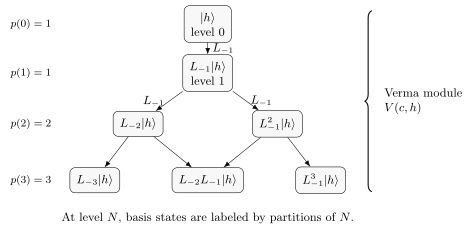
A primary state generates a Verma module. At level , the number of naive descendants is the partition number .
This is already reminiscent of the string oscillator Fock space. There, too, a level is built by partitions of an integer. The difference is that Virasoro descendants are generated by stress-tensor modes, not by target-space oscillator modes.
Inner products and descendant norms
Section titled “Inner products and descendant norms”In radial quantization, Hermitian conjugation is defined by inversion on the complex plane. For the Virasoro modes,
This gives an inner product on each level of a Verma module. The Gram matrix at level is the matrix of inner products among the level- descendants.
At level one there is only one descendant:
Its norm is
So unitarity requires
If , this level-one descendant has zero norm. In the vacuum module, the state corresponds to , which must vanish.
At level two choose the ordered basis
The Gram matrix is
The entries follow directly from the Virasoro algebra. For instance,
so
The determinant is
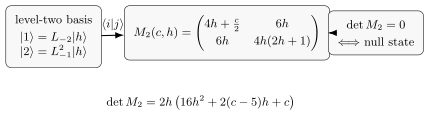
The level-two Gram determinant vanishes when the two descendants become linearly dependent after quotienting by a zero-norm state.
The determinant detects zero-norm combinations. If , there is a nonzero level-two descendant orthogonal to every level-two state. In a unitary representation, such a state must be null and must be removed from the physical Hilbert space.
Level-two null states
Section titled “Level-two null states”Let us find the null vector explicitly. Try
A null descendant that generates a submodule must itself be highest-weight:
It is enough to impose and , because higher positive modes follow from commutators. First,
and
Therefore
or
The condition gives
Substituting the value of gives
Thus the standard level-two null vector is
provided
Equivalently,
These two branches are the first glimpse of the Kac table.
Null submodules and irreducible modules
Section titled “Null submodules and irreducible modules”A null vector has zero norm, but its importance is larger than that one number. If is both null and highest-weight, then its descendants
form an entire submodule. In a unitary theory, every state in this null submodule is orthogonal to every state in the full module.
The irreducible representation is obtained by quotienting:
This quotienting is not a technical afterthought. It is part of the definition of the physical state space. In string theory, zero-norm descendants similarly encode gauge redundancies. For example, the massless vector polarization
is the spacetime shadow of a null state on the worldsheet.
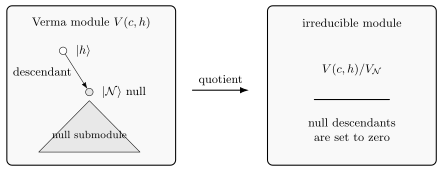
A null highest-weight descendant generates its own Verma submodule. The irreducible module is obtained by quotienting out that entire null submodule.
The Kac determinant
Section titled “The Kac determinant”The level-two determinant is the first nontrivial case of a general theorem. At level , the Gram matrix has size . Its determinant factorizes as
where is a nonzero constant independent of .
The interpretation is direct:
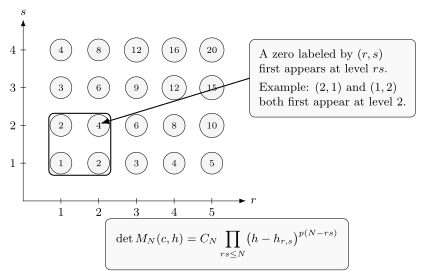
Zeros of the Kac determinant are labeled by integer pairs . The first null vector appears at level , and its descendants produce zeros at higher levels.
A convenient parameterization is
with
For general complex , this is just a way to parametrize and the zeros of the determinant. When and are coprime positive integers, the formula becomes the entry point to minimal models.
Unitarity and why null states matter
Section titled “Unitarity and why null states matter”A unitary CFT must have a positive-semidefinite inner product. The Kac determinant gives strong constraints on which are allowed.
For , the familiar unitary highest-weight representations have
Null states can occur at special values, but generic modules are irreducible.
For , unitarity is far more restrictive. The allowed central charges are the discrete series
and the allowed weights are Kac-table weights
with
These are the unitary minimal models. We will examine them on the next page.
The lesson is worth emphasizing: two-dimensional conformal symmetry is infinite-dimensional, so representation theory is a dynamical constraint. A few algebraic data, plus null-vector consistency, can determine entire families of correlation functions.
Exercises
Section titled “Exercises”Exercise 1. Count descendants at low levels
Section titled “Exercise 1. Count descendants at low levels”List a basis of descendants at levels in a generic Verma module and check that the number of states is .
Solution
The basis states are labeled by partitions of :
Thus the counts are
which are .
Exercise 2. Derive the level-two Gram matrix
Section titled “Exercise 2. Derive the level-two Gram matrix”Using the Virasoro algebra, show that in the basis , ,
Solution
The first entry is
For the off-diagonal entry,
Since and , this reduces to
Finally,
obtained by commuting the two operators through the two operators until they annihilate .
Exercise 3. Find the level-two null vector
Section titled “Exercise 3. Find the level-two null vector”Let
Impose .
Solution
The equation gives
and
Therefore
The equation gives
Substitution yields
Exercise 4. Orthogonality of a null submodule
Section titled “Exercise 4. Orthogonality of a null submodule”Suppose is a null highest-weight descendant. Show that all descendants of are orthogonal to all states in the Verma module.
Solution
A general descendant of has the form
Pair it with a general descendant of . Moving all lowering operators in the bra to raising operators using , the inner product reduces to a linear combination of terms of the form
or, equivalently after commuting, to matrix elements involving positive modes acting on . Since is highest-weight, all positive modes annihilate it. The remaining term is proportional to . Hence the whole null submodule is orthogonal to the full module.
Exercise 5. Locate the first few Kac zeros
Section titled “Exercise 5. Locate the first few Kac zeros”Using the Kac determinant formula, explain why a zero at first occurs at level , while a zero at first occurs at level .
Solution
The determinant at level contains factors with :
For , the product , so the factor first appears at .
For , the product is , so the factor first appears at . At higher levels it reappears with multiplicity because the null state has descendants.