In conformal gauge the classical bosonic string is deceptively simple. The embedding fields obey a free two-dimensional wave equation,
(∂τ2−∂σ2)Xμ=0,
but they must also satisfy the Virasoro constraints
X˙2+X′2=0,X˙⋅X′=0.
For an open string with Neumann boundary conditions in all target-space directions, we also impose
X′μ(τ,0)=X′μ(τ,π)=0.
This page studies one of the most important classical solutions: a rigidly rotating open string. It is the cleanest classical derivation of the stringy Regge relation
J=α′M2.
This relation is the historical reason that strings were first taken seriously as models of hadrons, and it remains one of the best ways to remember what the parameter α′ means physically.
Consider a string rotating in the X1-X2 plane, with all other spatial coordinates set to zero. A convenient conformal-gauge parametrization is
X0=Aτ,X1=Acosσcosτ,X2=Acosσsinτ,
with
X3=⋯=XD−1=0.
The constant A has dimensions of length. It sets the size of the string. At a fixed target-space time
t=X0=Aτ,
the spatial embedding is
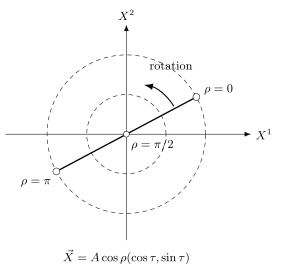
X(τ,σ)=Acosσ(cosτ,sinτ).
As σ runs from 0 to π, cosσ runs from 1 to −1. Thus the string is a straight line segment of length 2A passing through the origin. As τ increases, this line segment rotates rigidly.
A classical open string rotating in the X1-X2 plane. The midpoint at σ=π/2 is at the origin, while the endpoints move at the speed of light.
The target-space angular velocity is not 1; it is
Ω=dX0dτ=A1.
The physical velocity of a point labelled by σ is
dX0dX=∂τX0∂τX=cosσ(−sinτ,cosτ),
so
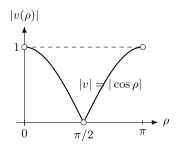
dX0dX=∣cosσ∣.
The endpoints at σ=0,π move at speed 1, while the midpoint at σ=π/2 is at rest. This is a very stringy feature: the endpoints of the classical rotating open string are massless and move at the speed of light.
The speed is maximal at the two endpoints and vanishes at the midpoint.
The nontrivial check is the constraint equation. We have
X˙0=A,X˙1=−Acosσsinτ,X˙2=Acosσcosτ,
so the spatial velocity squared is
∣X˙∣2=A2cos2σ.
The spatial tangent is
X′1=−Asinσcosτ,X′2=−Asinσsinτ,
so
∣X′∣2=A2sin2σ.
With the mostly-plus metric,
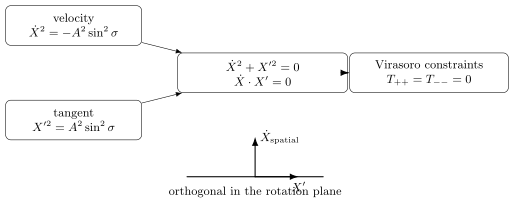
X˙2=−A2+A2cos2σ=−A2sin2σ,
and
X′2=A2sin2σ.
Hence
X˙2+X′2=0.
Moreover,
X˙⋅X′=0,
because the velocity is perpendicular to the string tangent in the rotation plane. Thus the solution satisfies
T++=T−−=0.
The Virasoro constraints hold pointwise on the worldsheet. The negative contribution from X0 is essential.
This cancellation is the classical ancestor of a fact that will recur in quantization: the time coordinate is not an ordinary positive-norm oscillator. The constraints remove unphysical longitudinal and timelike degrees of freedom.
Flat target space has spacetime translation symmetry
δXμ=aμ,
and Lorentz symmetry
δXμ=ωμνXν,ωμν=−ωνμ.
The corresponding translation current is
Pτμ=TX˙μ,Pσμ=−TX′μ.
The equation of motion is the conservation law
∂τPτμ+∂σPσμ=0.
The spacetime momentum is the charge on a constant-τ slice:
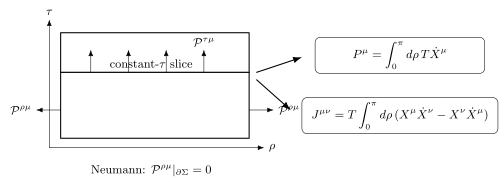
Pμ=∫0πdσPτμ=T∫0πdσX˙μ.
For open strings with Neumann boundary conditions,
Pσμσ=0,π=−TX′μσ=0,π=0,
so no spacetime momentum flows out of the endpoints. This is why the total momentum is conserved.
The Lorentz current is
Jαμν=XμPαν−XνPαμ.
In particular,
Jτμν=T(XμX˙ν−XνX˙μ),
and the spacetime angular momentum is
Jμν=∫0πdσJτμν=T∫0πdσ(XμX˙ν−XνX˙μ).
Spacetime Poincare invariance gives worldsheet currents. Constant-τ integrals of their time components give the spacetime momentum Pμ and angular momentum Jμν.
Energy and angular momentum of the rotating string
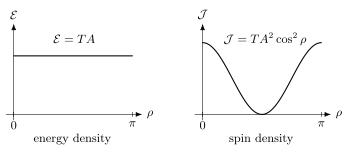
The energy density is constant in the coordinate σ, while the angular-momentum density is proportional to cos2σ.
Eliminate A between
E=πTA
and
J=2πTA2.
From A=E/(πT),
J=2πTπ2T2E2=2πTE2.
Since
T=2πα′1,
we find
2πT1=α′.
In the rest frame of the string,
M2=E2,
and therefore
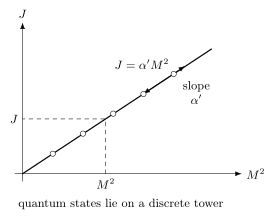
J=α′M2.
This is the classical open-string Regge trajectory.
The rotating open string gives a linear relation between spin and mass squared. Quantum effects shift the intercept but not the leading large-M2 slope.
says that α′ is the slope of the leading open-string Regge trajectory. Equivalently,
α′=2πT1
is the inverse string tension up to the conventional factor 2π.
This is physically intuitive. If the string tension is large, it costs a lot of energy to make a long string, so the slope in the J-M2 plane is small. If the tension is small, long strings are cheap, and large angular momentum can be obtained at smaller mass.
Classically A is continuous, so the curve is continuous. Quantum mechanically the angular momentum is quantized, and the leading trajectory becomes a sequence of states. The intercept is also shifted by the quantum zero-point energy. Schematically one expects
J=α′M2+a,
where a is a quantum intercept. In the bosonic open string, this same intercept is responsible for the tachyon in the spectrum. We will derive this from oscillator quantization rather than assume it.
satisfies the conformal-gauge equations of motion, the Neumann boundary condition, and the Virasoro constraints. Its conserved charges are
E=πTA,J=2πTA2.
Eliminating A gives
J=2πTE2=α′M2.
Thus α′ is the Regge slope of the classical open string. The next lecture note begins the quantization of the closed string, where the same conformal-gauge equations become oscillator mode expansions and Virasoro constraints on the string Hilbert space.