
Linear Response and Kubo Formulas
Why transport starts with retarded correlators
Section titled “Why transport starts with retarded correlators”Thermodynamics tells us the equation of state. It says, for example, how the pressure depends on temperature and chemical potential . Transport asks a different question: if the system is slightly disturbed away from equilibrium, how does it return?
In holography this is not a side topic. The earliest dramatic successes of finite-temperature AdS/CFT were not only equilibrium statements such as , but dynamical statements: diffusion constants, conductivities, quasinormal modes, and the shear viscosity of a strongly coupled plasma. The universal pattern is simple:
- perturb the thermal CFT by a weak source,
- compute a retarded Green function,
- take a low-frequency, long-wavelength limit,
- read off a transport coefficient.
The corresponding bulk statement is equally compact: solve a linearized fluctuation problem around a black brane, impose an infalling condition at the horizon, renormalize the on-shell action, and take the same Kubo limit.
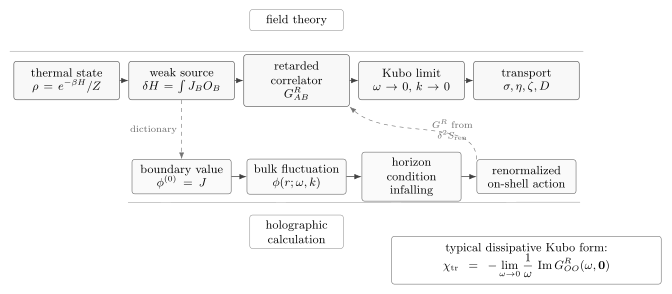
Linear response in the CFT and its holographic implementation. A weak boundary source becomes a boundary value for a bulk fluctuation. The retarded correlator is selected by the infalling horizon condition, and transport follows from the small- Kubo limit.
This page is the field-theory gateway to the next four pages. The next page computes conductivity; the page after that computes ; then we discuss fluid/gravity and the phenomenological lessons for plasma physics. Here we set the conventions carefully enough that the later holographic calculations have something precise to compute.
Throughout this page the boundary spacetime dimension is , and the number of spatial dimensions is
Thermal expectation values are
The retarded response kernel
Section titled “The retarded response kernel”Consider a small time-dependent source coupled to an operator ,
To first order in , the response of another operator is governed by the retarded correlator
With the Hamiltonian sign convention above,
up to the usual adiabatic prescription that switches the perturbation on in the far past. Some books place the opposite sign in the Hamiltonian source. That flips the sign of the response kernel, but not the physics once the source convention is used consistently. Holographic papers also differ by factors of , by whether the source is introduced in the action or Hamiltonian, and by the normalization of . The safest habit is this:
A Kubo formula is a statement about the response of a precisely normalized operator to a precisely normalized source.
We use the Fourier convention
so that
The retarded correlator is analytic in the upper half complex -plane. Its singularities in the lower half-plane are relaxation modes. In a holographic black-brane background these singularities are quasinormal modes.
Spectral functions and dissipation
Section titled “Spectral functions and dissipation”For a Hermitian bosonic operator , define the spectral density by
With this convention, positivity of spectral weight gives for for standard positive-norm observables. The imaginary part of the retarded correlator measures absorption. In the bulk, absorption is literally absorption by the horizon.
The fluctuation-dissipation theorem relates this dissipative part to equilibrium fluctuations. If
then the KMS condition implies
and the symmetrized correlator is
Thus the same low-frequency spectral density that controls dissipation also controls thermal noise. This is why transport is not merely a classical hydrodynamic idea; it is encoded in real-time quantum correlation functions.
What counts as a transport coefficient?
Section titled “What counts as a transport coefficient?”A transport coefficient is not just any coefficient in a low-frequency expansion. It is a parameter in the constitutive relations of the long-wavelength effective theory.
For a conserved current, the conservation law is
In the local rest frame of an isotropic medium, the first-order constitutive relation contains
where is the charge density, is the diffusion constant, is the conductivity, and is an external electric field. The susceptibility is
For a neutral relativistic fluid, the stress tensor in the Landau frame begins as
where
projects transverse to the fluid velocity, and
is the shear tensor. The coefficients and are the shear and bulk viscosities.
For a conformal plasma,
up to conformal anomalies on curved backgrounds and contact terms. Thermal SYM on flat space is the canonical example.
Kubo formulas for conductivity and viscosity
Section titled “Kubo formulas for conductivity and viscosity”Kubo formulas extract transport coefficients from retarded correlators at zero spatial momentum. The most commonly used formulas are the following.
| Coefficient | Source | Retarded correlator | Kubo formula |
|---|---|---|---|
| Electric conductivity | |||
| Shear viscosity | |||
| Bulk viscosity | spatial trace | ||
| Charge diffusion | chemical potential | pole of | |
| Shear diffusion | metric source or | pole in transverse stress channel |
The repeated spatial indices in the bulk-viscosity formula are summed. The formula is schematic because, in practice, one must use a gauge-invariant trace channel with the correct subtraction of equilibrium pressure and contact terms. For conformal theories in flat space the answer is simply .
The shear and conductivity formulas have a useful equivalent statement. At small frequency and zero spatial momentum,
and
where and are real analytic terms, often including contact terms. The transport coefficient is the slope of the dissipative imaginary part.
This is a recurring source of mistakes. The real part of at small can be shifted by local counterterms or thermodynamic contact terms. The dissipative slope is much more robust.
Diffusion as a pole, not just a coefficient
Section titled “Diffusion as a pole, not just a coefficient”Conductivity is a zero-momentum Kubo coefficient. Diffusion is more naturally seen as a pole at small but nonzero momentum.
Turn on a small chemical-potential source . The constitutive relation
together with charge conservation gives
In Fourier space,
Using the Einstein relation , the density-density retarded correlator takes the hydrodynamic form
The pole is
This pole is the signature of a conserved density that relaxes only by spreading. In a holographic black brane, the same pole appears as the lowest quasinormal mode in the charge diffusion channel.
There is an important order-of-limits lesson here:
but
The first limit asks for the homogeneous response at finite frequency; a exactly conserved total charge cannot change. The second asks for the static response to a chemical potential; it gives the susceptibility. Hydrodynamics is full of such noncommuting limits.
Shear diffusion and sound
Section titled “Shear diffusion and sound”Momentum conservation produces hydrodynamic poles in stress-tensor correlators. Consider a transverse momentum perturbation with momentum along and velocity along . Linearized hydrodynamics gives
where
At zero chemical potential, , so
This is why the famous holographic result also immediately gives a shear diffusion constant
for a neutral plasma described by two-derivative Einstein gravity.
The longitudinal stress channel contains sound modes,
where is the speed of sound. For a conformal fluid in spatial dimensions,
For a neutral relativistic fluid, the attenuation constant is
In conformal holographic plasmas, , so sound attenuation is controlled by .
The metric source and stress-tensor normalization
Section titled “The metric source and stress-tensor normalization”The stress tensor is sourced by the boundary metric. In a QFT on a background metric , define
For a small perturbation around flat space,
the source term is schematically
That factor of is easy to lose. If one differentiates the holographic on-shell action with respect to , the normalization of the resulting two-point function must match the normalization of the stress tensor in the Kubo formula.
For shear viscosity one uses the tensor perturbation at zero spatial momentum. In isotropic backgrounds this channel often decouples from all other fluctuations and behaves like a minimally coupled massless scalar. That simplification is the technical reason the holographic computation of is so elegant.
The holographic Kubo recipe
Section titled “The holographic Kubo recipe”For a bulk field dual to an operator , the near-boundary expansion has the schematic form
where the precise powers depend on the radial coordinate and on the operator dimension. The source is the leading boundary datum .
For a black-brane background, the retarded correlator is obtained by imposing:
- fixed source at the AdS boundary,
- infalling regularity at the future horizon,
- holographic renormalization of the radial canonical momentum.
Let be the renormalized canonical momentum conjugate to . Then, for a decoupled linear fluctuation,
up to source-normalization factors and possible signs fixed by the precise action convention. The Kubo formula then takes the low-frequency limit of this object.
For example, the conductivity follows from a Maxwell fluctuation :
The shear viscosity follows from the metric perturbation :
At small , the imaginary part comes from horizon absorption. This is the physical reason black-hole horizons behave like dissipative media from the boundary perspective.
Euclidean correlators are not enough
Section titled “Euclidean correlators are not enough”Thermal Euclidean correlators are defined at discrete Matsubara frequencies,
for bosonic operators. For appropriate analytic functions one has the continuation rule
But transport coefficients require the slope at real . Analytic continuation from Euclidean data is a delicate inverse problem. This is one of the practical strengths of Lorentzian holography: the infalling boundary condition directly computes on the real-frequency axis.
The price is that one must be more careful about boundary conditions. Euclidean regularity at a smooth tip is not the same statement as Lorentzian infalling regularity at a future horizon, although they are related by analytic continuation for equilibrium retarded functions.
Momentum conservation and infinite DC conductivity
Section titled “Momentum conservation and infinite DC conductivity”A subtle point appears at finite charge density. If translations are exact, the electric current overlaps with the conserved momentum. A homogeneous electric field accelerates the whole plasma, so the DC conductivity contains a delta function:
with a corresponding pole in the imaginary part,
Therefore the simple finite number called exists only after specifying the situation: zero density, no overlap with momentum, explicit momentum relaxation, probe limit, lattice, disorder, axions, massive-gravity-like models, or the incoherent conductivity that removes the momentum drag contribution.
This is not a nuisance; it is physics. In a perfectly translationally invariant charged plasma, charge transport is tied to momentum transport. Later, in the finite-density module, this point becomes central to strange-metal holography.
Positivity and the second law
Section titled “Positivity and the second law”Transport coefficients that multiply entropy-producing terms are nonnegative in ordinary unitary thermal systems:
In field theory this follows from spectral positivity and the fluctuation-dissipation theorem. In hydrodynamics it is required by local entropy production. In two-derivative holographic gravity it is reflected in the fact that horizons absorb positive flux.
This is one of the pleasant conceptual loops in holography:
Common mistakes
Section titled “Common mistakes”Mistake 1: using Euclidean correlators directly. Transport coefficients are extracted from retarded correlators. Euclidean correlators are useful, but a Kubo formula is a real-time statement.
Mistake 2: ignoring contact terms. Analytic real terms in can shift under counterterms. The dissipative slope of is the robust part in the basic viscosity and conductivity formulas.
Mistake 3: taking limits in the wrong order. Hydrodynamic correlators have noncommuting and limits. Conductivity, susceptibility, and diffusion probe different limits.
Mistake 4: forgetting source normalization. The metric source has a factor of in . Gauge-field, scalar, and metric perturbations all have their own normalizations.
Mistake 5: calling every low-frequency pole hydrodynamic. Hydrodynamic modes are tied to conserved quantities or spontaneously broken symmetries. Generic quasinormal modes are relaxation modes, not hydrodynamic modes.
Mistake 6: assuming finite DC conductivity at finite density. With exact translations and finite charge density, momentum conservation usually produces an infinite DC response.
Exercises
Section titled “Exercises”Exercise 1: Derive the retarded response formula
Section titled “Exercise 1: Derive the retarded response formula”Let
Working to first order in , show that the change in is governed by a commutator with support only inside the future of the source.
Solution
In the interaction picture,
where the source-dependent part is
The first-order change in the expectation value is
Substituting the source gives
Using antisymmetry of the commutator,
with
The step function expresses causality: the source can affect only later measurements.
Exercise 2: The diffusion pole and susceptibility
Section titled “Exercise 2: The diffusion pole and susceptibility”Starting from
and charge conservation, derive
assuming .
Solution
Charge conservation is
Linearizing around equilibrium and substituting the constitutive relation gives
In Fourier space this becomes
Therefore
Using gives
The pole is at
At the correlator is , as required for a static chemical-potential response.
Exercise 3: Reading viscosity from a small-frequency expansion
Section titled “Exercise 3: Reading viscosity from a small-frequency expansion”Suppose the retarded correlator in the shear channel has the expansion
where , , and are real. Show that the Kubo formula extracts and not the contact terms.
Solution
Taking the imaginary part gives
if and are real. Therefore
The real analytic terms do not contribute to this dissipative slope. This is why the Kubo formula is insensitive to many local counterterm ambiguities.
Exercise 4: Noncommuting limits of the diffusion correlator
Section titled “Exercise 4: Noncommuting limits of the diffusion correlator”Using
compute
and
Explain the physical difference.
Solution
First take at fixed nonzero :
Then gives
In the opposite order, first take :
Then gives
The first limit probes a homogeneous time-dependent perturbation. Since total charge is conserved, it cannot relax by diffusion. The second probes the static response to a chemical potential and therefore gives the susceptibility.
Exercise 5: Holographic extraction of a conductivity
Section titled “Exercise 5: Holographic extraction of a conductivity”Consider a bulk Maxwell fluctuation
in a neutral black-brane background. Near the boundary,
and let be the renormalized radial canonical momentum conjugate to . Write the retarded current correlator and the DC conductivity in terms of these quantities.
Solution
The boundary source for is . After imposing infalling regularity at the future horizon, the retarded correlator is obtained from the source-response ratio
up to the overall normalization fixed by the Maxwell action and the current normalization.
The DC conductivity is then
In many two-derivative holographic models the low-frequency flux associated with can be evaluated at the horizon, which is why DC transport often has a simple horizon formula.
Further reading
Section titled “Further reading”- R. Kubo, “Statistical-Mechanical Theory of Irreversible Processes. I,” the original linear-response paper.
- L. P. Kadanoff and P. C. Martin, “Hydrodynamic equations and correlation functions,” a classic bridge between hydrodynamics and correlators.
- P. Kovtun, “Lectures on hydrodynamic fluctuations in relativistic theories”, a clean modern treatment of relativistic hydrodynamic correlators and Kubo formulas.
- D. T. Son and A. O. Starinets, “Minkowski-space correlators in AdS/CFT correspondence”, the standard retarded-correlator prescription used in holographic transport.
- G. Policastro, D. T. Son, and A. O. Starinets, “Shear viscosity of strongly coupled supersymmetric Yang-Mills plasma”, the original holographic shear-viscosity computation.