
Near-Extremal D3-Branes and Entropy
The extremal D3-brane is simultaneously a solitonic object of type IIB string theory and the gravitational description of a stack of coincident D3-branes. Its near-horizon region is , and its worldvolume theory is four-dimensional super-Yang—Mills theory. The near-extremal D3-brane is what happens when we heat this system slightly above the BPS ground state. On the gravity side, the throat develops a horizon. On the gauge-theory side, the brane worldvolume theory becomes a thermal plasma.
This is the first sharp thermodynamic test of holography. A black-brane horizon knows about the number of microscopic degrees of freedom of a large- gauge theory. More precisely, the Bekenstein—Hawking area law gives
whereas the free SYM gas gives
The ratio is
The factor is not a failure of the duality. It is the point. The black brane computes the strongly coupled large- plasma, while the free-field answer computes the weakly coupled plasma. Supersymmetry does not protect the thermal free energy. What is protected, in a much more structural sense, is the scaling , the hallmark of adjoint matrix degrees of freedom.
From extremal to near-extremal branes
Section titled “From extremal to near-extremal branes”An extremal D3-brane carries Ramond—Ramond five-form flux and saturates a BPS bound. Its energy is fixed by its charge. If we add a small amount of energy while keeping the charge fixed, the solution becomes non-extremal. Physically this means that the brane stack has thermal excitations above its supersymmetric ground state.
For a black D-brane in string frame, the standard non-extremal form is
with
The function is the blackening factor. The surface is the horizon. The harmonic function carries the brane charge. For the D3-brane,
and the dilaton is constant. The constant is fixed by the five-form flux through the surrounding :
Equivalently, in the common AdS/CFT convention
Thus the curvature radius is large in string units precisely when the ‘t Hooft coupling is large.
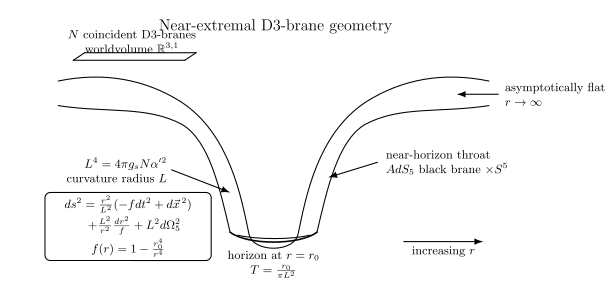
A near-extremal D3-brane has the same R—R charge as the extremal D3-brane, but the throat ends on a horizon at . In the decoupling limit the near-horizon region becomes an black brane times .
For D3-branes the ten-dimensional geometry is particularly simple because the dilaton does not run. The five-form flux is self-dual, schematically
and flux quantization fixes the integer .
The full asymptotically flat metric describes both the brane and its surrounding bulk spacetime. The decoupling limit isolates the throat dynamics:
For thermal physics it is often cleaner to keep and in the formulas and simply focus on the region . In this region , and the metric becomes
This is the planar AdS-Schwarzschild black brane times a round . The spatial coordinates are the D3-brane worldvolume coordinates. The radial coordinate is the holographic energy scale: large is the ultraviolet of the gauge theory, and small is the infrared. The horizon at represents thermal screening in the gauge theory.
Hawking temperature
Section titled “Hawking temperature”The temperature is fixed by regularity of the Euclidean geometry. Continue . Near the horizon write
The Euclidean part of the near-horizon metric is
This is flat polar space if the Euclidean time circle has period
Therefore
The horizon radius is proportional to the temperature. Heating the gauge theory pushes the horizon outward in the AdS radial direction.
Bekenstein-Hawking entropy
Section titled “Bekenstein-Hawking entropy”The entropy is one quarter of the horizon area in ten-dimensional Planck units:
At fixed time and fixed , the horizon is
Let be the coordinate volume of the three spatial worldvolume directions. In the near-horizon metric, the induced metric along is
so the spatial volume element contributes . The sphere has radius , so its area is
Thus
The ten-dimensional Newton constant is
Using
we obtain
So the entropy density is
This is an extraordinary formula. The gravity calculation used a smooth classical horizon in ten dimensions, but the answer has precisely the scaling expected of a four-dimensional conformal gauge theory with adjoint degrees of freedom.
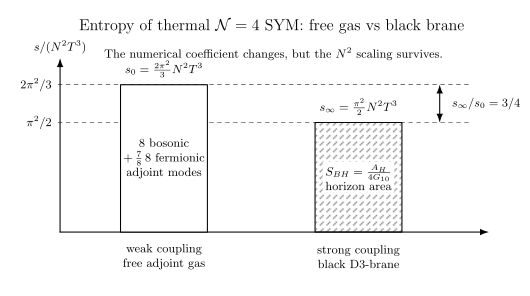
The free plasma and the black D3-brane plasma both scale as , but their numerical coefficients differ. The black-brane answer is the strong-coupling, large- limit.
The free SYM gas
Section titled “The free N=4\mathcal N=4N=4 SYM gas”The weak-coupling comparison is a useful calibration. The field content of SYM consists of
all in the adjoint representation of or . In the large- limit the number of adjoint color states is .
A single real massless bosonic degree of freedom in four dimensions has entropy density
A fermionic degree of freedom contributes the same expression multiplied by . Per adjoint color index, SYM has
where is the number of physical gluon polarizations and is the number of real fermionic helicity states. Hence
The ratio is therefore
The factor should be read as a strong-coupling prediction. Thermal quantities are not protected by supersymmetry, because the thermal ensemble itself breaks supersymmetry. Interactions reorganize the plasma. The holographic result says that at infinite ‘t Hooft coupling and infinite , the effective number of thermodynamic degrees of freedom is of the free-field count.
Free energy, pressure, and energy density
Section titled “Free energy, pressure, and energy density”Because the gauge theory is conformal, thermodynamics in flat space has the form
The black D3-brane entropy fixes
Thus
and
At weak coupling,
It is common to write the planar free energy as
where
String corrections in the gravity dual give the large- expansion
The term is the holographic imprint of the leading correction to the type IIB effective action. Its positive sign is physically reasonable: as decreases from infinity, the entropy coefficient begins to move upward from toward the free value .
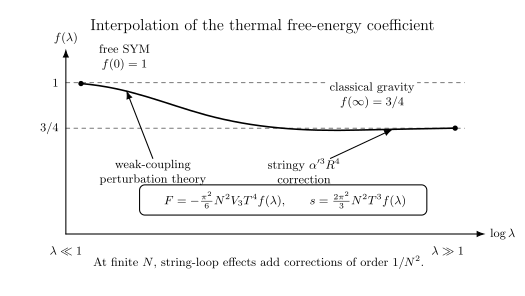
The planar thermal free energy is written as . Free fields give , while the classical black D3-brane gives . Finite- and finite- corrections correspond to stringy and string-loop corrections in the bulk.
Validity of the classical black-brane calculation
Section titled “Validity of the classical black-brane calculation”The supergravity calculation is not just a formal manipulation. It has a precise domain of validity.
First, the curvature radius must be large compared with the string length:
This suppresses higher-derivative corrections. Second, string loops must be small:
Together, the cleanest classical window is
In this window the geometry is weakly curved and quantum gravity effects are suppressed. The black D3-brane then gives a controlled prediction for the planar, strongly coupled thermal gauge theory.
The entropy itself also needs to be large for a thermodynamic description:
This condition is automatic in the planar thermodynamic limit, where and is large.
Why the D3-brane is special
Section titled “Why the D3-brane is special”Other near-extremal branes also teach us about the number of microscopic degrees of freedom. The striking scalings are
The D3-brane case is the easiest to interpret directly: is the number of adjoint matrix degrees of freedom in a four-dimensional gauge theory. The M2 and M5 scalings are more mysterious from a naive worldvolume perspective. The behavior of M2-branes and the behavior of M5-branes are among the sharpest early clues that strongly coupled brane theories can have degrees of freedom that are not visible in a weakly coupled Lagrangian description.
For D3-branes, however, the story is already complete enough to be a paradigm. We have two descriptions of the same thermal system:
The entropy calculation says that the area of a classical horizon counts the thermal states of a large- gauge theory.
Summary
Section titled “Summary”The near-extremal D3-brane is the finite-temperature version of the D3-brane throat. In the decoupling limit it becomes the planar black brane times ,
The Hawking temperature and entropy density are
The corresponding free energy is
Comparing with the free SYM result
gives the famous ratio
The agreement in the scaling, together with the controlled strong-coupling coefficient, is one of the foundational successes of the gauge/gravity correspondence.
Exercises
Section titled “Exercises”1. Euclidean derivation of the Hawking temperature
Section titled “1. Euclidean derivation of the Hawking temperature”Starting from
show that absence of a conical singularity at requires
Solution
Near the horizon, set . Then
Also . Therefore
Define
Then is the radial part and
Thus
For this to be smooth polar space, the angular variable must have period . Hence
2. Horizon area and D3-brane entropy
Section titled “2. Horizon area and D3-brane entropy”Using the near-horizon metric, compute the horizon area and show that
Use
Solution
At , the induced metric on the horizon is
Hence
The Bekenstein—Hawking entropy is
Using gives
Now
Therefore
3. Counting the free-field entropy
Section titled “3. Counting the free-field entropy”Verify that the free SYM entropy density is
at large .
Solution
A real massless bosonic degree of freedom contributes
A fermionic degree of freedom contributes of this. Per adjoint color index, SYM contains
Thus
For one should replace by , which is immaterial in the planar limit.
4. The three-quarters factor
Section titled “4. The three-quarters factor”Using the two entropy densities
compute the ratio . Why is this ratio not expected to be ?
Solution
The ratio is
It is not expected to be because entropy and free energy at finite temperature are not protected supersymmetric quantities. The thermal ensemble breaks supersymmetry. The free answer describes , while the black-brane answer describes in the planar limit. The robust feature is the scaling, not the numerical coefficient.
5. Free energy from entropy
Section titled “5. Free energy from entropy”Assume conformal invariance and write
Use the black D3-brane entropy to find , , , and .
Solution
Since
and
we find
Therefore
The pressure is
For a conformal theory in four dimensions, , hence
6. Classical-supergravity window
Section titled “6. Classical-supergravity window”Show that the conditions for suppressing both corrections and string loops can be written as
Use and .
Solution
Suppressing corrections requires small curvature in string units:
Thus . Suppressing string loops requires
Up to the inessential numerical factor , this means . Combining the two conditions gives
7. Flux normalization and the AdS radius
Section titled “7. Flux normalization and the AdS radius”The D3-brane tension is
The ten-dimensional Newton constant is
Use dimensional analysis and flux quantization to explain why the D3-brane harmonic function must have the form
Solution
The D3-brane is codimension six, so its transverse Green function in flat space behaves as . Therefore the harmonic function must be
The coefficient is set by the total R—R charge, which is proportional to , multiplied by the gravitational coupling . Thus
Using the given formulas,
Hence
The exact coefficient obtained from five-form flux quantization is