
Crossing and the Conformal Bootstrap
The OPE lets us compute a four-point function by expanding pairs of nearby operators. But a four-point function has more than one OPE channel. We can expand , or , or . These are not different physical observables. They are different ways of computing the same correlator.
The equality of these different expansions is called crossing symmetry. In a local CFT, crossing is the analytic expression of OPE associativity:
where the equation is not meant as a naive pointwise product of singular operators, but as an equality inside correlation functions after using the convergent OPE in appropriate radial quantization domains.
The modern conformal bootstrap is the program of solving, or constraining, CFT data from this requirement:
For AdS/CFT, this page is a big milestone. Crossing is the CFT form of bulk consistency. In large- theories it forces the appearance of multi-trace operators, controls anomalous dimensions, and makes it possible to test whether a proposed spectrum can come from a local theory of fields and gravity in AdS.
OPE associativity as a four-point equation
Section titled “OPE associativity as a four-point equation”Consider four scalar primary operators. Conformal symmetry fixes their four-point function up to a function of the cross-ratios . For identical scalars of dimension , we use the convention
where
The variable is small in the OPE channel. The variable is small in the OPE channel. For identical operators, permuting the insertion points cannot change the correlator. Exchanging and sends
while changing the kinematic prefactor. Equating the two representations gives
Equivalently,
This is the simplest crossing equation. It compares the channel with the crossed channel.
Inserting conformal blocks
Section titled “Inserting conformal blocks”The OPE channel gives the conformal block expansion
The sum runs over primary operators in the OPE . For a unitary CFT with unit-normalized operators,
For a single real identical scalar without extra internal symmetry, Bose symmetry allows only even spins in the singlet OPE channel:
The identity operator appears with
Substitute the conformal block expansion into crossing. Define the crossing vector
Then crossing becomes the infinite-dimensional sum rule
Separating the identity contribution gives
where
This equation is the workhorse of the numerical conformal bootstrap. The functions are known once conformal blocks are known. The unknowns are the allowed spectrum and the nonnegative coefficients .
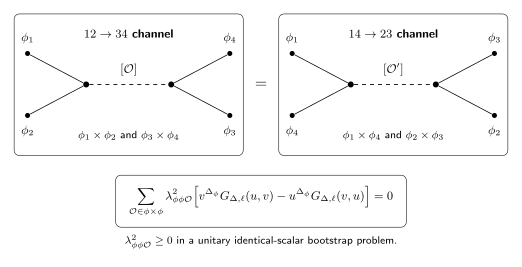
Crossing equates different OPE decompositions of the same four-point function. For identical scalars, the equality between the and channels gives an infinite sum rule built from crossing vectors . In a unitary identical-scalar problem the coefficients are nonnegative: .
What is actually being bootstrapped?
Section titled “What is actually being bootstrapped?”The CFT data relevant to this four-point function are
Crossing asks whether these data can satisfy
Unitarity supplies two crucial ingredients. First, the coefficients are nonnegative. Second, the exchanged dimensions satisfy unitarity bounds. For scalar and symmetric traceless tensor primaries in ,
and
with conserved currents and the stress tensor sitting at shortening values:
Thus a bootstrap problem is usually stated as follows. Choose some assumptions, such as external dimension , spacetime dimension , global symmetry, gaps in certain sectors, or existence of a stress tensor. Then ask:
If the answer is no, the assumptions are inconsistent. If the answer is yes, the assumptions may describe one or more CFTs, though crossing of a single correlator alone rarely proves existence or uniqueness.
The crossing-symmetric point
Section titled “The crossing-symmetric point”It is useful to introduce complex variables by
The crossing-symmetric Euclidean point is
At this point, the two OPE channels are as balanced as possible. Numerical bootstrap algorithms often act on crossing equations by taking derivatives at or near this point. A typical linear functional has the form
The cutoff is the derivative order. Larger means a stronger search space for constraints, but also a larger numerical problem.
The reason this works is that crossing is an equality of functions. If two analytic functions are equal, then all of their derivatives at a point agree. Taking finitely many derivatives gives a finite-dimensional projection of the full problem. Increasing recovers more and more of the functional equality.
Linear functionals and exclusions
Section titled “Linear functionals and exclusions”Write the crossing equation schematically as
Here labels allowed exchanged primaries, and . Suppose we can find a linear functional such that
and
for every operator allowed by the assumptions. Acting with on crossing gives
But the right-hand side is strictly positive. Contradiction.
Therefore, the assumed spectrum is impossible.
This is the conceptual heart of numerical bootstrap bounds. To exclude a hypothesized gap, one searches for a functional that is positive on all blocks compatible with that gap. If such a functional exists, no unitary CFT with that gap and external dimension can exist.
Geometrically, the vectors generate a positive cone. Crossing says that must lie inside this cone. A separating linear functional proves that it does not.
A basic scalar gap bound
Section titled “A basic scalar gap bound”A common bootstrap question is: given a scalar of dimension , how large can the lowest non-identity scalar dimension in be?
Let the lowest such scalar be called , with dimension . To test a proposed lower bound
we allow only operators satisfying
If a positive functional exists for these assumptions, then the gap is too large. The maximal allowed gives an upper bound on as a function of .
This is the origin of the famous bootstrap bound plots. At special values of , kinks or islands may appear. A kink is not a theorem by itself, but it is often a sign that a real CFT is sitting at an extremal point of the allowed space.
Mixed correlators and islands
Section titled “Mixed correlators and islands”A single correlator can produce strong constraints, but many interesting CFTs are isolated more cleanly using mixed correlators.
Suppose a theory has several low-lying scalar primaries, for example and in a -symmetric theory. One studies the correlators
and imposes crossing on all of them simultaneously.
The schematic crossing equation becomes vector-valued:
For mixed correlators, the coefficients are often positive semidefinite matrices rather than single nonnegative numbers, because the same exchanged operator can couple to several external pairs. This is why semidefinite programming naturally appears.
Mixed correlators allow one to impose more structure: global symmetry sectors, parity sectors, gaps in different channels, and equality of OPE coefficients required by symmetry. The result can be a small allowed region, an island, in the space of low-lying scaling dimensions.
Global symmetries
Section titled “Global symmetries”If the CFT has a global symmetry group , operators are organized into representations of . The OPE decomposes into symmetry channels:
Crossing then becomes a vector equation coupling different representation sectors. For example, in an model, the product of two fundamental scalars decomposes into singlet, symmetric traceless, and antisymmetric representations. Each sector has its own spectrum and positivity conditions.
This is important for AdS/CFT because global symmetries of the boundary CFT become gauge symmetries in the bulk. Flavor current sectors, charged operator sectors, and symmetry selection rules are all visible in crossing equations.
What crossing does and does not assume
Section titled “What crossing does and does not assume”Crossing does not assume a Lagrangian. It does not assume weak coupling. It does not assume quasiparticles. It does not assume large . This is why it is so powerful.
What it does assume is more basic: locality, a Hilbert space with positive norm in unitary problems, conformal symmetry, and the validity of the OPE. In Euclidean CFT, radial quantization gives a clean way to understand OPE convergence. In Lorentzian signature, the same crossing equations have further analytic consequences tied to causality and lightcone singularities.
Crossing also does not usually determine a CFT from one equation. A full CFT must satisfy crossing for all correlators, with all global symmetry and spin structures, together with Ward identities, anomalies, and other consistency conditions. Numerical bootstrap studies finite but increasingly powerful projections of this infinite system.
Large- meaning: why double-trace operators are forced
Section titled “Large-NNN meaning: why double-trace operators are forced”In a large- CFT, single-trace operators behave like single-particle states in AdS. Multi-trace operators behave like multi-particle states. For a scalar single-trace operator of dimension , large- factorization gives the leading generalized-free four-point function
This already satisfies crossing:
But its conformal block expansion contains an infinite tower of double-trace operators of schematic form
with leading dimensions
Thus crossing plus large- factorization already predicts the CFT avatar of two-particle states in AdS.
At the next order in , single-trace exchanges and contact interactions correct the four-point function. Crossing then requires shifts in double-trace data:
and corrections to OPE coefficients. In the bulk, these are interaction energy shifts and changes in overlap between two-particle states and boundary operator products.
So one of the deepest lessons of crossing for AdS/CFT is:
Single blocks are not enough
Section titled “Single blocks are not enough”A single conformal block in one channel is almost never crossing-symmetric by itself. This matters holographically.
If a bulk field is exchanged in AdS, the corresponding boundary single-trace block appears in one OPE channel. But a full Witten exchange diagram decomposes into that single-trace block plus an infinite set of double-trace blocks. Those extra blocks are not optional decoration. They are required by crossing and by the OPE.
This is why the statement
is generally false. A conformal block isolates one irreducible conformal representation. A Witten diagram gives a full contribution to a correlator, and a full correlator must obey crossing.
A more refined statement is that special objects, such as geodesic Witten diagrams, compute individual conformal blocks. Ordinary exchange diagrams are larger crossing-compatible objects.
Analytic bootstrap viewpoint
Section titled “Analytic bootstrap viewpoint”Numerical bootstrap often starts from positivity and linear functionals. Analytic bootstrap starts from special kinematic limits.
The most important one is the lightcone limit. In one channel, take
while keeping the other cross-ratio fixed. The identity operator, conserved currents, or low-twist operators dominate one channel. Crossing then implies the existence of large-spin operators in the crossed channel.
For identical scalars, one finds families of double-twist operators
with dimensions approaching
plus anomalous corrections controlled by low-twist exchanges in the crossed channel.
This is the analytic ancestor of many holographic results. In large- CFTs, the same logic becomes the systematic large-spin expansion of two-particle states in AdS.
AdS/CFT checkpoint
Section titled “AdS/CFT checkpoint”Crossing is the boundary consistency condition that makes bulk physics possible.
At leading large , crossing gives generalized free fields and double-trace towers: the boundary description of free multi-particle states in AdS. At subleading order, crossing ties single-trace exchange, double-trace anomalous dimensions, and contact interactions into one consistent structure. In Lorentzian kinematics, crossing and analyticity lead to causality constraints that become bulk causality, positivity, and chaos bounds.
A useful slogan is
One must not overread the slogan: crossing alone does not automatically produce a weakly coupled local bulk. But every consistent AdS dual must pass the crossing test, and the detailed way it passes the test is precisely where bulk dynamics is encoded.
Common pitfalls
Section titled “Common pitfalls”Crossing is not merely permutation symmetry of a prefactor. The prefactor changes under permutations, and the reduced correlator transforms nontrivially.
The coefficients in the identical-scalar unitary bootstrap are nonnegative only after choosing positive two-point normalization and an appropriate basis of exchanged operators. With multiple tensor structures or mixed correlators, positivity becomes matrix positivity.
A kink in a numerical bound is evidence, not a proof by itself. It becomes compelling when combined with mixed correlators, global symmetry, spectrum extraction, and stability under increasing numerical precision.
A single channel expansion is not a complete correlator. A complete correlator must admit all OPE expansions and satisfy crossing between them.
What to remember
Section titled “What to remember”For an identical scalar , the crossing equation is
Using conformal blocks, this becomes
where
Unitarity turns the unknown coefficients into nonnegative numbers. Linear functionals can then prove that proposed spectra are impossible. In large- CFTs, the same equations organize the emergence of multi-particle AdS states and constrain their interactions.
Exercises
Section titled “Exercises”Exercise 1: Derive identical-scalar crossing
Section titled “Exercise 1: Derive identical-scalar crossing”Starting from
show that invariance under exchanging and implies
Solution
Under , the cross-ratios are exchanged:
The same four-point function can therefore be written as
Equating this with the original representation gives
Now use
Thus
Exercise 2: Identity crossing vector
Section titled “Exercise 2: Identity crossing vector”Use to show that the identity contribution to the crossing equation is
Solution
By definition,
For the identity,
Therefore
Exercise 3: Generalized free field crossing
Section titled “Exercise 3: Generalized free field crossing”The leading large- four-point function of a generalized free scalar of dimension has reduced correlator
Show that it obeys identical-scalar crossing.
Solution
Compute the crossed expression:
Distribute the prefactor:
This is exactly
Thus generalized free field theory satisfies crossing at leading large .
Exercise 4: Linear functional exclusion
Section titled “Exercise 4: Linear functional exclusion”Assume crossing has the form
Show that if there exists a linear functional satisfying
for all allowed , then the assumed spectrum is impossible.
Solution
Apply to crossing:
By assumption,
Also, for every allowed operator,
because and . Therefore the right-hand side is strictly positive, which contradicts the equality to zero. Hence no CFT spectrum satisfying the assumptions can obey crossing.
Exercise 5: Why a single block is not crossing-symmetric
Section titled “Exercise 5: Why a single block is not crossing-symmetric”Explain why a single nontrivial conformal block in one OPE channel cannot usually be a complete four-point function.
Solution
A single block represents one conformal family in one OPE channel. Crossing requires the complete correlator to admit equivalent decompositions in other OPE channels. A single block has the correct OPE behavior in its chosen channel, for example
as the OPE limit is approached, but it does not generally transform into itself under with the required external prefactor.
Therefore a crossing-symmetric correlator must combine many blocks with carefully related coefficients. In holographic CFTs, a bulk exchange diagram similarly contains not only the single-trace block of the exchanged field but also double-trace blocks required by crossing.
Further reading
Section titled “Further reading”For the two-dimensional origin of conformal blocks and crossing, see Di Francesco, Mathieu, and Sénéchal, especially the operator formalism and conformal bootstrap sections. For modern higher-dimensional bootstrap methods, see Rychkov’s EPFL Lectures on Conformal Field Theory in and Simmons-Duffin’s TASI Lectures on the Conformal Bootstrap. For the AdS/CFT perspective, compare large- conformal block expansions with Witten diagrams, double-trace anomalous dimensions, and the lightcone bootstrap.