
Casimir and Conformal Families
A primary operator is not a lonely object. Once a primary exists, conformal symmetry forces an infinite tower of descendants to exist with it. This tower is called a conformal family or conformal multiplet. The family is the local-operator version of one representation of the conformal algebra.
The organizing invariant of this representation is the quadratic conformal Casimir. It is the same number on the primary and on every descendant. This is why conformal blocks are not arbitrary functions: they are eigenfunctions of a second-order differential operator whose eigenvalue is fixed by the exchanged primary.
The basic slogan is
where is the scaling dimension and is the spin representation.
For AdS/CFT this is not just representation-theory bookkeeping. The same group acts as the conformal group of the boundary CFT and as the isometry group of . The CFT Casimir is therefore the boundary form of the bulk wave-equation label. For a scalar field in ,
which is exactly the scalar part of the conformal Casimir eigenvalue.
Conformal families
Section titled “Conformal families”Let be a primary operator. In radial quantization it creates the state
The primary conditions are
Descendants are obtained by acting with momenta:
The conformal family is the span of all such states:
Since
a level- descendant has dimension
In position space, acting with corresponds to taking a derivative:
Thus the local operators in the conformal family are schematically
When carries spin, the descendants are reorganized into irreducible representations. For example, a level-one descendant of a symmetric traceless spin- primary is obtained from
which decomposes into spin , spin , and mixed-symmetry pieces. The divergence descendant is the spin part.
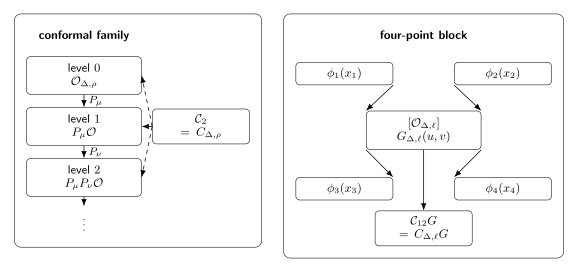
A conformal family is generated from one primary by repeated action of . The quadratic Casimir has the same eigenvalue on every descendant. In a four-point function, the conformal block is the contribution of the whole family and solves a Casimir eigenvalue equation.
Families, multiplets, and modules
Section titled “Families, multiplets, and modules”The words family, multiplet, and representation are often used almost interchangeably. The distinction is mostly one of viewpoint.
| language | meaning |
|---|---|
| conformal representation | the abstract representation of the conformal algebra |
| conformal multiplet | the states in radial quantization |
| conformal family | the corresponding local operators |
| primary | lowest-weight state, annihilated by |
| descendant | state obtained by acting with |
A generic family is called a long multiplet. At special values of , some descendant can become null. Then the physical irreducible representation is obtained by quotienting out the null submodule. This gives a short multiplet.
The previous page gave the most important examples:
and
The first is a free equation of motion. The second is a conservation equation. Both are statements about null descendants inside a conformal family.
The quadratic conformal Casimir
Section titled “The quadratic conformal Casimir”The conformal algebra is generated by
We use radial-quantization conventions with
and
The quadratic Casimir may be written as
It commutes with every conformal generator:
Equivalently, using
we can write
This second form makes the eigenvalue on a primary transparent. Since
we get
Therefore
The dilatation part gives
The rotation part gives the ordinary quadratic Casimir of the spin representation :
Thus the conformal Casimir eigenvalue is
For a symmetric traceless spin- representation,
so
This is one of the most frequently used formulas in modern CFT.
Why every descendant has the same Casimir
Section titled “Why every descendant has the same Casimir”Because commutes with , it has the same eigenvalue on descendants. If
then
The descendants have different scaling dimensions and different tensor decompositions, but they share the same conformal Casimir eigenvalue. This is exactly what it means for them to belong to one conformal representation.
Useful examples
Section titled “Useful examples”Scalar primary
Section titled “Scalar primary”For a scalar primary, is the trivial representation, so
Therefore
This is the same expression that appears in the scalar AdS mass-dimension relation,
The equality is not accidental. The scalar Laplacian on AdS is the geometric realization of the Casimir.
Conserved current
Section titled “Conserved current”For a conserved current,
Thus
This is a useful warning: the quadratic Casimir is powerful, but it is not a complete operator label. The identity representation also has , but a conserved current and the identity are obviously different representations.
Stress tensor
Section titled “Stress tensor”For the stress tensor,
Therefore
The stress-tensor family is universal in any local CFT. In AdS/CFT it is the boundary family associated with the graviton.
Large- double-trace operators
Section titled “Large-NNN double-trace operators”In a large- CFT, suppose is a scalar single-trace primary with dimension . Double-trace primaries have schematic form
with leading dimensions
Their leading Casimir eigenvalues are
These are the CFT counterparts of two-particle states in global AdS.
Shadow symmetry of the Casimir
Section titled “Shadow symmetry of the Casimir”The quadratic Casimir satisfies
Indeed,
The representation with dimension
is called the shadow representation. The Casimir equation alone cannot distinguish a block from its shadow solution. The OPE boundary condition does.
In the OPE limit , the cross-ratio
goes to zero. A physical block for an exchanged operator of dimension behaves as
The shadow solution behaves instead as
Thus
The OPE sums over families
Section titled “The OPE sums over families”The operator product expansion does not merely sum over primary operators. It sums over conformal families. For two scalar primaries,
The sum is over primary operators . Once the primary and coefficient are specified, conformal symmetry fixes the relative coefficients of all descendants.
This is why the data of a CFT can be listed as
rather than as an infinite list of unrelated derivative operators.
Conformal blocks as family contributions
Section titled “Conformal blocks as family contributions”Consider a four-point function of scalar primaries. Conformal symmetry lets us write it as a kinematic prefactor times a function of cross-ratios:
where
In the OPE channel,
The function is the conformal block for the family .
A conformal block is therefore
It is the complete contribution of one conformal family.
The Casimir equation for blocks
Section titled “The Casimir equation for blocks”Let be the conformal generators acting on the point . The total generator acting on the pair is
The corresponding quadratic Casimir is
When the OPE exchanges the family , the pair transforms in the representation of . Therefore the block satisfies
This equation is the origin of the Casimir method for conformal blocks. In practice becomes a second-order differential operator in the cross-ratios , or equivalently in variables defined by
The explicit differential operator is not needed yet. The structural point is enough:
This is directly analogous to ordinary angular momentum. Spherical harmonics are eigenfunctions of the Casimir ; conformal blocks are eigenfunctions of the Casimir.
Normalization and OPE behavior
Section titled “Normalization and OPE behavior”The Casimir equation fixes the block only after choosing a normalization and imposing the physical OPE behavior. A common normalization is
For identical external scalars, the leading angular structure is often written using a Gegenbauer polynomial,
where is the angle between the two OPE pairs in the small- limit.
The conceptual content is convention-independent:
Two-dimensional comment
Section titled “Two-dimensional comment”In two dimensions, global conformal symmetry factorizes into holomorphic and antiholomorphic parts. A primary is labeled by
The global quadratic Casimirs are essentially
But two-dimensional CFT usually has the full Virasoro algebra. A global conformal family is generated by
whereas a Virasoro family is generated by
Therefore
This is why Virasoro blocks in are much richer than global conformal blocks. In AdS/CFT, this distinction becomes the statement that boundary gravitons are encoded in Virasoro descendants.
AdS/CFT checkpoint
Section titled “AdS/CFT checkpoint”The representation-theoretic picture of this page is almost the AdS/CFT dictionary in miniature.
In global , the isometry group is , the same as the boundary conformal group. A one-particle bulk state forms a lowest-weight representation:
The CFT primary corresponds to the lowest-energy bulk state:
The CFT descendants correspond to global AdS excitations:
For a scalar field,
For spinning fields, the Casimir includes the spin contribution and encodes the corresponding representation. At the level of four-point functions, the Casimir equation for a conformal block is the boundary counterpart of a bulk wave equation for an exchanged field.
This is why conformal blocks are central in holography. They are not merely convenient basis functions. They are the boundary representation-theoretic imprint of exchanging a definite AdS representation.
Common pitfalls
Section titled “Common pitfalls”Pitfall 1: thinking the primary alone is exchanged
Section titled “Pitfall 1: thinking the primary alone is exchanged”The OPE and the conformal block decomposition exchange an entire family:
The primary labels the family, but the descendants are physically present and required by symmetry.
Pitfall 2: using as a complete label
Section titled “Pitfall 2: using CΔ,ℓC_{\Delta,\ell}CΔ,ℓ as a complete label”The quadratic Casimir is not always unique. Shadow-related representations share it, and different physical operators can have the same or the same Casimir. A full CFT label includes spin representation, global-symmetry representation, degeneracy label, and OPE coefficients.
Pitfall 3: forgetting shortening
Section titled “Pitfall 3: forgetting shortening”A conserved current is not a generic spin-one family. A stress tensor is not a generic spin-two family. Conservation removes null descendants. This affects state counting, conformal blocks, and holographic interpretation.
Pitfall 4: confusing global and Virasoro families in
Section titled “Pitfall 4: confusing global and Virasoro families in d=2d=2d=2”A 2D global family is generated by and . A Virasoro family is generated by all and with . The Virasoro family is much larger.
Exercises
Section titled “Exercises”Exercise 1: Casimir eigenvalue of a scalar primary
Section titled “Exercise 1: Casimir eigenvalue of a scalar primary”Use
to compute the quadratic Casimir eigenvalue of a scalar primary of dimension .
Solution
For a scalar primary,
Therefore
and
Thus
Exercise 2: descendants have the same Casimir
Section titled “Exercise 2: descendants have the same Casimir”Suppose
Show that has the same eigenvalue.
Solution
The quadratic Casimir commutes with every conformal generator, in particular
Therefore
All descendants in one conformal family have the same quadratic Casimir eigenvalue.
Exercise 3: Casimir values for special operators
Section titled “Exercise 3: Casimir values for special operators”For a symmetric traceless spin- primary,
Compute the value for the identity operator, a conserved current , and the stress tensor .
Solution
The identity has
so
A conserved current has
Hence
The stress tensor has
Therefore
So
Exercise 4: shadow degeneracy
Section titled “Exercise 4: shadow degeneracy”Show that
Why does this not mean that and describe the same physical operator in a given CFT?
Solution
The spin term is unchanged. The dimension-dependent term obeys
Therefore
The two representations solve the same Casimir equation, but their OPE behavior differs:
The physical OPE expansion selects the behavior associated with the actual operator dimension in the spectrum. The other solution is the shadow solution.
Exercise 5: scalar mass-dimension relation in AdS
Section titled “Exercise 5: scalar mass-dimension relation in AdS”Assume a scalar bulk field in is dual to a scalar primary of dimension . Starting from
solve for .
Solution
The equation is quadratic:
Solving gives
The two roots obey
so they are a shadow pair. In standard quantization, the larger root is usually the CFT operator dimension. In the allowed alternative-quantization window, the smaller root can also define a consistent boundary operator.
Takeaway
Section titled “Takeaway”A conformal family is the complete tower generated from one primary by translations:
The quadratic Casimir labels the entire family:
and for symmetric traceless spin ,
The OPE sums over families, and a conformal block is the contribution of one family to a four-point function. The Casimir equation is the bridge between representation theory and practical calculations of conformal blocks. In AdS/CFT, the same Casimir is the group-theoretic label of the corresponding bulk representation.