
Inner Products and Conjugation
The previous page explained how radial quantization turns a local operator into a state on :
That statement is only half of the Hilbert-space story. A Hilbert space also needs an inner product. In an ordinary Hamiltonian quantization, the inner product is usually given to us from canonical quantization. In Euclidean CFT, the inner product is more subtle: it is reconstructed from Euclidean correlation functions by a reflection operation.
The key point is this:
On flat Euclidean space, radial reflection is inversion through the unit sphere,
On the cylinder, where , the same operation is simply
This page develops the inner product, the adjoint operation on local operators, the adjoints of conformal generators, and the first consequences of positivity. This is the foundation for the unitarity bounds on the next page.
Conventions for this page
Section titled “Conventions for this page”There are two common ways to write the conformal algebra. One uses Hermitian spacetime generators and therefore many explicit factors of . The other, common in conformal bootstrap and Euclidean radial quantization, absorbs those factors and writes the representation-theory algebra as
This page uses this second convention. In it, is Hermitian, and are adjoints, and the generators are anti-Hermitian:
If one instead defines Hermitian angular momentum generators
then
Nothing physical depends on this convention. What matters is the invariant statement:
The cylinder picture
Section titled “The cylinder picture”Radial quantization maps punctured Euclidean space to the cylinder:
The ket state is prepared by a path integral over the region of earlier radial time. If the quantization sphere is the unit sphere , then the ket lives inside the unit ball:
The bra state must be prepared by the reflected configuration at later radial time:
The reflection that exchanges these two regions is
Since , this is
In vector notation this is inversion through the unit sphere:
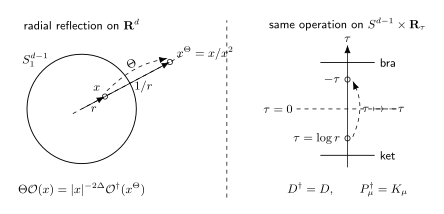
Radial conjugation. On , the reflection that turns a ket insertion into a bra insertion is inversion , mapping to . On the cylinder it is simply . For a scalar primary, radial conjugation sends to .
This is the Euclidean version of the familiar Hamiltonian statement that bras are obtained from kets by time reflection plus complex conjugation. The only novelty is that the Euclidean time coordinate is radial time.
States from insertions inside the unit sphere
Section titled “States from insertions inside the unit sphere”Let be a collection of local operator insertions inside the unit ball. For example,
Radial quantization interprets this collection as a state on the unit sphere:
If a Lagrangian description exists, this state is represented by the path integral over the unit ball with the insertions included. If no Lagrangian description is available, the same state is characterized abstractly by its correlation functions with all operators outside the sphere.
The inner product of two such states should be computed by gluing a reflected bra configuration outside the unit sphere to a ket configuration inside the unit sphere. Thus, for two insertion collections and ,
Here is an anti-linear operation: it complex-conjugates coefficients and reflects each operator insertion by inversion.
This equation is the basic definition of the radial inner product.
Radial reflection positivity
Section titled “Radial reflection positivity”The condition that the Euclidean theory describes a unitary Lorentzian theory is not just conformal invariance. It is also reflection positivity.
In radial quantization, reflection positivity says that for every collection of insertions inside the unit ball,
Equivalently,
This is the Euclidean origin of Hilbert-space positivity.
The positivity condition is powerful because can be any finite linear combination of local operator insertions. For example,
Then reflection positivity implies
Thus the matrix
must be positive semidefinite. This simple statement becomes, after expanding in conformal families, the positivity input used in the conformal bootstrap.
A Euclidean CFT can obey all conformal Ward identities and crossing equations but fail reflection positivity. Such a theory is nonunitary. The Yang-Lee edge singularity is a famous two-dimensional example of a useful nonunitary CFT. For AdS/CFT preparation, however, the unitary case is the main one: a positive CFT Hilbert space is the boundary avatar of a ghost-free bulk quantum theory.
Conjugating scalar primaries
Section titled “Conjugating scalar primaries”Let be a scalar primary of dimension . Under inversion,
the Weyl factor is
A scalar primary transforms with one factor of . Therefore the radial Hermitian conjugate of a scalar primary is
When is Hermitian as an internal operator, , this becomes
The subscript “rad” is often omitted, but it is conceptually important. The operation is not merely ordinary complex conjugation. It includes inversion.
The formula is easy to remember from the special case . The ket is
The bra must be an insertion at infinity:
This is exactly the formula already anticipated on the previous page.
Inner products from two-point functions
Section titled “Inner products from two-point functions”Suppose and are scalar primaries with dimensions and . Their flat-space two-point function has the form
where is a Hermitian matrix within the subspace of operators having the same quantum numbers and the same dimension. The radial inner product is
Therefore
In a unitary CFT, is positive semidefinite. After quotienting out possible null states, one can choose an orthonormal basis of primaries:
In this basis, the scalar two-point function is usually normalized as
This normalization is not just cosmetic. It is the normalization in which OPE coefficients become physical structure constants, and in which positivity of conformal block expansions becomes transparent.
Conjugating spinning primaries
Section titled “Conjugating spinning primaries”For spinning primaries, inversion also rotates tensor indices. The relevant matrix is the inversion tensor
It satisfies
For a symmetric traceless spin- primary of dimension , radial conjugation gives schematically
This is the higher-dimensional version of the familiar two-dimensional rule that a primary field with weights acquires powers of the conformal Jacobian under radial conjugation.
A convenient way to package spinning operators is to contract them with a null polarization vector :
Then the conjugation rule can be written by reflecting the polarization as well:
This is why the inversion tensor appeared earlier in the page on spinning correlators. It is not a random tensor structure; it is the tensorial part of conformal inversion, and therefore it is built into the radial inner product for spinning states.
Adjoint of the conformal generators
Section titled “Adjoint of the conformal generators”The radial inner product determines the adjoint operation on the conformal algebra. Since generates translations in cylinder time , it is the cylinder Hamiltonian:
A unitary theory must have
Rotations act within each sphere , so they are unitary symmetries of the spatial slice. In the no-explicit- convention used here,
Equivalently, the Hermitian angular momenta are .
The most important relation is
There are several ways to see this.
First, raises the cylinder energy because
while lowers it because
In a Hilbert space with a Hermitian Hamiltonian, energy-raising and energy-lowering operators should be adjoints.
Second, inversion exchanges translations and special conformal transformations. A special conformal transformation is precisely
Since radial Hermitian conjugation includes inversion, it maps to .
Third, on the cylinder, radial reflection sends
A generator with -weight is reflected into a generator with -weight . Thus and are exchanged.
This adjoint relation is the algebraic engine behind unitarity bounds. Norms of descendants are computed by moving every from the ket to a acting on the bra, and then using the conformal algebra.
Primary states and descendants revisited
Section titled “Primary states and descendants revisited”A primary state obeys
and
Descendants are obtained by acting with :
Their norms are not arbitrary. They are fixed by the algebra and the norm of the primary.
For a scalar primary, the first descendant has norm
Since
we may replace by the commutator:
For a scalar primary, . Therefore
So
If the primary has positive norm, positivity of the first descendants implies
This is only the first, weakest scalar constraint. The stronger scalar unitarity bound
for nontrivial scalar primaries comes from analyzing level-two descendants. That is the subject of the next page. The important lesson here is already visible: unitarity bounds are not mysterious dynamical inequalities. They are positivity of Gram matrices in radial quantization.
Gram matrices and null states
Section titled “Gram matrices and null states”At each descendant level, one can form a Gram matrix of inner products. For example, at level one above a scalar primary, the descendant basis is
The Gram matrix is
At level two, the natural descendants are
They decompose under rotations into symmetric traceless, vector, and scalar pieces, depending on the spin of the primary. Positivity of all these pieces gives sharper bounds.
A null state is a nonzero-looking descendant whose norm is zero. In a unitary theory, null states are orthogonal to all states and must be quotiented out. Physically, null states usually signal a shortening condition:
For example, a conserved current satisfies
In radial quantization, this means that a particular descendant of is null. The stress tensor similarly satisfies
which is a shortening condition for the stress-tensor multiplet.
In AdS/CFT, these shortening conditions are boundary shadows of bulk gauge invariances. A conserved current is dual to a bulk gauge field, and the stress tensor is dual to the graviton.
BPZ conjugation in two-dimensional CFT
Section titled “BPZ conjugation in two-dimensional CFT”In two-dimensional CFT, radial conjugation is often called BPZ conjugation, after Belavin, Polyakov, and Zamolodchikov. On the plane, radial reflection maps
For a primary field of weights , the conjugation rule has the schematic form
with convention-dependent phases for fields with spin. For scalar fields, where , this reduces to
The Virasoro modes obey
This is the two-dimensional version of
Indeed, in two dimensions the global conformal generators are embedded in the Virasoro algebra as
The translation generator is represented by , and the special conformal generator by . The BPZ adjoint relation
is exactly the same idea.
Positivity of OPE coefficients
Section titled “Positivity of OPE coefficients”Reflection positivity also explains why unitary conformal block expansions have positive coefficients.
Take a Hermitian scalar primary with two-point function normalized as
Consider the OPE
If the exchanged primary basis is orthonormal, then the contribution of each conformal family to the four-point function is proportional to
For identical Hermitian scalars in a unitary CFT, these coefficients are nonnegative:
This positivity is not a decorative detail. It is the reason the numerical conformal bootstrap can turn crossing symmetry into rigorous inequalities. Crossing symmetry alone says that different OPE decompositions agree. Reflection positivity says the coefficients in the decomposition have definite signs.
Euclidean versus Lorentzian unitarity
Section titled “Euclidean versus Lorentzian unitarity”Reflection positivity is a Euclidean condition. Lorentzian unitarity is the statement that the Hilbert space has positive norm and that time evolution is unitary.
The bridge between them is analytic continuation. Roughly speaking:
In ordinary Euclidean QFT this is part of the Osterwalder-Schrader reconstruction logic. In CFT, radial quantization gives a particularly geometric realization: the reflection surface is , the Euclidean time is , and the Hamiltonian is .
This is why dimensions of local operators in a unitary CFT are real. They are eigenvalues of a Hermitian operator:
If the theory is unitary, then has a real spectrum. If the vacuum is the lowest-energy state on the cylinder, then nontrivial operators have nonnegative dimensions, and more detailed descendant positivity gives the familiar unitarity bounds.
Contact terms and coincident points
Section titled “Contact terms and coincident points”The inner product formulas above are cleanest when operator insertions are separated. Coincident points require regularization and contact terms. This is not a failure of the formalism; it is the usual local nature of QFT.
For example, the stress tensor has contact terms in Ward identities. Conserved currents have contact terms when their Ward identity surface crosses charged operators. Composite operators may mix with other operators of the same quantum numbers and dimension.
The radial Hilbert-space prescription avoids most confusion by keeping the reflection surface away from all insertions. One first defines states by insertions strictly inside the unit sphere and bras by reflected insertions strictly outside. Only after the correlator is well-defined should one take limits such as or .
This is also good practice in AdS/CFT. Boundary correlators often have contact-term ambiguities, but separated-point correlators and their conformal data are unambiguous.
AdS/CFT checkpoint
Section titled “AdS/CFT checkpoint”The radial inner product is the CFT-side origin of bulk unitarity.
In global AdS/CFT, the CFT Hilbert space on is identified with the Hilbert space of quantum gravity in global . The CFT dilatation operator is the global AdS Hamiltonian:
Therefore:
Short multiplets are especially important holographically. A conserved current multiplet has a null descendant and is dual to a bulk gauge field. The stress tensor multiplet is dual to the graviton. In supersymmetric examples, BPS shortening produces protected operator dimensions, which become protected masses or charges in the bulk.
Thus reflection positivity is not a minor Euclidean axiom. It is the boundary consistency condition behind a healthy bulk Hilbert space.
Summary
Section titled “Summary”Radial quantization defines the CFT Hilbert space on . The inner product is obtained by reflecting ket insertions through the unit sphere and evaluating the resulting Euclidean correlator:
For scalar primaries,
For spinning primaries, inversion tensors act on the indices. The conformal generators obey
in the no-explicit- convention. Reflection positivity implies positive Gram matrices of states and descendants. These positivity constraints lead directly to unitarity bounds and to positive conformal block coefficients.
For AdS/CFT, this structure is indispensable: it is how the CFT knows about a positive-norm bulk Hilbert space and real global AdS energies.
Exercises
Section titled “Exercises”Exercise 1 — Radial conjugation of a scalar primary
Section titled “Exercise 1 — Radial conjugation of a scalar primary”Let be a Hermitian scalar primary of dimension . Show that the radial conjugate of is
Explain why the factor is needed.
Solution
Radial reflection sends
This is a conformal transformation. Its local scale factor is
Thus the Weyl factor is
A scalar primary of dimension transforms with a factor , so inversion gives
Hermitian conjugation also complex-conjugates the operator. If is Hermitian, then , and therefore
The factor is required because inversion is not an isometry of flat space. It is a conformal transformation with a position-dependent scale factor.
Exercise 2 — Bra state from an insertion at infinity
Section titled “Exercise 2 — Bra state from an insertion at infinity”Starting from
show that the conjugate bra is
Then compute if
Solution
The ket insertion at the origin is reflected to infinity by radial conjugation. For a scalar primary, the correct finite bra is obtained by multiplying the large- insertion by :
Now compute the norm:
Using the two-point function,
Thus choosing gives a unit-normalized primary state.
Exercise 3 — Why
Section titled “Exercise 3 — Why Pμ†=KμP_\mu^\dagger=K_\muPμ†=Kμ”Use the radial reflection and the commutators
to explain why and must be adjoints in radial quantization.
Solution
The operator is the cylinder Hamiltonian:
The commutator
means that raises the cylinder energy by one unit. If
then
Similarly,
means that lowers the cylinder energy by one unit.
Hermitian conjugation in Euclidean time reverses time. In radial quantization, Euclidean time reversal is
Therefore an energy-raising operator is reflected into an energy-lowering operator. Since raises and lowers, radial Hermitian conjugation identifies them:
Exercise 4 — Level-one norm of a scalar descendant
Section titled “Exercise 4 — Level-one norm of a scalar descendant”Let be a scalar primary with
Using
show that
Solution
By radial conjugation,
Because , we can write
Use the commutator:
For a scalar primary,
and
Therefore
Substituting back,
Exercise 5 — Positivity of a two-operator Gram matrix
Section titled “Exercise 5 — Positivity of a two-operator Gram matrix”Let and be scalar primaries with the same dimension and the same global quantum numbers. Suppose their two-point functions are
Use reflection positivity to show that the matrix must be positive semidefinite.
Solution
Consider the state
Its norm is
The radial inner product gives
Therefore
Reflection positivity says that this must be nonnegative for all complex coefficients :
That is exactly the statement that is positive semidefinite.
Further reading
Section titled “Further reading”For two-dimensional BPZ conjugation and radial quantization, see Di Francesco, Mathieu, and Sénéchal, Chapter 6. For higher-dimensional radial quantization, reflection positivity, and unitarity bounds, see Rychkov’s CFT lectures and Simmons-Duffin’s TASI lectures. For AdS/CFT, the essential point to retain is and : these are the boundary representation-theory statements behind positive bulk energy and the raising/lowering structure of global AdS states.