
Covariant Virasoro Constraints and Bosonic Spectra
The previous page built the oscillator expansion of the free string. We now impose the Virasoro constraints quantum mechanically and read off the first bosonic string spectra.
The story has two layers. First, we build a covariant Fock space using all spacetime components of the oscillators. This keeps Lorentz symmetry manifest. Second, we impose the quantum constraints and quotient null states. The quotient is essential: the covariant Fock space contains timelike oscillators with negative norm, but the physical Hilbert space is ghost-free only at the critical intercept and dimension.
From classical constraints to physical-state conditions
Section titled “From classical constraints to physical-state conditions”Classically, conformal gauge leaves the constraints
At the quantum level the oscillator algebra is
with the same formula for . The Virasoro generators are normal-ordered quadratic operators,
and similarly for .
The matter Virasoro algebra is
and
Because positive and negative modes are adjoints, one does not impose every as an annihilation condition. The old covariant prescription is Gupta-Bleuler-like:
and
For closed strings there are two copies:
and
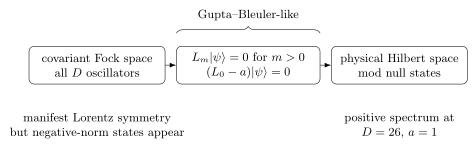
The covariant Fock space is larger than the physical Hilbert space. Positive Virasoro modes impose constraints, imposes the mass shell, and null descendants are quotiented out.
The constant is the normal-ordering intercept. In light-cone gauge one finds
The critical bosonic string has
For the moment we keep explicit. This makes clear which pieces of the spectrum are kinematic and which require the critical theory.
The Fock space and number operators
Section titled “The Fock space and number operators”The vacuum with momentum satisfies
and
For an open string, a general Fock-space state is a finite linear combination of states of the form
The number operator is
and it obeys
Thus raises the level by .
For the open string,
The condition gives
Since ,
For the closed string,
The two mass-shell equations imply
and hence
This is the level-matching condition.
The first open-string levels
Section titled “The first open-string levels”At level the state is the oscillator vacuum,
Its mass is
For the critical bosonic string , so
This is the open-string tachyon. It is not a particle moving faster than light; it is a signal that the perturbative bosonic-string vacuum is unstable.
At level , the general state is
Its mass is
For , this state is massless. The condition gives transversality. Using
we find
Thus
A polarization proportional to is null, because
Therefore
and the massless vector has physical polarizations.
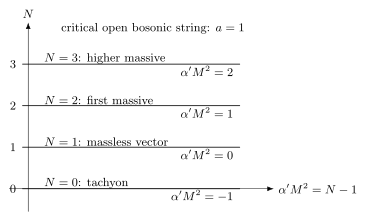
For the critical open bosonic string, . The ground state is tachyonic, level is a massless vector, and level is the first massive level.
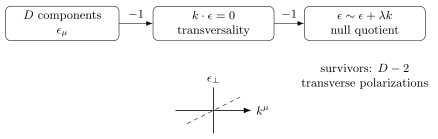
The covariant vector starts with components. The constraint removes one component, and the null equivalence removes another, leaving transverse polarizations.
At level , the general open-string state may be written
where is symmetric. The mass is
For ,
The conditions and relate and . After quotienting null states, the physical states form a massive spin-two representation. In the number of physical states at this level is
which equals the dimension of the traceless symmetric tensor representation of the massive little group :
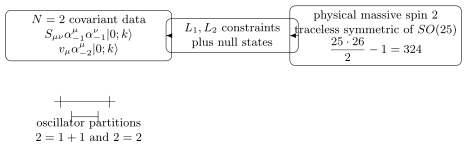
At level , the oscillator partitions give tensor and vector covariant data. The constraints and null states combine them into the physical massive spin-two representation.
Negative-norm states and the no-ghost structure
Section titled “Negative-norm states and the no-ghost structure”Covariant quantization keeps all spacetime components of . This makes Lorentz symmetry manifest, but because
some covariant Fock-space states have negative norm. For example,
The Virasoro constraints remove the timelike and longitudinal excitations, while null states are quotiented out. This is analogous to covariant quantization of electrodynamics, but substantially more delicate because the constraints form the infinite-dimensional Virasoro algebra.
The no-ghost theorem says that the physical Hilbert space of the bosonic string has nonnegative norm for
and the critical, Lorentz-invariant theory is
Light-cone quantization will make the positive-norm transverse spectrum manifest and will also explain why these critical values are forced.
The closed-string spectrum
Section titled “The closed-string spectrum”Closed strings have two independent oscillator towers. A general state is built by acting with both left- and right-moving creation operators:
The number operators are
The physical-state conditions imply
At , the critical closed bosonic string has
This is the closed-string tachyon.
At the first matched excited level,
we have
For this state is massless:
The polarization tensor decomposes into symmetric traceless, antisymmetric, and trace parts:
These are interpreted as
respectively: the graviton, antisymmetric two-form, and dilaton. The clean physical decomposition is made after imposing transversality and quotienting gauge redundancies, but the covariant tensor structure already reveals the key result: a consistent closed string contains a massless spin-two state.
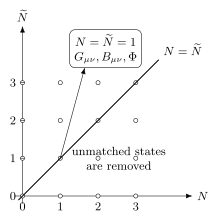
Closed-string states carry a left level and a right level . Physical states obey . The first matched excited level gives , , and .
Leading Regge trajectories
Section titled “Leading Regge trajectories”The oscillator spectrum also explains the approximately linear Regge behavior that motivated string theory.
For the open string, the leading trajectory at level is represented by
It has maximal spin
and mass formula
Therefore
For the critical bosonic string,
For the closed string, the leading trajectory uses matched left and right level :
The maximal spin is
while
Hence
For ,
The closed-string trajectory has half the slope of the open-string trajectory, and its massless spin-two state is the graviton.
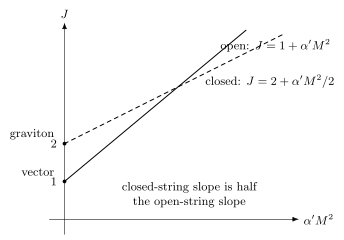
For , the leading open trajectory is , while the leading closed trajectory is . The closed-string slope is half the open-string slope.
Summary
Section titled “Summary”The covariant bosonic spectra are controlled by four equations:
At the critical values and , the open string contains a massless vector at level , while the closed string contains the massless graviton, two-form, and dilaton at . The next page derives the same spectrum in light-cone gauge, where only transverse oscillators appear.
Exercises
Section titled “Exercises”Exercise 1: Why not impose all strongly?
Section titled “Exercise 1: Why not impose all LnL_nLn strongly?”Explain why the quantum theory imposes
rather than demanding for every .
Solution
The modes satisfy
Thus positive and negative modes are adjoints. If both and were imposed as annihilation constraints for all , the Hilbert space would be overconstrained. The Virasoro algebra also contains a central term,
so the quantum constraints are not identical to the classical constraints as strong operator equations. The correct old-covariant prescription is Gupta-Bleuler-like: impose the positive modes and the shifted condition, then quotient null states.
Exercise 2: Open-string mass formula
Section titled “Exercise 2: Open-string mass formula”Derive
from
Solution
The physical-state condition gives
Since , this becomes
Therefore
Exercise 3: Transversality of the massless vector
Section titled “Exercise 3: Transversality of the massless vector”Let
Show that implies .
Solution
Use
For and ,
Since ,
For the open string,
Therefore
The physical-state condition gives .
Exercise 4: A negative-norm oscillator
Section titled “Exercise 4: A negative-norm oscillator”Assume . Show that has negative norm.
Solution
The norm is
Since , this equals
The oscillator algebra gives
Thus the norm is .
Exercise 5: Closed-string level matching
Section titled “Exercise 5: Closed-string level matching”Use
to derive .
Solution
For a closed string,
The two physical-state conditions are
and
Subtracting gives
Thus .
Exercise 6: Open and closed Regge slopes
Section titled “Exercise 6: Open and closed Regge slopes”Assume . For the leading open trajectory use and . For the leading closed trajectory use and . Derive both trajectories.
Solution
For the open string,
Thus
so
For the closed string,
Hence
and
The closed-string slope is half the open-string slope.