
One-Loop Strings, Tori, and Modular Invariance
At tree level, a closed string sweeps out a sphere and an open string sweeps out a disk. At one loop, the basic closed-string worldsheet is a torus. This is the first place where a striking new feature of string theory becomes visible: the one-loop integral is not over Schwinger proper times from zero to infinity, as in ordinary field theory. It is over the moduli space of tori, and the small-proper-time region is removed by modular invariance.
That statement is often summarized as “strings have no one-loop ultraviolet divergence.” The slogan is correct, but it is worth understanding precisely what it means. Modular invariance does not say that every string amplitude is finite. It says that the would-be ultraviolet region of the torus is gauge-equivalent to another region already counted. The only boundary of the genus-one moduli space is the long-tube cusp, and that boundary has the interpretation of infrared propagation of physical closed-string states. Tachyons or massless tadpoles can still cause divergences, but they are infrared divergences.
The goal of this page is to make that mechanism explicit, first for bosonic strings and then for RNS superstrings. The essential ingredients are:
- the torus modulus ;
- the modular group acting on ;
- the invariant measure ;
- the CFT trace ;
- the Dedekind eta function and theta functions;
- the sum over spin structures required by the GSO projection.
The torus as a complex worldsheet
Section titled “The torus as a complex worldsheet”A Euclidean torus can be represented as the complex plane quotiented by a lattice:
Equivalently, introduce a complex coordinate with the identifications
The two independent one-cycles are conventionally called the -cycle and the -cycle. In the parallelogram picture, the -cycle is generated by , and the -cycle is generated by .
The parameter is the complex structure modulus of the torus. It is not merely a metric parameter. In two-dimensional conformal field theory, Weyl rescalings remove the local scale of the metric, but they cannot remove the shape of the torus. For a genus-one worldsheet, the remaining shape parameter is precisely .
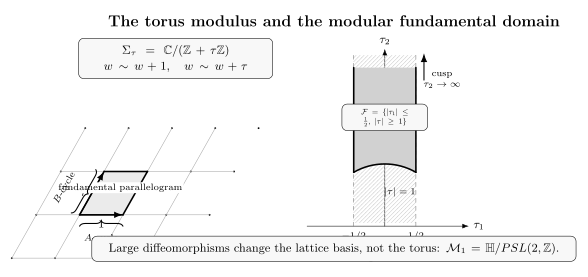
A torus is specified by a lattice basis , but different bases can describe the same lattice. The modular fundamental domain chooses one representative of each equivalence class.
A change of lattice basis gives the same torus. Take two new primitive cycles
The corresponding modulus is
The matrices act identically on , so the group is
It is generated by the two transformations
The transformation changes the -cycle by adding the -cycle. The transformation exchanges the two cycles, up to orientation. These are large diffeomorphisms of the worldsheet: they are gauge symmetries, not physical transformations that create new tori.
A standard fundamental domain is
The vertical sides are identified by , and the circular arcs are identified by . This region has only one noncompact end: the cusp .
The invariant measure
Section titled “The invariant measure”The upper-half-plane metric
is invariant under . Consequently the natural modular-invariant measure is
Indeed, for
one has
so
This simple formula is one of the main reasons the one-loop string amplitude is conceptually cleaner than a generic field-theory loop integral. The integration is over a quotient space,
and is a convenient representative of that quotient.
Field-theory proper time versus string modulus
Section titled “Field-theory proper time versus string modulus”In ordinary quantum field theory, the one-loop vacuum amplitude of a scalar field can be written using Schwinger proper time:
In flat spacetime dimensions this gives, per spacetime volume,
The region is the ultraviolet region: a virtual particle propagates for very short proper time, so large momenta dominate the loop.
For a closed string, the analogous trace is not over a particle Hilbert space but over the Hilbert space of a two-dimensional CFT. Let
The torus partition function of a CFT with central charges is
Equivalently,
where
For a consistent closed-string theory one usually has , and the integral over enforces level matching in the long-cylinder channel:
Thus plays the role of proper time, while is the twist inserted before gluing the two ends of the cylinder to make a torus.
The crucial difference from field theory is that string theory does not integrate over the full strip
That strip overcounts physically identical tori. The correct integration region is the modular fundamental domain .
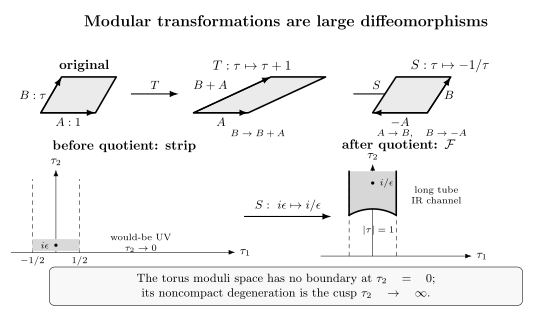
The modular transformations and change the lattice basis. In particular, maps a short Euclidean proper time to a long one, so the apparent ultraviolet region is not a boundary of moduli space.
The free boson and the Dedekind eta function
Section titled “The free boson and the Dedekind eta function”For one noncompact scalar on the torus, the partition function is the product of the zero-mode integral and the oscillator determinant. With the standard string normalization,
up to the infinite spacetime-volume factor associated with the center-of-mass zero mode.
The Dedekind eta function is
Its two basic modular transformations are
The zero-mode factor is not decoration: it is exactly what makes the noncompact scalar partition function modular invariant. Under , one has
and therefore
This is a useful sanity check: a single free scalar CFT is a modular-invariant theory on the torus once its zero modes are included.
The bosonic string torus amplitude
Section titled “The bosonic string torus amplitude”For the critical closed bosonic string, the matter fields are free scalars, and the conformal ghosts contribute the determinant of the system. In a conventional normalization, suppressing an overall sign and numerical constants, the genus-one vacuum amplitude is
Equivalently,
The factor comes from the noncompact zero modes. The factor from the matter oscillators is reduced to by the ghosts, which cancel two longitudinal oscillator directions. The extra factor of is also part of the ghost zero-mode and gauge-fixing normalization. The net integrand multiplying has modular weight zero.
At the cusp,
The exponential growth is the closed-string tachyon. Since the cusp is a long tube, this divergence is an infrared divergence caused by the propagation of a tachyonic spacetime state. It is not a short-distance divergence on the worldsheet.
This distinction is essential. Modular invariance removes the region that would have been interpreted as ultraviolet in the Schwinger strip, but it does not cure an unstable vacuum. Bosonic string theory remains unstable because of the tachyon.
Why the ultraviolet region is absent
Section titled “Why the ultraviolet region is absent”The usual strip contains points with arbitrarily small . But a torus with small is not necessarily a new torus. For example, the transformation gives
Thus a very short cylinder with modulus is equivalent to a very long cylinder with modulus . In field theory these would be distinct proper times. In string theory they are the same point in moduli space.
The geometry of the fundamental domain makes this vivid:
There is no path inside to . The smallest possible value of in is , reached at the two corners and .
By contrast, the cusp remains. In that limit the torus degenerates into a long thin tube, and the amplitude factorizes into a sum over closed-string states propagating for a long proper time:
That is exactly the form of an infrared propagation amplitude. Massless states may produce power-law divergences if tadpoles are present; tachyons produce exponential divergences. Supersymmetric flat ten-dimensional vacua avoid both the tachyon and the one-loop cosmological constant.
Fermions on the torus and spin structures
Section titled “Fermions on the torus and spin structures”For RNS strings, the worldsheet fermions require an additional choice: their boundary conditions around the two cycles of the torus. These choices are called spin structures.
Let . A convenient convention is
With this convention, means antiperiodic boundary condition around the -cycle, and means periodic boundary condition around the -cycle. Similarly for and the -cycle.
The four possibilities are:
The theta function with characteristics is
At , the standard functions are
For one complex chiral fermion, the oscillator partition function in a given even spin structure is
The odd spin structure has fermion zero modes, so its vacuum partition function vanishes unless enough fermion insertions are present to soak up the zero modes.
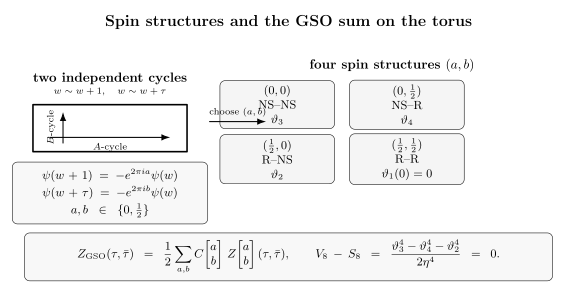
The four spin structures specify NS or R boundary conditions around the two cycles. Modular transformations mix the spin structures, so a consistent superstring vacuum amplitude is a GSO-weighted sum over them.
The important point is that modular transformations do not preserve each spin structure individually. They permute them, up to phases. Therefore a superstring amplitude with a fixed spin structure is not a complete answer. The GSO projection is equivalently a modular-invariant sum over spin structures.
The GSO sum and type II modular invariance
Section titled “The GSO sum and type II modular invariance”In light-cone gauge, the transverse RNS matter consists of eight bosons and eight fermions. It is useful to organize the chiral fermion contribution in terms of the level-one characters
Since , one has as functions, but it is still useful to distinguish them because they correspond to opposite spacetime chiralities.
The chiral GSO projection of the supersymmetric type II string produces the combination
Jacobi’s abstruse identity says
Thus the one-loop type II vacuum amplitude vanishes in flat spacetime. Schematically,
For type IIA, the right-moving Ramond chirality is opposite, so the right-moving character is conventionally written with rather than :
The vanishing is a consequence of spacetime supersymmetry: bosonic and fermionic physical states cancel level by level in the one-loop vacuum energy. But the deeper consistency condition is modular invariance. The phases in the spin-structure sum are not optional signs; they are fixed by the requirement that the full integrand be well-defined on moduli space.
What modular invariance teaches us
Section titled “What modular invariance teaches us”The one-loop torus amplitude packages several foundational ideas into one formula.
First, the worldsheet theory must be a consistent CFT on every Riemann surface, not only on the plane. On the torus this means that the partition function must be modular invariant.
Second, the physical closed-string spectrum is constrained by level matching. The dependence of the trace keeps track of , and modular invariance ties this projection to the geometry of the torus.
Third, ultraviolet behavior in string theory is intrinsically different from ultraviolet behavior in particle theory. The would-be short-proper-time region is gauge-equivalent to a long-proper-time region. The remaining degeneration is infrared propagation of actual string states.
Fourth, in the RNS formalism, the GSO projection is not merely a trick for removing tachyons. It is the spin-structure sum that makes the superstring path integral modular invariant and gives spacetime supersymmetry.
This is why the torus is such a central object. It is the first place where the consistency of the worldsheet CFT, spacetime spectrum, absence of ultraviolet overcounting, and spacetime supersymmetry all meet.
Exercises
Section titled “Exercises”Exercise 1: Invariance of the modular measure
Section titled “Exercise 1: Invariance of the modular measure”Let
Show that
Solution
Differentiate the fractional linear transformation:
Therefore
Also,
Hence
Exercise 2: The scalar partition function under
Section titled “Exercise 2: The scalar partition function under SSS”Using
show that
is invariant under .
Solution
Under ,
Thus
The zero-mode factor is essential for this cancellation.
Exercise 3: Modular invariance of the critical bosonic integrand
Section titled “Exercise 3: Modular invariance of the critical bosonic integrand”Ignoring constants and spacetime volume, the matter-plus-ghost factor in the critical bosonic string is
Show that it is invariant under .
Solution
Under , one has
while
Multiplying the two transformations gives
Since the measure is also invariant, the full integrand is invariant under . Invariance under follows because the phase of cancels between holomorphic and antiholomorphic factors.
Exercise 4: Why the torus has no one-loop UV boundary
Section titled “Exercise 4: Why the torus has no one-loop UV boundary”Explain why the region in the strip is not a boundary of the torus moduli space.
Solution
The strip
does not yet quotient by the full modular group. Points in this strip related by describe the same torus. For example,
Thus a torus that looks like a very short cylinder is equivalent to one that looks like a very long cylinder with a different choice of cycles. The fundamental domain removes this overcounting and obeys . Therefore is not a boundary of moduli space. The only noncompact boundary is the cusp , which is an infrared degeneration.
Exercise 5: The odd spin structure
Section titled “Exercise 5: The odd spin structure”Using the convention
identify which spin structure has periodic boundary conditions around both cycles. Why does its vacuum partition function vanish for free fermions?
Solution
Periodic boundary condition around the -cycle requires
so . Periodic boundary condition around the -cycle similarly gives . Thus the doubly periodic spin structure is
It corresponds to , which vanishes:
Physically, doubly periodic fermions have zero modes. In a Grassmann path integral, integration over unsaturated fermion zero modes gives zero. Correlators in the odd spin structure can be nonzero only if enough fermionic insertions are included to soak up the zero modes.
Exercise 6: Jacobi’s identity and the type II vacuum amplitude
Section titled “Exercise 6: Jacobi’s identity and the type II vacuum amplitude”The chiral supersymmetric character is
Use Jacobi’s abstruse identity to explain why the flat-space type II one-loop cosmological constant vanishes.
Solution
Jacobi’s abstruse identity is
Therefore
The type IIB torus integrand contains
while type IIA contains
Since as theta-function combinations at zero argument, the chiral factor vanishes in either case. This is the worldsheet expression of spacetime supersymmetry: bosonic and fermionic states cancel level by level in the one-loop vacuum energy.