
Thermal Field Theory and Euclidean Time
Why finite temperature is the next natural step
Section titled “Why finite temperature is the next natural step”The zero-temperature dictionary teaches us to compute vacuum correlators of a CFT from a bulk path integral with prescribed boundary sources. Finite temperature asks for the same kind of object, but in a different state. Instead of the vacuum state , we use a density matrix
This one line is the entrance to black-hole physics in AdS/CFT. The trace is the reason Euclidean time becomes a circle. The Boltzmann factor is Euclidean time evolution by length . The periodic identification of initial and final states is the trace. Therefore thermal QFT on a spatial manifold is naturally formulated on
On the gravity side, the same boundary manifold becomes the conformal boundary of a Euclidean bulk geometry. At large and strong coupling, the CFT partition function is approximated by a sum over smooth classical bulk saddles with that boundary:
This is the conceptual bridge from thermal field theory to Euclidean AdS black holes. The same thermal circle that appears from the trace in the CFT becomes the Euclidean time circle that may or may not smoothly cap off in the bulk.
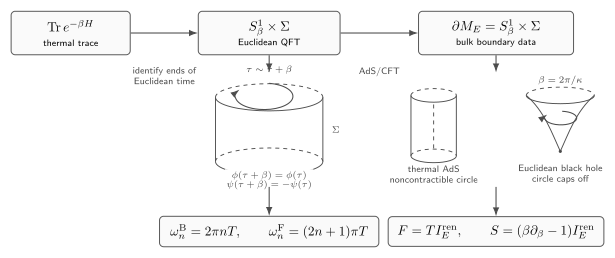
A thermal trace turns Euclidean time into a circle . Bosons are periodic, fermions are anti-periodic, and energies become Matsubara frequencies. In holography the same is the conformal boundary of Euclidean bulk saddles; a black-hole saddle is smooth only for the correct relation between and the surface gravity.
The slogan is useful only if we keep it precise:
finite temperature does not automatically mean “put a black hole in the bulk”; it means “put the CFT on a thermal Euclidean circle and sum over the allowed bulk fillings.”
The black hole is one possible filling. It dominates only in the appropriate ensemble and temperature regime.
The thermal ensemble
Section titled “The thermal ensemble”For a quantum system with Hamiltonian , the canonical ensemble is
and a thermal expectation value is
In a QFT on a spatial manifold , one should write more carefully
The thermodynamic quantities follow from :
Equivalently,
If has volume , define the free-energy density and pressure
For a translationally invariant thermal state, the Lorentzian stress tensor takes the perfect-fluid equilibrium form
where . A flat-space CFT has vanishing stress-tensor trace away from anomalies, so
Scale invariance then implies
where is a theory-dependent number. In a strongly coupled large- CFT with an Einstein-gravity dual, is proportional to the number of degrees of freedom, typically or .
On a compact spatial manifold such as , there is an additional scale, the radius . The partition function is then a function of the dimensionless combination , and vacuum Casimir energy can contribute. This distinction matters for the Hawking-Page transition: the CFT on has a finite-volume thermal partition function, while the planar black brane describes the thermodynamic limit on .
From the trace to a Euclidean path integral
Section titled “From the trace to a Euclidean path integral”The operator is time evolution by imaginary time. In Lorentzian signature,
Set
Then
For a bosonic quantum-mechanical coordinate , the transition amplitude has a Euclidean path-integral representation
Taking the trace sets and integrates over the common value:
The same logic applies to quantum fields. A finite-temperature bosonic field theory is a Euclidean field theory on
with bosonic fields obeying
Fermions obey antiperiodic boundary conditions,
The minus sign is not optional. It comes from the Grassmann coherent-state trace and is also required by the spin-statistics structure of thermal equilibrium. It is the reason finite temperature explicitly breaks supersymmetry: bosons and fermions cannot both be placed in the same thermal boundary condition around .
Thus the thermal partition function is schematically
For a CFT, should be understood as a Euclidean conformal manifold. In holography the boundary metric is specified only up to Weyl rescaling, so one fixes a representative such as
KMS condition: the operator origin of the thermal circle
Section titled “KMS condition: the operator origin of the thermal circle”The Euclidean circle is not merely a path-integral trick. It is the analytic expression of thermal equilibrium.
For two bosonic Heisenberg operators and , define
Using and cyclicity of the trace gives the Kubo-Martin-Schwinger condition
For fermionic operators, the corresponding relation includes the sign appropriate to exchanging Grassmann-odd operators. In Euclidean time this becomes antiperiodicity.
The Euclidean time-ordered correlator is
For bosonic operators it is periodic,
while for fermionic operators it is antiperiodic. More generally, thermal correlators are analytic in strips of complex time, with KMS relations specifying how boundary values on opposite sides of the strip are glued. This analytic structure is what allows equilibrium Euclidean correlators to be related to Lorentzian response functions, although the continuation is much subtler than replacing by in every formula.
Matsubara frequencies
Section titled “Matsubara frequencies”Because Euclidean time is compact, Fourier modes along are discrete. A periodic bosonic field has the expansion
An antiperiodic fermion has
These are the bosonic and fermionic Matsubara frequencies. They are the momentum eigenvalues around the thermal circle.
A thermal Euclidean two-point function can be represented as
for bosonic operators, with the appropriate fermionic frequencies for fermionic operators.
The bosonic zero mode is special. At high temperature, modes with can become heavy compared with long spatial scales, leaving an effective theory in one fewer dimension. This is the field-theory origin of thermal dimensional reduction. In holography the analogous separation of scales appears in near-horizon and hydrodynamic expansions.
Euclidean correlators versus retarded correlators
Section titled “Euclidean correlators versus retarded correlators”Euclidean thermal correlators are natural for equilibrium thermodynamics. Retarded correlators are natural for response. The retarded function is
for a bosonic operator. It determines linear response and transport coefficients.
The Euclidean frequency-space correlator samples the analytic continuation of the retarded correlator at imaginary frequencies. With common conventions,
up to convention-dependent signs and contact terms. The important point is conceptual: Euclidean data live at discrete imaginary frequencies, while real-time response requires analytic continuation to real frequency.
This is usually ill-conditioned if one starts from approximate Euclidean data, as in lattice field theory. In holography the Lorentzian prescription is sharper: solve the bulk wave equation in a black-hole background with infalling boundary conditions at the horizon. The Euclidean computation and the Lorentzian computation are different continuations of the same thermal state, but they answer different questions.
A useful division of labor is:
| Quantity | Euclidean thermal path integral? | Lorentzian real-time prescription? |
|---|---|---|
| free energy | yes | usually unnecessary |
| entropy from | yes | sometimes |
| static susceptibilities | yes | yes |
| spectral density | indirectly | yes |
| diffusion constants | indirectly | yes |
| quasinormal poles | no, not directly | yes |
| chaos and OTOCs | not by ordinary Euclidean correlators | yes, with Schwinger-Keldysh structure |
This is why finite-temperature holography has two complementary calculational pillars: Euclidean saddles for thermodynamics and Lorentzian black holes for real-time dynamics.
Sources at finite temperature
Section titled “Sources at finite temperature”Thermal generating functionals are ordinary source generating functionals evaluated in a thermal state. For a scalar operator ,
The connected generating functional is
Thermal correlators are obtained by functional differentiation:
The thermal state breaks Lorentz invariance. Even in a flat-space CFT, the heat bath picks a rest-frame vector
Therefore finite-temperature one-point functions can be nonzero even when vacuum one-point functions vanish. For example, the stress tensor has and , and scalar one-point functions may be allowed if the theory has scalar primaries whose thermal expectation values are not forbidden by symmetries:
in flat space, for a scalar primary of dimension and coefficient determined by CFT data and dynamics.
For holography, the source story is unchanged but the background is thermal. A boundary scalar source fixes the leading asymptotic behavior of a bulk field on a Euclidean geometry whose boundary is . The renormalized canonical momentum gives . At large , the dominant thermal saddle determines which bulk geometry the field propagates on.
Chemical potentials as thermal twists
Section titled “Chemical potentials as thermal twists”The grand canonical ensemble is
Here is a conserved charge and is its chemical potential. The thermodynamic potential is
and
In a Euclidean path integral, a chemical potential can be represented by a constant background gauge field around the thermal circle. With the convention that a Lorentzian source is , Wick rotation gives an imaginary Euclidean component, schematically
Equivalently, one can absorb the chemical potential into twisted boundary conditions for a field of charge :
with for bosons and for fermions. For an imaginary chemical potential the twist is a phase.
The gauge-invariant object is the holonomy around the thermal circle,
not the local value of by itself. This point is crucial in holography. For a Euclidean charged black hole, the thermal circle is contractible in the interior. A smooth one-form must have trivial holonomy around a contractible cycle after accounting for allowed gauge transformations. In practical Lorentzian black-hole calculations one often chooses a gauge in which
so the chemical potential is a boundary-to-horizon potential difference, not simply an arbitrary constant added to .
Angular velocities are similar. A rotating thermal ensemble has
In Euclidean language this is a twisted identification involving both Euclidean time and angular coordinates. In the bulk it corresponds to rotating black-hole saddles with fixed angular potential at the boundary.
Gauge theory on the thermal circle
Section titled “Gauge theory on the thermal circle”Thermal gauge theory contains one more subtlety: the gauge field component along the thermal circle has a gauge-invariant holonomy. The thermal Wilson line, or Polyakov loop, is
In an gauge theory without dynamical fundamental matter, the Polyakov loop is charged under center symmetry. Its expectation value is an order parameter for confinement in suitable settings:
This statement needs care in finite volume and in theories with fundamental matter, where center symmetry may be absent or explicitly broken. But it remains one of the most useful bridges between finite-temperature gauge theory and holography. In the bulk, a Polyakov loop is represented by a fundamental string worldsheet ending on the thermal circle at the boundary. If the thermal circle is contractible in the bulk, the string worldsheet can cap off; if not, the corresponding saddle may be absent or suppressed. This is the line-operator version of the Hawking-Page confinement/deconfinement story.
Thermal boundary conditions also break supersymmetry. Even SYM is not supersymmetric at finite temperature, because fermions are antiperiodic around . This is perfectly consistent with using the theory as a controlled strongly coupled plasma: the Lagrangian is supersymmetric, but the thermal state is not.
Holographic translation table
Section titled “Holographic translation table”The finite-temperature dictionary begins with the following entries.
| Boundary thermal object | Bulk interpretation |
|---|---|
| Euclidean conformal boundary of the bulk saddle | |
| asymptotic thermal-circle period | |
| negative renormalized Euclidean on-shell action | |
| for the dominant saddle | |
| thermal entropy | horizon area term for black-hole saddles, plus corrections |
| energy and pressure | holographic stress tensor on the thermal boundary |
| chemical potential | boundary value or holonomy of a bulk gauge field |
| charge density | radial electric flux / current one-point function |
| Polyakov loop | string worldsheet ending on the thermal circle |
| KMS condition | Euclidean periodicity and thermal analyticity |
| real-time response | Lorentzian bulk fields with horizon boundary conditions |
The next page turns the entry “Euclidean bulk saddle” into an explicit geometry. In particular, smoothness near a Euclidean black-hole horizon fixes the period , producing Hawking temperature.
Common mistakes
Section titled “Common mistakes”Mistake 1: treating finite temperature as just a mass scale. Temperature is a scale, but it also chooses a state and a thermal circle. The state breaks Lorentz invariance, imposes KMS analyticity, and changes the allowed saddles.
Mistake 2: forgetting the fermion minus sign. Fermions are antiperiodic around the thermal circle. Periodic fermions compute a different object, often a supersymmetric index or a twisted partition function, not an ordinary thermal partition function.
Mistake 3: confusing Euclidean and retarded correlators. Euclidean correlators at Matsubara frequencies do not directly give spectral functions without analytic continuation. Holographic retarded correlators require Lorentzian horizon conditions.
Mistake 4: saying the bulk temperature is arbitrary. For a smooth Euclidean black-hole saddle, the period of Euclidean time is fixed by regularity at the cap. Choosing a different period creates a conical singularity unless an appropriate source or defect is inserted.
Mistake 5: treating alone as the chemical potential. In a black-hole background the physical chemical potential is the gauge-invariant potential difference between boundary and horizon, or equivalently the appropriate thermal holonomy with regularity imposed.
Mistake 6: assuming every finite-temperature saddle is a black hole. Thermal AdS and other horizonless saddles can contribute to the same boundary thermal partition function. Which saddle dominates depends on temperature, spatial topology, charges, and the ensemble.
Exercises
Section titled “Exercises”Exercise 1: The trace produces periodic bosonic fields
Section titled “Exercise 1: The trace produces periodic bosonic fields”For a quantum-mechanical coordinate , use
to explain why the Euclidean paths contributing to the partition function obey .
Solution
The transition amplitude has the Euclidean path-integral representation
Taking the trace means setting the final state equal to the initial state and integrating over it:
Thus each path begins at and ends at . Therefore
For fields, the same trace condition gives periodic bosonic field configurations on .
Exercise 2: Matsubara frequencies
Section titled “Exercise 2: Matsubara frequencies”Show that periodicity and antiperiodicity around the Euclidean thermal circle imply
Solution
A Fourier mode around the Euclidean circle is
For a periodic bosonic field,
so
Hence
For an antiperiodic fermion,
so
Therefore
Exercise 3: KMS from cyclicity
Section titled “Exercise 3: KMS from cyclicity”Let
Assume and are bosonic. Show that
Solution
Use
Then
By cyclicity of the trace,
Therefore
For fermionic operators, moving a Grassmann-odd operator around the trace gives the corresponding minus sign.
Exercise 4: Equation of state of a flat-space CFT
Section titled “Exercise 4: Equation of state of a flat-space CFT”Assume a translationally invariant thermal state of a -dimensional CFT on flat space. Use scale invariance to write . Then show that
Solution
In a flat-space CFT, the thermal pressure is the only dimension- scalar made from the temperature, so
The free-energy density is
The entropy density is
The energy density is
Since , this gives
Equivalently, this follows from tracelessness of the stress tensor:
Exercise 5: Chemical potential as a twist
Section titled “Exercise 5: Chemical potential as a twist”Consider a field of charge in the grand canonical ensemble
Explain why the chemical potential may be represented as a twist
where is for bosons and is for fermions.
Solution
The operator inserted in the trace is
when . The factor evolves the system around the Euclidean thermal circle. The extra factor acts as a charge rotation when the end of the Euclidean path is glued to the beginning.
For a field of charge ,
up to the sign convention used for the charge generator. Therefore gluing the final field to the initial field includes a factor . The ordinary thermal trace also gives the usual statistics sign, so
with for bosons and for fermions. Equivalently, the twist can be described by a constant background gauge field along the Euclidean thermal circle.
Exercise 6: Euclidean black-hole regularity preview
Section titled “Exercise 6: Euclidean black-hole regularity preview”Suppose the near-horizon Euclidean metric of a black-hole saddle takes the form
where is the cap of the Euclidean thermal circle. What period must have for the geometry to be smooth?
Solution
The two-dimensional part of the metric is
This is flat polar space if the angular coordinate is
Smoothness at requires
Therefore
so the Euclidean time period must be
The corresponding temperature is
This is the Euclidean origin of the Hawking temperature formula.
Further reading
Section titled “Further reading”For classic finite-temperature field theory, see Joseph I. Kapusta and Charles Gale, Finite-Temperature Field Theory: Principles and Applications, and Michel Le Bellac, Thermal Field Theory. For a concise hands-on treatment, see Mikko Laine and Aleksi Vuorinen, Basics of Thermal Field Theory. For the original AdS black-hole thermodynamics background, see Hawking and Page, “Thermodynamics of Black Holes in anti-De Sitter Space”. For the use of thermal AdS/CFT in confinement and phase transitions, see Witten, “Anti-de Sitter Space, Thermal Phase Transition, and Confinement in Gauge Theories”. For a broad AdS/CFT review including finite-temperature physics, see Aharony, Gubser, Maldacena, Ooguri, and Oz, Large N Field Theories, String Theory and Gravity. For real-time thermal holography, see Son and Starinets, “Minkowski-Space Correlators in AdS/CFT Correspondence”.