
The $bc$ Ghost System and Ghost Zero Modes
Conformal gauge fixes the worldsheet metric locally, but gauge fixing in a path integral is never free. The Faddeev-Popov determinant produced by fixing diffeomorphisms and Weyl transformations is represented by anticommuting fields. These are the reparameterization ghosts and .
The system has two jobs. Algebraically, it cancels the conformal anomaly of the matter fields in . Geometrically, its zero modes encode the remaining conformal Killing symmetries and the moduli of punctured Riemann surfaces. This page develops the CFT of the ghosts; the next page uses it in the Polyakov path integral.
Why ghosts appear
Section titled “Why ghosts appear”Start with the Polyakov path integral schematically:
Conformal gauge chooses a representative
Gauge fixing introduces a Jacobian. As in ordinary gauge theory, this Jacobian may be written as a path integral over anticommuting fields. The infinitesimal conformal transformation parameter becomes the ghost , while the antighost is naturally paired with deformations of the metric.
In a chiral sector, the action is the first-order system
There is an antiholomorphic copy for closed strings,
For bosonic string reparameterization ghosts,
The negative conformal weight of is not a typo. It is why has zero modes on the sphere.
The anticommuting first-order system
Section titled “The anticommuting first-order system”It is useful to study a one-parameter family of anticommuting first-order systems,
The basic OPE is
with no singular or OPEs. The fields are Grassmann odd, so their modes anticommute.
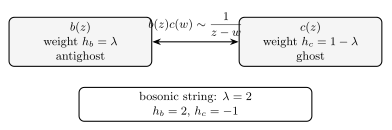
The system is a first-order anticommuting CFT. For the bosonic string, , so has weight and has weight .
The stress tensor is
It gives the primary-field OPEs
and
The central charge is
For reparameterization ghosts, , hence
For free bosons, , so the total central charge is
The condition of vanishing Weyl anomaly is therefore
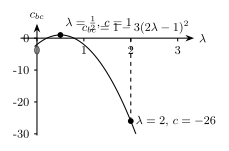
The anticommuting central charge is . The reparameterization ghost value gives .
A useful side example:
Section titled “A useful side example: λ=1/2\lambda=1/2λ=1/2”At the system has
This is equivalent to a complex chiral fermion, or two real Majorana fermions. If
then
On the Euclidean cylinder, fermions can be periodic or antiperiodic:
This is only a preview, but it explains why the NSR superstring will require spin structures.
Mode expansions and oscillator algebra
Section titled “Mode expansions and oscillator algebra”For general , the plane mode expansions are
Equivalently,
The OPE gives
The Virasoro modes follow from
A convenient normal-ordered expression is
For reparameterization ghosts, , so
and

The singular OPE is equivalent to the mode algebra . For , the three modes are associated with global conformal transformations on the sphere.
Ghost number
Section titled “Ghost number”The chiral ghost-number current is often written as
With this convention,
Ghost number is useful because string amplitudes must soak up ghost zero modes. On compact worldsheets, the ghost-number bookkeeping is tied to the geometry of conformal Killing vectors and moduli.
Ghost vacua
Section titled “Ghost vacua”Because the field has weight in the bosonic string, its vacuum structure is slightly unusual. On the open-string cylinder one often uses two ground states,
with
This two-state zero-mode system is the oscillator version of a path-integral fact: if a Grassmann zero mode appears and nothing absorbs it, the integral vanishes.
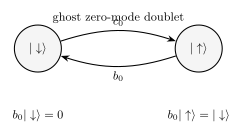
The zero modes generate a two-state ghost-vacuum structure. This is the simplest avatar of the general ghost zero-mode rule in string amplitudes.
The sphere and three zero modes
Section titled “The sphere and three ccc zero modes”On the Riemann sphere the holomorphic conformal Killing vectors are
They generate the transformations
The corresponding -ghost zero-mode part is
where the indexing follows the plane expansion . A chiral sphere correlator therefore vanishes unless it contains three insertions.
The standard normalization is
For closed strings, the antiholomorphic ghosts give
This is why sphere amplitudes are often written with three unintegrated closed-string vertices,
and the remaining vertices integrated over the sphere.
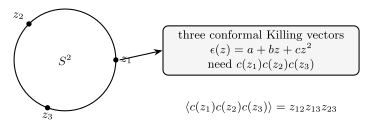
The sphere has three holomorphic conformal Killing vectors. Three insertions soak up the corresponding zero modes and are usually attached to three unintegrated vertex operators.
What to remember
Section titled “What to remember”The ghosts are the CFT representation of the Faddeev-Popov determinant for conformal gauge. For the bosonic string,
Together with free bosons, the total central charge is , so flat bosonic string theory is Weyl invariant only at . In amplitudes, ghost zero modes determine how many unintegrated vertex operators must be inserted. On the sphere, the magic number is three.
Exercises
Section titled “Exercises”Exercise 1. Weights from the ghost stress tensor
Section titled “Exercise 1. Weights from the ghost stress tensor”Verify that
makes a primary of weight and a primary of weight .
Solution
Using , contract the stress tensor with and . The singular terms are
and
These are precisely the OPEs of primaries with weights and .
Exercise 2. Central charge checks
Section titled “Exercise 2. Central charge checks”Compute for , , and .
Solution
Using
we find
and
Exercise 3. Mode algebra from the OPE
Section titled “Exercise 3. Mode algebra from the OPE”Use the contour definitions of and to derive .
Solution
Compute
The inner contour gives . Therefore
Exercise 4. Three ghosts on the sphere
Section titled “Exercise 4. Three ccc ghosts on the sphere”Use conformal invariance to determine the dependence of .
Solution
For three primary fields of weights ,
Here all three fields are ghosts with . Thus each exponent equals , and
The standard normalization sets .
Exercise 5. Why three, not two?
Section titled “Exercise 5. Why three, not two?”Explain why a sphere amplitude with only two insertions vanishes in the chiral ghost path integral.
Solution
The sphere has three holomorphic conformal Killing vectors, corresponding to three zero modes. A Grassmann integral over zero modes vanishes unless every zero mode appears once in the integrand. Two insertions can absorb at most two zero modes, leaving one unabsorbed. Hence the correlator vanishes.