
The Decoupling Limit and the AdS/CFT Dictionary
The most economical route to the AdS/CFT correspondence is not to postulate holography. It is to take the same stack of D3-branes seriously in two different low-energy descriptions and then notice that the interacting sectors left over are not allowed to be different.
Consider coincident D3-branes in type IIB string theory in ten-dimensional flat space. The D3-brane background has metric
where and
The dilaton is constant and the self-dual five-form flux carries units through the . The same object also has an open-string description: the low-energy excitations of open strings ending on the stack form four-dimensional super-Yang—Mills theory with gauge group . The interacting part is usually the theory; the overall center-of-mass multiplet decouples in flat space.
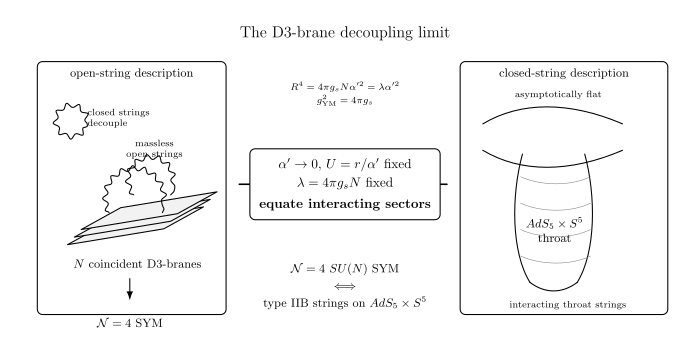
The AdS/CFT correspondence comes from equating the interacting sectors of two descriptions of the same D3-brane system. Open strings on the branes give SYM; closed strings in the near-horizon throat give type IIB string theory on .
The open-string decoupling limit
Section titled “The open-string decoupling limit”In the brane description we send
while keeping the four-dimensional gauge coupling fixed. Massive open-string states have masses of order and disappear from the low-energy spectrum. The massless open-string fields on the D3-branes remain. They are the gauge field , six adjoint scalars describing transverse brane motion, and four adjoint Weyl fermions. Together they form the vector multiplet.
With the common AdS/CFT normalization
where is the ‘t Hooft coupling. Some books use a different trace normalization for gauge generators; then factors of move between and the action. The invariant statement is that
Bulk closed strings also have massless modes, but in the limit their interaction with the brane theory disappears. The ten-dimensional Newton coupling scales as
so gravitational interactions become negligible. The open-string viewpoint therefore leaves
The free closed-string sector is not the interesting part. The interacting part is the gauge theory.
The closed-string decoupling limit
Section titled “The closed-string decoupling limit”Now look at the same D3-branes as a curved spacetime. For , the geometry is almost flat. For , the harmonic function becomes
and the metric becomes
This is with common radius . If we introduce the Poincare coordinate
then the near-horizon metric is
The conformal boundary is at , equivalently in the near-horizon coordinate system. The Poincare horizon is at , equivalently .
Why does the throat decouple from the asymptotically flat region? The key is gravitational redshift. A local excitation at radius with proper energy is measured at infinity with energy
Thus excitations deep in the throat can have finite local string-scale energy while their energy at infinity is arbitrarily small. In the low-energy limit, the asymptotically flat modes and the throat modes stop communicating efficiently. The closed-string viewpoint leaves
Since the free closed-string sector appears in both descriptions, the remaining interacting sectors must be equivalent:
with units of five-form flux through the .
The Maldacena limit
Section titled “The Maldacena limit”A sharper version of the limit keeps the energy variable
fixed as . In the near-horizon region the metric can be written as
Equivalently,
This relation is the first practical entry in the dictionary. Curvature in string units is controlled by . Therefore classical two-derivative supergravity is reliable when
String loops are controlled by , or, at fixed ,
Thus the planar limit suppresses string loops, while large suppresses corrections. A compact way to remember the regimes is
This is why the original tests of AdS/CFT often compared strongly coupled gauge theory with weakly curved classical gravity. The duality is much broader than this limit, but the supergravity corner is where calculations become most transparent.
Symmetries: why is the right answer
Section titled “Symmetries: why AdS5×S5AdS_5\times S^5AdS5×S5 is the right answer”The bosonic isometry group of is , exactly the conformal group in four-dimensional Minkowski space. The isometry group of is , exactly the R-symmetry group of SYM. Including fermionic generators, both sides have the same superconformal group,
This symmetry match is not a proof, but it is a severe consistency check. It tells us which quantum numbers bulk states must carry under the dual CFT. A field with spin on transforms under , so it is dual to an operator carrying quantum numbers. A bulk field with mass in is dual to a local operator with conformal dimension ; for a scalar,
The next page derives this relation carefully from the near-boundary wave equation. For now, the slogan is enough: bulk masses are boundary scaling dimensions.
Radial direction as energy scale
Section titled “Radial direction as energy scale”The Poincare metric
has the exact scaling symmetry
A scale transformation in the boundary theory must therefore move us in the radial direction. Small corresponds to short distances and high energies; large corresponds to long distances and low energies. Equivalently,
This is the UV/IR relation. It is one of the deepest pieces of the dictionary: locality in the radial direction is a geometric encoding of renormalization-group scale.
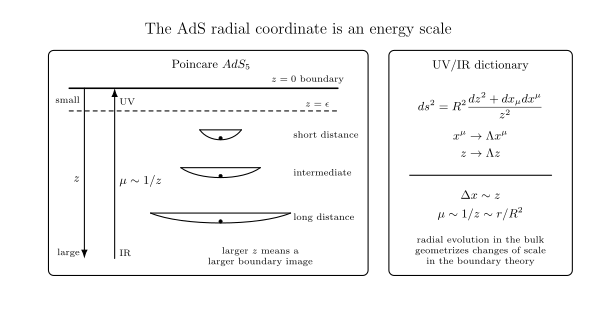
The AdS coordinate behaves like an inverse energy scale. The boundary at is the ultraviolet of the CFT; the Poincare horizon at is the infrared. In the original D3 coordinate , large is UV and small is IR.
A useful physical picture is this. A bulk object localized at radial position has boundary size of order . If it is very close to the boundary, it can affect fine-grained UV structure in the CFT. If it falls deep into the bulk, its boundary image spreads out and describes lower-energy, longer-distance physics.
The GKPW prescription
Section titled “The GKPW prescription”The most precise operational dictionary is the Gubser—Klebanov—Polyakov—Witten prescription. Let be a bulk field in whose boundary value is . The boundary value is not just a boundary condition; it is the source for a CFT operator :
The prescription is
In the classical Euclidean supergravity limit,
so the connected generating functional is obtained by evaluating the bulk action on the classical solution with prescribed boundary value:
Functional derivatives generate correlation functions:
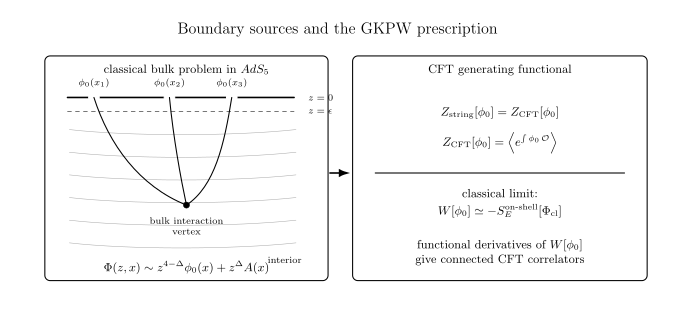
In the GKPW dictionary, a bulk field is solved with boundary value . That boundary value sources the dual CFT operator . At large and large , the string partition function is approximated by the exponential of the classical on-shell supergravity action.
The prescription should be read as a variational principle, not as a mnemonic. The bulk field determines how the source propagates into the interior; the on-shell action measures the response. The nonlocal dependence of the on-shell action on is precisely the set of CFT correlation functions.
First entries of the field/operator dictionary
Section titled “First entries of the field/operator dictionary”The source/operator rule gives the following basic correspondences:
A particularly important family of chiral primaries is schematically
These are dual to Kaluza—Klein modes on . Their protected dimensions make them ideal tests of the dictionary, because they can be compared across weak and strong coupling without renormalization ambiguities.
What the correspondence says, and what it does not simplify
Section titled “What the correspondence says, and what it does not simplify”The statement is an equality of quantum theories:
It is not merely an equality of symmetries, nor merely an approximation to large . The approximation enters only when we choose a tractable corner. In the best-controlled classical gravity regime,
Then quantum string theory reduces to classical type IIB supergravity. Outside this regime the duality remains meaningful, but the bulk side requires genuine string theory on a Ramond—Ramond background, which is much harder than the supergravity limit. Conversely, weakly coupled SYM corresponds to a highly curved string background, so ordinary supergravity is not reliable there.
This inversion of difficulty is the point. The duality turns questions about strongly coupled large- gauge theory into questions about weakly curved gravity, and questions about quantum gravity into questions about an ordinary non-gravitational quantum field theory.
Exercises
Section titled “Exercises”Exercise 1. Derive the near-horizon metric
Section titled “Exercise 1. Derive the near-horizon metric”Starting from
show that the metric is with common radius .
Solution
For ,
Substituting gives
Now set . Since ,
Thus
which is .
Exercise 2. Curvature in string units
Section titled “Exercise 2. Curvature in string units”Using and , show that . Explain why suppresses corrections.
Solution
The ‘t Hooft coupling is
Therefore
Stringy corrections to supergravity are controlled by powers of the curvature measured in string units. The curvature scale is , so the expansion parameter is roughly
Thus makes the geometry weakly curved in string units and suppresses higher-derivative corrections.
Exercise 3. The UV/IR relation from scaling
Section titled “Exercise 3. The UV/IR relation from scaling”Show that the AdS metric
is invariant under , . What does this imply about the energy scale of the dual field theory?
Solution
Under the scaling,
The numerator gains a factor , and the denominator gains the same factor. Hence is invariant.
In a conformal field theory, sends energies to . Since this same transformation sends , the radial coordinate behaves like inverse energy:
The boundary is the UV, while large is the IR.
Exercise 4. Decoupling of bulk gravity in the open-string limit
Section titled “Exercise 4. Decoupling of bulk gravity in the open-string limit”Use to explain why the gauge theory on the D3-branes decouples from dynamical ten-dimensional gravity as with fixed.
Solution
The strength of ten-dimensional gravitational interactions is controlled by . In the D3-brane decoupling limit, is kept fixed while , so
Massless closed strings still exist, but their interactions vanish. Their coupling to the brane sector also vanishes in the low-energy limit. Therefore the open-string massless modes form an autonomous four-dimensional quantum field theory, while the remaining ten-dimensional closed strings become a free decoupled sector.
Exercise 5. Extracting one-point functions from the on-shell action
Section titled “Exercise 5. Extracting one-point functions from the on-shell action”Suppose the Euclidean on-shell action has the expansion
Using , find the connected two-point function of the dual operator.
Solution
By definition,
Since at the classical level,
Therefore
up to the sign conventions chosen for the Euclidean source term. Many authors absorb this sign into the definition of or of the source coupling; the invariant rule is that CFT correlators are obtained by functional differentiation of the renormalized on-shell action with respect to boundary sources.
Exercise 6. Scalar dimension from a massless bulk field
Section titled “Exercise 6. Scalar dimension from a massless bulk field”For a scalar in , the mass-dimension relation is
What dimensions are allowed for a massless scalar? Which one is usually relevant for the dilaton in ?
Solution
Set . Then
so
The root corresponds to a constant mode/source behavior. The normalizable response associated with the dilaton is dual to a dimension-four operator, schematically
so the relevant operator dimension is .
Exercise 7. Matching symmetries
Section titled “Exercise 7. Matching symmetries”Identify the CFT meaning of the two geometric isometry groups and of .
Solution
The isometry group of is , which is the conformal group of a four-dimensional relativistic CFT. It contains translations, Lorentz transformations, dilatations, and special conformal transformations.
The isometry group of is , which is locally isomorphic to . In SYM this is the R-symmetry group rotating the six adjoint scalars and the four supercharges. The full supersymmetric extension is the superconformal group .