
The Polyakov Path Integral and Moduli
The Polyakov formulation turns perturbative string theory into a path integral over two kinds of fields:
The maps describe the embedding of the worldsheet into spacetime. The metric describes the intrinsic geometry of the worldsheet. Since two metrics related by a worldsheet diffeomorphism and a Weyl rescaling represent the same physics, the path integral must divide by
This division is not merely formal bookkeeping. It produces the ghost system, the finite-dimensional integral over moduli space, and the familiar rule that on the sphere three punctures may be fixed by .
The unfixed Polyakov integral
Section titled “The unfixed Polyakov integral”For a Euclidean closed bosonic string in flat spacetime, the matter action is
A genus- contribution to an -point amplitude has the schematic form
The precise power of depends on the normalization of external states. The topological dependence is universal: a closed oriented worldsheet of genus carries Euler characteristic
so the vacuum worldsheet contribution is weighted by .
The quotient by gauge symmetries means that we should not integrate separately over every metric. Instead we must choose one representative on each orbit and include the corresponding Faddeev-Popov determinant.
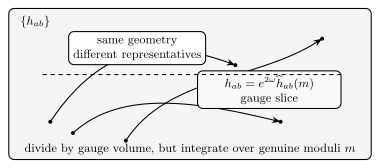
The intrinsic metric is integrated modulo diffeomorphisms and Weyl transformations. Gauge fixing chooses a slice through this infinite-dimensional space, while true moduli remain as finite-dimensional integration variables.
Metric fluctuations: gauge directions and moduli
Section titled “Metric fluctuations: gauge directions and moduli”Let be a reference metric depending on moduli . An infinitesimal metric fluctuation decomposes as
Here is a vector field generating a diffeomorphism, is a Weyl variation, and are representatives of tangent vectors to moduli space. The operator extracts the traceless part of the diffeomorphism variation:
The trace of vanishes in two dimensions:
So the three pieces in have distinct meanings:
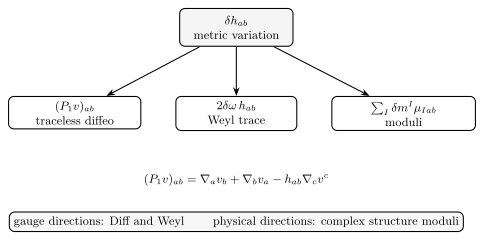
The decomposition of separates redundant gauge variations from true deformations of the Riemann surface. The latter become coordinates on moduli space.
For a closed oriented surface with punctures, the stable cases obey
The sphere and torus have special conformal Killing symmetries. For the sphere, the group of globally defined conformal maps is
This group has complex dimension . Therefore an -punctured sphere has
moduli. Equivalently, three punctures may be fixed, conventionally to , , and .
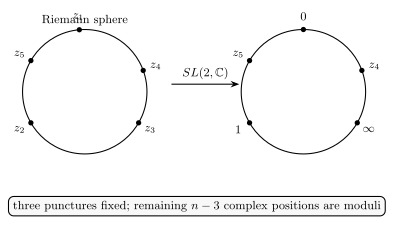
The Möbius group removes three complex positions on the sphere. The remaining puncture positions are genuine moduli to be integrated over.
Conformal gauge and the Faddeev-Popov determinant
Section titled “Conformal gauge and the Faddeev-Popov determinant”Conformal gauge chooses
At the classical level, the matter action is independent of the conformal factor . If Weyl invariance survives quantization, the integral cancels against the Weyl gauge volume and can be discarded. What remains is the integral over moduli and a Faddeev-Popov determinant.
The determinant is produced by the change of variables from general metric fluctuations to gauge parameters plus moduli:
The Jacobian is represented by anticommuting ghosts. The ghost is the fermionic version of the diffeomorphism parameter , while the antighost pairs with traceless metric variations. In complex coordinates the holomorphic part is
with an antiholomorphic copy
The field has conformal weight and has conformal weight . Their OPE is
This is the same system introduced as a conformal field theory. The path integral explains its geometric origin.
Conformal Killing vectors and fixed punctures
Section titled “Conformal Killing vectors and fixed punctures”A conformal Killing vector is a diffeomorphism that preserves conformal gauge. On the Riemann sphere, the holomorphic conformal Killing vectors are generated by
The corresponding ghost zero modes are the three modes
A nonzero sphere ghost correlator must soak up these zero modes. In the holomorphic sector,
For the closed string, the antiholomorphic ghosts give the complex conjugate factor.
The standard tree-level closed-string prescription is therefore
The three unintegrated vertices fix the gauge freedom. The remaining vertex positions are integrated because they are genuine moduli of the punctured sphere.
For open strings on the disk or upper half-plane, the analogous statement uses the real group and three boundary ghosts.
Moduli and -ghost insertions
Section titled “Moduli and bbb-ghost insertions”Higher-genus amplitudes require integration over the moduli space of Riemann surfaces. The tangent directions to moduli space are represented by Beltrami differentials
Each modulus is paired with a -ghost insertion
The antiholomorphic sector contributes
The schematic closed-string genus- measure is
where the are vertex operators in a convenient integrated or unintegrated representation. The formula is schematic because special cases with conformal Killing vectors require separate treatment, but the principle is robust: moduli are integrated, and each modulus brings a -ghost insertion.
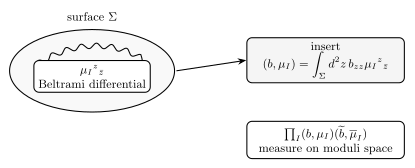
The insertion is the finite-dimensional remnant of the Faddeev-Popov determinant after conformal gauge fixing. It pairs an antighost with a Beltrami differential representing a modulus.
The torus is the simplest higher-genus example. A complex torus is
with one complex modulus , modulo modular transformations. The one-loop vacuum amplitude therefore contains an integral over a fundamental domain of , together with the corresponding ghost and matter determinants.
The gauge-fixed recipe
Section titled “The gauge-fixed recipe”The full story can be summarized as follows.
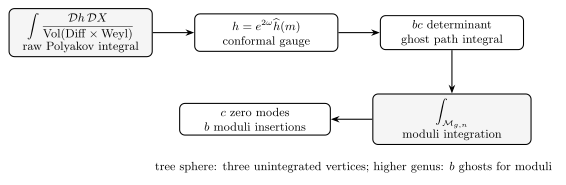
Gauge fixing converts the original metric integral into a CFT correlator with ghost insertions and an integral over moduli space.
In words:
- Start with the Polyakov integral over and .
- Divide by .
- Choose conformal gauge .
- Exponentiate the Faddeev-Popov determinant using ghosts.
- Fix conformal Killing symmetries using ghosts.
- Integrate over true moduli using -ghost insertions.
This is the bridge from the classical Polyakov action to the practical rules for string perturbation theory. The next page explains the last missing consistency condition: Weyl invariance must survive quantization. Its failure is the Weyl anomaly, and its gauge-fixed remnant is BRST symmetry.
Exercises
Section titled “Exercises”Exercise 1. Tracelessness of
Section titled “Exercise 1. Tracelessness of P1vP_1vP1v”Show that
is traceless in two dimensions.
Solution
Contract with :
In two dimensions , so
Exercise 2. Punctures on the sphere
Section titled “Exercise 2. Punctures on the sphere”Use the dimension of the Möbius group to explain why the moduli space of an -punctured sphere has complex dimension .
Solution
Each puncture has one complex coordinate, so before quotienting there are complex parameters. The globally defined conformal maps of the sphere are Möbius transformations,
which form a complex three-dimensional group. For generic marked points this group can fix three punctures. The remaining number of complex parameters is therefore
Exercise 3. Three ghosts on the sphere
Section titled “Exercise 3. Three ccc ghosts on the sphere”Assuming that is a primary of weight , use global conformal invariance and antisymmetry to determine
Solution
The correlator must be antisymmetric under exchange of any two insertion points because is fermionic. It must also transform with weight in each argument. The unique expression with these properties, up to normalization, is
With the standard ghost vacuum normalization, .
Exercise 4. Why ghosts accompany moduli
Section titled “Exercise 4. Why bbb ghosts accompany moduli”Explain why a modulus is paired with an insertion of the form
Solution
A variation of the complex structure is represented by a Beltrami differential . In the Faddeev-Popov construction, the antighost pairs with traceless metric variations. The finite-dimensional part of the determinant associated with changing moduli therefore inserts the natural pairing between and :
This insertion also soaks up zero modes associated with moduli.