
Current Algebras and WZW Models
A two-dimensional CFT can be exactly solvable for two different but closely related reasons. The first is the Virasoro symmetry generated by the stress tensor . The second is the presence of extra holomorphic currents whose operator products close among themselves. These currents generate an affine Lie algebra, also called a Kac-Moody current algebra.
This page explains the compact logic:
For AdS/CFT, this material is not a decorative corner of 2D CFT. It is one of the main languages of string worldsheets, especially strings on group manifolds and strings on with NS-NS flux. It is also the cleanest example of how an infinite-dimensional symmetry can determine spectra, conformal blocks, and correlation functions.
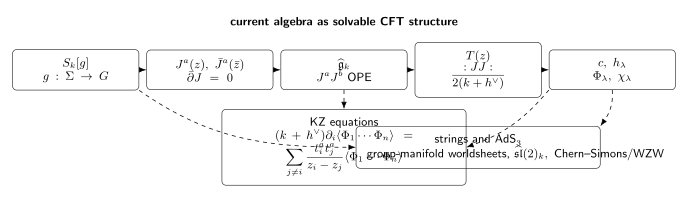
The basic structure of current-algebra CFT. Chiral currents obey an OPE that becomes the affine algebra in modes. The Sugawara construction builds from the currents, while WZW models provide Lagrangian realizations. The affine Ward identities lead to the Knizhnik-Zamolodchikov equations for conformal blocks.
1. Chiral currents in two-dimensional CFT
Section titled “1. Chiral currents in two-dimensional CFT”Let be a Lie algebra with generators satisfying
A two-dimensional CFT has a left-moving current algebra if it contains holomorphic spin-one currents
whose OPE closes as
Here is an invariant metric on , and is called the level. For compact simple groups in unitary WZW models, is a nonnegative integer. The right-moving sector can have independent antiholomorphic currents
with a similar OPE.
The double pole is the key new feature. If it were absent, the OPE would simply encode the ordinary Lie algebra. The double pole is the central extension; it is what turns the loop algebra of maps into an affine Kac-Moody algebra.
A useful way to read the current OPE is:
This is the same philosophy as the Virasoro algebra: the classical algebra of conformal transformations acquires a central extension in the quantum theory.
2. From current OPEs to affine modes
Section titled “2. From current OPEs to affine modes”Expand the holomorphic currents in Laurent modes:
The OPE implies
This is the affine Lie algebra . The zero modes obey the original finite-dimensional Lie algebra:
The nonzero modes are the genuinely two-dimensional enhancement. They are analogous to Virasoro descendants, but organized by an internal symmetry rather than spacetime conformal transformations.
A useful dictionary is:
| Object | Meaning |
|---|---|
| holomorphic conserved current | |
| ordinary global symmetry generator | |
| current-algebra creation operators in radial quantization | |
| annihilation operators on affine primaries | |
| level, central extension, WZW coupling | |
| affine Kac-Moody algebra |
The central term has an immediate consequence: the level is not an optional decoration. It enters the stress tensor, conformal weights, modular transformations, fusion rules, and the worldsheet interpretation of WZW models.
3. Affine primary fields
Section titled “3. Affine primary fields”A field is a left affine primary in representation of if
where is the matrix representing on . In radial quantization this means
The affine descendants are obtained by acting with negative current modes:
Thus a finite-dimensional Lie algebra representation is promoted to an infinite-dimensional affine module.
For compact WZW models, the allowed representations are not arbitrary. They must be integrable highest-weight representations at level . For example,
This finite list is why compact WZW models are rational CFTs: only finitely many affine primary families appear.
4. Sugawara construction: building from currents
Section titled “4. Sugawara construction: building T(z)T(z)T(z) from currents”The most beautiful fact about current algebras is that the stress tensor can often be built directly from the currents. For a simple Lie algebra , the Sugawara stress tensor is
where is the dual Coxeter number of and is the inverse invariant metric.
This stress tensor satisfies the Virasoro OPE
with central charge
for compact simple in the standard normalization.
It also makes the currents into conformal primaries of weight one:
For an affine primary in representation , the conformal weight is
where is defined by
For ,
so
This is one of the simplest exact spectra in interacting 2D CFT.
5. The Wess-Zumino-Witten model
Section titled “5. The Wess-Zumino-Witten model”The current algebra above is not merely abstract. It is realized by the Wess-Zumino-Witten model, whose fundamental field is a map
where is the two-dimensional worldsheet and is a Lie group.
For compact simple , the Euclidean WZW action can be written schematically as
where is a three-manifold with boundary
The first term is the nonlinear sigma model on . The second term is the Wess-Zumino term. It is topological in the sense that it depends on an extension of into , but the quantum path integral is well-defined when the ambiguity in this extension changes the action by an integer multiple of .
With the usual normalization of the trace, this requires
for compact simply connected simple .
Classically, the WZW model has chiral equations of motion. In a common convention,
and the equations of motion imply
The global symmetry is enhanced to a chiral current algebra. Quantum mechanically, the currents obey the affine OPEs at level , and the stress tensor is the Sugawara stress tensor.
This is an important example of a general lesson:
That lesson is everywhere in string theory.
6. Affine Ward identities
Section titled “6. Affine Ward identities”The affine OPE with a primary field gives Ward identities for current insertions. For primary fields in representations ,
where acts on the -th representation.
This equation says that inserting a holomorphic current is equivalent to summing over simple poles at all charged operator insertions. It is the current-algebra analogue of the stress-tensor Ward identity
The current Ward identity is often more powerful because it knows the internal representation theory.
7. Knizhnik-Zamolodchikov equations
Section titled “7. Knizhnik-Zamolodchikov equations”The Sugawara relation expresses in terms of the currents. Combining this relation with the current Ward identity gives differential equations for chiral conformal blocks. These are the Knizhnik-Zamolodchikov equations.
Let be a chiral conformal block of affine primary fields. Then
for each insertion .
The KZ equations are the current-algebra counterpart of BPZ equations in Virasoro minimal models. Both are differential equations for conformal blocks, but they come from different mechanisms:
| Equation | Origin | Typical input |
|---|---|---|
| BPZ | Virasoro null states | degenerate Virasoro modules |
| KZ | affine current algebra + Sugawara | WZW affine symmetry |
The KZ equation is especially important because it makes conformal blocks concrete. It also displays the relation between CFT monodromy, braiding, fusion, and quantum groups.
8. Example: current algebra
Section titled “8. Example: U(1)U(1)U(1) current algebra”The simplest current algebra comes from a free compact boson . A holomorphic current is
with OPE
This is an abelian affine algebra, often called . There is no structure-constant term because is abelian.
Vertex operators carry charge:
and the current OPE is
up to normalization conventions for and .
The abelian example is useful because it shows that current algebras are not intrinsically nonabelian. What is special about nonabelian WZW models is the simultaneous presence of a nontrivial structure-constant pole and a central pole.
For , the affine algebra is
The allowed affine primaries are labeled by spin
Their conformal weights are
and the central charge is
At , the allowed primaries are
with
The WZW model is equivalent, in a precise sense, to a compact boson at a special radius. This equivalence is one of the classic places where free-field, current-algebra, and rational-CFT viewpoints meet.
10. Why WZW models matter for strings
Section titled “10. Why WZW models matter for strings”In first-quantized string theory, the worldsheet theory must be a two-dimensional CFT. WZW models are among the most important exactly solvable worldsheet CFTs because they describe strings propagating on group manifolds with background flux.
The basic geometric picture is:
The Wess-Zumino term is directly related to the antisymmetric -field background. In sigma-model language, the WZW model gives an exact CFT because the metric and -field are tuned so that the beta functions vanish in a highly symmetric way.
This is particularly important for backgrounds. Strings on with NS-NS flux are described by a noncompact WZW model based on
or closely related Euclidean continuations such as . This theory is much subtler than compact : it has continuous representations, spectral flow sectors, and delicate normalizability issues. But the organizing principle is the same: affine symmetry controls the worldsheet CFT.
One must not confuse three different central charges:
| Quantity | Where it lives | Meaning |
|---|---|---|
| worldsheet CFT | Virasoro central charge of the string worldsheet theory | |
| affine algebra | level of the current algebra | |
| boundary CFT | Brown-Henneaux central charge in AdS/CFT |
They are related in specific models, but they are not the same object.
11. Current algebra versus Virasoro symmetry
Section titled “11. Current algebra versus Virasoro symmetry”Every 2D CFT has the stress tensor and therefore Virasoro symmetry. A current-algebra CFT has more symmetry:
The extended symmetry imposes extra selection rules. For example, an ordinary Virasoro three-point coefficient may be allowed by conformal symmetry, but forbidden by representation theory. Schematically,
requires that the tensor product
contain a singlet, and in the affine theory it must also obey level-dependent fusion constraints.
This is a major difference between generic CFT and rational current-algebra CFT: the latter has a finite, highly structured set of representations and fusion rules.
12. AdS/CFT checkpoint
Section titled “12. AdS/CFT checkpoint”Current algebras appear in holography in several ways.
First, on string worldsheets, WZW models give exact CFT descriptions of backgrounds with group-manifold structure. The flagship example is the description of strings on with NS-NS flux.
Second, in AdS/CFT, bulk Chern-Simons gauge fields induce chiral current algebras in the boundary theory. This is the three-dimensional version of a general lesson: gauge fields in AdS are dual to conserved currents in the CFT.
Third, current algebra gives an exact playground for the relation
This is exactly the kind of structural thinking needed for holography. In AdS/CFT we often do not solve the bulk theory directly. Instead, we identify the boundary symmetry, spectrum, and OPE data, then use consistency to reconstruct bulk physics.
13. Common pitfalls
Section titled “13. Common pitfalls”A holomorphic current is not merely any conserved current. In a 2D CFT, a conserved vector current satisfies a conservation equation, but a chiral current has a stronger property:
This means its correlators are meromorphic functions of , up to singularities at operator insertions.
The level is not the central charge. The level is the central extension of the current algebra; the Virasoro central charge obtained from Sugawara is
For noncompact WZW models, compact-unitary statements need care. Formulas such as the current OPE and Sugawara stress tensor remain central, but representation theory, normalizability, and modular properties are more subtle.
Finally, WZW models are not the only CFTs with current algebra, but they are the canonical Lagrangian realization of affine Lie symmetry.
Exercises
Section titled “Exercises”Exercise 1: Derive the affine mode algebra
Section titled “Exercise 1: Derive the affine mode algebra”Starting from
and
show that
Solution
Use radial ordering. The commutator is obtained by letting the contour circle the singularity at :
The simple pole gives
The remaining integral gives .
The double pole gives
Therefore
Combining the two terms gives the affine algebra.
Exercise 2: Sugawara dimensions for
Section titled “Exercise 2: Sugawara dimensions for SU(2)kSU(2)_kSU(2)k”For , show that
Then compute the allowed primaries and conformal weights for .
Solution
For ,
The Sugawara formulas give
and
At level , the integrable spins are
Their conformal weights are
The central charge is
Exercise 3: Why the WZW level is quantized
Section titled “Exercise 3: Why the WZW level is quantized”Assume is compact, simple, and simply connected. With the standard normalization,
Explain why the Wess-Zumino term forces .
Solution
The Wess-Zumino term is defined by extending the worldsheet map to a three-manifold with . Two different extensions and can be glued to form a closed three-manifold. For compact simply connected simple , the difference of the two Wess-Zumino integrals is classified by the winding number and is proportional to
The Wess-Zumino contribution to the Euclidean action therefore shifts by
up to the chosen normalization convention. The path-integral weight is invariant only if
for all . Thus must be an integer.
Exercise 4: The KZ equation as a Ward identity
Section titled “Exercise 4: The KZ equation as a Ward identity”Use the Sugawara formula and the current Ward identity to explain why a chiral block of affine primaries obeys a first-order differential equation rather than an arbitrary dependence on insertion points.
Solution
The Virasoro Ward identity says that inserting into a correlator produces derivatives with respect to insertion points. In particular, the coefficient of the simple pole at gives .
In a WZW model, however, is not independent. It is given by the Sugawara expression
Each current insertion can be moved through the correlator using
Therefore the simple pole of near can be re-expressed as a sum over Lie algebra generators acting on the other insertions. This produces
Thus affine symmetry plus Sugawara turns conformal covariance into a differential equation for the chiral conformal blocks.
Further reading
Section titled “Further reading”For a deeper 2D CFT treatment, read the sequence on simple Lie algebras, affine Lie algebras, WZW models, and fusion rules in Di Francesco, Mathieu, and Sénéchal. For string theory, the worldsheet role of WZW models is especially important in group-manifold compactifications and in backgrounds with NS-NS flux. For the next page, keep in mind the contrast between compact rational CFTs and noncompact theories: modular invariance and representation theory become subtler, but the current algebra remains the organizing principle.