
1. What Is Holographic Quantum Matter?
Holographic quantum matter is the study of strongly coupled many-body systems using gravitational dual descriptions. Its most characteristic use is not to draw pretty analogies between black holes and materials, but to compute observables in regimes where ordinary weak-coupling tools fail: thermalization without quasiparticles, transport governed by hydrodynamics and horizons, finite-density states with strong entanglement, and ordered phases whose dynamics is controlled by black-brane instabilities.
The subject begins with a modest observation. In weakly interacting systems, the low-energy world is often made of long-lived particles or quasiparticles. In a Landau Fermi liquid, excitations near the Fermi surface live parametrically long at low temperature. In a conventional phonon system, the basic long-wavelength excitations are collective but still particle-like. But many quantum many-body systems do not admit such a simple description. They relax quickly, redistribute energy efficiently, and show response functions whose poles are not narrow quasiparticle poles.
Holography gives a controlled arena for such behavior. The dual gravitational description contains horizons. Horizons absorb. Perturbations decay into them. Their damped normal modes are quasinormal modes. The boundary theory interprets the same data as dissipative response.
The central metaphor is useful, but it should be sharpened into a dictionary:
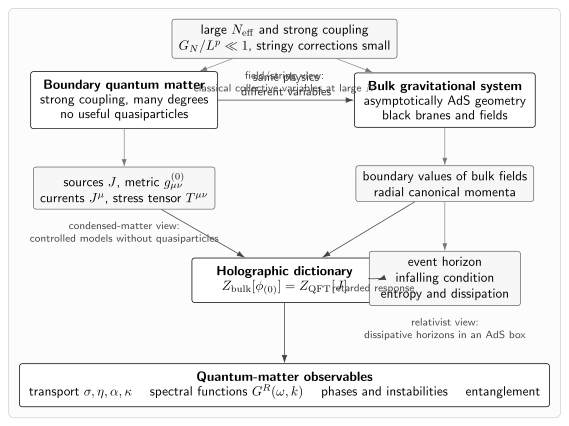
Holographic quantum matter relates strongly coupled boundary dynamics to gravitational dynamics in one higher dimension. Boundary sources excite bulk fields. Horizons absorb perturbations and produce dissipative response. Different levels of control range from exact dualities to top-down models, bottom-up models, and phenomenological mechanisms.
The physical target: matter without simple quasiparticles
Section titled “The physical target: matter without simple quasiparticles”A quasiparticle description has three ingredients.
First, there are identifiable elementary low-energy excitations. Second, those excitations live long compared with microscopic times. Third, complicated states can be approximately built by combining many of them.
This is not the only possible organization of quantum matter. A strongly coupled plasma, a quantum critical fluid, or a strange metal can equilibrate on a timescale of order
in units with . This is not a theorem for all systems, nor does it by itself define a material. It is a useful order-of-magnitude diagnostic: when thermalization occurs on the only available thermal timescale, long-lived quasiparticles are unlikely to be the right organizing principle.
Holographic models naturally produce such fast relaxation. The reason is geometric. A finite-temperature state is represented by a black brane. Perturbations fall into the horizon. The characteristic decay frequencies are set by the temperature:
The boundary interpretation is that the strongly coupled system has damped collective modes rather than stable particle excitations.
The three languages
Section titled “The three languages”The subject is most transparent when one keeps three languages side by side.
| Boundary language | Bulk language | Physical meaning |
|---|---|---|
| State at finite temperature | black brane | thermal many-body system |
| Retarded Green’s function | infalling bulk wave equation | causal linear response |
| Spectral weight | horizon absorption | dissipation |
| Poles of | quasinormal modes | relaxation channels |
| Conserved current | bulk gauge field | global symmetry and charge transport |
| Stress tensor | bulk metric | energy, momentum, and heat transport |
| Relevant deformation | scalar profile | RG flow away from a fixed point |
| Condensate | normalizable mode of charged field | spontaneous symmetry breaking |
| Translation breaking | spatially dependent sources or axions | finite DC transport |
A good holographic calculation translates all three columns at once. If one only solves a bulk differential equation without asking what is sourced and what is measured, the result is not yet physics. If one only writes boundary hydrodynamics without identifying which coefficient the horizon computes, one misses the computational power of the duality.
Why large matters
Section titled “Why large NNN matters”Classical gravity is a mean-field-like limit of a very large number of strongly interacting degrees of freedom. The rank of the boundary theory controls the number of degrees of freedom. Schematically,
for matrix large- examples. The classical gravitational saddle becomes reliable when is large and quantum gravity loops are suppressed.
Large is both a strength and a limitation.
It is a strength because it gives calculability. One can solve classical equations for a metric, gauge field, scalar, or spinor and obtain strongly coupled many-body observables.
It is a limitation because most laboratory systems do not have an actual large parameter of this kind. Holographic quantum matter is therefore best read as a collection of controlled mechanisms and universality templates, not as a literal microscopic model of every material.
Horizons as dissipative systems
Section titled “Horizons as dissipative systems”A future horizon is a one-way membrane for classical perturbations. Consider a bulk field fluctuation near a nonextremal horizon. In an ingoing Eddington—Finkelstein coordinate , with tortoise coordinate , regular infalling behavior is
The outgoing solution behaves as and is singular on the future horizon in the retarded problem. Thus causal boundary response is encoded by imposing infalling boundary conditions.
The horizon also explains why quasinormal modes replace quasiparticles. Quasinormal frequencies are complex:
The imaginary part is the decay rate. A quasiparticle pole would be long-lived if or . Many holographic modes do not have this hierarchy.
What is being modeled?
Section titled “What is being modeled?”Holographic quantum matter contains several levels of claim.
An exact duality is a precise equivalence between a boundary theory and a bulk quantum gravity/string theory. These are rare and special, but they define the conceptual foundation.
A top-down model descends from a known string or supergravity construction. It has controlled higher-dimensional origin, flux quantization, and field content. It may still describe an idealized large- theory rather than a specific material.
A bottom-up model keeps the fields and couplings needed to study a mechanism. Examples include Einstein—Maxwell theory for charged horizons, Einstein—Maxwell—Dilaton theory for IR scaling, and axion models for momentum relaxation.
A phenomenological analogy uses holography to organize experimental patterns or mechanisms. This can be extremely useful, but the claim is weaker.
The same observable may appear at several levels. Conductivity can be computed in a top-down probe-brane model, a bottom-up axion model, or a hydrodynamic effective theory inspired by horizons. The meaning of the result depends on the level of control.
A first example: conductivity
Section titled “A first example: conductivity”Suppose a boundary theory has a conserved current . The source is a boundary gauge field . A small electric field is
up to sign conventions. Linear response gives
so the conductivity is
again up to contact terms and convention choices.
In the bulk, is dual to a gauge-field perturbation . The conductivity is found by solving the radial wave equation with two boundary conditions:
- fix the source near the boundary,
- impose infalling behavior at the horizon.
The response coefficient is the canonical radial momentum conjugate to . In simple neutral black-brane backgrounds, the zero-frequency conductivity can often be read directly from horizon data. This is the first glimpse of a general theme: transport coefficients are infrared observables, and horizons are efficient infrared calculators.
What makes quantum matter holographic?
Section titled “What makes quantum matter holographic?”The adjective does not mean that every condensed-matter system secretly lives on the boundary of a classical spacetime. It means that certain strongly coupled many-body problems admit, or are modeled by, a dual description in which the energy scale of the boundary theory becomes a radial direction.
The radial coordinate is not merely a visualization aid. It organizes source data, response data, horizon regularity, Wilsonian flow, and IR scaling. In the simplest Poincare patch, the AdS metric is
with boundary at . Roughly, small corresponds to UV physics and large to IR physics. At finite temperature, a horizon cuts off the geometry at , with .
Common pitfalls
Section titled “Common pitfalls”Pitfall 1: “No quasiparticles” means no excitations. Not true. It means the useful excitations are not long-lived particles. There can still be hydrodynamic modes, order-parameter modes, collective poles, branch cuts, and quasinormal modes.
Pitfall 2: A horizon automatically means a real material. A horizon means thermal entropy and dissipation in the dual large- system. Material relevance requires additional comparison.
Pitfall 3: Bottom-up means untrustworthy. Bottom-up models can be very trustworthy for mechanism-level questions if their assumptions are explicit and their observables are robust.
Pitfall 4: Top-down means experimentally realistic. Top-down control is microscopic control, not material realism.
Pitfall 5: A scaling exponent is a complete explanation. Exponents are diagnostics. The mechanism behind them comes from the full set of equations, symmetries, conserved quantities, and boundary conditions.
Exercises
Section titled “Exercises”Exercise 1: Quasiparticle versus quasinormal mode
Section titled “Exercise 1: Quasiparticle versus quasinormal mode”Explain why a quasinormal mode with frequency is quasiparticle-like only if is parametrically small compared with the relevant real energy scale.
Solution
A long-lived excitation produces an oscillation that persists for many periods. The period is of order and the lifetime is of order . A quasiparticle-like interpretation requires , or . If is comparable to , the excitation decays within one oscillation time and is better interpreted as a damped collective response.
Exercise 2: Why infalling boundary conditions are dissipative
Section titled “Exercise 2: Why infalling boundary conditions are dissipative”For a perturbation near a horizon, compare and . Which one is regular on the future horizon?
Solution
The ingoing Eddington—Finkelstein coordinate is . A field behaving as is regular for waves falling into the future horizon. The outgoing solution depends on and is singular on the future horizon in the retarded problem. Therefore retarded Green’s functions impose the infalling solution.
Exercise 3: Model status
Section titled “Exercise 3: Model status”Why is “top-down” not the same as “experimentally realistic”?
Solution
A top-down model descends from string theory or supergravity, so its internal consistency and field content are controlled. But the boundary theory may be large-, supersymmetric, strongly coupled, and unlike any microscopic material. Top-down control answers “what theory is this?” It does not automatically answer “which material is this?”
Further reading
Section titled “Further reading”For broader orientation, consult Hartnoll—Lucas—Sachdev on holographic quantum matter, Zaanen—Liu—Sun—Schalm on holographic duality in condensed matter physics, and Ammon—Erdmenger on finite-temperature, hydrodynamic, and condensed-matter applications of gauge/gravity duality.