
Bosonic Physical States and the No-Ghost Structure
The CFT machinery now lets us return to the central question of covariant string quantization: which oscillator states are physical? In light-cone gauge this question looked easy: only the transverse oscillators survive. In covariant quantization the answer is more subtle because we keep all spacetime components of , including the timelike one. The price is an indefinite Fock space, and the cure is the Virasoro constraint.
A physical string state is therefore not merely a Fock-space vector. It is a Virasoro-primary state satisfying the mass-shell condition, modulo null states. This quotient is the worldsheet origin of spacetime gauge invariance.
The physical-state conditions
Section titled “The physical-state conditions”For the open bosonic string, the old covariant physical-state conditions are
In the critical bosonic string,
For the closed string there are two Virasoro algebras, so one imposes
The difference of the two zero-mode equations gives level matching,
These equations are the quantum form of the classical constraints . The zero-mode equation is the mass-shell condition; the positive-mode equations remove unphysical polarizations.

Covariant quantization begins with an indefinite Fock space. The physical Hilbert space is the constrained subspace modulo null physical states. In the critical theory this is isomorphic to the transverse light-cone spectrum.
More precisely, for the open string,
The quotient is essential. Null states have zero norm but need not be the zero vector. They generate gauge redundancies, just as longitudinal photons are pure gauge in Maxwell theory.
State-operator translation
Section titled “State-operator translation”The state-operator correspondence converts the physical-state conditions into statements about conformal weights. A state created by an operator is a highest-weight state exactly when is primary:
The zero-mode equation fixes the conformal weight.
For an open-string boundary vertex operator, the integrated insertion is
so must have boundary weight . For a closed-string bulk vertex operator, the integrated insertion is
so must have weights .
Later we will attach ghosts to make unintegrated vertices. For now the matter part obeys
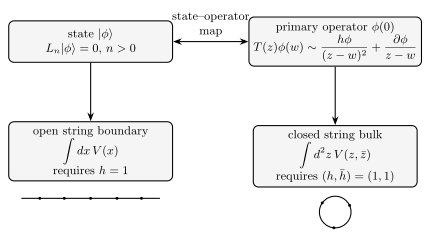
The physical-state conditions are CFT conditions. Highest-weight states correspond to primary operators, while integrated string vertices require weight on the boundary or weights in the bulk.
Normalization checkpoint
Section titled “Normalization checkpoint”With
one has
On the open-string boundary, the doubling trick gives
These two formulas are the most common source of factor-of-four mistakes in comparing open and closed string masses.
Example: the open-string tachyon
Section titled “Example: the open-string tachyon”The simplest open-string matter vertex is
The boundary conformal weight is . Requiring gives
With mostly-plus metric, , hence
This is the open bosonic string tachyon. The tachyon is not caused by covariant quantization; it is already present in light-cone gauge. It is a signal that the perturbative vacuum of the bosonic open string is unstable.
Example: the open-string photon
Section titled “Example: the open-string photon”The level-one open-string state is
The corresponding boundary operator is
Since has weight , the weight-one condition gives
Thus this state is massless. The nonzero Virasoro condition imposes transversality. Using
we get
and therefore
There is also a null state,
Hence the polarization has the gauge equivalence
The physical number of polarizations is
exactly as in light-cone gauge.
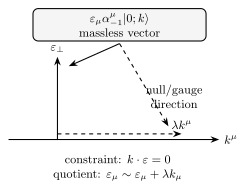
At level one, the Virasoro constraint removes the polarization component parallel to , and the null state generated by identifies longitudinal polarizations. The result is a massless gauge boson.
This is the first place where the quotient by null states becomes physically vivid: it is precisely the gauge equivalence of a spacetime vector field,
First massive open-string level
Section titled “First massive open-string level”At level the most general covariant open-string state is
The mass formula gives
The constraints and relate the vector to the longitudinal components and trace of . Null descendants then remove the remaining gauge redundancy. The final physical representation is the symmetric traceless rank-two tensor of the massive little group .
For the critical bosonic string, , so the little group is and
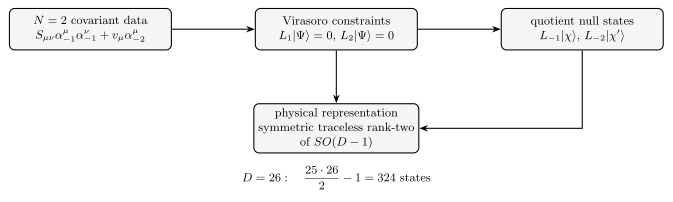
The level-two covariant data are larger than the physical representation. The Virasoro constraints and null-state quotient reduce them to a symmetric traceless massive tensor.
This example is a useful consistency check: light-cone gauge counts transverse oscillators, while covariant quantization starts from Lorentz tensors and then removes gauge and null directions. The two answers agree only at the critical dimension.
Closed-string massless state
Section titled “Closed-string massless state”For the closed string, the first massless state is
The corresponding matter vertex is
The condition gives
The positive-mode constraints give
and null states generate gauge equivalences of the form
The tensor decomposes as
These pieces become the graviton, Kalb-Ramond two-form, and dilaton. Their spacetime dynamics will reappear when we study massless vertex operators and the low-energy effective action.
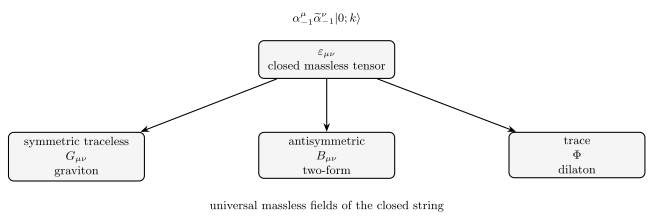
The closed-string level-one tensor contains the universal massless fields of the bosonic closed string: the graviton, the antisymmetric two-form, and the dilaton.
The no-ghost theorem
Section titled “The no-ghost theorem”The old covariant Fock space is indefinite because
Before imposing constraints, timelike oscillators create negative-norm states. The nontrivial statement is that for the critical values
the physical quotient contains no negative-norm states.
One useful formulation of the no-ghost theorem is
where the right-hand side is the Hilbert space generated by the transverse oscillators. This theorem explains why the covariant and light-cone spectra are the same theory in two different gauges.
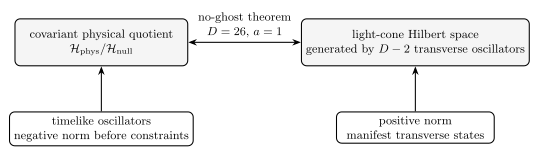
The no-ghost theorem is the bridge between manifest Lorentz covariance and manifest positivity. It works at the same critical values and found from light-cone Lorentz invariance.
What to remember
Section titled “What to remember”The Virasoro constraints do three things at once. First, gives the mass shell. Second, for imposes transversality-type conditions. Third, null states implement gauge redundancies. In CFT language, physical string states are weight-one matter primaries on the boundary or weight- matter primaries in the bulk, dressed by ghosts when one computes amplitudes.
The next step is to understand the ghosts themselves. They are not new spacetime particles; they are the conformal field theory produced by gauge fixing worldsheet gravity.
Exercises
Section titled “Exercises”Exercise 1. Boundary weight and the open tachyon
Section titled “Exercise 1. Boundary weight and the open tachyon”Using , derive the open-string tachyon mass.
Solution
The integrated boundary vertex must have weight , so
With mostly-plus signature, . Therefore
Exercise 2. Transversality of the open-string vector
Section titled “Exercise 2. Transversality of the open-string vector”Show directly that implies .
Solution
Using
we have
Since and ,
The physical-state condition gives .
Exercise 3. Longitudinal vector as a null state
Section titled “Exercise 3. Longitudinal vector as a null state”Show that the vector state with polarization is generated by a Virasoro descendant.
Solution
For the scalar ground state with ,
Thus a polarization proportional to is a descendant. Its norm is proportional to , hence it is null on shell.
Exercise 4. Counting the first massive representation
Section titled “Exercise 4. Counting the first massive representation”Compute the dimension of the symmetric traceless rank-two representation of .
Solution
A symmetric rank-two tensor in dimensions has
components. Removing the trace removes one component, so
Exercise 5. Closed-string massless fields
Section titled “Exercise 5. Closed-string massless fields”Decompose a rank-two polarization into symmetric traceless, antisymmetric, and trace pieces. Which spacetime fields do they represent?
Solution
Write
After imposing transversality and accounting for gauge redundancies, these become the graviton , the antisymmetric two-form , and the scalar dilaton .