
Confinement, Wilson Loops, and Mass Gaps
The main idea
Section titled “The main idea”Confinement is not a single sentence. In a four-dimensional gauge theory, several related but logically distinct diagnostics often travel together:
| Diagnostic | Field-theory statement | Holographic avatar |
|---|---|---|
| Wilson-loop confinement | a large rectangular loop gives | a string worldsheet is forced to lie along an IR wall, cap, or string-frame minimum |
| mass gap | local gauge-invariant correlators have no spectral weight below | normalizable bulk modes have a lowest nonzero mass |
| center symmetry | fundamental Polyakov loops are order parameters in pure gauge theory | contractibility or noncontractibility of the Euclidean thermal circle |
| large- flux tubes | string breaking is suppressed | fundamental worldsheets are stable at leading order in |
A good holographic confining model should make these diagnostics mutually consistent, but one should not identify them blindly. A model may have a discrete meson spectrum without a true Wilson-loop area law. A finite-volume CFT may have discrete energy levels without being confining. A gauge theory with dynamical fundamental matter may have a mass gap while fundamental strings can break.
The cleanest holographic Wilson-loop criterion is geometric. Consider a static fundamental string in the string-frame metric. If the effective local string tension
has a positive infrared minimum, then a long string connecting two boundary heavy sources spends most of its length at that minimum. The heavy-quark potential becomes
At the same time, a mass gap arises when the radial wave equation for bulk fluctuations becomes a confining Sturm-Liouville problem: the radial interval effectively ends, or the Schrödinger potential grows in the IR, so normalizable modes have discrete masses.
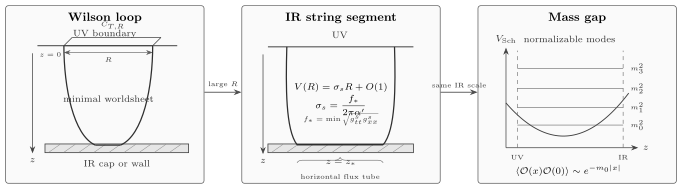
A confining holographic background has an infrared structure that affects both strings and fields. A long Wilson-loop worldsheet lies near the IR wall or cap, giving . Linearized bulk fluctuations see an effective radial potential and produce discrete poles in boundary correlators.
This page explains how these statements are derived, when they are reliable, and where the standard traps hide.
What Wilson-loop confinement means
Section titled “What Wilson-loop confinement means”For a heavy external quark-antiquark pair separated by distance , the rectangular Wilson loop of temporal length extracts the static potential:
Equivalently,
A pure confining gauge theory has
so that the rectangular loop obeys
The leading term is proportional to the area of the rectangle. Perimeter terms and corner terms are subleading in the static-potential extraction.
There are several common large-distance behaviors:
| Static potential | Wilson-loop behavior | Interpretation |
|---|---|---|
| no area law | conformal Coulombic behavior | |
| area law | confining flux tube for external probes | |
| perimeter-like behavior | screening or string breaking | |
| area law plus effective-string corrections | long confining flux tube |
The phrase external probes is important. In a pure gauge theory, fundamental Wilson loops are sharp confinement diagnostics because there are no dynamical fundamental charges to break the string. In QCD with dynamical quarks, a long flux tube can break by pair production. Then the fundamental Wilson loop is not an exact asymptotic order parameter, even though the physical spectrum still contains only color singlets.
In large- holography this distinction becomes visible on the gravity side. A classical string connecting two boundary endpoints is the leading saddle for external heavy sources. If the model includes flavor branes, other saddles may exist in which the string breaks or ends on flavor degrees of freedom. In the strict probe limit such effects are often suppressed, but they are not conceptually absent.
The holographic Wilson-loop setup
Section titled “The holographic Wilson-loop setup”The fundamental string computes a Wilson loop through
in the classical string limit. The relevant metric is the string-frame metric. For a static Euclidean background, write the part of the metric needed for a string stretched along one boundary spatial direction as
Define
Use static gauge,
The Nambu-Goto action becomes
Because the Lagrangian has no explicit dependence, there is a first integral. Let be the turning point of the string, where . Then
Solving for the separation gives
The bare energy is
This expression diverges near the UV boundary because each external source has an infinite bare mass. A standard subtraction removes two straight strings:
The finite constant depends on how the heavy-source mass is defined. The coefficient of the large- term does not.
The confinement criterion
Section titled “The confinement criterion”The large- behavior is controlled by the deepest region accessible to the string. If has a positive minimum at an IR point ,
then the turning point approaches as . The worldsheet consists of two nearly vertical pieces plus a long horizontal piece at . The horizontal piece gives
Therefore
A similar conclusion holds when the geometry ends at a smooth cap or an effective wall, provided the string cannot go further inward and
This is the practical holographic confinement criterion:
In a string-frame domain-wall metric,
the relevant function is
Thus
when the minimum is positive and accessible to the classical string.
The string-frame qualification is not cosmetic. In ten dimensions,
A dilaton profile can change the Wilson-loop criterion even when the Einstein-frame geometry appears innocuous.
Pure AdS gives Coulomb behavior, not confinement
Section titled “Pure AdS gives Coulomb behavior, not confinement”In Euclidean Poincaré AdS,
The relevant function is
It has no positive IR minimum. As ,
The string can lower its energy by dipping deeper into AdS as the quark separation increases. The result is not a flux tube but the conformal strong-coupling potential
for the Maldacena-Wilson loop in the canonical AdS duality.
This is the cleanest sanity check. An asymptotically AdS UV region is not enough for confinement. The Wilson-loop area law is an IR property.
Hard-wall confinement
Section titled “Hard-wall confinement”The hard-wall model cuts off AdS at
The metric remains
At large separation the string descends to the wall, runs horizontally, and returns to the boundary. Since
the hard-wall estimate of the string tension is
Using the canonical relation gives
This formula is pedagogically useful but should not be overinterpreted. The hard wall introduces confinement by hand. The wall boundary condition for the string is part of the model. A smooth top-down geometry should replace the artificial cutoff with a cap, brane construction, flux, or dynamical scalar profile.
Soft-wall spectra are not automatically Wilson-loop confinement
Section titled “Soft-wall spectra are not automatically Wilson-loop confinement”The original soft-wall model modifies the five-dimensional action by a dilaton-like factor,
This is excellent for modeling linear radial Regge trajectories,
But the Wilson-loop criterion depends on the metric seen by the fundamental string. If the string-frame metric is still pure AdS, then
still has no positive IR minimum. A dilaton inserted into a probe-field action does not by itself change the Nambu-Goto action. Therefore
A dynamical soft-wall or improved holographic QCD model can produce Wilson-loop confinement if the backreacted string-frame geometry has the right IR behavior. The distinction is crucial: spectral confinement and Wilson-loop confinement are related goals, but they are computed from different bulk objects.
Smooth caps and the AdS soliton
Section titled “Smooth caps and the AdS soliton”Many top-down confining backgrounds are better thought of as smooth caps than as hard walls. A typical mechanism is that an internal or spatial circle shrinks smoothly in the infrared. Near the tip, a smooth two-dimensional cigar looks like
where regularity fixes the periodicity of .
A standard example is the AdS soliton,
The circle shrinks smoothly at . If a Wilson loop extends along a nonshrinking spatial direction , then
so the long-distance string tension is
The same IR scale also controls the lowest normal-mode masses. This is why the AdS soliton is one of the clearest geometries for teaching confinement-like physics: the geometry ends smoothly, Wilson loops become linear, and fluctuation spectra become discrete.
Black horizons give screening for temporal Wilson loops
Section titled “Black horizons give screening for temporal Wilson loops”A finite-temperature deconfined plasma is dual to a black brane or black hole. In a planar black-brane metric,
For a temporal Wilson loop,
At the horizon,
This is not a confining wall. The connected U-shaped string can be replaced at large separation by two disconnected strings falling into the horizon. The heavy-quark potential is screened,
rather than linearly confining.
Spatial Wilson loops at finite temperature are different. For a spatial loop, the relevant factor uses two spatial metric components,
so the horizon can act like an endpoint for the spatial string calculation. One may obtain a spatial string tension of order
in AdS/CFT conventions. This is often called magnetic confinement, but it is not confinement of static electric charges. Temporal Wilson loops diagnose heavy-quark screening; spatial Wilson loops probe the magnetostatic sector of the thermal theory.
Mass gaps from bulk normal modes
Section titled “Mass gaps from bulk normal modes”Now consider local gauge-invariant operators such as
Their holographic duals are bulk fluctuations: dilaton modes, axion modes, metric modes, form fields, or mixtures of fields depending on the compactification. To compute the spectrum:
- choose the background,
- linearize the bulk equations,
- form gauge-invariant fluctuation variables,
- impose normalizability at the UV boundary,
- impose regularity or an IR boundary condition at the wall or cap.
For a scalar fluctuation in a five-dimensional background, one often obtains
This is a Sturm-Liouville problem. A mass gap means the smallest nonzero eigenvalue satisfies
A discrete tower gives a spectral representation
in Euclidean signature. At infinite , these poles are stable. At finite but large , they broaden into narrow resonances with widths suppressed by powers of .
The hard-wall example makes this concrete. For a scalar of five-dimensional mass in AdS, a normalizable mode can be written schematically as
A Dirichlet condition at gives
so
where is the -th zero of . The mass gap is
The same logic applies more generally: the IR geometry replaces the CFT continuum by a normal-mode problem.
Wilson-loop area law versus mass gap
Section titled “Wilson-loop area law versus mass gap”A Wilson-loop area law and a mass gap are strongly correlated in many confining theories, but neither definition is a perfect substitute for the other.
A finite box can give a discrete spectrum without confinement. A theory on has discrete energies because the spatial volume is finite, not because it dynamically confines color on . Conversely, with dynamical fundamental matter, the flux tube can break, so the fundamental Wilson loop need not have an asymptotic area law even though the physical spectrum has a mass gap.
Holographically:
while
They probe the same geometry but not the same equations. The string tension has dimension two,
while the mass gap has dimension one,
If both are set by one IR scale , one expects
but the dimensionless coefficients are independent dynamical data.
Center symmetry and Polyakov loops
Section titled “Center symmetry and Polyakov loops”In a pure gauge theory, confinement can also be formulated using the center symmetry. The thermal Polyakov loop is
It is an order parameter when there are no dynamical fundamental charges. In holography its expectation value is computed by a string worldsheet ending on the thermal circle at the boundary.
Topology matters:
| Dominant Euclidean saddle | Thermal circle | Polyakov loop | Interpretation |
|---|---|---|---|
| thermal AdS or AdS soliton | noncontractible | suppressed | confined-like |
| Euclidean black hole or black brane | contractible | finite disk worldsheet allowed | deconfined |
This is the Wilson-loop version of the Hawking-Page story. A contractible thermal circle allows the string worldsheet for a single Polyakov loop to cap off smoothly. A noncontractible thermal circle obstructs that disk saddle.
Higher representations and -ality
Section titled “Higher representations and NNN-ality”The fundamental string computes the potential between external sources in the fundamental representation. More generally, one can ask about Wilson loops of nonzero -ality . At large , possible holographic avatars include:
- fundamental strings,
- D-branes carrying units of fundamental-string charge,
- baryon vertices where strings can end,
- more complicated saddles depending on the compact space and representation.
For fixed at large , one often expects approximately
at leading order, with interactions suppressed by powers of . For finite, D-brane descriptions can become more appropriate. This page mostly discusses the diagnostic, but the broader lesson is that confinement is a statement about stable flux sectors, not merely about one classical worldsheet.
How to read a holographic confinement model
Section titled “How to read a holographic confinement model”When a paper or model claims confinement, ask five questions.
1. Which frame controls the Wilson loop?
Section titled “1. Which frame controls the Wilson loop?”Wilson loops use the string-frame metric. If the dilaton varies, compute
before applying the string-tension criterion.
2. What is the IR endpoint?
Section titled “2. What is the IR endpoint?”Is the geometry a hard wall, a smooth cap, a good singularity, or a horizon? A hard wall is a boundary condition. A smooth cap is geometry. A horizon usually indicates screening for temporal Wilson loops.
3. Which Wilson loop is being computed?
Section titled “3. Which Wilson loop is being computed?”Temporal Wilson loops diagnose heavy-quark confinement or screening. Spatial Wilson loops at finite temperature diagnose a different magnetic-sector string tension. Supersymmetric Wilson loops with scalar couplings can differ from ordinary Wilson loops.
4. Is there a mass gap in all relevant channels?
Section titled “4. Is there a mass gap in all relevant channels?”A discrete radial spectrum with supports a mass-gap interpretation. But one must check relevant scalar, tensor, vector, and pseudoscalar channels. A Goldstone boson from chiral symmetry breaking is massless in the chiral limit and does not contradict confinement.
5. Are fundamentals dynamical?
Section titled “5. Are fundamentals dynamical?”If dynamical quarks are present, ask whether string breaking is included. A model can show a long linear potential at intermediate distances while the asymptotic fundamental potential saturates.
Common mistakes
Section titled “Common mistakes”Mistake 1: “Any IR cutoff is confinement.”
Section titled “Mistake 1: “Any IR cutoff is confinement.””An IR cutoff creates a scale and can create a discrete spectrum. Wilson-loop confinement requires a finite nonzero string-frame tension at the IR locus. The distinction matters.
Mistake 2: “A soft wall automatically gives an area law.”
Section titled “Mistake 2: “A soft wall automatically gives an area law.””The original soft wall gives linear radial spectra for probe fields. The fundamental Wilson loop depends on the Nambu-Goto action and the string-frame metric. Without a string-frame minimum or cap, the Wilson-loop area law does not follow.
Mistake 3: “A black-hole horizon is just another hard wall.”
Section titled “Mistake 3: “A black-hole horizon is just another hard wall.””For temporal Wilson loops, the relevant factor includes , which vanishes at a Euclidean black-hole horizon. This gives screening, not a confining temporal string tension.
Mistake 4: “The mass gap and string tension are the same observable.”
Section titled “Mistake 4: “The mass gap and string tension are the same observable.””They are related but distinct. The mass gap comes from normalizable bulk field fluctuations; the string tension comes from a classical fundamental string. They can be controlled by the same IR scale without having the same coefficient.
Mistake 5: “A linear potential at intermediate distances is asymptotic confinement.”
Section titled “Mistake 5: “A linear potential at intermediate distances is asymptotic confinement.””Many models show an approximately linear regime over a finite range. True Wilson-loop confinement is an asymptotic large- statement, subject to the caveat of dynamical string breaking.
Exercises
Section titled “Exercises”Exercise 1: Extracting the potential
Section titled “Exercise 1: Extracting the potential”Assume a rectangular Wilson loop obeys
at large . Compute the static potential.
Solution
The static potential is
Using the given expression,
Therefore
The perimeter term proportional to drops out in the static-potential limit. The term shifts the heavy-source mass.
Exercise 2: The first integral of the holographic string
Section titled “Exercise 2: The first integral of the holographic string”For
derive
where is the turning point of the string.
Solution
Because has no explicit dependence,
is conserved. Since
we find
At the turning point , one has , so
Thus
which implies
Exercise 3: Hard-wall string tension
Section titled “Exercise 3: Hard-wall string tension”In hard-wall AdS,
Compute the large- string tension of a fundamental Wilson loop, assuming the string can run along the wall at .
Solution
The relevant string-frame factor is
At the wall,
The horizontal string segment has energy density
Using gives
Exercise 4: A hard-wall mass gap
Section titled “Exercise 4: A hard-wall mass gap”A scalar normal mode in hard-wall AdS has radial profile
With Dirichlet boundary condition , find the mass spectrum and show that the theory has a gap.
Solution
The boundary condition gives
so
Let be the -th positive zero of . Then
and hence
The lowest mass is
which is nonzero. Therefore the spectrum has a mass gap of order .
Exercise 5: Why a horizon screens temporal Wilson loops
Section titled “Exercise 5: Why a horizon screens temporal Wilson loops”Consider a Euclidean black-brane metric
Show why the temporal Wilson-loop string does not produce a confining string tension at .
Solution
For a temporal Wilson loop, the relevant local tension is
Here
Therefore
At the horizon,
so
A zero effective tension at the horizon is not a confining wall. It allows disconnected strings falling into the horizon and leads to screening of temporal Wilson loops.
Further reading
Section titled “Further reading”- J. M. Maldacena, Wilson Loops in Large N Field Theories. The original holographic Wilson-loop prescription in the large- and strong-coupling limit.
- S.-J. Rey and J.-T. Yee, Macroscopic Strings as Heavy Quarks in Large N Gauge Theory and Anti-de Sitter Supergravity. The companion heavy-quark/string construction.
- A. Brandhuber, N. Itzhaki, J. Sonnenschein, and S. Yankielowicz, Wilson Loops, Confinement, and Phase Transitions in Large N Gauge Theories from Supergravity. An early treatment of Wilson loops and confinement in supergravity backgrounds.
- Y. Kinar, E. Schreiber, and J. Sonnenschein, Potential from Strings in Curved Spacetime: Classical Results. A systematic derivation of holographic confinement criteria from the Nambu-Goto action.
- E. Witten, Anti de Sitter Space, Thermal Phase Transition, and Confinement in Gauge Theories. The classic geometric account of Hawking-Page physics, mass gaps, and confinement-like behavior.
- J. Polchinski and M. J. Strassler, Hard Scattering and Gauge/String Duality. A highly influential use of warped confining backgrounds and IR cutoffs in gauge/string duality.
- U. Gursoy, E. Kiritsis, F. Nitti, and collaborators on improved holographic QCD. These works analyze confinement criteria, glueball spectra, and thermodynamics in dynamical Einstein-dilaton geometries.