
Radial Quantization
Radial quantization is one of the places where conformal field theory suddenly becomes simple. In ordinary quantum mechanics one chooses a time coordinate, quantizes on constant-time slices, and studies time evolution generated by the Hamiltonian. In radial quantization one instead chooses the radius from an origin as Euclidean time. Spheres around the origin are the equal-time slices, and dilatations play the role of the Hamiltonian.
The construction is especially natural in a CFT because the flat metric on punctured Euclidean space is conformally equivalent to the cylinder:
The central result is the state-operator correspondence:
and, for a primary operator of scaling dimension ,
Thus the scaling dimension of a local operator is the energy of the corresponding cylinder state. This is one of the most important conceptual bridges to AdS/CFT: in global AdS, boundary time translations act as the CFT Hamiltonian on , and a bulk particle of energy is dual to a CFT state with dimension in units of the AdS radius.
From flat space to the cylinder
Section titled “From flat space to the cylinder”Write a point in Euclidean space as
where is a point on the unit sphere . The flat metric becomes
Now introduce the radial time coordinate
Then
and therefore
The metric
is the Euclidean cylinder metric on . Thus flat space minus the origin is Weyl-equivalent to the cylinder:
For a conformal field theory, the local physics is invariant under Weyl rescaling, up to the usual anomaly subtleties in even dimensions. So a CFT on can be viewed as a CFT on the cylinder. The origin becomes , and infinity becomes .
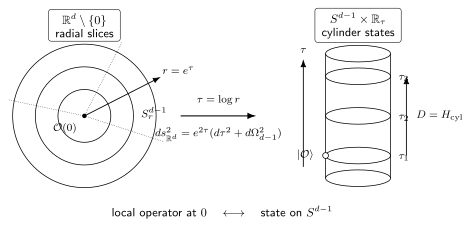
Radial quantization. Spheres around the origin in become constant- slices of the cylinder . A local operator inserted at the origin prepares a state on , and radial evolution is generated by the dilatation operator .
This is the geometric reason that the dilatation operator is a Hamiltonian. Since
translation in means scaling in :
The vector field generating translations in is
This is precisely the vector field generating dilatations. Therefore the cylinder Hamiltonian is
Strictly speaking, this equality is a convention-dependent statement about the normalization of the cylinder radius. If the sphere has radius , then
Throughout this page we set .
Radial ordering
Section titled “Radial ordering”In ordinary Euclidean QFT, correlation functions do not come with an obvious time ordering unless we choose a time direction. Radial quantization chooses as Euclidean time. Thus the ordering operation is radial ordering.
For two operators,
For many operators, radial ordering places larger-radius insertions to the left. Equivalently, on the cylinder it places later Euclidean time insertions to the left.
This simple definition is the hidden mechanism behind much of CFT. It turns correlation functions on flat space into matrix elements in a Hilbert space:
The role of the Hilbert space is played by the space of states on a sphere . The role of Euclidean time evolution is played by
This is why radial quantization makes the OPE feel like ordinary spectral decomposition.
Weyl transformation of operators
Section titled “Weyl transformation of operators”Let be a scalar primary of scaling dimension . The flat-space and cylinder operators are related by the Weyl factor. Since
the corresponding local operators obey
This factor is crucial. Without it, the limit would usually be singular. With it, a primary insertion at the origin becomes a finite cylinder state:
For a scalar primary, the state is independent of the direction . For spinning primaries, the state carries the corresponding representation of , and one should keep track of polarization data on the sphere.
The inverse statement is equally important. A state prepared on the sphere by a local insertion at the origin can be evolved outward by radial time evolution. A local operator is not just an observable; in radial quantization it is also a state-creating device.
Path-integral definition of the state
Section titled “Path-integral definition of the state”The state can be defined without assuming a Lagrangian, but the path-integral picture is very useful when a Lagrangian exists. Choose a sphere of radius around the origin. The path integral over the ball with an insertion prepares a wavefunctional of boundary data on :
This wavefunctional is the state on the sphere. Changing corresponds to evolving the state in radial time. In a CFT this evolution is controlled by .
This is the operator-state correspondence in its most physical form:
Conversely, given a state on the sphere, shrink the sphere to the origin. If the theory has a good local operator expansion, the state can be represented by a local operator inserted at the origin. This is why CFT Hilbert spaces and local operator spectra are so tightly linked.
The dilatation charge from the stress tensor
Section titled “The dilatation charge from the stress tensor”The current associated with an infinitesimal conformal transformation generated by a conformal Killing vector is
For dilatations,
Thus the dilatation current is
Its divergence is
In a CFT on flat space,
up to contact terms and possible anomaly effects on curved backgrounds. Therefore
The charge is obtained by integrating this current over a sphere surrounding the origin:
Because the current is conserved, the value of the integral is independent of the radius , as long as the sphere is not moved across an operator insertion. This is the radial-quantization analogue of conservation of ordinary energy.
This is also the geometric origin of Ward identities. If a sphere surrounds a collection of local insertions, the charge integral acts on those insertions by the corresponding conformal transformation.
Primary states
Section titled “Primary states”A scalar primary operator obeys
and
At the origin, the first relation gives
Acting on the vacuum, which is conformally invariant,
we find
Thus the state created by a primary operator has cylinder energy .
The second relation gives
So a primary state is a lowest-energy state in a conformal multiplet. The special conformal generators lower the cylinder energy, and the translation generators raise it.
Indeed, the conformal algebra contains
Therefore, if
then
and
provided the states are nonzero.
This is the higher-dimensional analogue of the familiar two-dimensional statement that a primary state is annihilated by the positive Virasoro modes and descendants are obtained by acting with lowering modes. The terminology differs slightly across dimensions, but the representation-theoretic idea is the same: primaries generate conformal families.
Descendants
Section titled “Descendants”Starting with a primary state , the descendants are obtained by acting with translations:
Their cylinder energy is
On the operator side, descendants are derivatives of the primary:
and more generally
Thus one conformal family has the schematic form
modulo possible null states or equations of motion.
The full Hilbert space on the sphere decomposes into conformal families:
This decomposition is one of the fundamental reasons CFT is solvable in principle. Instead of diagonalizing an arbitrary Hamiltonian, one classifies representations of the conformal algebra.
Cylinder two-point function
Section titled “Cylinder two-point function”The flat-space scalar two-point function is
Use
Then
where
Multiplying by the Weyl factors for the two cylinder operators gives
This formula is worth remembering. It shows explicitly how a power law on flat space becomes exponential decay on the cylinder at large Euclidean time separation.
For large positive ,
so
This is exactly the behavior of a state of energy propagating for Euclidean time :
So the formula again confirms
The bra state and insertion at infinity
Section titled “The bra state and insertion at infinity”The ket is created by an insertion at the origin. The corresponding bra is created by an insertion at infinity. For a scalar primary, one defines
Then the flat-space two-point function gives
If we choose the standard normalization
then
The precise Hermitian conjugation operation in radial quantization is not ordinary complex conjugation at fixed Euclidean time. It involves inversion,
which exchanges the origin and infinity. The next page develops this carefully because it is the starting point for reflection positivity and unitarity bounds.
OPE as spectral decomposition
Section titled “OPE as spectral decomposition”Radial quantization also explains why the OPE is so powerful.
Suppose two operators are inserted inside a sphere, and all other operators are inserted outside the sphere. From the viewpoint of the sphere, the inner insertions prepare a state. Since the Hilbert space on the sphere has a basis of energy eigenstates, this state can be expanded in conformal families:
Translated back into local operators, this becomes the operator product expansion:
The OPE is not merely a formal short-distance expansion. In a unitary CFT, radial quantization gives it a Hilbert-space interpretation: it is a convergent expansion of a state, as long as the sphere separating the inner and outer insertions exists.
This is the conceptual seed of conformal blocks. A four-point function can be decomposed by inserting a complete set of cylinder energy eigenstates between pairs of operators. The sum over descendants inside one conformal family is a conformal block.
Subtleties on the cylinder
Section titled “Subtleties on the cylinder”There are a few subtleties worth keeping visible.
First, radial time is Euclidean time, not physical Lorentzian time. After Wick rotation on the cylinder, becomes the Lorentzian cylinder. In AdS/CFT this Lorentzian cylinder is the natural boundary of global AdS.
Second, the vacuum energy on the cylinder can differ from zero because of Weyl anomalies and Casimir effects. In two-dimensional CFT one famously finds a shift by in the cylinder Hamiltonian when expressed in terms of plane Virasoro generators:
for the usual cylinder with angular circle of circumference . The plane dilatation operator itself is
The distinction matters for torus partition functions and finite-size energies. It does not change the basic local statement that a primary operator of dimension creates a state whose energy above the appropriate vacuum is governed by .
Third, noncompact CFTs can have continuous spectra. Then the direct sum over primaries should be replaced by a direct integral over representations. The local logic of radial quantization still works, but the Hilbert-space decomposition is less discrete.
AdS/CFT checkpoint
Section titled “AdS/CFT checkpoint”Radial quantization is one of the cleanest entry points into the AdS/CFT dictionary.
The boundary of global Euclidean AdS is conformal to . The CFT Hamiltonian on this cylinder is the dilatation operator . Therefore:
in units where the AdS radius is one.
This explains several standard pieces of holographic language:
- A single-trace primary corresponds to a one-particle bulk state.
- Descendants correspond to the same bulk particle with boundary momentum or angular excitations.
- Multi-trace operators correspond, at large , to multi-particle states.
- The CFT vacuum on corresponds to global AdS.
- The stress tensor state corresponds to the graviton sector.
The celebrated scalar mass-dimension relation
should be understood in this representation-theoretic context. The bulk field furnishes a representation of the AdS isometry group , and the boundary primary furnishes the corresponding conformal representation. Radial quantization is the CFT-side construction that makes this statement concrete.
Summary
Section titled “Summary”Radial quantization replaces flat-space time by logarithmic radius:
Because
CFT correlation functions can be interpreted as cylinder transition amplitudes. The dilatation operator becomes the cylinder Hamiltonian,
and every primary operator creates a cylinder energy eigenstate:
Descendants are obtained by acting with , and their energies are . The OPE becomes spectral decomposition on the sphere. This is why radial quantization is not just a technical trick; it is the Hilbert-space foundation of CFT and the representation-theoretic foundation of the AdS/CFT dictionary.
Exercises
Section titled “Exercises”Exercise 1 — Flat space as a Weyl-rescaled cylinder
Section titled “Exercise 1 — Flat space as a Weyl-rescaled cylinder”Show that the flat Euclidean metric on is Weyl-equivalent to the cylinder metric on .
Solution
Write
Then
Set
Then
so
Therefore
Thus
with
Exercise 2 — Primary energy on the cylinder
Section titled “Exercise 2 — Primary energy on the cylinder”Let be a scalar primary of scaling dimension , and define
Using
show that
Solution
At the origin, the derivative term vanishes:
Assume the vacuum is conformally invariant, so
Then
Insert the commutator:
The second term vanishes, and the first gives
So the cylinder energy of the primary state is .
Exercise 3 — Descendant energies
Section titled “Exercise 3 — Descendant energies”Use
to show that
Solution
First consider one :
Using
we get
For momenta, commute through each . Each commutator contributes one extra unit of energy. Therefore
Exercise 4 — Cylinder two-point function
Section titled “Exercise 4 — Cylinder two-point function”Starting from
with
show that
Solution
First compute
Expanding,
Factor out :
Using
we get
Therefore
The cylinder operators are
Multiplying the flat two-point function by cancels the factor in the denominator. Hence
Exercise 5 — Why the OPE converges radially
Section titled “Exercise 5 — Why the OPE converges radially”Consider a four-point function with and . Explain why the product can be expanded in a complete basis of states on , and why this gives the OPE channel for .
Solution
The two inner operators lie inside the sphere . In radial quantization, the path integral over the ball bounded by this sphere prepares a state on :
The Hilbert space on the sphere has a basis of dilatation eigenstates, organized into conformal families:
Therefore
where labels descendants inside the conformal family of the primary .
The two outer operators define a bra state outside the same sphere. The four-point function is the overlap of the outer bra with the inner ket:
Inserting the complete basis gives a sum over exchanged conformal families. Written in local-operator language, this is precisely the OPE expansion of , followed by evaluation of the resulting three-point functions with and .
The expansion is radial because the separating sphere exists only when the inner insertions are strictly inside the outer ones. This geometric separation is what controls convergence.
Further reading
Section titled “Further reading”For two-dimensional radial quantization and the operator formalism, see Di Francesco, Mathieu, and Sénéchal, Chapter 6. For the higher-dimensional version used in the conformal bootstrap, see Rychkov’s CFT lectures and Simmons-Duffin’s TASI lectures. For AdS/CFT preparation, keep the cylinder interpretation especially close: it is the boundary Hilbert space of global AdS.