
Higher-Spin, Vector Models, and Sparse Spectra
The main idea
Section titled “The main idea”The canonical AdS/CFT example can create a dangerous habit. One sees a large- CFT and immediately imagines an Einstein-like bulk dual: a metric, a few light matter fields, black holes, and stringy corrections far above the AdS scale. That habit is often useful, but it is not a theorem.
Large by itself gives a classical expansion. It does not guarantee that the classical bulk theory is Einstein gravity.
The sharp lesson of higher-spin holography is:
More precisely, a CFT with large stress-tensor two-point coefficient has a small bulk Newton constant,
This is the condition for a semiclassical bulk expansion. But to get a local Einstein-like effective field theory below the AdS scale, one also needs a gap in the single-particle spectrum, especially in higher-spin single-trace operators:
The phrase “single-trace” is being used in the broad AdS/CFT sense: a single-particle CFT primary. In a matrix theory this is often literally a trace, such as . In a vector model it is usually a singlet bilinear, such as or .
The contrast is the whole point:
- Sparse matrix-like large- CFTs can have an Einstein/string bulk with a parametrically high string scale.
- Vector-like large- CFTs have an infinite tower of light higher-spin currents and are instead dual to higher-spin gravity, not to ordinary Einstein gravity.
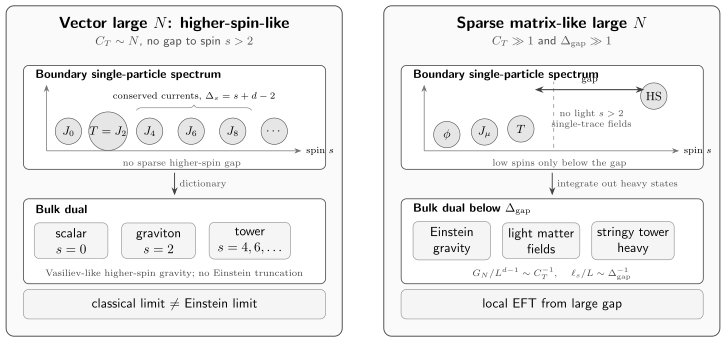
Two different large- universes. Vector models have and an infinite tower of conserved or nearly conserved higher-spin currents, giving Vasiliev-like higher-spin gravity in AdS. Sparse matrix-like CFTs have and , giving a local Einstein effective theory below the scale set by the first stringy or higher-spin single-particle states.
The slogan for this page is:
That sentence should be read carefully. It does not mean that all higher-spin fields disappear from the full theory. In string theory they are present, but their masses are of order the string scale. At strong ‘t Hooft coupling in the canonical duality,
When , those stringy higher-spin states are heavy compared with the AdS scale and can be integrated out. The result is ordinary supergravity plus controlled higher-derivative corrections. In vector-model holography, by contrast, the higher-spin tower remains at the AdS scale. There is no Einstein truncation with a finite number of low-spin fields.
Two meanings of “classical bulk”
Section titled “Two meanings of “classical bulk””It is helpful to separate two notions that are often blurred.
Semiclassical bulk expansion
Section titled “Semiclassical bulk expansion”A CFT with a large parameter has a weak bulk loop expansion. Since the stress tensor maps to the graviton,
the normalization of stress-tensor correlators determines the gravitational coupling:
Thus means
so quantum gravity loops are suppressed. This is the bulk analogue of large- factorization.
For a matrix large- theory,
for suitably normalized single-trace operators. The bulk loop-counting parameter is roughly .
For a vector large- theory,
for suitably normalized singlet bilinear operators . The bulk loop-counting parameter is roughly .
Both have a classical limit. The difference is what becomes classical.
Local Einstein effective field theory
Section titled “Local Einstein effective field theory”Einstein-like holography needs more than a small Newton constant. It needs a low-energy bulk Lagrangian organized by a derivative expansion:
with higher-derivative terms suppressed by a scale much higher than .
In a stringy AdS dual, that scale is usually the string scale:
A large gap means the first genuinely stringy or higher-spin single-particle states have large AdS energy. Below that energy, the bulk cannot resolve their structure, so the dynamics is local and low-spin.
Without a large gap, the bulk may still be classical, but it is not Einstein-like. It can contain infinitely many light higher-spin fields whose interactions are nonlocal at the AdS scale. This is the higher-spin/vector-model world.
Conserved higher-spin currents
Section titled “Conserved higher-spin currents”A symmetric traceless spin- primary operator in a unitary -dimensional CFT obeys the unitarity bound
When the bound is saturated, the operator is conserved:
For , this is an ordinary conserved current. For , it is the stress tensor. For , it is a higher-spin conserved current.
The AdS dictionary says that a conserved spin- current maps to a massless spin- gauge field in the bulk:
For spin , a useful mass-dimension relation is
with the understanding that gauge redundancies and AdS representation theory determine the precise field equation. If
then
So the CFT statement “there is a conserved spin- current” is the bulk statement “there is a massless spin- gauge field.”
For and , this is familiar and welcome:
For , it is much more restrictive. A finite number of interacting massless higher-spin fields in flat space is strongly constrained by no-go theorems. AdS evades the flat-space assumptions, but only in a special way: consistent higher-spin theories contain an infinite tower of fields and interactions tied to the AdS scale.
Thus a conserved higher-spin current is not just another light operator. It is a sign of an enlarged symmetry powerful enough to reorganize the entire theory.
Free vector models and their higher-spin currents
Section titled “Free vector models and their higher-spin currents”Consider the free vector model in dimensions:
The fundamental fields are not singlets under . The natural singlet primaries are bilinears:
and, for even spins in the real bosonic singlet sector,
The improvements are chosen so that the currents are symmetric, traceless, primary, and conserved:
Their dimensions are
Already this spectrum tells us the nature of the bulk dual. There is an infinite tower
of single-particle fields with AdS-scale masses. The spin- member is the graviton; the spin-, spin-, and higher members are massless higher-spin gauge fields. The dual is not Einstein gravity plus a few matter fields. It is a Vasiliev-like higher-spin theory.
In , the basic free scalar has dimension
so the scalar singlet
has
This is important because the corresponding bulk scalar in AdS has
which admits two allowed quantizations:
The free vector model uses the quantization, while the critical model uses the quantization at leading large .
The Klebanov-Polyakov duality
Section titled “The Klebanov-Polyakov duality”The basic higher-spin/vector-model duality is the Klebanov-Polyakov proposal:
There are two closely related boundary theories:
The same bulk scalar has , but the boundary condition changes. This is one of the cleanest physical uses of alternate quantization:
The bulk side contains a scalar plus one massless gauge field for each even spin:
This theory is often called the minimal type-A Vasiliev theory. The non-minimal version contains all integer spins and is naturally related to vector models. Fermionic vector models are associated with type-B higher-spin theories, whose light scalar is parity odd in the simplest versions.
The duality is conceptually powerful because the boundary theory is weakly coupled or exactly solvable at large , while the bulk is a genuine gravitational theory with infinitely many gauge fields. It is a rare case where quantum gravity in AdS is dual to a theory that is much simpler than a strongly coupled matrix CFT.
Why the singlet sector matters
Section titled “Why the singlet sector matters”A subtle point: the free vector model has fundamental fields . If one keeps the full theory, the spectrum contains non-singlet operators. A simple Vasiliev theory is not dual to all of them.
The usual holographic statement is about the singlet sector. Operationally, one can project to singlets by gauging the global symmetry with a topological or non-dynamical gauge field. In flat space at zero temperature, this distinction can look harmless. On compact spaces or at finite temperature, it is not harmless: singlet projection changes the state counting.
For example, the singlet sector of a vector model has many fewer degrees of freedom than the full ungauged theory. This matters for black-hole-like questions. Vector-model/higher-spin duality is not expected to reproduce the same kind of large AdS black holes as a sparse matrix CFT with deconfined degrees of freedom.
The lesson is:
One should not say “the free vector model is dual to Vasiliev theory” without specifying which singlet projection and which bulk boundary conditions are intended.
Matrix large versus vector large
Section titled “Matrix large NNN versus vector large NNN”Both matrix and vector theories have large- factorization, but their operator algebras and bulk interpretations differ.
A matrix model has adjoint fields . Its single-trace operators look like
At large ,
and connected correlators of normalized single-trace operators scale as
The topological expansion is organized by two-dimensional surfaces:
That is why matrix large- naturally suggests closed strings.
A vector model has fields . Its singlet “single-particle” operators are bilinears:
With normalized bilinears
the connected -point functions scale as
So the three-point coupling scales as
and the four-point connected piece scales as
The corresponding bulk coupling is therefore
This is still a classical bulk limit, but not a closed-string genus expansion of the matrix type. The combinatorics of vector models lead naturally to tree-level higher-spin fields rather than to a finite-tension string theory with an Einstein low-energy limit.
What higher-spin symmetry does to a CFT
Section titled “What higher-spin symmetry does to a CFT”Higher-spin symmetry is extraordinarily constraining.
In an ordinary interacting CFT, one expects the stress tensor and global currents to be conserved, but generic higher-spin symmetric traceless operators acquire anomalous dimensions:
In a free theory, there are infinitely many conserved higher-spin currents. The existence of such currents reflects the fact that free particles carry infinitely many conserved charges.
In three-dimensional unitary CFTs with a unique stress tensor, the Maldacena-Zhiboedov theorem makes this intuition precise: the existence of one conserved higher-spin current implies an infinite tower of conserved higher-spin currents, and the correlators are those of free bosons or free fermions, up to the allowed structures and assumptions.
The theorem is an AdS/CFT diagnostic. If a CFT has exact higher-spin symmetry, its bulk dual is not a generic interacting Einstein theory. The bulk has higher-spin gauge symmetry, which is the spacetime reflection of the boundary conservation laws.
The contrapositive is what we use all the time:
In such a theory, higher-spin single-trace operators should be heavy:
or at least parametrically above the low-energy bulk cutoff.
Slightly broken higher-spin symmetry
Section titled “Slightly broken higher-spin symmetry”Higher-spin symmetry can also be slightly broken. This happens in important large- three-dimensional Chern-Simons vector models.
Consider a or vector model coupled to Chern-Simons gauge fields at level . The large- ‘t Hooft limit is
At , the single-trace spectrum still contains currents with approximately conserved higher-spin charges. At finite , the higher-spin currents are not exactly conserved. Schematically,
This implies anomalous dimensions
On the bulk side, the spin- gauge field becomes slightly massive:
This is the higher-spin analogue of a Higgs mechanism. The gauge symmetry is exact at and weakly broken at finite .
Chern-Simons vector models are especially beautiful because the planar three-point functions depend continuously on , while the single-trace spectrum remains higher-spin-like at leading large . The bulk interpretation is a parity-violating family of higher-spin theories. These models are also part of the broader web of three-dimensional bosonization dualities.
The important message for this course is not the technical details of Chern-Simons matter. It is the scale separation:
not
So these theories are not Einstein-like, even though they have controlled large- expansions.
The large-gap criterion
Section titled “The large-gap criterion”The modern CFT-first view of AdS/CFT says that a local bulk effective theory is encoded in special properties of the CFT data. The rough criterion is:
The first condition gives small . The second condition organizes perturbation theory into tree-level and loop-level bulk diagrams. The third condition allows a derivative expansion.
A very useful way to say this is:
where is the shortest length scale at which new single-particle physics appears. In a string compactification,
Below the gap, integrating out heavy single-trace operators produces local higher-derivative interactions:
This is the AdS version of Wilsonian effective field theory.
The gap is not a gap to all operators. That would be impossible in an interacting large- CFT, because multi-trace operators are always present. If and are light single-trace primaries, then double-trace operators have leading dimensions
These are dual to two-particle states in AdS. They are not evidence against locality. The sparse-spectrum condition is a gap in the single-particle spectrum, especially in spin single-trace primaries.
What the gap means in familiar examples
Section titled “What the gap means in familiar examples”In the canonical duality,
the gap depends on the ‘t Hooft coupling:
At weak coupling, the theory has many nearly conserved higher-spin operators. For example, twist-two operators of schematic form
have dimensions close to their free-field values. The dual string is not well approximated by supergravity.
At strong coupling,
the string scale separates from the AdS scale:
The first stringy higher-spin states have
This is why classical type IIB supergravity is a good approximation. The low-energy bulk includes the graviton, gauge fields from isometries, protected Kaluza-Klein modes, and other supergravity fields, but not the full string tower.
Vector models sit at the opposite end. They have
for infinitely many , so there is no large higher-spin gap:
The bulk dual is classical at large , but its interactions are controlled by higher-spin symmetry rather than by an Einstein derivative expansion.
Higher-spin gravity in AdS
Section titled “Higher-spin gravity in AdS”Higher-spin gravity is not merely “gravity plus a spin- field.” A consistent interacting theory contains infinitely many fields:
or a minimal even-spin subset, depending on the model.
The spin- field is the graviton. The spin- fields, when present, are ordinary gauge fields. The higher fields are gauge fields with transformations schematically of the form
The dots denote trace terms and nonlinear corrections. These gauge symmetries remove unphysical polarizations and enforce the boundary conservation laws.
Vasiliev theory gives nonlinear equations for these infinitely many fields in AdS. The formalism is elegant but technically unfamiliar: it uses master fields depending on auxiliary spinor-like variables and noncommutative star products. For this course, the essential physics is enough:
- The theory is naturally formulated in AdS, not flat space.
- It contains an infinite tower of massless higher-spin gauge fields.
- Its interaction scale is tied to the AdS radius.
- It is dual to vector-like CFTs with exact or weakly broken higher-spin symmetry.
This explains why higher-spin holography is both close to and far from the canonical AdS/CFT example. It is close because it is a real gauge/gravity duality. It is far because the bulk is not governed by an Einstein effective action with a large separation of scales.
AdS higher-spin dualities
Section titled “AdS3_33 higher-spin dualities”The previous page explained that AdS gravity is special because its asymptotic symmetry algebra is Virasoro. AdS higher-spin gravity is special for a related reason: many higher-spin theories in three bulk dimensions can be written as Chern-Simons theories.
Ordinary AdS gravity can be written as
Chern-Simons theory. Higher-spin extensions replace by a larger algebra, such as
or an infinite-dimensional algebra such as .
On the boundary, the Virasoro symmetry is enhanced to a -algebra. Minimal model holography proposes a duality between certain large- limits of two-dimensional minimal models and higher-spin theories on AdS.
This story is not the same as the vector-model/Vasiliev duality in AdS, but it teaches the same structural lesson:
It also reinforces a warning: AdS theories can look gravitational while having no local bulk gravitons in the Einstein sector. Boundary symmetry and spectrum are more informative than the word “gravity.”
A CFT-data diagnostic for bulk locality
Section titled “A CFT-data diagnostic for bulk locality”Suppose someone hands you a CFT and asks whether it has a local Einstein-like dual. What should you look for?
A practical diagnostic is the following.
| CFT property | Bulk interpretation | Einstein-like? |
|---|---|---|
| small | necessary | |
| factorization of low-dimension single-particle correlators | tree-level bulk expansion | necessary |
| unique stress tensor | one connected gravitational sector | usually necessary |
| no conserved currents with | no massless higher-spin gauge fields | necessary for Einstein-like interacting bulk |
| for single-trace | stringy/higher-spin states are heavy | crucial |
| low-dimension double-trace towers | multi-particle AdS states | expected, not a problem |
| polynomially bounded Mellin amplitudes at low energy | local derivative expansion | strong evidence |
This table is a compact version of the modern “holography from CFT” viewpoint. Crossing symmetry of CFT four-point functions is extremely restrictive. In large- CFTs with a gap, solutions to crossing at leading nontrivial order organize themselves like Witten diagrams generated by local bulk interactions.
That is a profound result. It means bulk locality is not an extra mystical assumption. It is encoded in ordinary CFT consistency conditions plus special spectral data.
Why higher-spin fields obstruct an Einstein truncation
Section titled “Why higher-spin fields obstruct an Einstein truncation”Imagine trying to start with a higher-spin/vector-model dual and simply discard the spin-, spin-, and higher fields. This does not work.
The boundary reason is simple. The currents are part of the single-particle operator algebra. Their three-point functions with the stress tensor and with each other are nonzero. Removing the dual bulk fields would remove poles and exchange contributions required by CFT OPE data.
The bulk reason is also simple. Higher-spin gauge symmetry ties the fields together. Interactions of the spin- field alone are not closed under the full gauge algebra. The infinite tower is not optional decoration; it is needed for consistency.
This is analogous to string theory, where the infinite tower of string states is required for ultraviolet consistency. But there is a crucial difference:
In the first case, the tower can be integrated out at low energy. In the second case, it cannot.
The role of anomalous dimensions
Section titled “The role of anomalous dimensions”A conserved spin- current has
If the theory is deformed so that the current is no longer conserved, then
The anomalous dimension measures the breaking of higher-spin symmetry. In the bulk, it measures the mass of the corresponding spin- field:
so for small ,
There are three regimes:
| CFT regime | Higher-spin dimensions | Bulk regime |
|---|---|---|
| exact higher-spin symmetry | massless higher-spin gauge fields | |
| slightly broken higher-spin symmetry | light massive higher-spin fields | |
| sparse strong-coupling regime | for | heavy stringy/higher-spin states |
The last regime is the one that produces Einstein gravity at low energies.
This is why anomalous dimensions are not just technical CFT data. They are bulk mass measurements.
Higher-spin symmetry versus string theory
Section titled “Higher-spin symmetry versus string theory”String theory also has infinitely many higher-spin particles. Why is it not automatically higher-spin gravity?
The answer is scale. In a weakly curved string compactification,
The higher-spin string excitations are massive in AdS units, and only a finite number of supergravity fields remain light. Their interactions are local at scales much larger than .
At special tensionless limits, string theory can acquire enhanced higher-spin symmetry. The boundary CFT then develops many nearly conserved higher-spin currents. Weakly coupled SYM is an example of a CFT regime where many higher-spin-like operators become light. The bulk string is then highly curved in string units:
and supergravity is not reliable.
Thus higher-spin holography is not disconnected from string theory. It is best viewed as a controlled corner where an infinite higher-spin symmetry is manifest, while Einstein gravity appears only after a large gap opens.
Common mistakes
Section titled “Common mistakes”Mistake 1: “Large means Einstein gravity.”
Section titled “Mistake 1: “Large NNN means Einstein gravity.””Large means a classical bulk expansion. The classical bulk might be Einstein gravity, string theory, higher-spin gravity, or something more exotic. The spectrum decides.
Mistake 2: “A low-dimension spin- operator is harmless.”
Section titled “Mistake 2: “A low-dimension spin-444 operator is harmless.””A single low-dimension spin- single-trace operator can already signal trouble for a simple Einstein truncation. If it is conserved, it is a massless spin- gauge field. If it is merely light, it is a low-cutoff bulk degree of freedom that cannot be ignored.
Mistake 3: “The gap is a gap to all operators.”
Section titled “Mistake 3: “The gap is a gap to all operators.””No. Double-trace operators remain light and numerous. They are multi-particle states in AdS. The crucial gap is in the single-particle, single-trace spectrum, especially for spin .
Mistake 4: “Higher-spin gravity is just a small correction to GR.”
Section titled “Mistake 4: “Higher-spin gravity is just a small correction to GR.””It is not. Higher-spin gauge symmetry changes the structure of the theory. Vasiliev theory is not Einstein gravity plus perturbatively small spin- matter.
Mistake 5: “Free vector models are dual to ordinary weakly coupled bulk fields.”
Section titled “Mistake 5: “Free vector models are dual to ordinary weakly coupled bulk fields.””The bulk is weakly coupled at large , but it contains infinitely many massless higher-spin fields. Weak coupling is not the same as low-spin locality.
Mistake 6: “The fundamental vector field is a bulk single-particle field.”
Section titled “Mistake 6: “The fundamental vector field is a bulk single-particle field.””In the singlet-sector duality, the fundamental is not a singlet operator and does not correspond to an ordinary local bulk field. The basic bulk fields map to singlet bilinears.
A compact dictionary
Section titled “A compact dictionary”| Boundary object | Bulk object |
|---|---|
| in vector model | |
| singlet bilinear | scalar field in AdS |
| conserved , | massless spin- gauge field |
| critical versus free vector model | alternate boundary condition for scalar |
| weakly broken higher-spin current | light massive spin- field |
| no Einstein low-energy truncation | |
| local bulk EFT below the gap | |
| double-trace operator | two-particle AdS state |
| matrix large- genus expansion | closed-string perturbation theory |
The last row is useful but not universal. Some CFTs are neither simple matrix theories nor simple vector theories. The diagnostic remains the same: inspect the CFT data.
Worked example: free versus critical in
Section titled “Worked example: free versus critical O(N)O(N)O(N) in d=3d=3d=3”In the free vector model,
The scalar singlet maps to an AdS scalar with
This mass admits both standard and alternate quantization because it lies in the window above the Breitenlohner-Freedman bound:
The two possible dimensions are
At the critical point, the Hubbard-Stratonovich description introduces a field coupled as
At leading large , the operator corresponding to the scalar singlet has dimension
Thus the free and critical theories differ in the boundary condition for the same bulk scalar:
The higher-spin tower is present in both cases at , although interactions and effects differ. This is a beautiful example of how RG flow and alternate quantization are linked in AdS/CFT.
Worked example: detecting the Einstein limit in SYM
Section titled “Worked example: detecting the Einstein limit in N=4\mathcal N=4N=4 SYM”Consider four-dimensional SYM.
The large- condition is
which gives
But classical five-dimensional Einstein gravity also requires strong ‘t Hooft coupling:
Why? Because the higher-spin string states have dimensions of order
At weak coupling, many single-trace operators are light, including higher-spin operators that are close to conserved currents. The bulk is stringy at the AdS scale. At strong coupling, those operators acquire large anomalous dimensions, the gap opens, and the low-energy bulk becomes supergravity.
So the actual supergravity regime is not merely
It is
in conventions where .
The conditions mean:
This is the canonical example of the general rule.
Research-level perspective
Section titled “Research-level perspective”Higher-spin/vector-model dualities are not side curiosities. They are stress tests for the foundations of holography.
They show that:
- Bulk gravity does not require matrix degrees of freedom. Vector models can have gravitational duals.
- Classicality and locality are different. Large gives classicality; a spectral gap gives locality.
- The CFT spectrum is the bulk cutoff. Operator dimensions are not merely labels; they are AdS masses.
- Einstein gravity is not generic. It is a special low-energy phase of holography with higher-spin/stringy states parametrically heavy.
- Crossing symmetry knows about bulk locality. Large- crossing solutions with a gap organize into local Witten diagrams.
For research, this page is a bridge between three literatures that are sometimes studied separately:
- higher-spin gravity and Vasiliev theory,
- vector-model and Chern-Simons-matter dualities,
- CFT-bootstrap constraints on bulk locality.
A modern AdS/CFT practitioner should be fluent in all three, even if their primary work is black holes, transport, entanglement, or string compactifications. The large-gap criterion is now one of the cleanest ways to state what makes a holographic CFT “Einstein-like.”
Exercises
Section titled “Exercises”Exercise 1: Vector large- scaling
Section titled “Exercise 1: Vector large-NNN scaling”Let
in a free vector model. Use Wick contractions to determine the -scaling of the connected -point function
Solution
The unnormalized bilinear
has one summed vector index loop in a connected Wick contraction of any number of bilinears. Therefore the connected correlator of unnormalized bilinears scales as
Each normalized operator contributes a factor , so
Thus
This is the vector-model analogue of large- factorization. The bulk coupling scales as .
Exercise 2: Conserved currents and massless higher-spin fields
Section titled “Exercise 2: Conserved currents and massless higher-spin fields”For a spin- symmetric traceless primary, use
to show that a conserved current has . Then expand for
Solution
A conserved spin- current saturates the unitarity bound,
Substituting into the second factor gives
so
For a slightly broken current,
Then
and
Thus
Small anomalous dimensions correspond to small bulk masses for the higher-spin fields.
Exercise 3: The scalar in AdS
Section titled “Exercise 3: The scalar in AdS4_44”Show that a scalar with in AdS admits dimensions and . Explain why this is relevant for the free and critical vector models in .
Solution
For a scalar in AdS,
For AdS, . With ,
This gives
so
Therefore
In the free vector model, the scalar singlet has dimension . In the critical model, the corresponding scalar operator has dimension . The two theories are therefore represented holographically by different boundary conditions for the same bulk scalar.
Exercise 4: Why double-trace operators do not destroy the gap
Section titled “Exercise 4: Why double-trace operators do not destroy the gap”Suppose a large- CFT has a light scalar single-trace operator of dimension . Show that it has double-trace operators with dimensions
at leading large . Why does this not contradict the sparse-spectrum criterion?
Solution
At leading large , generalized free-field factorization implies that products of two single-trace primaries behave as independent two-particle states. Schematically,
Their leading dimensions are additive:
These operators can have dimensions of order one or moderately large dimensions even in a sparse holographic CFT. They do not contradict the sparse-spectrum criterion because they are not single-particle states. They are dual to two-particle states in AdS.
The gap required for Einstein-like locality is a gap in the single-trace, single-particle spectrum, especially for spin operators. Multi-trace towers are expected and necessary in any large- bulk theory.
Exercise 5: Classify the dual
Section titled “Exercise 5: Classify the dual”For each CFT, classify the expected bulk regime as “Einstein-like,” “stringy at the AdS scale,” or “higher-spin-like.”
- Large- free vector model singlet sector.
- Large- critical vector model in .
- SYM at and .
- SYM at , , and .
- A hypothetical large- CFT with no single-trace spin operators below .
Solution
-
The free vector model singlet sector is higher-spin-like. It has infinitely many conserved higher-spin currents.
-
The critical vector model is also higher-spin-like at leading large . It differs from the free model by the scalar boundary condition and by interactions, but it still has the higher-spin tower at .
-
Weakly coupled SYM is stringy at the AdS scale. It has many low-twist higher-spin single-trace operators with small anomalous dimensions. Supergravity is not reliable.
-
Strongly coupled large- SYM with weak string coupling is Einstein-like at low energies. The string scale is high in AdS units, , and loops are suppressed.
-
The hypothetical large- sparse CFT is Einstein-like below the scale set by , assuming crossing and other CFT consistency conditions are satisfied and the low-lying spectrum contains a sensible stress tensor sector.
Exercise 6: The gap as a string scale
Section titled “Exercise 6: The gap as a string scale”In AdS/CFT, use
to estimate the dimension of the first stringy excitation. Why is the answer proportional to rather than ?
Solution
The string mass scale is
The AdS dimension of a heavy bulk particle is approximately its mass in AdS units:
Therefore the first stringy excitation has
Using
we find
Thus
The quantity controls the classical string action, such as Wilson-loop areas. The mass of a string oscillator in AdS units involves , which gives the fourth root.
Further reading
Section titled “Further reading”- I. R. Klebanov and A. M. Polyakov, “AdS Dual of the Critical Vector Model,” arXiv:hep-th/0210114.
- M. A. Vasiliev, “Higher Spin Gauge Theories in Various Dimensions,” arXiv:hep-th/0401177.
- S. Giombi and X. Yin, “Higher Spin Gauge Theory and Holography: The Three-Point Functions,” arXiv:0912.3462.
- J. Maldacena and A. Zhiboedov, “Constraining Conformal Field Theories with a Higher Spin Symmetry,” arXiv:1112.1016.
- I. Heemskerk, J. Penedones, J. Polchinski, and J. Sully, “Holography from Conformal Field Theory,” arXiv:0907.0151.
- O. Aharony, G. Gur-Ari, and R. Yacoby, “Correlation Functions of Large Chern-Simons-Matter Theories and Bosonization in Three Dimensions,” arXiv:1207.4593.
- M. R. Gaberdiel and R. Gopakumar, “An AdS Dual for Minimal Model CFTs,” arXiv:1011.2986.