
Chaos, Shockwaves, and the Butterfly Effect
The main idea
Section titled “The main idea”Black holes are not merely good thermodynamic objects. In holography they are also the simplest known systems that are maximally chaotic.
The slogan is compact:
The quantitative version is sharper. In a thermal large- CFT with an Einstein-gravity black-hole dual, the squared commutator of two simple operators grows for an intermediate range of times as
where
is the Lyapunov exponent and is the butterfly velocity. Here means the effective number of thermal degrees of freedom; in a holographic CFT it is proportional to the thermal entropy per thermal cell and to .
The growth cannot continue forever. It becomes order one at the scrambling time
where is the entropy in a thermal cell. For AdS/CFT, , so parametrically
This page explains why this happens. The mechanism is beautifully geometric: time evolution near a horizon is a boost, so a small perturbation inserted at boundary time has local near-horizon energy
At sufficiently early insertion time, the perturbation backreacts into a gravitational shockwave. The phase shift from scattering through this shockwave is precisely what the boundary out-of-time-order correlator detects.
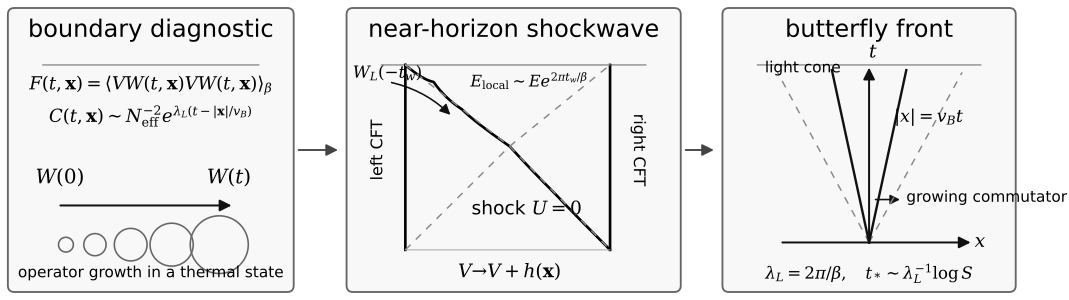
Holographic chaos connects three equivalent viewpoints: OTOCs diagnose operator growth in the boundary theory; early insertions in the thermofield double create exponentially blueshifted near-horizon shockwaves; localized perturbations spread inside a butterfly cone , with for two-derivative Einstein gravity.
Why ordinary correlators are not enough
Section titled “Why ordinary correlators are not enough”Thermal systems have many kinds of relaxation. A two-point function such as
measures linear response. Its poles are quasinormal modes in a black-hole dual. This tells us how a small expectation value relaxes back to equilibrium.
Chaos is a different question. It asks how a small perturbation changes the later action of another operator. In classical mechanics this is measured by sensitivity to initial conditions,
In quantum mechanics the closest analogue is a commutator. If and nearly commute, then has not yet become sensitive to the degree of freedom probed by . If the commutator becomes large, the operator has grown into a complicated operator involving the degrees of freedom touched by .
For Hermitian operators, a useful diagnostic is the thermal squared commutator
The minus sign makes positive for Hermitian , since is anti-Hermitian. At early times in a large- system,
At scrambling,
This is not the same as exponential decay of a two-point function. A two-point function can decay in a non-chaotic system. Chaos is diagnosed by the growth of noncommutativity between operators separated in time.
Out-of-time-order correlators
Section titled “Out-of-time-order correlators”The squared commutator is closely related to an out-of-time-order correlator, or OTOC. For simple operators and , define schematically
The name comes from the ordering: reading from left to right, the operator times are , not monotonically ordered. This is exactly what makes the correlator sensitive to the failure of and to commute.
In a large- chaotic theory, one often has an intermediate-time regime
where is an order-one coefficient depending on the operators and normalizations. This form is valid only in the window
At very early times there is microscopic transient behavior. Near and after , the exponential approximation breaks down. At finite entropy, no correlator can grow exponentially forever.
A technically cleaner version uses a regulated thermal insertion. Let
Then a common regulated OTOC is
The insertions of spread the operators around the Euclidean thermal circle. This softens contact singularities and is the natural form in the analytic arguments behind the chaos bound.
The chaos bound
Section titled “The chaos bound”For thermal quantum systems satisfying suitable assumptions of analyticity, boundedness, and factorization, the Lyapunov exponent obeys
in units with . Restoring units,
Two-derivative Einstein black holes saturate the bound:
This saturation is one of the cleanest ways in which black holes behave like the fastest possible thermal scramblers. The result is not a statement that every holographic model is automatically maximally chaotic in every limit. Stringy corrections, higher-derivative corrections, weak coupling, higher-spin dynamics, or finite- effects can modify the simple Einstein result or shrink the regime in which the exponential form is visible.
A useful hierarchy is:
| Boundary regime | Bulk regime | Chaos expectation |
|---|---|---|
| large , large gap, finite | classical Einstein black hole | |
| large , finite string scale | stringy corrections near the horizon | modified OTOC kernel; often weaker effective growth |
| weakly coupled gauge theory | no simple Einstein horizon | slower scrambling, model-dependent |
| finite entropy | finite-dimensional effective Hilbert space | no indefinite exponential growth |
The statement is therefore a sharp result in a sharp regime: semiclassical Einstein gravity around a black-hole horizon.
The horizon as a boost machine
Section titled “The horizon as a boost machine”The gravitational origin of the exponential is elementary. Near any nonextremal horizon, the geometry is locally Rindler. Suppress transverse directions and write
where is dimensionless Rindler time. The physical boundary time is related by
Introduce Kruskal-like coordinates
Then
A time translation acts as a boost:
Equivalently, evolving an infalling particle from earlier and earlier boundary times toward a fixed near-horizon slice exponentially boosts its momentum. A perturbation inserted at time has local momentum near the horizon scaling as
For modest this is a probe particle. For of order , its gravitational field is no longer negligible: it creates a shockwave.
This is the geometric heart of holographic chaos. The exponent is not a mysterious CFT number. It is the surface gravity of the horizon.
Shockwaves in the two-sided black hole
Section titled “Shockwaves in the two-sided black hole”Consider the thermofield double state dual to a two-sided AdS black hole. Insert a simple operator on the left boundary at time . In the bulk, this creates a particle that falls toward the horizon. By the time it reaches the slice, its energy is exponentially boosted:
The backreacted geometry is well approximated by a shockwave localized on a horizon. In Kruskal coordinates, the schematic form is
or, equivalently, by a shift across the shock:
For a spatially homogeneous perturbation, is a constant. For a localized perturbation in a planar black brane, the shock profile decays in the transverse spatial directions:
at large . The coefficient defines the butterfly velocity through
The shock is small when . It becomes order one when
Since , this gives
Thus the scrambling time is the time it takes a Planck-suppressed gravitational interaction to be amplified by near-horizon boost kinematics into an order-one effect.
The OTOC as high-energy near-horizon scattering
Section titled “The OTOC as high-energy near-horizon scattering”Why does the OTOC know about this shockwave? The answer is that the OTOC rearranges operator order in exactly the way needed to describe near-horizon scattering.
In the TFD description, one can relate a one-sided thermal OTOC to a two-sided correlator involving early and late insertions. The early operator creates the shock. The later operator sends a probe through the shock. The correlator compares the amplitude with and without the shock-induced shift.
At high boost, the relevant bulk process is eikonal scattering near the horizon. The center-of-mass energy grows as
The eikonal phase behaves schematically as
where is the transverse impact parameter and decays away from the perturbation. Therefore
The OTOC begins to deviate substantially from its factorized value when the eikonal phase is order one. This reproduces the same exponential growth and the same scrambling scale.
The important lesson is that the leading chaotic behavior is controlled by graviton exchange near the horizon. This is why two-derivative gravity gives a universal answer for .
Spatial chaos and the butterfly velocity
Section titled “Spatial chaos and the butterfly velocity”In a spatially extended system, chaos does not appear everywhere at once. A localized perturbation spreads through the thermal state. A standard phenomenological form is
inside the regime where the exponent is still negative or moderately positive. The contour where the exponent vanishes is
This is the butterfly front. The region behind it has become strongly affected by the perturbation; the region far ahead of it has not.
For the planar AdS Schwarzschild black brane,
with
the Einstein-gravity result is
where is the boundary spacetime dimension. Thus for AdS/CFT, where ,
The fact that is important. The butterfly cone lies inside the microscopic light cone of a relativistic boundary theory. It is a speed for the spread of operator growth, not the speed of a signal.
Scrambling versus thermalization
Section titled “Scrambling versus thermalization”The terms thermalization, hydrodynamization, relaxation, and scrambling are often casually interchanged. In holography they refer to different physics.
| Process | Boundary diagnostic | Bulk diagnostic | Typical scale |
|---|---|---|---|
| Relaxation | two-point functions, | quasinormal modes | |
| Hydrodynamization | stress tensor enters hydro regime | long-wavelength black-brane dynamics | often |
| Entanglement growth | entanglement entropy after a quench | extremal surfaces, entanglement tsunami | model-dependent |
| Scrambling | OTOCs, commutator growth | shockwave/eikonal scattering |
In large- holographic theories, scrambling is parametrically later than ordinary local relaxation because of the logarithm of entropy. A black brane can look locally equilibrated long before an initially simple perturbation has spread over all thermal degrees of freedom.
This distinction matters in black-hole information. The scrambling time is the timescale over which information thrown into a black hole becomes distributed over the horizon degrees of freedom. It is not the evaporation time, the Page time, or the quasinormal damping time.
Stringy and finite-coupling corrections
Section titled “Stringy and finite-coupling corrections”The universal Einstein result comes from graviton exchange near the horizon. If the bulk has finite string length, the scattering is not exactly pointlike gravitational shockwave scattering. Stringy effects smear the interaction and can modify the detailed OTOC kernel.
In the canonical duality, finite string length means finite ‘t Hooft coupling:
The clean Einstein regime is
At large but finite , one expects string-scale corrections to the bulk high-energy scattering. These corrections do not remove the near-horizon boost mechanism, but they can modify the coefficient, the spin dependence of the exchanged object, and the range of times over which a simple Einstein-shock description is accurate.
Higher-derivative corrections in the gravitational action can also affect chaos. Not every higher-derivative model is a healthy UV-complete theory, however. The chaos bound is one reason that causality, analyticity, and positivity constraints on effective gravity matter: arbitrary higher-derivative terms may produce unphysical behavior if treated outside their proper regime.
Chaos in the thermofield double
Section titled “Chaos in the thermofield double”The previous page introduced the TFD state
Chaos has a particularly vivid meaning in this state. The unperturbed TFD has large two-sided correlations between appropriate left and right operators. Geometrically, these correlations are supported by the smooth Einstein—Rosen bridge.
Now act with a simple operator on the left at time :
For small , this is a mild perturbation. For , the bulk perturbation is a shockwave strong enough to disrupt probes crossing the wormhole. A right-left two-point function, such as
can be strongly suppressed compared with its value in the unperturbed TFD.
This is not because the two CFTs interact. They do not. It is because the state has been changed by a left operator whose bulk image becomes highly boosted near the horizon. The wormhole geometry is a diagnostic of the entangled state, and the shockwave is a diagnostic of how early perturbations are encoded in that state.
Relation to complexity and interior growth
Section titled “Relation to complexity and interior growth”Shockwave calculations also touch the physics of black-hole interiors and complexity, although this page will not rely on any particular complexity proposal.
For the unperturbed TFD, two-sided evolution by makes the Einstein—Rosen bridge longer. Inserting early perturbations produces additional shocks inside the geometry. Multiple shocks can create a complicated interior made of alternating boosted perturbations.
The connection to complexity is intuitive: simple early operations can become hard to undo after scrambling. In the boundary theory, reversing their effect requires knowing and acting on a highly complex operator. In the bulk, the same statement appears as a large gravitational shift near the horizon.
This intuition is useful, but one should not confuse the sharply defined OTOC/shockwave calculation with less sharply defined notions of computational complexity. The OTOC gives a concrete correlation function. Complexity proposals are additional observables or conjectures.
What exactly is universal?
Section titled “What exactly is universal?”The following facts are robust in classical Einstein holography:
- the near-horizon boost gives ,
- the leading eikonal interaction is gravitational,
- the Lyapunov exponent is ,
- the scrambling time is logarithmic in entropy,
- localized perturbations spread with a model-dependent determined by the horizon geometry.
The following are not universal without extra assumptions:
- the exact numerical coefficient in front of the OTOC correction,
- the butterfly velocity in nonconformal, anisotropic, charged, or higher-derivative backgrounds,
- the behavior after the scrambling time,
- the relation between and charge, energy, or thermal diffusion,
- the interpretation of OTOC decay as literal information loss.
In modern holography, is often the universal number, while is the geometric diagnostic of a particular horizon.
Common mistakes
Section titled “Common mistakes”Mistake 1: Identifying chaos with quasinormal decay.
Quasinormal modes control ordinary retarded correlators. OTOCs probe operator growth and noncommutativity. Both are real-time observables of black holes, but they are not the same calculation.
Mistake 2: Saying that the OTOC is simply a four-point function.
The ordering matters. A time-ordered four-point function and an out-of-time-order four-point function can have very different late-time behavior.
Mistake 3: Forgetting the finite window of exponential growth.
The formula
is not valid for all . It is an intermediate large- approximation before saturation.
Mistake 4: Treating as a signal velocity.
The butterfly velocity is the speed of the operator-growth front. It is bounded by causality in relativistic systems, but it is not the same as the speed of light or sound.
Mistake 5: Using the chaos bound without its assumptions.
The bound relies on thermal equilibrium, analyticity, boundedness, and an appropriate large hierarchy between microscopic and scrambling scales. It is not a generic statement about every classical instability one can define in a gravitational background.
Mistake 6: Ignoring the distinction between one-sided and two-sided pictures.
The two-sided shockwave geometry is a powerful representation of a thermal OTOC, but the original chaotic dynamics can be formulated in one CFT. The second CFT is a purification tool, not an extra physical bath coupled to the first CFT.
Exercises
Section titled “Exercises”Exercise 1: Scrambling time from the commutator
Section titled “Exercise 1: Scrambling time from the commutator”Suppose the early-time squared commutator behaves as
where is order one and . Estimate the scrambling time at which .
Solution
Set
Then
Taking the logarithm gives
Since is order one,
The additive ambiguity is not meaningful at the parametric level. The important point is the logarithmic dependence on entropy.
Exercise 2: The near-horizon boost
Section titled “Exercise 2: The near-horizon boost”Near a nonextremal horizon, take
Show that a time translation acts as a boost of and .
Solution
Under ,
and
Thus the time translation rescales the two null coordinates oppositely:
This is a Lorentz boost in the local Rindler frame. It is the origin of the exponential blueshift in the shockwave calculation.
Exercise 3: Butterfly front from the shock profile
Section titled “Exercise 3: Butterfly front from the shock profile”Assume a localized shock profile gives a commutator of the form
Derive the butterfly velocity and the front position after the scrambling time.
Solution
The exponent is
The front is where this becomes order zero:
Define
Then the front satisfies
Therefore
The front only makes sense for . Before that, the perturbation has not become order one even at .
Exercise 4: Butterfly velocity for the AdS black brane
Section titled “Exercise 4: Butterfly velocity for the AdS black brane”For the planar AdS Schwarzschild black brane, the shockwave mass scale is
and the temperature is
Using , show that
Solution
First compute the Lyapunov exponent:
Then
Since
we find
Canceling common factors gives
For , this gives .
Exercise 5: Restoring units in the chaos bound
Section titled “Exercise 5: Restoring units in the chaos bound”In units with , the chaos bound is
Restore and .
Solution
The inverse temperature is
if energy is measured in ordinary units. A Lyapunov exponent has units of inverse time, while has units of energy. Dividing by converts energy to inverse time. Thus
Equivalently, if one defines as an inverse energy, then
and the conversion to inverse time supplies the factor .
Exercise 6: Why two-point decay is not enough
Section titled “Exercise 6: Why two-point decay is not enough”Give an example of why decay of a two-point function does not by itself imply many-body chaos.
Solution
A free massive field at finite temperature can have two-point functions that decay due to dephasing, thermal damping from an environment, or a continuous spectrum. But in a free theory, Heisenberg operators do not grow into complicated many-body operators in the same way as in an interacting chaotic system. Commutators are fixed by the linear equations of motion and do not display the large hierarchy
followed by scrambling.
Thus two-point decay measures relaxation of a particular perturbation, while an OTOC measures the growth of operator noncommutativity. Holographically, the former is governed by quasinormal modes; the latter by near-horizon high-energy scattering and shockwaves.
Further reading
Section titled “Further reading”- S. H. Shenker and D. Stanford, Black Holes and the Butterfly Effect.
- S. H. Shenker and D. Stanford, Multiple Shocks.
- D. A. Roberts, D. Stanford, and L. Susskind, Localized Shocks.
- J. Maldacena, S. H. Shenker, and D. Stanford, A Bound on Chaos.
- S. H. Shenker and D. Stanford, Stringy Effects in Scrambling.
- D. A. Roberts and B. Swingle, Lieb-Robinson Bound and the Butterfly Effect in Quantum Field Theories.
- D. Stanford, Many-body chaos at weak coupling.
- D. Harlow, Jerusalem Lectures on Black Holes and Quantum Information.