
The Conformal Algebra
The finite conformal transformations of flat space are useful, but the real engine of CFT is their Lie algebra. The algebra tells us how local operators are organized, why descendants are obtained by acting with translations, why conserved currents sit at shortening thresholds, why conformal blocks are Casimir eigenfunctions, and why AdS/CFT begins with the simple-looking identity
This page develops the conformal algebra in a form optimized for AdS/CFT. The main point is not just that the symmetry group is . The main point is that CFT operator theory is representation theory of the same algebra that acts geometrically on AdS.
Conventions
Section titled “Conventions”For the boundary of Lorentzian , we take flat spacetime with metric , where . I will write and .
The physics literature uses several sign conventions for generators. To keep the geometric part standard, start with Hermitian spacetime generators
These generate translations, Lorentz transformations, dilatations, and special conformal transformations. When discussing representation theory, it is often cleaner to remove the factors of by defining
Then the algebra has no explicit ‘s. In that convention, raises scaling dimension and lowers it. I will use the Hermitian convention for the explicit spacetime commutators and the sans-serif convention for representation-theory statements.
For Euclidean CFT on , replace by . Much of the algebraic structure is the same, but Lorentzian AdS/CFT naturally highlights .
The conformal Killing equation
Section titled “The conformal Killing equation”An infinitesimal coordinate transformation
is conformal if it changes the metric only by a local scale factor. To first order, this gives the conformal Killing equation
This equation says that the symmetric traceless part of vanishes. In dimensions , its most general flat-space solution is finite-dimensional:
The four terms are:
| Parameter | Transformation | Number |
|---|---|---|
| translations | ||
| Lorentz transformations | ||
| dilatations | ||
| special conformal transformations |
The total number is
which is exactly the dimension of .
This counting is already a hint. The conformal group of Lorentzian -dimensional flat space is not some mysterious new object; it is the orthogonal group in a space with two extra directions.
The commutation relations
Section titled “The commutation relations”The conformal algebra is generated by
The Poincare subalgebra is
The dilatation generator commutes with Lorentz transformations and assigns weights to and :
Special conformal transformations commute among themselves,
and transform as Lorentz vectors,
The most important mixed commutator is
This last relation is where most of the representation theory begins. A primary operator is annihilated by at the origin; descendants are obtained by acting with ; and the mixed commutator controls the norms of descendants. Those norms lead directly to unitarity bounds.
The three-grading by dilatations
Section titled “The three-grading by dilatations”In the representation-theory convention with generators , the relevant commutators become
Thus the algebra has a natural three-grading:
where
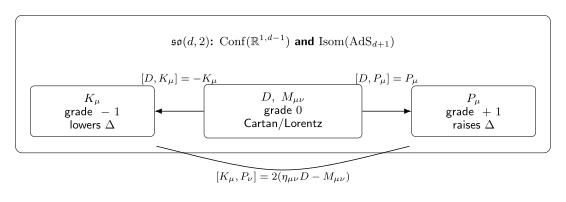
The conformal algebra is naturally organized by dilatation weight. In radial quantization, generates descendants and annihilates primaries at the origin. The same algebra is , the isometry algebra of .
The grading means
with . In particular,
This is the algebraic reason CFT representations look like highest-weight or lowest-weight representations. At the origin, is a lowering operator, so a unitary representation cannot keep lowering forever. It must start from a primary.
Primaries and descendants
Section titled “Primaries and descendants”A local operator at the origin is classified by its transformation under , namely by its scaling dimension and Lorentz representation. A primary operator obeys
where are spin indices and are the Lorentz generators in the representation carried by the operator.
Descendants are obtained by acting with translations:
Because
a level- descendant has dimension . This is why a conformal multiplet is discrete above its primary even when the CFT is interacting.
Away from the origin, the transformation of a scalar primary is fixed by translating the origin result. In infinitesimal form,
for a scalar primary. For spinning primaries, one adds a local Lorentz rotation term proportional to .
This formula is worth digesting. It says that a primary is not just any local operator. It transforms covariantly under the local scale factor generated by a conformal transformation. Descendants transform with extra inhomogeneous terms because derivatives of primaries are not usually primaries.
Repackaging the algebra as
Section titled “Repackaging the algebra as so(d,2)\mathfrak{so}(d,2)so(d,2)”Introduce auxiliary indices
and generators of satisfying
where the ambient metric has two timelike directions. The conformal generators can be embedded as
This change of basis turns the conformal commutators into the standard orthogonal Lie algebra. Conceptually, it says that translations and special conformal transformations are not unrelated miracles. They are rotations involving the two extra embedding directions.
This is also the first place where the future AdS story becomes unavoidable. The conformal algebra is already the algebra of rotations in , and is naturally defined as a hyperboloid inside that same space.
The AdS isometry algebra
Section titled “The AdS isometry algebra”Embed into with coordinates and metric of signature by
The transformations preserving the ambient quadratic form are . Since they also preserve the hyperboloid, they are isometries of :
This gives the group-theoretic core of AdS/CFT:
In Poincare coordinates,
the boundary is at . The conformal generators act on the boundary coordinates in the expected way. In the bulk, they extend to AdS Killing vectors. For example, dilatations act as
The radial coordinate transforms like an energy scale. This is the seed of the relation between radial motion in AdS and RG scale in the CFT.
Special conformal transformations also extend into the bulk. Infinitesimally,
At the boundary , this reduces to the ordinary boundary special conformal transformation
The extra term is precisely what is needed to preserve the AdS metric in the interior.
The quadratic Casimir
Section titled “The quadratic Casimir”The quadratic Casimir of the conformal algebra is
For a primary operator of scaling dimension in a symmetric traceless spin- representation, the eigenvalue is
This formula appears everywhere:
- conformal blocks are eigenfunctions of the conformal Casimir;
- bulk fields in AdS furnish representations of the same algebra;
- the scalar mass-dimension relation is the spin-zero version.
For a scalar primary dual to a scalar bulk field,
Solving for gives
Already at the algebraic level, bulk mass is not merely a parameter in a wave equation. It is the label of an representation, hence the label of a CFT conformal family.
Conserved currents and shortening
Section titled “Conserved currents and shortening”Some conformal multiplets are shorter than a generic primary multiplet. The simplest examples are conserved currents.
A spin-one primary current obeys
In representation theory, this means that a descendant is null. The current multiplet is shorter than a generic spin-one multiplet. In a unitary CFT, this shortening occurs at the protected dimension
Similarly, the stress tensor obeys
and has protected dimension
In AdS/CFT, these protected CFT operators identify massless bulk gauge fields:
The logic is symmetry-based. Conserved currents generate global symmetries in the CFT; in AdS, the corresponding fields are gauge fields. The stress tensor generates spacetime symmetry in the CFT; in AdS, the corresponding field is the graviton.
The special case
Section titled “The special case d=2d=2d=2”For , the flat-space conformal algebra is finite-dimensional. In two dimensions, the local conformal algebra becomes infinite-dimensional, and after quantization one obtains two Virasoro algebras. But the global part is still finite:
in Lorentzian signature. In Euclidean signature, the global group is related to acting by Mobius transformations on the Riemann sphere.
This distinction is crucial. The global conformal algebra is the symmetry matching the isometries of . The Virasoro algebra is a much stronger asymptotic symmetry structure, and its central charge is what eventually enters the Brown-Henneaux and Cardy stories.
What this page buys us
Section titled “What this page buys us”The conformal algebra gives a compact answer to several questions that otherwise look unrelated.
First, why do local operators come in families? Because generates descendants from a primary annihilated by .
Second, why are scaling dimensions like energies? Because after radial quantization, becomes the Hamiltonian on the cylinder.
Third, why does AdS have one extra radial direction? Because the CFT dilatation generator acts geometrically in the bulk as a rescaling of both boundary coordinates and the AdS radial coordinate.
Fourth, why does the scalar dictionary contain ? Because both sides are labels of the same representation.
The next pages will turn this algebra into geometry, first through conformal compactification and the cylinder, and then through embedding-space methods.
Exercises
Section titled “Exercises”Exercise 1: Count the conformal generators
Section titled “Exercise 1: Count the conformal generators”Use the conformal Killing equation in to argue that the conformal algebra has
generators.
Solution
For , the general infinitesimal conformal Killing vector is
The parameters are:
Therefore the total number is
This equals , since has dimension and here .
Exercise 2: Show that translations raise dimension
Section titled “Exercise 2: Show that translations raise dimension”In the representation-theory convention, suppose
Show that the descendant has dimension .
Solution
Use the Jacobi identity:
Substituting the commutators gives
Thus is a level-one descendant of dimension .
Exercise 3: Recover the scalar AdS mass-dimension relation
Section titled “Exercise 3: Recover the scalar AdS mass-dimension relation”A scalar conformal family has quadratic Casimir eigenvalue
A scalar field in has the same Casimir eigenvalue . Find .
Solution
Equating the two eigenvalues gives
This is a quadratic equation:
Solving gives
The standard quantization usually chooses , while in an allowed mass window above the Breitenlohner-Freedman bound there can also be an alternate quantization associated with .
Exercise 4: Check the boundary limit of a bulk special conformal transformation
Section titled “Exercise 4: Check the boundary limit of a bulk special conformal transformation”In Poincare coordinates, the AdS special conformal Killing vector has infinitesimal action
Show that it reduces to the ordinary boundary special conformal transformation as .
Solution
At the boundary, set in the transformation of :
This is exactly the infinitesimal special conformal transformation on .
The radial variation is
so if , then . Thus the boundary is mapped to itself, as required for a bulk isometry inducing a boundary conformal transformation.
Exercise 5: Why is the stress tensor dimension protected?
Section titled “Exercise 5: Why is the stress tensor dimension protected?”Use the fact that is conserved and that the conserved translation charge is
to argue dimensionally that has scaling dimension .
Solution
The translation generator has scaling dimension , because it has the same dimension as a derivative:
The spatial integral has dimension , so if has dimension , then
Equating this to gives
hence
This is consistent with conservation , which is a shortening condition of the conformal multiplet.
Further reading
Section titled “Further reading”For the classic two-dimensional perspective, see Di Francesco, Mathieu, and Senechal, Chapter 4 for global conformal invariance and Chapter 5 for the special enhancement in two dimensions. For a modern higher-dimensional CFT treatment, see Rychkov’s lectures and Simmons-Duffin’s TASI lectures. For the AdS/CFT use of , the essential next step is to study AdS as a hyperboloid embedded in .