
Sources, Operators, and Generating Functionals
The main idea
Section titled “The main idea”The AdS/CFT dictionary begins with a simple piece of quantum field theory. To measure a local operator , couple it to a classical source and study how the partition function changes. In the cleanest convention,
Then is the generating functional of connected correlation functions:
and similarly for higher derivatives.
Holography turns this source calculus into a gravitational boundary-value problem. The source becomes the leading boundary datum of a bulk field , and the generating functional is computed from the renormalized on-shell bulk action:
This is the core of the Gubser-Klebanov-Polyakov/Witten prescription. The later pages will derive the bulk side. This page builds the QFT side carefully.
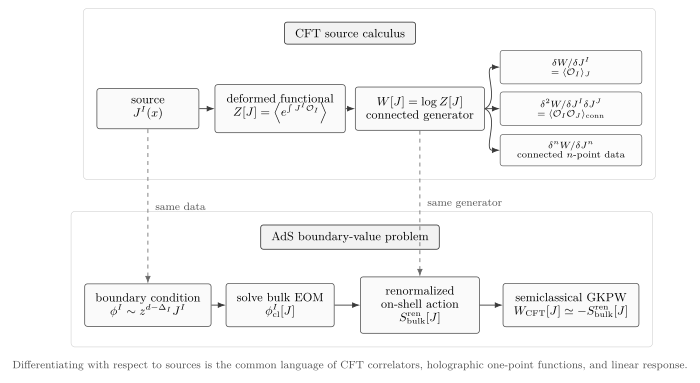
A source couples to a CFT operator and defines a generating functional . Functional derivatives of produce connected correlators. In AdS/CFT, the same source is the boundary value of a bulk field , while the renormalized on-shell action computes in the semiclassical regime.
The important lesson is not merely that is “dual to” . The useful statement is operational:
Once this is understood, local correlators, one-point functions, Ward identities, transport coefficients, and response functions are all variations of the same idea.
Sources are background fields, not quantum operators
Section titled “Sources are background fields, not quantum operators”A source is a classical function or background field that appears in the definition of the path integral. For a scalar operator, the deformation is schematically
in the convention where . The source is not integrated over. It is an external knob.
This distinction matters. The operator fluctuates quantum mechanically. The source labels which QFT problem one is solving. Differentiating with respect to inserts into correlation functions.
More generally, a QFT can be coupled to a collection of sources:
Here sources scalar or spinning operators , is a background gauge field for a conserved current , and the metric sources the stress tensor. More invariantly, the stress tensor is defined by varying the theory with respect to the background metric, not by adding an arbitrary in flat space.
In holography, these sources become boundary data:
| CFT source | CFT operator | Bulk field |
|---|---|---|
| scalar source | scalar operator | scalar field |
| background gauge field | conserved current | bulk gauge field |
| boundary metric | stress tensor | bulk metric |
| spinor source | fermionic operator | bulk spinor |
| source for a line or defect | nonlocal observable | string, brane, or defect geometry |
The superscript on and means “leading boundary value,” not necessarily “small perturbation.” The boundary metric is part of the definition of the CFT background.
Dimensions of sources
Section titled “Dimensions of sources”The source has a scaling dimension fixed by the operator it couples to. In units where , the deformation of the action must be dimensionless:
If has scaling dimension , then
Thus:
| Operator dimension | Source dimension | Name of deformation |
|---|---|---|
| relevant | ||
| marginal | ||
| irrelevant |
This is the CFT version of a radial statement in AdS. A source for a relevant operator grows toward the infrared, so its bulk field tends to backreact strongly in the interior. A source for an irrelevant operator is small in the infrared but dangerous near the ultraviolet boundary; it usually requires specifying UV data beyond the low-energy theory.
For a conserved current , the dimension is fixed by conservation:
The source therefore has dimension one, as expected for a gauge field. For the stress tensor,
and its source, the metric , is dimensionless.
Full correlators from , connected correlators from
Section titled “Full correlators from Z[J]Z[J]Z[J], connected correlators from W[J]W[J]W[J]”Assume for simplicity. Expanding the exponential gives
Therefore derivatives of generate ordinary correlation functions:
The logarithm removes disconnected pieces. Its expansion is the cumulant expansion:
Hence
This distinction is indispensable in large- holography. The classical bulk action computes , not directly. Exponentiating the classical answer gives :
At leading large , is of order . Its functional derivatives generate connected correlators with the expected large- scaling.
The one-point function in a source background
Section titled “The one-point function in a source background”The first derivative of gives the expectation value in the presence of the source:
This formula is more important than it looks. It tells us that the source-dependent one-point function contains all connected correlators. Expanding around ,
Thus the response of a one-point function to a small source is a two-point function. The nonlinear response is controlled by higher connected correlators.
This is the field-theory origin of the holographic rule:
Later, for a scalar field in AdS, the near-boundary expansion will have the form
for standard quantization away from special integer cases. The coefficient is the source. The coefficient is related to the expectation value, after counterterms and possible local terms are included:
The exact normalization depends on the bulk action convention. The conceptual point is invariant: the source is the boundary condition, while the vev is obtained from the renormalized canonical momentum.
Euclidean sign conventions
Section titled “Euclidean sign conventions”There are two common conventions. They differ by signs, not by physics.
Correlator convention
Section titled “Correlator convention”This page mostly uses
Then connected correlators are direct derivatives of :
In this convention, the semiclassical holographic relation is
Euclidean free-energy convention
Section titled “Euclidean free-energy convention”In holographic renormalization it is often cleaner to insert the source into the Euclidean action as
and define
Then
while connected two-point functions carry an extra sign:
In this convention, the classical gravity statement is often written simply as
Both conventions are common. A trustworthy holographic calculation must state which one is being used, especially for Euclidean correlators and stress-tensor variations. Lorentzian retarded correlators require further and boundary-condition prescriptions, which appear later in the course.
Functional derivatives with several sources
Section titled “Functional derivatives with several sources”Real CFTs have many operators. Let denote a collection of sources for operators :
Repeated derivatives give matrix-valued correlators:
If operators mix under renormalization, the sources mix oppositely. This is why the source vector should be thought of as a coordinate system on the space of deformations. Changing renormalization scheme can redefine both operators and sources by local terms.
In holography, this mixing appears as coupled bulk fields. A scalar can mix with the trace of the metric near the boundary; a vector can mix with metric perturbations at finite density; metric perturbations in different channels can mix depending on momentum and symmetry. The source/operator formalism remains the organizing principle even when the equations are coupled.
Metric and current sources
Section titled “Metric and current sources”The metric and background gauge fields deserve special attention because their source dependence encodes Ward identities.
For a theory on a background metric, define the generating functional by
In the correlator convention, a common definition is
up to sign conventions associated with whether one varies or . In the Euclidean free-energy convention , one often writes instead
again with convention-dependent signs. The invariant statement is this: the stress tensor is the response of the theory to a change of background geometry.
Similarly, if is a background gauge field for a conserved current, then
in the correlator convention. Holographically, is the boundary value of a bulk gauge field. The expectation value is obtained from the renormalized radial electric flux.
These definitions are not just formal. They are how one computes:
| Quantity | Source derivative |
|---|---|
| current two-point function | |
| stress-tensor two-point function | |
| conductivity | real-time current response to |
| viscosity | real-time stress response to metric shear |
| charge density | one-point function from |
| energy density and pressure | one-point function from boundary metric variations |
This is why transport theory, thermodynamics, and holographic renormalization all start from the same object: a source-dependent generating functional.
Ward identities from source invariance
Section titled “Ward identities from source invariance”Ward identities are consequences of redundancies or symmetries of the source-dependent generating functional. This is the most economical way to derive them.
Global symmetry and background gauge invariance
Section titled “Global symmetry and background gauge invariance”Suppose has charge under a global symmetry, and we turn on a background gauge field and source :
Background gauge invariance says that is invariant under
Varying and integrating by parts gives the Ward identity
up to anomaly terms if the symmetry is anomalous. When and the symmetry is non-anomalous, this reduces to current conservation:
In the bulk, this Ward identity follows from bulk gauge invariance and the radial constraint equation.
Diffeomorphism Ward identity
Section titled “Diffeomorphism Ward identity”If sources vary in spacetime, energy-momentum is exchanged with the external backgrounds. For scalar sources and background gauge fields, the diffeomorphism Ward identity takes the schematic form
The first term is the Lorentz force density from the background gauge field. The second says that a spacetime-dependent coupling can inject momentum into the system. In holography, this identity is the boundary form of the bulk momentum constraint.
Weyl Ward identity
Section titled “Weyl Ward identity”For a CFT deformed by scalar sources, Weyl invariance implies
for sources with no beta functions, where is the conformal anomaly and possible local source-dependent anomaly. More generally, quantum beta functions replace by .
This formula is one of the cleanest ways to remember relevant deformations: a source with explicitly breaks scale invariance.
Contact terms and scheme dependence
Section titled “Contact terms and scheme dependence”Functional derivatives are distributions. When two insertion points coincide, contact terms appear. For example, adding a local functional of the source,
changes the two-point function by
Separated-point correlators are unchanged. Coincident-point data are scheme-dependent unless protected by anomalies or Ward identities.
This is not a nuisance specific to holography. It is ordinary QFT. Holographic renormalization makes it visible because the on-shell action diverges near the AdS boundary and must be supplemented by local counterterms:
The finite local part of is a scheme choice. In the CFT, it is the freedom to add local functionals of background sources.
A practical rule:
Many apparent disagreements in holographic two-point functions are disagreements about contact terms, normalization, or Euclidean sign conventions.
Sources versus expectation values
Section titled “Sources versus expectation values”A central trap in AdS/CFT is confusing a source with a vacuum expectation value. In a CFT, the difference is sharp:
whereas
In the bulk, both appear as coefficients in the near-boundary expansion of the same field. That is why the confusion is tempting.
For a scalar in standard quantization,
The leading coefficient is the source. The subleading coefficient is related to the vev. But local terms can mix into the precise relation:
When the scalar mass lies in the alternate-quantization window, the roles of the two coefficients can be exchanged by a Legendre transform. That is not a contradiction; it means the same bulk boundary condition can define different CFTs or different choices of operator dimension. This will be discussed after the mass-dimension relation.
Legendre transforms and effective actions
Section titled “Legendre transforms and effective actions”The generating functional is source-based. Sometimes one wants a functional of expectation values instead. Define
The Legendre transform is
where is eliminated in favor of . Varying gives
Thus stationary points of at describe possible expectation values in the undeformed theory.
In ordinary QFT, is the one-particle-irreducible effective action. In holography, Legendre transforms appear in at least three important places:
- alternate quantization for scalars near the Breitenlohner-Freedman window;
- multi-trace deformations, especially double-trace flows;
- changing ensembles, for example between fixed chemical potential and fixed charge density.
The moral is that sources and vevs are conjugate variables. Holographic boundary conditions choose which variable is fixed.
Multi-trace sources
Section titled “Multi-trace sources”A source for a single-trace operator is not the same as a multi-trace deformation. Compare
with
The first changes the one-point source. The second changes the dynamics of the theory. At large , double-trace deformations are especially tractable because factorization makes behave semiclassically. Holographically, they often correspond to mixed boundary conditions relating the source-like and vev-like coefficients:
or, depending on quantization, the inverse relation.
This is a preview. The main point for this page is that the generating functional can be enlarged to include sources for composite operators, but each source corresponds to a distinct deformation of the QFT.
Euclidean sources, Lorentzian sources, and states
Section titled “Euclidean sources, Lorentzian sources, and states”A source is not always merely a deformation of the Hamiltonian. Its interpretation depends on where it is turned on.
Euclidean sources
Section titled “Euclidean sources”A Euclidean source over the full Euclidean spacetime computes ordinary Euclidean correlators. A Euclidean source on part of a Euclidean manifold can prepare a state. For example, a source on a Euclidean cap can prepare an excited state on the boundary time slice where the cap ends.
Lorentzian sources
Section titled “Lorentzian sources”A Lorentzian time-dependent source changes the Hamiltonian:
in the correlator convention. It injects energy and creates real-time response. Retarded functions are obtained by differentiating the causal response of one-point functions:
where
The Euclidean generating functional alone does not automatically specify the retarded prescription in a black-hole background. In Lorentzian holography, one must impose causal boundary conditions, such as infalling conditions at horizons. This returns later in the pages on real-time correlators and quasinormal modes.
How this page becomes the GKPW prescription
Section titled “How this page becomes the GKPW prescription”The QFT source calculus says:
AdS/CFT says:
In the classical supergravity limit,
Therefore
in the correlator convention used above. If one uses the Euclidean free-energy convention, the signs are reshuffled but the source dependence is the same.
The computational algorithm is:
- choose a boundary source ;
- solve the bulk equations with boundary behavior ;
- evaluate and renormalize the on-shell action;
- differentiate with respect to ;
- set unless computing in a deformed theory or background source.
This is the seed of Witten diagrams. Expanding the classical solution and on-shell action perturbatively in generates tree-level diagrams. Including bulk quantum loops gives corrections.
Common mistakes
Section titled “Common mistakes”Mistake 1: Confusing the source with the operator
Section titled “Mistake 1: Confusing the source with the operator”The source is a classical background. The operator is a quantum observable. The statement really means that is the boundary condition for the bulk field , not that is a fluctuating CFT operator.
Mistake 2: Confusing the source with the vev
Section titled “Mistake 2: Confusing the source with the vev”Both the source and the vev appear in the asymptotic expansion of a bulk field. The source is fixed; the vev is computed. In standard quantization, the source is the leading coefficient for scalar operators, while the vev is related to the subleading coefficient after renormalization.
Mistake 3: Forgetting connected versus disconnected correlators
Section titled “Mistake 3: Forgetting connected versus disconnected correlators”Derivatives of generate full correlators. Derivatives of generate connected correlators. The classical bulk action computes the connected generating functional.
Mistake 4: Treating contact terms as universal
Section titled “Mistake 4: Treating contact terms as universal”Adding finite local counterterms changes coincident-point terms. Momentum-space correlators can shift by polynomials in momentum. These terms are often scheme-dependent, although anomalies and Ward identities can fix special local pieces.
Mistake 5: Ignoring sign conventions
Section titled “Mistake 5: Ignoring sign conventions”A formula for can differ by a minus sign depending on whether the source is written as in the exponent or in the Euclidean action. Always track whether the generating functional is or .
Exercises
Section titled “Exercises”Exercise 1: Connected correlators from
Section titled “Exercise 1: Connected correlators from W[J]W[J]W[J]”Let
Show that
Solution
First,
Differentiating again gives
At and ,
and
Therefore
This is the connected two-point function.
Exercise 2: Dimension of a source
Section titled “Exercise 2: Dimension of a source”A scalar primary operator has scaling dimension . Use dimensional analysis of
to determine the scaling dimension of . Which sources are relevant, marginal, and irrelevant?
Solution
The action is dimensionless. Since has dimension and has dimension , we need
Thus
If , the source has positive mass dimension and the deformation is relevant. If , the source is dimensionless and the deformation is marginal. If , the source has negative mass dimension and the deformation is irrelevant.
Exercise 3: A Ward identity from background gauge invariance
Section titled “Exercise 3: A Ward identity from background gauge invariance”Let be invariant under
Using
derive the corresponding Ward identity.
Solution
The variation of is
Integrating the first term by parts gives
ignoring boundary terms. Since is arbitrary and , we obtain
This is current conservation modified by explicit charged sources. For and no anomaly, it becomes .
Exercise 4: Contact terms from finite counterterms
Section titled “Exercise 4: Contact terms from finite counterterms”Suppose the connected generating functional is shifted by a finite local term,
How does the two-point function change? Does this affect separated points?
Solution
The added term contributes
and therefore
Thus
This affects only coincident points. For , the separated-point correlator is unchanged. In momentum space, this contact term appears as a momentum-independent polynomial contribution.
Exercise 5: Legendre transform
Section titled “Exercise 5: Legendre transform”Let
Define
where is treated as a functional of . Show that
Solution
Vary :
Using
the terms proportional to cancel. Therefore
which implies
At zero source, stationary points of describe possible expectation values in the undeformed theory.
Further reading
Section titled “Further reading”For the original source/boundary-value formulation of AdS/CFT, see Gubser, Klebanov, and Polyakov, Gauge Theory Correlators from Non-Critical String Theory, and Witten, Anti de Sitter Space and Holography. For the systematic treatment of one-point functions, counterterms, Ward identities, and holographic renormalization, see Skenderis, Lecture Notes on Holographic Renormalization. For the role of Legendre transforms and alternate quantization, see Klebanov and Witten, AdS/CFT Correspondence and Symmetry Breaking.