
Numerical Holography and Open Problems
Numerics are not a decorative extra in holographic quantum matter. They are one of the main ways the subject becomes a laboratory.
The analytic solutions that built intuition in the previous pages are highly symmetric: neutral black branes, Reissner—Nordström black branes, simple Einstein—Maxwell—dilaton scaling geometries, homogeneous axion models, probe fields, and linearized perturbations in translationally invariant backgrounds. Real questions quickly break this symmetry. Lattices, stripes, vortices, disorder, pair-density waves, finite-momentum instabilities, nonlinear optical response, and fully backreacted ordered phases generally do not reduce to one-line black-brane metrics.
The useful slogan is
A numerical holographer is not merely solving equations. They are constructing a state of a strongly coupled many-body system, choosing an ensemble, fixing sources, imposing regularity in the deep IR, renormalizing UV data, and checking Ward identities. The computer is doing analysis with a stern poker face.
What kind of numerical problem is it?
Section titled “What kind of numerical problem is it?”The first step is to identify the mathematical type of the problem. Holographic computations come in several families.
| Problem | Typical equations | Boundary conditions | Output |
|---|---|---|---|
| Homogeneous equilibrium background | Nonlinear ODEs in | UV sources, horizon regularity | Thermodynamics, one-point functions |
| Homogeneous linear response | Linear ODEs in at | UV source/response, infalling horizon | Green functions, conductivities, QNMs |
| Inhomogeneous static background | Nonlinear elliptic PDEs in or | UV lattice/order data, horizon/axis regularity | Phase diagrams, free energies, charge profiles |
| Inhomogeneous DC transport | Linear elliptic equations on the horizon or bulk | Periodic sources, regularity | DC conductivity matrices |
| Quasinormal modes | Linear eigenvalue problem | Source-free UV data, infalling horizon | Pole locations |
| Time-dependent dynamics | Hyperbolic or mixed evolution equations | Initial data, boundary driving, horizon regularity | Quenches, thermalization, turbulence |
This page focuses mainly on stationary and linear-response problems, because those are the daily bread of holographic quantum matter. Fully time-dependent numerical relativity is a large subject of its own. It appears here only where it directly touches quenches and nonequilibrium quantum matter.
ODEs versus PDEs
Section titled “ODEs versus PDEs”A homogeneous black brane has fields depending only on the holographic coordinate:
Then the Einstein—matter equations reduce to coupled nonlinear ordinary differential equations. This is the setting for many textbook calculations: holographic superconductors in the probe limit, homogeneous Q-lattices, linear axion models, homogeneous EMD flows, and many quasinormal-mode computations.
A literal lattice, a stripe, a vortex, or a disordered source forces the fields to depend on boundary directions as well:
The same physical dictionary is now implemented by nonlinear partial differential equations. This is the point at which numerical holography becomes a craft.
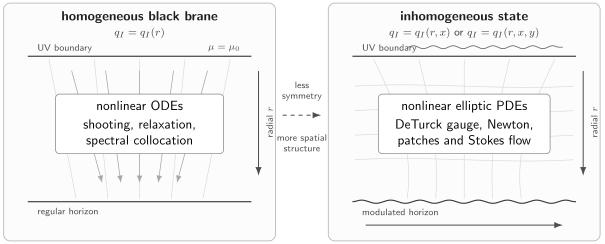
Homogeneous ansätze reduce holographic backgrounds to radial ODEs. Lattices, stripes, disorder, vortices, and spatially varying order parameters generally produce coupled PDEs in the radial and boundary directions.
The danger is to underestimate how much physics is hidden in the phrase “turn on a lattice.” A homogeneous axion model with may capture momentum relaxation efficiently, but it does not have a Brillouin zone, Bloch bands, Umklapp selection rules, or a spatially resolved charge density. A literal periodic chemical potential
does. It also forces the bulk fields to become inhomogeneous, which is why it is harder.
Boundary value problems, not initial value problems
Section titled “Boundary value problems, not initial value problems”Most equilibrium holographic computations are boundary value problems. One specifies data at the UV boundary and at the horizon, then solves in between.
Near the UV boundary, the asymptotic expansion fixes sources and responses. For example, schematically,
and
At the horizon, one does not prescribe arbitrary data. One imposes regularity. For static backgrounds in Euclidean signature, this means smoothness of the thermal cigar. For Lorentzian retarded response, it means infalling regularity in ingoing Eddington—Finkelstein coordinates.
For a nonextremal horizon, a convenient local radial coordinate has
Euclidean smoothness fixes the period of imaginary time:
In numerical coordinates, this smoothness becomes algebraic relations among the Taylor coefficients of all fields at the horizon. A very common source of wrong numerical answers is imposing too many or too few horizon conditions. The solution then still converges, in the purely numerical sense, to the wrong problem. The machine is loyal but not wise.
A minimal ODE workflow
Section titled “A minimal ODE workflow”For a homogeneous finite-density background, one often starts with an ansatz such as
The workflow is usually:
- Use scaling symmetries to set convenient units, often or .
- Expand all fields near the horizon and keep only regular branches.
- Expand all fields near the boundary and identify sources and responses.
- Shoot or relax from horizon to boundary.
- Tune horizon data so unwanted sources vanish.
- Evaluate the renormalized on-shell action or thermodynamic densities.
- Check the first law and Ward identities.
For example, in a source-free holographic condensate one tunes the horizon data so that
The equation solver does not know the difference between an explicit source and a spontaneous order parameter. The boundary conditions tell it.
Shooting
Section titled “Shooting”Shooting is conceptually simple: integrate from the horizon to the boundary and tune the initial horizon parameters until the UV boundary conditions are satisfied. It is excellent for small systems of ODEs, especially near analytic black-brane backgrounds.
Its weaknesses are equally important. Shooting can be unstable when the system contains growing and decaying modes, when the IR is near-extremal, or when the solution passes close to a singular scaling regime. In those cases, a tiny numerical contamination in the wrong mode can dominate the UV data.
Relaxation and collocation
Section titled “Relaxation and collocation”Relaxation methods solve for the whole radial profile at once. After discretizing , one treats the differential equations and boundary conditions as a large nonlinear algebraic system.
A Newton iteration has the schematic form
where is the discretized equation and is its Jacobian. The method is powerful when one has a good initial seed. It is merciless when one does not.
Spectral collocation is especially popular. For a smooth function on , one expands in Chebyshev polynomials,
or evaluates the function at Chebyshev—Gauss—Lobatto points
For analytic functions, spectral coefficients often decay exponentially. That is why spectral methods can be astonishingly accurate with modest grids. For nonsmooth functions, sharp disorder, or phase boundaries, the same methods can show Gibbs oscillations and slow convergence. Smoothness is not a technical footnote; it is the fuel.
When gravity is gauge redundant
Section titled “When gravity is gauge redundant”Einstein’s equations are not ordinary elliptic equations. They have diffeomorphism redundancy. If is a solution, then any coordinate transform of is also a solution. Numerically, this redundancy appears as zero directions in the differential operator.
For highly symmetric ODE systems, one can often fix the gauge by hand. For PDE problems, especially fully backreacted inhomogeneous black holes, a robust method is needed. The workhorse is the Einstein—DeTurck method.
Choose a reference metric with the same asymptotic and horizon structure as the desired metric. Define the DeTurck vector
Then replace the Einstein equation by the Einstein—DeTurck equation
where denotes the original Einstein equation, including cosmological constant and matter contributions in trace-reversed form if convenient. If the solution also satisfies
then it is a genuine solution of the original Einstein equations. The DeTurck term is not new physics. It is gauge fixing.
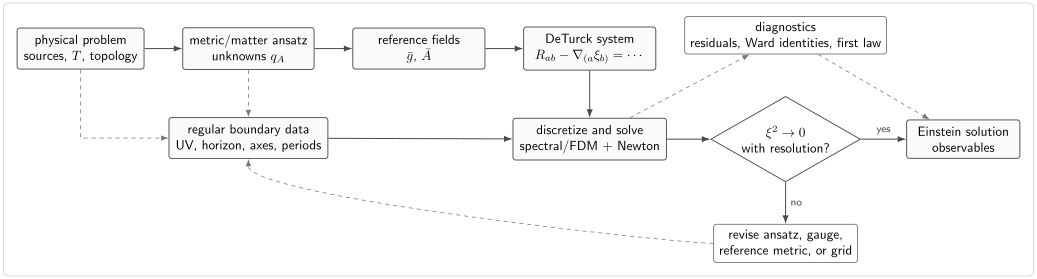
The Einstein—DeTurck method converts many stationary gravitational problems into elliptic boundary value problems. A numerical solution is accepted as an Einstein solution only after checking that the DeTurck vector vanishes in the continuum limit.
The reference metric is not a guess for the final answer. It is a gauge anchor. It should have the same causal and boundary structure: the same conformal boundary, the same horizon topology, the same axes or periodic identifications, and the same type of asymptotics. A bad reference metric can make the numerical problem ill-conditioned or impose the wrong topology.
The caveat is important. The equation
can in principle have solutions with , called Ricci solitons in the vacuum setting. In many static Euclidean or asymptotically AdS situations, maximum-principle arguments rule these out under suitable boundary conditions. In general, especially with matter fields, stationarity, or complicated boundaries, one must check numerically that
with increasing resolution.
Boundary conditions in PDE problems
Section titled “Boundary conditions in PDE problems”For a PDE background, every boundary of the computational domain has physical meaning.
At the conformal boundary, one fixes the sources: chemical potential, lattice amplitude, boundary metric, scalar source, magnetic field, or strain. At a horizon, one imposes regularity. At an axis, one imposes smooth polar behavior. At a periodic boundary, one imposes periodicity. At an artificial patch interface, one imposes continuity of fields and normal derivatives.
A useful checklist is:
| Boundary | Typical condition | Common mistake |
|---|---|---|
| UV conformal boundary | Fix sources; extract vevs | Accidentally fixing response data |
| Nonextremal horizon | Regular Taylor expansion | Imposing without checking gauge regularity |
| Axis of symmetry | Smoothness and no conical defect | Wrong parity condition for one field |
| Periodic direction | Periodic fields and derivatives | Incommensurate grid with lattice period |
| Patch interface | Continuity of field and flux | Allowing derivative jumps |
| Extremal horizon | IR scaling or matched boundary data | Treating it like a smooth nonextremal cigar |
Extremal horizons are especially delicate. The near-horizon region can become an infinite throat. Numerically, this often causes scale separation, stiffness, and ambiguous IR boundary conditions. Many calculations therefore approach extremality by solving at small nonzero temperature and extrapolating.
Linear response on numerical backgrounds
Section titled “Linear response on numerical backgrounds”Once a background is known, observables are obtained from fluctuations. For fields , write
The linearized equations have the schematic form
For retarded Green functions, the horizon condition is infalling regularity. Near a nonextremal horizon,
in Schwarzschild-like coordinates, or simply regularity in ingoing Eddington—Finkelstein coordinates.
Near the boundary,
The Green-function matrix is obtained by solving several linearly independent source problems and differentiating the renormalized responses:
Quasinormal modes are the same differential problem with a different UV condition:
The allowed frequencies are poles of :
where is the source matrix built from a basis of infalling solutions. Numerically, this becomes an eigenvalue or root-finding problem.
DC transport and horizon fluids
Section titled “DC transport and horizon fluids”For many holographic models, DC transport can be computed without solving the full optical response at every . The idea is to perturb the system by constant electric fields and thermal gradients, then use radially conserved currents.
In homogeneous models, this often gives closed-form horizon formulae such as
or model-specific exact variants.
In inhomogeneous lattices, the DC problem can reduce to a forced Stokes problem on the black-hole horizon. Schematically,
with horizon charge density , entropy density , electric field , and thermal drive . Solving these horizon equations yields averaged currents and hence the DC conductivity matrix. This is one of the cleanest examples of the membrane paradigm becoming a practical numerical method.
The warning is that horizon formulae compute DC response under specific assumptions: stationarity, regular horizons, correct treatment of magnetization currents, and the right ensemble. They are not shortcuts around understanding the variational problem.
Extracting physical observables
Section titled “Extracting physical observables”The numerical solution is not the final answer. The final answer is a renormalized boundary observable.
For one-point functions, use the variation of the renormalized action:
For thermodynamics, compare free energies in the same ensemble. In the grand canonical ensemble,
where is the renormalized Euclidean on-shell action. In the canonical ensemble, one Legendre transforms with respect to charge.
For transport, use Kubo formulae, for example
up to contact-term and magnetization subtleties.
For phases with spontaneous order, the source must vanish while the response does not:
For striped or crystalline phases, the spatial average and the spatially resolved profile carry different information:
A phase diagram drawn only from averaged quantities can miss the central physics.
Error control: the boring part that saves the paper
Section titled “Error control: the boring part that saves the paper”A numerical holographic result should come with checks. The best checks are not cosmetic; they are independent physical statements.
| Check | What it catches |
|---|---|
| Spectral convergence with increasing | Insufficient resolution, nonsmoothness |
| Residual norm | Failure to solve discretized equations |
| Constraint equations | Gauge or formulation mistakes |
| in DeTurck method | Ricci solitons or poor convergence |
| Ward identities | Wrong counterterms or boundary conditions |
| First law of thermodynamics | Incorrect free energy or charge normalization |
| Smarr relation when available | Global normalization errors |
| Kramers—Kronig relations | Inconsistent optical conductivity |
| Sum rules | Missing contact terms or spectral weight |
| Coordinate/gauge independence | Gauge artifacts mistaken for physics |
| Alternative discretization or patching | Method-specific artifacts |
For instance, in a translationally invariant charged brane, the thermodynamic quantities should satisfy
and, for a conformal theory in flat space,
If the numerical background violates these after holographic renormalization, the problem is not “small numerical error.” It is usually a convention error, a counterterm error, or a boundary-condition error.
Continuation and phase diagrams
Section titled “Continuation and phase diagrams”Most interesting solutions are not found from scratch. They are continued from known solutions.
A typical strategy is:
The zero mode tells us where a new branch begins. Suppose a fluctuation has a static normalizable mode at some control parameter :
Then one can seed a nonlinear solve by
This is how many holographic superconductors, striped phases, helical phases, lumpy black holes, and unstable branches are discovered.
Near turning points, ordinary parameter continuation can fail. If the branch bends in parameter space, one should use pseudo-arclength continuation. Instead of using as the only control parameter, one introduces a branch coordinate and solves
This prevents the solver from getting confused when .
Common failure modes
Section titled “Common failure modes”Mistaking a numerical branch for a stable phase
Section titled “Mistaking a numerical branch for a stable phase”A solution of the equations is not automatically thermodynamically dominant. It may be metastable or dynamically unstable. One must compare free energies in the same ensemble and, where possible, study linear perturbations.
Imposing spontaneous order by hand
Section titled “Imposing spontaneous order by hand”A striped phase is spontaneous only if the spatially modulated source is zero. If the boundary chemical potential or scalar source is modulated, translations are explicitly broken. Both are valuable, but they are different phases.
Forgetting magnetization currents
Section titled “Forgetting magnetization currents”In a magnetic field or spatially varying background, local currents can include circulating magnetization currents. Transport currents are not always equal to naive spatial averages of local currents. The subtraction is part of the observable definition.
Trusting one grid
Section titled “Trusting one grid”A single high-resolution plot is not convergence. Good numerics show how the answer changes with resolution, patch number, tolerance, and domain map. A gorgeous plot can still be a lie with antialiasing.
Using singular coordinates at the horizon
Section titled “Using singular coordinates at the horizon”Many horizon divergences are coordinate artifacts. Ingoing coordinates often turn a complicated infalling condition into ordinary regularity. When in doubt, transform to coordinates in which the future horizon is manifestly smooth.
Open problems in numerical holographic quantum matter
Section titled “Open problems in numerical holographic quantum matter”This course has repeatedly emphasized model status. The same caution applies to open problems. Some are conceptual; some are computational; many are both.
1. Fully backreacted disordered matter
Section titled “1. Fully backreacted disordered matter”Disorder is central in condensed matter, but hard in gravity. A realistic disorder average requires many inhomogeneous bulk solutions or a controlled statistical formulation. The questions are sharp:
Homogeneous momentum-relaxation models are useful, but they are not disorder. Literal random sources remain expensive, especially at low temperature and in two spatial boundary dimensions.
2. Spontaneous crystals, stripes, and pair-density waves
Section titled “2. Spontaneous crystals, stripes, and pair-density waves”Finite-momentum instabilities are easy to see at linear order. The fully backreacted endpoint can be very hard. In a spontaneous stripe, one must solve nonlinear PDEs, set the modulated source to zero, allow the wavevector to adjust, and compare free energies against homogeneous and explicitly pinned competitors.
The most interesting questions involve dynamics: phason relaxation, pinning by weak disorder, nonlinear sliding, and competition with superconductivity.
3. Low-temperature IR completions
Section titled “3. Low-temperature IR completions”Many EMD scaling geometries are singular in the deep IR. They may be acceptable intermediate scaling regimes, but a complete state requires an IR endpoint: a horizon, a cap, a condensate, a fermion fluid, a brane construction, or higher-derivative/string corrections.
Numerically, one would like controlled flows of the form
This is hard because the intermediate scaling region grows as temperature is lowered, creating severe scale separation.
4. Fermion backreaction beyond the fluid approximation
Section titled “4. Fermion backreaction beyond the fluid approximation”Probe fermions reveal spectral functions and Fermi momenta, but they do not by themselves determine the charge-carrying geometry. Electron stars and Dirac hair go further, yet many calculations use WKB or fluid approximations.
An open frontier is a more complete treatment of fermionic charge, quantum oscillations, pairing, and transport beyond the simplest large- and Thomas—Fermi limits.
5. Nonlinear nonequilibrium transport
Section titled “5. Nonlinear nonequilibrium transport”Linear response is mature. Nonlinear response is less so. Strong electric fields, driven steady states, Floquet sources, Joule heating, vortex motion, and turbulence all ask for time-dependent or stationary out-of-equilibrium geometries.
The conceptual question is whether the large- bath-like nature of holographic matter faithfully captures the target physics or washes out the bottlenecks that matter in real materials.
6. Holographic model selection
Section titled “6. Holographic model selection”Bottom-up models are wonderfully flexible. That is the problem. Given enough scalar potentials, gauge couplings, axions, lattices, and Chern—Simons terms, one can fit many scalings. The field needs sharper criteria:
Numerical holography can help by scanning model families, not just single examples.
7. Reproducibility and benchmark problems
Section titled “7. Reproducibility and benchmark problems”Many numerical holography calculations are technically demanding and hard to reproduce. A healthy field needs benchmark solutions, standard grids, public code fragments, and agreed diagnostic tests. Some classic problems should be reproducible by a graduate student in a week, not rediscovered in a panic over six months.
Good benchmark targets include:
- the holographic superconductor condensate curve;
- the lowest QNMs of AdS-Schwarzschild;
- a Q-lattice DC conductivity curve;
- a simple DeTurck lattice background;
- a horizon Stokes conductivity computation;
- an HRT surface in a Vaidya geometry.
The real point is cultural: trustworthy numerics require shareable checks, not just impressive figures.
A compact numerical checklist
Section titled “A compact numerical checklist”Before believing a numerical holographic result, ask:
- What is the ensemble?
- Which sources are fixed?
- Which vevs are allowed to vary?
- Is the horizon regular in smooth coordinates?
- Is the gravitational gauge fixed?
- Are constraint equations satisfied?
- Does the solution converge with resolution?
- Are thermodynamic identities satisfied?
- Are Ward identities satisfied?
- Are contact terms and magnetization currents treated correctly?
- Is the phase thermodynamically dominant or merely present?
- Which claims are robust, and which are model-specific?
This checklist is not glamorous. It is the difference between a numerical solution and a physics result.
Exercises
Section titled “Exercises”Exercise 1: ODE or PDE?
Section titled “Exercise 1: ODE or PDE?”Classify each setup as an ODE background problem, a PDE background problem, a linear ODE response problem, or a linear PDE response problem.
- RN-AdS black brane at finite .
- A holographic superconductor with homogeneous condensate.
- A chemical potential with full backreaction.
- Optical conductivity of a homogeneous RN-AdS brane.
- Quasinormal modes of an explicitly striped black brane.
Solution
- RN-AdS is homogeneous, so the background is an ODE problem. In fact, it is analytic in simple Einstein—Maxwell theory.
- A homogeneous holographic superconductor is a nonlinear ODE background problem.
- A spatially modulated chemical potential creates an inhomogeneous background, so it is a nonlinear PDE problem in .
- Homogeneous optical conductivity uses linearized fluctuations depending on only at fixed , so it is a linear ODE response problem.
- A striped background depends on . Its QNMs generally fluctuate over the same variables, so this is a linear PDE eigenvalue problem.
Exercise 2: why the DeTurck check is mandatory
Section titled “Exercise 2: why the DeTurck check is mandatory”Suppose a numerical solution satisfies
Show that if , it solves the original Einstein equation . Why is the converse not enough for numerics?
Solution
If , then
and the modified equation reduces immediately to
Thus a DeTurck solution with vanishing DeTurck vector is an Einstein solution.
The numerical issue is that the modified equations may admit solutions with . These solve the gauge-fixed problem but not the original gravitational equations. Therefore one must check that a suitable norm, for example , decreases to zero as the continuum limit is approached.
Exercise 3: source-free condensate
Section titled “Exercise 3: source-free condensate”A scalar near the boundary behaves as
Which condition describes spontaneous condensation? Which condition describes explicit symmetry breaking?
Solution
Spontaneous condensation means the source vanishes but the response is nonzero:
Explicit symmetry breaking means the source is turned on:
The response may also be nonzero in that case, but it is no longer a purely spontaneous order parameter.
Exercise 4: quasinormal modes versus Green functions
Section titled “Exercise 4: quasinormal modes versus Green functions”For a scalar fluctuation in a black-brane background, explain the difference between computing and computing a quasinormal mode frequency.
Solution
Both computations impose infalling boundary conditions at the horizon. The difference is the UV boundary condition.
For a Green function, one fixes a nonzero source and reads off the response:
For a quasinormal mode, the source is set to zero:
Only discrete complex frequencies allow a nontrivial infalling, source-free solution. These frequencies are the poles of the retarded Green function.
Exercise 5: spectral convergence
Section titled “Exercise 5: spectral convergence”Why do Chebyshev spectral methods often converge exponentially for smooth holographic backgrounds but poorly for a discontinuous random source?
Solution
Spectral methods approximate a function by global basis functions. If the function is analytic on the domain, the spectral coefficients decay exponentially with mode number, so increasing the grid gives rapid convergence.
A discontinuity or sharp nonsmooth feature has slowly decaying spectral coefficients. Global polynomial approximations then develop oscillations near the discontinuity, the Gibbs phenomenon, and convergence becomes slow. For rough disorder, one may need smoothing, finite-element methods, domain decomposition, or many realizations with careful resolution tests.
Exercise 6: phase dominance
Section titled “Exercise 6: phase dominance”A numerical code finds a new hairy black-brane branch below a critical temperature. What must be checked before calling it the preferred phase?
Solution
Existence is not dominance. One must compare the appropriate thermodynamic potential in the same ensemble. In the grand canonical ensemble, compare
at fixed , , and all other sources. In the canonical ensemble, compare the Legendre-transformed free energy at fixed charge density.
One should also check stability when possible. A branch can exist but be dynamically unstable or metastable.
Further reading
Section titled “Further reading”For the Einstein—DeTurck method, stationary gravitational boundary value problems, zero modes, boundary conditions, patching, and spectral collocation, the review by Dias, Santos, and Way is the standard practical entry point. For holographic renormalization, source/response data, finite-temperature thermodynamics, and real-time correlators, use the textbook treatments by Ammon—Erdmenger, Natsuume, and Năstase. For holographic quantum matter computations in transport, finite density, memory matrices, probe branes, disorder, quenches, and symmetry breaking, use Hartnoll—Lucas—Sachdev together with Zaanen—Liu—Sun—Schalm. For entanglement surfaces and quench diagnostics, use Rangamani—Takayanagi.