
Near-Horizon Geometry
The previous page explained that a stack of coincident D3-branes has two complementary descriptions. The open-string description gives four-dimensional super-Yang–Mills theory. The closed-string description gives the extremal D3-brane supergravity solution.
This page performs the central geometric step: it shows explicitly that the near-horizon region of the D3-brane solution is
This is the moment when the brane argument turns into the canonical AdS/CFT geometry.
The result is simple enough to remember, but subtle enough to deserve a careful derivation. The near-horizon limit is not merely the statement that is small. It is a controlled zoom into the throat of the D3-brane geometry, in which the asymptotically flat region decouples and the throat becomes a complete spacetime with its own conformal boundary.
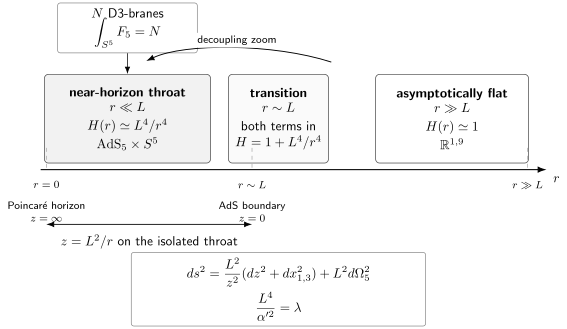
The extremal D3-brane geometry has an asymptotically flat region at , a transition region near , and a near-horizon throat at . In the throat, is approximated by , and the geometry becomes . The coordinate puts the AdS factor in Poincaré form; becomes the Poincaré horizon , while the mouth of the throat becomes the AdS boundary after the decoupling limit.
Why this matters
Section titled “Why this matters”The full D3-brane geometry is not pure AdS. It is a ten-dimensional spacetime that is asymptotically flat far from the branes and strongly warped near them. The AdS/CFT correspondence uses a special low-energy sector of this spacetime: the near-horizon throat.
The geometry teaches three foundational lessons.
First, AdS is not inserted by hand. It emerges from the gravitational field of D3-branes.
Second, the radius of curvature is controlled by the same parameter that controls the strength of the gauge theory:
Thus weakly curved geometry corresponds to large ‘t Hooft coupling.
Third, the D3-brane charge becomes five-form flux through the :
The integer does not disappear when the branes are replaced by geometry. It becomes flux, and it controls the number of degrees of freedom in the dual gauge theory.
The extremal D3-brane solution
Section titled “The extremal D3-brane solution”Work in type IIB string theory with ten-dimensional coordinates split as
where
The D3-branes fill the directions and sit at the origin of the six transverse coordinates . Define the transverse radial coordinate
In string frame, the extremal D3-brane metric is
where
The Minkowski metric along the branes is
The dilaton is constant,
and the solution carries self-dual Ramond–Ramond five-form flux . Flux quantization relates the length scale to the D3-brane charge :
With the convention used in this course,
so
Different trace conventions can move factors of and between and . The invariant physical statement is that is proportional to , equivalently to the ‘t Hooft coupling up to convention.
The two terms in
Section titled “The two terms in H(r)H(r)H(r)”The harmonic function
has two pieces with different geometric meanings.
At large radius,
the constant term dominates:
The metric becomes approximately flat ten-dimensional Minkowski spacetime:
This is the asymptotically flat region.
Near the branes,
the second term dominates:
This is the near-horizon region. It is also called the throat because the radial proper distance grows logarithmically as one moves toward .
To see the throat behavior, look only at the radial part of the near-horizon metric. Since
the radial line element is
The proper radial distance between and is therefore
As , this distance diverges. The horizon at lies infinitely far down the throat in the extremal geometry.
Now take the near-horizon approximation
Then
Substitute these into the D3-brane metric:
The sphere term simplifies:
Thus
The last term is a round five-sphere of radius .
To recognize the first two terms as AdS, introduce the Poincaré radial coordinate
Then
The brane-parallel warp factor becomes
and the radial term becomes
Therefore
This is precisely
in Poincaré coordinates, with both factors having radius .
What happened to the branes?
Section titled “What happened to the branes?”A common first reaction is: if the branes were at , and has become the Poincaré horizon , where did the D3-branes go?
The answer is that the localized brane source has been replaced, in the near-horizon supergravity description, by flux and geometry. The D3-brane charge is measured by the five-form flux through the :
up to the conventional normalization of . The integer survives as topological flux data of the geometry.
This is familiar from other gravitational solutions. Outside a charged object, one can measure its charge by flux through a surrounding sphere even if the microscopic source is hidden behind a horizon or replaced by a smooth region in an effective description. In the D3-brane case, the near-horizon throat keeps the flux but discards the asymptotically flat region.
The geometric slogan is:
The field-theory slogan is:
The near-horizon limit is a zoom
Section titled “The near-horizon limit is a zoom”It is tempting to say simply: take , drop the in , and obtain AdS. That is correct as a local geometric statement, but the AdS/CFT limit is more precise.
The near-horizon limit is a zoom into the throat while keeping finite the energy scale seen by the D3-brane theory. A useful variable is
In the decoupling limit one sends
while keeping , , and fixed. Since
the ratio
becomes parametrically large in the throat scaling. Thus the in disappears from the metric measured in string units. The asymptotically flat region is removed, and the throat is blown up into a complete AdS spacetime.
One often writes the near-horizon metric in the form
with the same convention . This makes the gauge-theory coupling dependence visible: the curvature radius in string units is
The next page will focus on the decoupling limit in more detail. For now, the important point is that the AdS boundary of the near-horizon geometry is not the original asymptotically flat infinity. It is the upper end of the throat after the zoom.
The redshift interpretation
Section titled “The redshift interpretation”The D3-brane throat also explains why near-horizon excitations are naturally low-energy excitations as seen from far away.
For a static excitation at radius , the relation between local proper energy and energy measured at infinity is controlled by the time-time component of the metric:
For the D3-brane solution,
so
In the near-horizon region,
hence
As , finite local energies are redshifted to arbitrarily small energies as seen from infinity. This is the closed-string-side reason that the low-energy limit keeps throat physics.
In the coordinate, this becomes
Large means deep interior and low boundary energy. Small means near the AdS boundary and high boundary energy. This is the first geometric hint of the UV/IR relation:
This statement will become sharper when we study holographic renormalization.
The sphere and the R-symmetry
Section titled “The sphere and the R-symmetry”The five-sphere is not an optional decoration. It remembers the six transverse directions to the D3-branes.
The original flat transverse space is
Writing it in polar coordinates gives
The rotations of the transverse space form
On the D3-brane worldvolume, the six transverse positions become six scalar fields of SYM. Rotating these scalars gives the R-symmetry:
On the gravity side, the same symmetry is the isometry group of :
Thus
The size of the sphere is also fixed by the flux. More flux means a larger radius in string units:
In other words, a large number of colors makes the compact space large enough for classical geometry to be reliable, provided the ‘t Hooft coupling is large.
The symmetry enhancement
Section titled “The symmetry enhancement”Before taking the near-horizon limit, the D3-brane solution is invariant under the four-dimensional Poincaré group along the branes and rotations of the transverse space:
After taking the near-horizon limit, the AdS factor has isometry group
and the sphere has isometry group
Thus the near-horizon bosonic symmetry is
This is exactly the bosonic symmetry expected of four-dimensional superconformal Yang–Mills theory:
The enhancement from to is a geometric reflection of conformal invariance. The D3-brane throat does not merely preserve scale invariance approximately; its metric is exactly AdS in the near-horizon limit, so it realizes the full conformal group geometrically.
The Poincaré horizon and the AdS boundary
Section titled “The Poincaré horizon and the AdS boundary”The coordinate change
maps the D3-brane throat as follows:
and
This can be confusing because the near-horizon approximation was derived for , while the AdS boundary seems to be at .
The resolution is that the decoupling limit zooms into the throat and removes the asymptotically flat region. In the original D3-brane solution, the near-horizon approximation is valid only below the transition scale . In the limiting throat geometry, the upper end of the throat is stretched into the AdS boundary. The boundary is therefore not the original ten-dimensional flat-space infinity. It is the boundary of the isolated near-horizon spacetime.
Similarly, the point is not an ordinary curvature singularity of the near-horizon geometry. It is the Poincaré horizon of AdS. The Poincaré patch covers only part of global AdS, and is a horizon of this coordinate patch.
This distinction matters later when we discuss boundary conditions. The CFT lives on the conformal boundary of the isolated AdS throat, not at the original location of the branes in the unreduced asymptotically flat geometry.
Curvature and the supergravity limit
Section titled “Curvature and the supergravity limit”Both the AdS and factors have radius . Curvature invariants scale as powers of . For example, the AdS part has schematic curvature
while the part has positive curvature of the same magnitude:
Stringy corrections are controlled by the curvature in string units:
Therefore the classical supergravity approximation requires
Bulk string loops are controlled by the string coupling. With the convention above,
So one also wants
which is achieved in the standard large- limit by taking
if one insists on weakly coupled ten-dimensional string perturbation theory, or more generally by taking large enough that gravitational loop corrections are suppressed. The common classical supergravity regime is summarized by
The first condition suppresses quantum gravity corrections, the second suppresses stringy curvature corrections, and the third keeps the ten-dimensional string coupling small.
Flux, radius, and degrees of freedom
Section titled “Flux, radius, and degrees of freedom”The D3-brane solution ties together three quantities:
Dimensional reduction on the gives a five-dimensional Newton constant of order
Since
and
one finds the important scaling
This is the gravitational version of the fact that an adjoint gauge theory has order degrees of freedom. In later pages, this scaling will appear in the central charges of SYM, the entropy density of black branes, and the normalization of stress-tensor correlators.
A compact derivation
Section titled “A compact derivation”It is useful to compress the entire derivation into one chain:
Here . In Lorentzian signature,
The first factor is AdS in Poincaré coordinates. The second factor is the round five-sphere. The two radii are equal because the geometry is supported by self-dual five-form flux in type IIB supergravity.
Dictionary checkpoint
Section titled “Dictionary checkpoint”The near-horizon D3-brane geometry gives the following translations.
Common confusions
Section titled “Common confusions”“Near horizon” means “set .”
Section titled ““Near horizon” means “set r=0r=0r=0.””No. The near-horizon region is the scaling region , not the single point . After the coordinate change , this entire region becomes the Poincaré patch of AdS.
“The AdS boundary is the original flat-space infinity.”
Section titled ““The AdS boundary is the original flat-space infinity.””No. The original D3-brane solution is asymptotically flat at . The AdS boundary is the upper end of the isolated throat after the near-horizon decoupling limit. It is not the same as the original asymptotically flat boundary.
“The shrinks near the horizon because .”
Section titled ““The S5S^5S5 shrinks near the horizon because r→0r\to0r→0.””No. In the near-horizon metric, the sphere term is
The has fixed radius in the throat.
“The branes vanish, so vanishes.”
Section titled ““The branes vanish, so NNN vanishes.””No. The localized brane source is replaced by five-form flux. The integer remains as
This flux controls both the geometry and the number of degrees of freedom of the dual gauge theory.
“Large alone makes the geometry weakly curved.”
Section titled ““Large NNN alone makes the geometry weakly curved.””Not quite. The curvature radius in string units is controlled by
Large suppresses bulk quantum loops, but large is needed to suppress stringy curvature corrections. Classical Einstein gravity requires both kinds of control.
“The radial coordinate is literally the field-theory energy.”
Section titled ““The radial coordinate is literally the field-theory energy.””The radial coordinate is geometrically tied to energy scale, but it is not literally equal to a renormalization scale in all circumstances. In the D3-brane throat, is a useful energy-like variable, and in Poincaré AdS small corresponds to the UV while large corresponds to the IR. Precise statements require specifying observables, cutoffs, and renormalization schemes.
Exercises
Section titled “Exercises”Exercise 1: Derive the near-horizon metric
Section titled “Exercise 1: Derive the near-horizon metric”Start from
with
Show that for ,
Solution
For ,
Therefore
and
Substituting gives
The sphere term becomes
So
Exercise 2: Put the throat in Poincaré coordinates
Section titled “Exercise 2: Put the throat in Poincaré coordinates”Using
show that
Solution
From ,
Then
For the radial term,
Thus
which is AdS in Poincaré form.
Exercise 3: Infinite throat distance
Section titled “Exercise 3: Infinite throat distance”Use the near-horizon radial line element
to compute the proper distance from to . What happens as ?
Solution
The proper distance is
As ,
Thus the extremal D3-brane throat has infinite proper length. The horizon at lies infinitely far down the throat in this radial metric.
Exercise 4: Redshift in the throat
Section titled “Exercise 4: Redshift in the throat”In the near-horizon region,
Show that a local excitation of energy at radius has energy
as measured relative to the asymptotic time coordinate.
Solution
For a static metric, the redshift relation is
In the near-horizon D3-brane geometry,
Therefore
and hence
As , fixed local energies are redshifted to very small asymptotic energies. This is why throat excitations survive the low-energy limit.
Exercise 5: Curvature in string units
Section titled “Exercise 5: Curvature in string units”Using
show that the condition is equivalent to .
Solution
Taking the square root of
gives
The condition that the curvature radius be large compared with the string length is
or
Using the parameter map, this is
which is equivalent to
Thus weak curvature in string units corresponds to strong ‘t Hooft coupling in the gauge theory.
Further reading
Section titled “Further reading”- J. Maldacena, The Large Limit of Superconformal Field Theories and Supergravity.
- O. Aharony, S. S. Gubser, J. Maldacena, H. Ooguri, and Y. Oz, Large Field Theories, String Theory and Gravity.
- J. Polchinski, S. Chaudhuri, and C. V. Johnson, Notes on D-Branes.
- J. Polchinski, TASI Lectures on D-Branes.
- J. Polchinski, Introduction to Gauge/Gravity Duality.
The next page will use this geometry to formulate the decoupling limit more precisely: which sectors remain, which sectors become free, and why the equality is between SYM and type IIB string theory on the isolated throat.