
Statement of the Correspondence
The previous unit explained how the canonical AdS/CFT example arises from D3-branes and why the large-, large- regime admits a classical supergravity approximation. We now begin the dictionary itself.
The first point is conceptual but absolutely essential: AdS/CFT is not merely a recipe for approximating a strongly coupled quantum field theory by a convenient gravitational model. In its sharp examples, it is a proposed equivalence between two descriptions of the same quantum system.
For the canonical example, the full statement is
The commonly used classical gravity formula is a limit of this statement, not the statement itself. The hierarchy is
where the first equality is the duality, the arrow to supergravity uses a low-energy/large-gap limit such as large , and the final saddle-point approximation uses large .
This page explains what is being equated, what data must be specified, and what the slogan
really means.
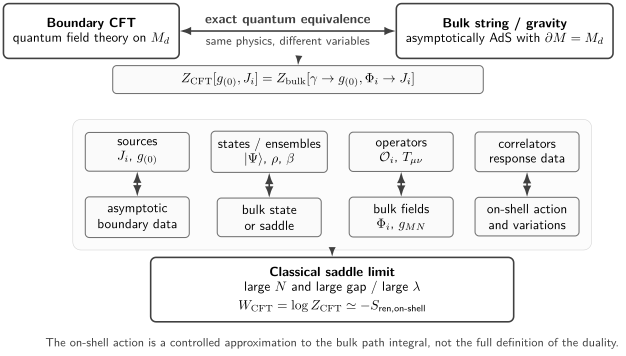
The logical layers of AdS/CFT. The exact statement equates a boundary CFT generating functional with a bulk string-theory partition function subject to asymptotically AdS boundary conditions. Large and a large stringy gap produce a weakly quantum local bulk effective theory. The familiar on-shell action formula is the leading classical saddle approximation.
Why this matters
Section titled “Why this matters”Many early mistakes in learning AdS/CFT come from using the right formula with the wrong interpretation.
For example, it is common to say that a boundary source is “equal to” the boundary value of a bulk field. That is a good first sentence, but it hides several choices: the conformal frame of the boundary metric, the normalization of the operator, the boundary condition imposed on the bulk field, possible counterterms, and sometimes the quantization scheme. Similarly, saying that a black hole is “dual to” a thermal state is correct only after one specifies the ensemble, the boundary manifold, the dominant saddle, and the time contour.
The dictionary is powerful because it is precise. But its precision comes from saying what object on one side is equal to what object on the other side.
The cleanest object is the partition functional with sources.
The exact statement in generating-functional form
Section titled “The exact statement in generating-functional form”Let be the -dimensional spacetime on which the CFT lives. Let be a representative of its conformal metric class, and let denote sources for local operators . The CFT generating functional is
The bulk side is a string-theory partition function over asymptotically AdS configurations whose boundary data are fixed by the same sources:
The correspondence says
This is the most compact functional statement of the duality. It should be read with several important qualifications.
First, the bulk is not just a fixed spacetime. In the full theory, the metric and other fields are dynamical, and one should sum over all configurations compatible with the prescribed asymptotic data.
Second, the boundary metric is a source. It couples to the stress tensor , so varying gives stress-tensor correlators.
Third, the equality is an equality of regulated and renormalized objects. Infinite AdS volume produces divergences, and those divergences match ultraviolet divergences in the CFT. The precise equality uses holographic renormalization.
Fourth, the word “source” is not just bookkeeping. Changing a source changes the boundary theory by adding an external field or coupling. On the bulk side this is implemented by changing the asymptotic boundary condition.
The canonical example
Section titled “The canonical example”For AdS/CFT, the boundary theory is four-dimensional SYM. The bulk theory is type IIB string theory on asymptotically backgrounds with units of self-dual five-form flux through the .
The schematic statement is
Here denotes possible background gauge fields for global symmetries, denotes sources for scalar operators, and the dots denote the rest of the supergravity/string modes. The complex coupling is matched to the IIB axio-dilaton:
With the convention used in this course,
This example is special because both sides are known very explicitly. The boundary theory is a well-defined quantum field theory, and the bulk theory is a standard string theory background in a controlled flux sector.
Equality of partition functions means equality of correlators
Section titled “Equality of partition functions means equality of correlators”The equality of generating functionals implies equality of all correlation functions obtained by functional differentiation.
With the source convention used in the course,
Thus
The two-point function is obtained by differentiating again:
The GKP/Witten prescription, developed on the next pages, says that at leading classical order
in Euclidean signature. Consequently,
up to the conventional factors of and possible signs depending on the source convention. The minus sign here comes from in Euclidean signature.
The source-boundary-value map
Section titled “The source-boundary-value map”For a scalar field in asymptotically , the near-boundary expansion takes the schematic form
The leading coefficient is interpreted as the source for a boundary operator of scaling dimension :
The subleading response coefficient is related to the expectation value , after holographic renormalization.
The mass of the scalar and the scaling dimension of the operator are related by
This relation is one of the cleanest examples of the dictionary: a bulk geometric parameter becomes boundary conformal data.
The same logic applies to other fields:
| Bulk field | Boundary source | Boundary operator |
|---|---|---|
| scalar | scalar coupling | scalar operator |
| gauge field | background gauge field | conserved current |
| metric | boundary metric | stress tensor |
| gravitino | background gravitino source | supercurrent |
| spinor | fermionic source | fermionic operator |
The metric entry is especially important. The CFT stress tensor is defined by the response to the boundary metric:
On the bulk side, is the leading term in the asymptotic metric. Thus the boundary stress tensor is extracted from the renormalized gravitational action by varying the boundary metric.
Equality of Hilbert spaces and spectra
Section titled “Equality of Hilbert spaces and spectra”The generating-functional statement is not the only way to say the correspondence. On global AdS, the boundary is the cylinder
The CFT quantized on this cylinder has a Hilbert space . The bulk theory on global AdS has a Hilbert space , with states such as gravitons, strings, branes, and black holes.
AdS/CFT says that these are two descriptions of the same Hilbert space:
This is not a trivial statement. The two descriptions organize states very differently.
In the CFT, states can be created by local operators through radial quantization. A primary operator of dimension creates a state on the sphere with energy
In the bulk, the corresponding single-particle excitation is a normal mode in global AdS. Descendant states correspond to acting with derivatives or momenta, which raise the global energy by integers. Multi-trace operators correspond, at leading large , to multiparticle bulk states.
This is why the state-operator correspondence is not a side topic. It is the CFT version of the bulk spectrum.
Equality of symmetries
Section titled “Equality of symmetries”A basic consistency check is the symmetry match.
For Lorentzian ,
which is the global conformal group of a -dimensional Lorentzian CFT. In the canonical example,
which is the R-symmetry group of SYM. Supersymmetry extends this match to the full superconformal symmetry.
The symmetry match does not prove the correspondence, but it is one of the reasons the dictionary is rigid. Bulk fields must transform in representations that match boundary operators.
For example, a bulk gauge symmetry associated with an isometry of the internal space corresponds to a global symmetry of the boundary theory. This is not a contradiction: gauge redundancies in the bulk become global symmetries at the boundary because gauge transformations that approach nonzero boundary values act as physical transformations of the boundary sources.
Equality of states and ensembles
Section titled “Equality of states and ensembles”The partition function also depends on the state or ensemble.
Some basic examples are:
| Boundary description | Bulk description |
|---|---|
| CFT vacuum on | global AdS |
| local operator insertion | bulk excitation sourced from the boundary |
| single-trace primary | single-particle bulk state |
| multi-trace operator | multiparticle bulk state |
| thermal state on the sphere | thermal AdS or AdS black hole, depending on temperature and saddle |
| thermal state on | planar AdS black brane |
| finite chemical potential | asymptotic value of a bulk gauge field |
The distinction between sources and states is important. A source changes the Hamiltonian or action. A state chooses which vector or density matrix in the Hilbert space is being used. Bulk boundary conditions encode sources; normalizable data encode states or expectation values.
For example, turning on a scalar source changes the CFT Lagrangian by adding
By contrast, an excited state with can have no source. In the bulk, that distinction appears as the difference between the non-normalizable and normalizable parts of a field.
Classical gravity as a controlled limit
Section titled “Classical gravity as a controlled limit”The exact partition function is generally too hard to compute. The practical power of AdS/CFT comes from controlled limits.
In the canonical example,
The large- limit suppresses bulk quantum loops. The large- limit suppresses stringy curvature corrections. In this regime the string partition function can be approximated by a supergravity path integral:
If the supergravity action is large in AdS units, this path integral is dominated by classical saddles:
When a single saddle dominates,
When several saddles compete, the dominant one gives the leading large- answer, and a change of dominance becomes a large- phase transition. The Hawking–Page transition is the standard example.
What is local, and what is not
Section titled “What is local, and what is not”AdS/CFT does not identify a local bulk point with a local boundary point. A bulk field depends on the radial coordinate , but the boundary theory has no extra spatial coordinate called .
The radial direction is encoded nonlocally in the boundary theory. Roughly,
but this is not an ordinary coordinate transformation. It is a statement about how scale transformations act:
Local bulk effective field theory emerges only in a special large- and large-gap regime. At finite , or without a large gap to stringy/higher-spin states, the boundary theory may still be perfectly well defined, but the bulk description need not resemble classical local gravity.
Boundary conditions are part of the theory
Section titled “Boundary conditions are part of the theory”A bulk field equation does not define a unique dual problem until boundary conditions are specified.
For a scalar field, the two independent near-boundary falloffs are
In standard quantization, the slower falloff is treated as the source, and the faster falloff is related to the expectation value. In a certain mass window, alternate quantization is possible, and the roles are changed. Mixed boundary conditions correspond to multi-trace deformations of the CFT.
So the statement
is shorthand. The precise dictionary specifies which coefficient is held fixed, what counterterms are used, and which variational principle is well posed.
The role of holographic renormalization
Section titled “The role of holographic renormalization”The equality of partition functions is not literally an equality of finite unregulated integrals.
In Poincaré coordinates,
the boundary lies at . The on-shell gravitational action typically diverges as the cutoff surface approaches the boundary. The renormalized action is defined schematically by
The counterterms are local functionals of the induced fields at the cutoff surface. They are the bulk representation of UV renormalization in the boundary theory.
This is why the next several pages will distinguish carefully between raw asymptotic coefficients and renormalized one-point functions.
What the correspondence does not say
Section titled “What the correspondence does not say”It is just as important to know what is not being claimed.
AdS/CFT does not say that every QFT has a simple weakly curved gravity dual. Most QFTs do not. A CFT with a classical Einstein-like bulk dual needs very special large- properties and a sparse spectrum of low-dimension single-trace operators.
AdS/CFT does not say that the boundary theory lives “on the surface of a black hole.” The boundary is the conformal boundary of AdS, not a material screen at finite distance.
AdS/CFT does not say that classical gravity is exact. Classical gravity is the leading saddle in a limit. Stringy and quantum corrections are real, and they correspond to finite-coupling and finite- effects in the CFT.
AdS/CFT does not give, by itself, a complete theory of de Sitter quantum gravity or flat-space quantum gravity. There are related holographic ideas in other asymptotics, but the AdS dictionary is especially sharp because AdS has a timelike conformal boundary on which an ordinary quantum theory can live.
AdS/CFT also does not make bulk locality fundamental. Bulk locality is emergent and approximate. The boundary theory is the nonperturbative definition in the best-understood examples.
Dictionary checkpoint
Section titled “Dictionary checkpoint”The core statement of the correspondence is
The basic source-operator map is
and
In Euclidean classical gravity,
The first functional derivative gives one-point functions; higher derivatives give connected correlators.
The classical gravity recipe is reliable only in a controlled limit, typically large and large gap or large .
Common confusions
Section titled “Common confusions”“The bulk theory and the boundary theory are two different systems that interact.”
Section titled ““The bulk theory and the boundary theory are two different systems that interact.””No. In AdS/CFT they are two descriptions of the same system. One does not put a CFT next to an AdS spacetime and let them exchange energy. The equality says that the CFT Hilbert space and the bulk quantum-gravity Hilbert space are two ways of organizing the same quantum states.
“The boundary source is the whole bulk field.”
Section titled ““The boundary source is the whole bulk field.””No. The source is the boundary datum of the bulk field. The bulk field in the interior is determined by solving the bulk equations with that boundary condition and with a choice of state or interior regularity condition.
“The on-shell action is the CFT action.”
Section titled ““The on-shell action is the CFT action.””No. The on-shell action is a functional of sources that computes the CFT generating functional in a saddle approximation. It is not the microscopic CFT Lagrangian.
“A black hole means the boundary theory is gravitational.”
Section titled ““A black hole means the boundary theory is gravitational.””No. The boundary theory remains an ordinary non-gravitational quantum theory. The black hole is the bulk representation of a high-energy or thermal state of that theory.
“The dictionary is unique without choices.”
Section titled ““The dictionary is unique without choices.””Not quite. Boundary conditions, counterterm schemes, operator normalizations, quantization choices, and ensembles must be specified. Physical quantities are scheme-independent when they should be, but intermediate formulas often are not.
Exercises
Section titled “Exercises”Exercise 1: Source dimension
Section titled “Exercise 1: Source dimension”Let be a scalar primary operator of scaling dimension in a -dimensional CFT. If the deformation
is dimensionless, what is the scaling dimension of the source ?
Solution
The measure has dimension
and the operator has dimension . For the integral to be dimensionless,
Thus
This matches the AdS near-boundary behavior
where the power is the scaling weight of the source.
Exercise 2: Stress tensor as a response
Section titled “Exercise 2: Stress tensor as a response”Suppose the CFT generating functional depends on a background metric and satisfies
Write as a functional derivative of .
Solution
By comparing coefficients of , we get
In the classical Euclidean gravity limit,
so
Different sign conventions for the Euclidean source coupling can shift this sign, so the important invariant statement is that the boundary stress tensor is obtained by varying the renormalized on-shell gravitational action with respect to the boundary metric.
Exercise 3: Why large gives a saddle
Section titled “Exercise 3: Why large NNN gives a saddle”Assume a bulk effective action has the schematic form
If , explain why the bulk path integral is dominated by classical saddles at large .
Solution
The Euclidean bulk path integral is schematically
If
then the exponential contains a large parameter. In the large- limit, configurations away from stationary points are strongly suppressed by destructive/steepest-descent behavior. The leading answer is therefore determined by classical solutions satisfying
Fluctuations around the saddle produce loop corrections suppressed by powers of .
Exercise 4: Why weakly coupled SYM is not classical gravity
Section titled “Exercise 4: Why weakly coupled SYM is not classical gravity”In AdS/CFT, use
to explain why weakly coupled SYM does not have a weakly curved classical supergravity description.
Solution
The curvature radius in string units is
If , then
The would-be AdS radius is smaller than the string length, so the bulk is highly stringy. The classical supergravity approximation assumes curvature radii much larger than the string scale, namely , which requires . Thus weakly coupled SYM may be tractable by perturbative field theory, but its dual bulk description is not weakly curved classical gravity.
Further reading
Section titled “Further reading”- J. Maldacena, The Large Limit of Superconformal Field Theories and Supergravity.
- S. S. Gubser, I. R. Klebanov, and A. M. Polyakov, Gauge Theory Correlators from Non-Critical String Theory.
- E. Witten, Anti de Sitter Space and Holography.
- O. Aharony, S. S. Gubser, J. Maldacena, H. Ooguri, and Y. Oz, Large Field Theories, String Theory and Gravity.
- K. Skenderis, Lecture Notes on Holographic Renormalization.