
Quantum-Critical Transport
The previous page explained how a retarded Green function is computed from a Lorentzian black-brane boundary-value problem. This page uses that machinery for the observables that made holography famous in many-body physics: transport coefficients.
The setting is deliberately clean. We study a translation-invariant thermal quantum critical state at zero charge density. Equivalently, the bulk background is a neutral planar AdS black brane, and the gauge field dual to a conserved boundary current is treated as a fluctuation, not as part of the background. This is the simplest arena in which the horizon acts as a dissipative medium.
The central lesson is:
This statement should be read with some restraint. Holography does not say that every quantum critical point in nature has the same conductivity or viscosity. It says that in large-, strongly coupled theories with a semiclassical gravitational dual, transport can be computed by solving classical wave equations in a black-brane geometry. That is already a remarkable amount of control over a problem that is usually brutal.
Throughout this page, is the number of boundary spatial dimensions and
is the boundary spacetime dimension. The bulk has dimension . We use units
The physical problem
Section titled “The physical problem”A quantum critical state has no intrinsic energy scale at . At nonzero temperature, the temperature itself is the only scale, so relaxation and transport often take the scaling form
up to dimensionless constants and velocities. This is the basic reason quantum-critical transport is interesting: it is transport not controlled by long-lived quasiparticles, impurity scattering, or a weak-coupling mean free path.
The observables are retarded correlators of conserved currents and stress tensors. If a global symmetry exists, the conserved current is
If translations are unbroken, the stress tensor obeys
Small external sources couple as
The source is a nondynamical background gauge field. The source is a nondynamical background metric perturbation. In holography these sources are literally the boundary values of bulk fields:
The retarded functions
then determine conductivity, diffusion, shear viscosity, sound attenuation, and the hydrodynamic pole structure.
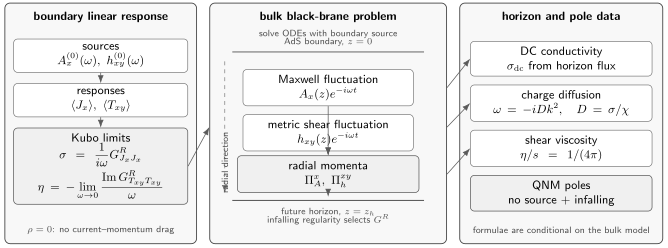
The transport dictionary for neutral holographic quantum critical matter. Boundary sources such as and excite bulk Maxwell and metric perturbations. Infalling regularity at the future horizon selects the retarded correlator. Kubo limits and hydrodynamic poles then give , , , shear diffusion, and sound attenuation.
Linear response and Kubo formulas
Section titled “Linear response and Kubo formulas”Let and be bosonic operators. The retarded correlator is
With Fourier convention
transport coefficients are low-frequency, long-wavelength limits of these correlators.
For an electric field in the direction, use the gauge . Then
for perturbations proportional to . Linear response gives
Ohm’s law is
Therefore
up to contact-term conventions. Equivalently,
with the sign depending on the Fourier convention for .
For shear viscosity, perturb the boundary metric by . The Kubo formula is
again in the same convention as above.
These two formulas are structurally identical. Conductivity is the absorptive response of a current to a vector source. Shear viscosity is the absorptive response of momentum flux to a metric source.
The neutral black brane background
Section titled “The neutral black brane background”The gravitational dual of a neutral thermal CFT state is the planar AdS-Schwarzschild black brane
with
The entropy density is the horizon area density divided by :
For a conformal fluid at zero chemical potential,
Here is energy density, is pressure, and is bulk viscosity. The vanishing of is not a holographic miracle; it follows from conformal invariance. A scale-invariant fluid cannot dissipate through uniform compression in the same way a generic nonconformal fluid can.
Current transport from a bulk Maxwell field
Section titled “Current transport from a bulk Maxwell field”A conserved boundary current is dual to a bulk gauge field . At zero density the background gauge field vanishes,
so the leading current-current correlator is obtained from a quadratic Maxwell action on the fixed black-brane geometry:
More general bottom-up models replace by a scalar-dependent coupling ; for now set .
Choose radial gauge
For a homogeneous electric perturbation,
the Maxwell equation is
Near the horizon one imposes the infalling condition. Near the boundary,
with possible logarithms in special dimensions. The leading coefficient is the source. The response is the renormalized radial electric flux
where
Thus
for the infalling solution normalized by .
The boundary conductivity is therefore
This equation is mundane-looking, but it is doing real work. A strongly coupled many-body conductivity has been reduced to a classical wave-absorption problem.
DC conductivity from the horizon
Section titled “DC conductivity from the horizon”The DC limit is especially transparent. Define the radial current
At and , the Maxwell equation says
So the current can be evaluated at any radial position. The boundary current equals the horizon current.
For an isotropic metric written schematically as
with , horizon regularity in ingoing coordinates gives a local Ohm’s law at the horizon. The result is the membrane-paradigm formula
for the simple Maxwell action.
For the AdS black brane above,
This matches the scaling expectation
In spatial dimensions, the conductivity is dimensionless:
This is the famous case most often associated with quantum critical transport in dimensions. In , conductivity has dimension of energy and scales as .
Optical conductivity and electromagnetic self-duality
Section titled “Optical conductivity and electromagnetic self-duality”The full optical conductivity generally requires solving the radial Maxwell equation at finite . In boundary dimensions with the simplest Maxwell action in , something special happens: bulk electromagnetic duality implies a frequency-independent conductivity,
This is elegant, but fragile. Higher-derivative terms such as
or couplings to additional bulk fields break the simple self-duality and produce nontrivial frequency dependence.
That fragility is good physics. A real quantum critical conductivity is constrained by scaling and symmetries, but it is not normally a single universal constant at all frequencies. The constant result is best understood as an exactly solvable benchmark, not as a generic prediction for all quantum critical matter.
Diffusion and the Einstein relation
Section titled “Diffusion and the Einstein relation”Conductivity describes the response to an electric field. Diffusion describes the relaxation of an inhomogeneous density.
At zero background density, let
be a small charge-density fluctuation. Hydrodynamics gives the continuity equation
The constitutive relation is Fick’s law,
Combining these equations gives the diffusion equation
For a Fourier mode , the hydrodynamic pole is
The same is related to the DC conductivity by the Einstein relation. Turn on a slowly varying chemical potential . In local equilibrium,
where
is the static charge susceptibility. The electric field is
Then Fick’s law becomes
Comparing with Ohm’s law gives
or
For the simple Maxwell field in an AdS black brane, one finds
and therefore
for .
In boundary spacetime dimensions, this reduces to
The important point is not the exact coefficient. The important point is the structure:
in a thermal quantum critical state.
The density-density correlator
Section titled “The density-density correlator”The diffusion pole appears directly in the retarded density correlator. Hydrodynamics predicts
This form satisfies two checks.
First, the pole is at
Second, the static limit gives the susceptibility:
up to the same contact-term convention.
The noncommutativity of limits is physical. At exactly , total charge is conserved and cannot relax. At small nonzero , charge can diffuse from one region to another.
Stress-tensor transport
Section titled “Stress-tensor transport”The stress tensor of a relativistic fluid is organized in a derivative expansion. To first order,
where
Here
projects orthogonally to the velocity, and
is the shear tensor.
The shear viscosity measures the dissipation of transverse momentum gradients. The bulk viscosity measures dissipation under compression. For a conformal fluid,
The hydrodynamic modes of are fixed by conservation,
There are two types that matter here.
Shear diffusion
Section titled “Shear diffusion”Take momentum along and a velocity perturbation transverse to it, say . Linearized hydrodynamics gives
Therefore the shear mode has dispersion
At zero chemical potential,
so
Longitudinal energy and momentum fluctuations produce sound:
where
For a conformal fluid,
The damping coefficient is
For a conformal holographic plasma with and ,
and
Again the scaling is quantum-critical:
The shear viscosity calculation in one page
Section titled “The shear viscosity calculation in one page”Now we compute the most famous number in holographic transport. Consider a transverse metric perturbation
It is useful to write
For an isotropic two-derivative Einstein gravity background, the fluctuation obeys the same equation as a minimally coupled massless scalar at zero spatial momentum. Its quadratic action takes the schematic form
where the omitted terms either vanish at or contribute contact terms for the Kubo limit.
The canonical radial momentum is
up to the conventional factor associated with the normalization of . The shear Green function is obtained from
In the low-frequency limit, the imaginary part is controlled by the horizon flux. Infalling regularity gives the horizon relation between radial derivative and time derivative. The result is
Compare this with the entropy density
Therefore
This is the Kovtun-Son-Starinets result in its simplest two-derivative form.
Why the ratio is small
Section titled “Why the ratio is small”At weak coupling, kinetic theory gives a large shear viscosity. Roughly,
where is a mean free path. If interactions are weak, particles travel far before colliding, so is large and is large.
The holographic fluid has no such long mean free path. It equilibrates on a time of order
That is why the dimensionless ratio is order one in natural units. More precisely, for classical Einstein gravity it is .
The ratio is the right object to compare across systems. The viscosity itself can be large if the entropy density is large. A hot large- plasma has many degrees of freedom, so both and scale like . The small quantity is not by itself, but
Hydrodynamic poles as quasinormal modes
Section titled “Hydrodynamic poles as quasinormal modes”On the previous page, quasinormal modes appeared as source-free infalling solutions. Hydrodynamic modes are special quasinormal modes forced toward the origin by conservation laws.
For charge diffusion,
For shear diffusion,
For sound,
These are not optional features of the holographic model. They must be present because the boundary theory has conserved charge, energy, and momentum. The bulk gravitational constraints know about the boundary Ward identities.
Generic nonhydrodynamic QNMs have frequencies of order :
They describe fast relaxation. Hydrodynamic QNMs are parametrically slower at small because conservation laws prevent local densities from disappearing; they can only spread.
Ward identities and gauge-invariant variables
Section titled “Ward identities and gauge-invariant variables”For current correlators, gauge invariance and charge conservation imply Ward identities. In Fourier space,
up to contact terms. In the bulk, this is reflected in the Maxwell constraint equation.
For momentum along , it is useful to decompose the gauge field into transverse and longitudinal channels. In radial gauge , define
and
This longitudinal combination is invariant under the residual gauge transformation
The diffusion pole lives in the longitudinal channel. The optical conductivity at can be computed from the transverse channel.
Metric perturbations similarly decompose into tensor, vector, and scalar channels under rotations transverse to . Shear diffusion lives in a vector channel. Sound lives in a scalar channel. The perturbation used for the Kubo formula is a tensor channel at , which is why the calculation is so clean.
What is universal, and what is not?
Section titled “What is universal, and what is not?”It is tempting to summarize holographic transport as a list of universal constants. That is the wrong moral. A better taxonomy is:
| Quantity | Holographic lesson | Universality status |
|---|---|---|
| Horizon absorption of a transverse graviton | Universal for classical two-derivative Einstein gravity, not universal in general | |
| at | Horizon electric flux | Depends on current normalization and bulk gauge couplings |
| Diffusion from hydrodynamics and susceptibility | Coefficient model-dependent; scaling is natural at quantum criticality | |
| Hydrodynamic poles | Boundary Ward identities become bulk constraints | Universal structure; coefficients depend on the theory |
| Constant in dimensions | Bulk electromagnetic self-duality | Special to simple Maxwell theory in |
The sharpest universal statement is structural: black branes turn strongly coupled real-time transport into horizon boundary conditions and radial fluxes.
Relation to condensed matter language
Section titled “Relation to condensed matter language”In condensed matter theory, a clean quantum critical point in often has a conductivity of the form
where is the charge of the carriers and is a dimensionless universal number of the critical theory. Holographic models compute the strong-coupling, large- analogue of .
This is not Drude physics. The Drude formula
assumes identifiable carriers with density , charge , mass , and lifetime . At a relativistic charge-neutral quantum critical point, the current is carried by thermally excited particles and antiparticles, or more abstractly by charged critical degrees of freedom. There need not be a quasiparticle lifetime at all.
Holography replaces the Drude story with a geometric one:
That is the conceptual leap.
A preview of finite density
Section titled “A preview of finite density”Everything above assumed zero background density. At finite density,
the current contains a convective part
If translations are exact, the momentum density cannot decay. Since electric current overlaps with momentum, a constant electric field accelerates the whole fluid. The clean DC conductivity therefore contains a delta function:
where for a relativistic fluid.
The finite part left after subtracting momentum drag is often called the incoherent conductivity. At zero density, the incoherent conductivity is simply the ordinary conductivity:
This is why quantum-critical transport is the right warm-up for holographic metals. The finite-density story is not a replacement of this page; it is this page plus momentum.
Common pitfalls
Section titled “Common pitfalls”Pitfall 1: calling a universal lower bound. It is a robust result for classical two-derivative Einstein gravity, not an absolute theorem for all quantum matter.
Pitfall 2: expecting to be as universal as . The conductivity depends on the normalization and dynamics of the bulk gauge field. Even in a CFT, different conserved currents can have different .
Pitfall 3: forgetting charge density. At , clean DC conductivity can be finite. At , translation invariance usually gives infinite DC conductivity.
Pitfall 4: identifying every pole with a quasiparticle. Hydrodynamic poles are long-lived because of conservation laws, not because they are Landau quasiparticles.
Pitfall 5: comparing instead of . The dimensionless ratio is what measures fluidity in natural units. Large- systems can have large and still very small .
Pitfall 6: ignoring contact terms. Kubo formulas depend on the absorptive part or the pole structure. Local counterterms can shift real analytic pieces of correlators.
Exercises
Section titled “Exercises”Exercise 1: Scaling of quantum-critical conductivity
Section titled “Exercise 1: Scaling of quantum-critical conductivity”Use dimensional analysis to show that the conductivity of a relativistic quantum critical theory in spatial dimensions scales as
What is special about ?
Solution
The current has scaling dimension
because the conserved charge
is dimensionless, so , and current conservation gives the same scaling for in a relativistic theory.
The electric field has one derivative acting on a gauge potential. Since appears in the action density and the action is dimensionless,
so
Therefore
Ohm’s law is
Hence
At a quantum critical point, the only scale at nonzero temperature is , so
For , the conductivity is dimensionless. This is why quantum critical conductivity in dimensions is often expressed as a universal number times .
Exercise 2: Derive the Einstein relation
Section titled “Exercise 2: Derive the Einstein relation”Starting from Fick’s law
and the static susceptibility
show that
Solution
A spatially varying chemical potential produces an electric field
Using , assuming is constant in linear response,
Fick’s law becomes
Since ,
Comparing with Ohm’s law
we get
Exercise 3: Diffusion pole from hydrodynamics
Section titled “Exercise 3: Diffusion pole from hydrodynamics”Use
to derive the pole
Solution
Substitute Fick’s law into charge conservation:
Take a Fourier mode
Then
The diffusion equation becomes
For a nonzero fluctuation,
so
Exercise 4: Horizon formula for DC conductivity
Section titled “Exercise 4: Horizon formula for DC conductivity”Consider the Maxwell action
in an isotropic black-brane metric
Show that the DC conductivity is
Solution
For a homogeneous perturbation , define the radial electric flux
In the DC limit, the Maxwell equation gives
so is independent of . It may therefore be evaluated at the horizon.
Near the future horizon, use ingoing Eddington-Finkelstein regularity. A regular field depends on
near the horizon. Thus the radial derivative and time derivative are related by
The physical electric field is
Up to the sign fixed by the convention for current flow,
Plugging into gives
Since ,
Exercise 5: Shear diffusion constant
Section titled “Exercise 5: Shear diffusion constant”Starting from the linearized transverse momentum equation
show that
Then use and to obtain
Solution
Take
Then
The linearized equation becomes
Dividing by the nonzero amplitude gives
Thus
Comparing with
we find
At zero chemical potential,
Therefore
Using
we obtain
Exercise 6: Why finite density changes the DC conductivity
Section titled “Exercise 6: Why finite density changes the DC conductivity”At zero density, the current has no convective piece proportional to fluid velocity. At finite density,
Explain why exact momentum conservation implies an infinite clean DC conductivity when .
Solution
In a translation-invariant system, total momentum is conserved. A uniform electric field exerts a force on the charge density:
If , the electric field continuously pumps momentum into the fluid. Since there is no momentum relaxation, the fluid velocity grows rather than settling to a steady finite value.
The electric current contains the convective contribution
Thus the growing momentum produces a growing current. In linear response, this appears as a delta function in the real part of the conductivity and a pole in the imaginary part:
At , this convective overlap is absent, so the clean DC conductivity can be finite.
Further reading
Section titled “Further reading”For quantum-critical transport and the holographic Maxwell calculation, see Hartnoll, Lucas, and Sachdev, Holographic Quantum Matter, especially the section on quantum critical charge dynamics. For hydrodynamics, Kubo formulas, diffusion, and shear viscosity, see Natsuume, AdS/CFT Duality User Guide, chapters on nonequilibrium physics and applications to plasmas. For a textbook treatment of linear response and holographic hydrodynamics, see Ammon and Erdmenger, Gauge/Gravity Duality. For the original viscosity calculation and its interpretation, see Policastro, Son, and Starinets, and the later Kovtun-Son-Starinets universality papers.