
Factorization Puzzles and Euclidean Wormholes
Guiding question. If two boundary quantum systems are exactly decoupled, why does the gravitational path integral sometimes appear to include connected Euclidean geometries joining their boundaries?
The island and replica-wormhole pages used one of the strangest lessons of modern black-hole physics: connected saddles in a gravitational replica path integral can be essential for computing fine-grained entropy. That success sharpened an older puzzle. In ordinary quantum mechanics, if two systems are independent, their partition functions and correlators factorize. But a semiclassical gravitational path integral with multiple asymptotic boundaries often appears to allow connected Euclidean wormhole saddles.
The tension is the factorization puzzle. In its cleanest form, it is the apparent clash between
for two decoupled copies of a fixed boundary theory, and a bulk expansion of the schematic form
where is a connected Euclidean saddle with both boundaries. If is interpreted as a contribution to the ordinary product partition function of two decoupled CFTs, then the bulk answer does not factorize.
The right lesson is subtle. Euclidean wormholes are not automatically wrong; in some theories they compute real and useful quantities. But in a fixed AdS/CFT dual pair, their interpretation must be more refined than “add every connected Euclidean saddle to the exact product partition function.” This page explains the puzzle, the clean ensemble interpretation, the baby-universe language, the relation to replica wormholes, and the main open problems.
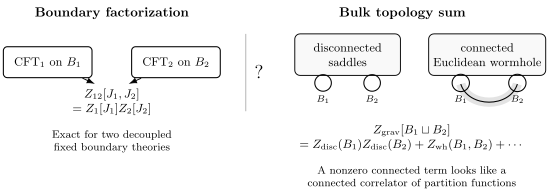
The factorization puzzle. Two decoupled boundary theories obey . A connected Euclidean bulk saddle with the same two asymptotic boundaries appears to contribute a nonfactorizing term . The question is not merely whether such saddles can exist semiclassically, but what exact observable they compute.
1. Exact factorization in a fixed boundary theory
Section titled “1. Exact factorization in a fixed boundary theory”Start with two decoupled quantum systems with Hilbert space
The two-temperature partition function factorizes exactly:
The same statement holds for Euclidean path integrals with independent sources:
Consequently, connected correlators of operators belonging to different decoupled theories vanish:
This is not a large- approximation. It is an exact microscopic statement. In an ordinary AdS/CFT dual pair, each asymptotic boundary is associated with its own copy of the boundary Hilbert space. If the copies are not coupled, the boundary answer must factorize.
So if a connected bulk geometry seems to contribute to , one of the words in that sentence must be interpreted carefully: connected, contribute, , or exact.
2. The bulk semiclassical temptation
Section titled “2. The bulk semiclassical temptation”The Euclidean gravitational path integral with specified asymptotic boundary data is often written schematically as
For one connected boundary, this sum includes bulk fillings of that boundary. For two or more boundaries, one must decide whether the sum includes connected manifolds whose conformal boundary has multiple components. If it does, then
The disconnected term factorizes:
The connected term does not. It gives
That is the puzzle. The gravitational path integral wants to sum over topologies. The boundary theory says that decoupled systems factorize exactly.
The puzzle is not merely philosophical. Connected Euclidean solutions with multiple AdS boundaries have been explicitly discussed, and in low-dimensional gravity connected topologies such as cylinders or higher-genus surfaces are calculable. At the same time, the Witten–Yau connectedness theorem and related results show that in many negatively curved settings with suitable boundary curvature assumptions, disconnected conformal boundaries are forbidden for complete connected Einstein fillings. Thus the existence and relevance of Euclidean wormholes is highly sensitive to the matter content, boundary conditions, topology, and precise definition of the gravitational path integral.
The sharp version of the puzzle is therefore:
When a semiclassical connected Euclidean saddle exists and appears to be allowed by the rules of the bulk path integral, what exact boundary quantity does it compute?
3. What kind of wormhole is this?
Section titled “3. What kind of wormhole is this?”The word “wormhole” is overloaded, so the distinction matters.
A Lorentzian Einstein–Rosen bridge in the eternal AdS black hole connects two exterior regions behind horizons. It is part of a real-time geometry dual to a special entangled state such as the thermofield double. It is nontraversable unless one modifies the dynamics, for example with a double-trace coupling.
A Euclidean wormhole is a connected Riemannian saddle of a Euclidean path integral. It need not describe a traversable passage in Lorentzian spacetime. Its job is to contribute to a Euclidean amplitude.
A replica wormhole connects different replicas in a path integral computing . It is Euclidean in the derivation, but the replicas are not independent physical universes; they are copies introduced to compute an entropy.
A baby universe is a closed component, or a sector of closed universes, that can be emitted and reabsorbed by asymptotic boundaries in a Euclidean path integral. In the old Coleman language and its modern AdS refinements, baby universes are used to organize how wormholes can induce an ensemble-like structure.
The factorization puzzle concerns Euclidean wormholes with multiple asymptotic boundaries in a putative exact bulk dual of decoupled boundary theories. It is not the same puzzle as ER=EPR, though both involve the relation between connectivity and quantum information.
4. Ensemble averages make connected wormholes natural
Section titled “4. Ensemble averages make connected wormholes natural”There is one situation in which connected Euclidean wormholes are not puzzling at all: the bulk theory is dual not to one fixed boundary theory, but to an ensemble of boundary theories.
Suppose is drawn from an ensemble . For a fixed , the product is just a product of two numbers. But after averaging,
The covariance term is a connected correlator. There is no contradiction because the ensemble average of a product is not generally the product of ensemble averages.
This is exactly the kind of quantity that a connected Euclidean wormhole can compute:
In this interpretation, the wormhole is not saying that a particular Hamiltonian fails to factorize. It is saying that different Hamiltonians in the ensemble have correlated spectral data.
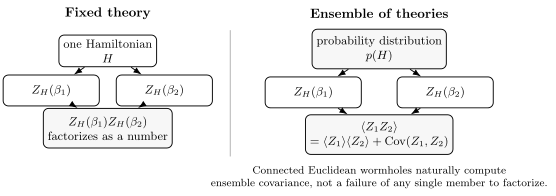
For a fixed theory, factorizes as a number. For an ensemble, can contain a connected covariance term. Euclidean wormholes are naturally interpreted as computing this covariance in theories whose bulk dual is ensemble-averaged.
This is the cleanest resolution in models where the boundary dual is genuinely an ensemble. It is also the reason JT gravity became the central laboratory for the factorization puzzle.
5. JT gravity and the double trumpet
Section titled “5. JT gravity and the double trumpet”JT gravity has a Euclidean path integral over two-dimensional surfaces. The basic one-boundary amplitude is a disk contribution to . The two-boundary amplitude includes a disconnected pair of disks and a connected cylinder-like geometry often called the double trumpet:
The connected term is not a mistake. In the Saad–Shenker–Stanford description, JT gravity is dual to a double-scaled matrix integral. The gravitational genus expansion computes ensemble-averaged spectral observables. The double trumpet computes the connected two-boundary spectral correlator of the matrix ensemble.
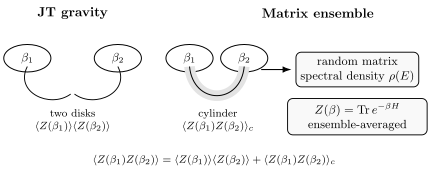
In JT gravity, the two-boundary amplitude contains two disks and a connected cylinder or double-trumpet contribution. The matrix-integral interpretation says that the connected geometry computes an ensemble connected correlator, not a violation of factorization in a fixed member of the ensemble.
This result is profound, but it is also limited. JT gravity teaches us that some gravitational path integrals are ensemble averages. It does not by itself imply that every AdS/CFT example is ensemble-averaged. For instance, the standard duality between type IIB string theory on and super Yang–Mills is usually understood as a duality with a fixed boundary theory, not an ensemble of gauge theories.
Thus JT gravity resolves the puzzle in JT-like models by changing the boundary interpretation. It leaves a harder question for fixed holographic CFTs:
must hold exactly, so what becomes of any putative connected Euclidean bulk saddle?
6. Baby universes and alpha states
Section titled “6. Baby universes and alpha states”The older Coleman–Giddings–Strominger idea was that Euclidean wormholes can be represented by baby universes. A baby universe is a closed component invisible to asymptotic observers except through its effect on amplitudes with asymptotic boundaries.
Modern AdS discussions often package this idea as follows. The gravitational path integral defines a Hilbert space of baby-universe states. Boundary partition functions act as commuting operators on this space:
If these operators are diagonalized simultaneously, an eigenstate satisfies
In such an -state, products factorize:
But in a more general baby-universe state , one obtains an average over labels:
This looks precisely like an ensemble average. The label plays the role of a superselection parameter specifying a particular member of the ensemble.
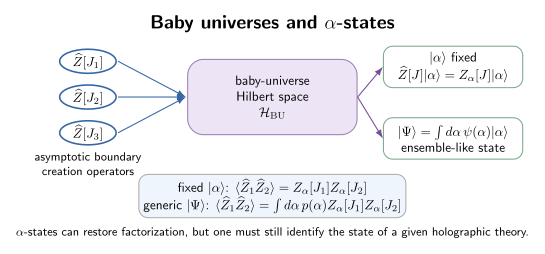
Baby-universe language separates an ensemble state from an -state. A general baby-universe state gives an average over labels and can have connected multi-boundary correlators. A fixed -state has definite values and restores factorization.
This language is useful because it makes the tension algebraic. The question becomes: which baby-universe state does the gravitational path integral prepare, and what boundary theory does that state describe?
For JT gravity, the natural answer is ensemble-like. For a fixed holographic CFT, the putative answer should be closer to a fixed -state, or else there must be additional nonperturbative effects that restore factorization.
7. Half-wormholes, eigenbranes, and nonperturbative completion
Section titled “7. Half-wormholes, eigenbranes, and nonperturbative completion”The ensemble interpretation is clean, but it is not the only lesson. In fixed-coupling versions of SYK-like toy models, one can ask what replaces the ensemble wormhole when the disorder couplings are held fixed.
A schematic story is:
Here is an ordinary disconnected contribution, is a wormhole-like contribution that is approximately independent of the particular couplings , and is a coupling-sensitive contribution sometimes described in terms of half-wormholes. The sum can factorize in a fixed theory even though the wormhole-like term appears in an intermediate collective-field description.
The moral is not that every fixed theory literally contains semiclassical half-wormholes of the same kind. The moral is that an effective saddle analysis can isolate a universal wormhole-like piece while hiding other nonperturbative, microstate-sensitive contributions needed for exact factorization.
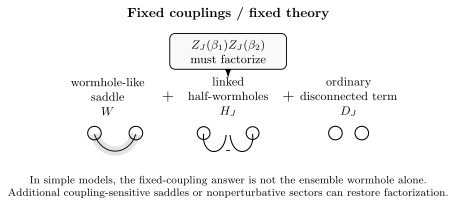
In fixed-coupling toy models, the factorized answer is not the ensemble wormhole alone. Additional coupling-sensitive pieces, often described as half-wormholes or nonperturbative sectors, combine with wormhole-like saddles to give the fixed-theory product .
A related theme appears in JT gravity through eigenbranes and spectral discreteness. The perturbative genus expansion of JT captures the smooth ensemble density of states. A fixed member of a discrete-spectrum theory requires nonperturbative information about individual eigenvalues. Brane-like contributions that condition or fix spectral data can change late-time observables and help restore fixed-theory behavior.
This should sound familiar from the Page-curve story. Semiclassical gravity often captures universal coarse-grained effects. Exact factorization and exact unitarity are sharper, more microscopic constraints. They are sensitive to effects invisible in any finite order of the naive semiclassical expansion.
8. Relation to replica wormholes and islands
Section titled “8. Relation to replica wormholes and islands”Replica wormholes are not the same as the Euclidean wormholes in the two-boundary factorization puzzle, but they are close enough to make the issue urgent.
The island formula is derived by computing
using a gravitational path integral with replicas. Replica wormholes are connected saddles joining these replicas. In the limit, they give the island rule
Why is this not immediately the same as a violation of factorization? Because the replicas are not independent physical CFTs whose product partition function is being measured. They are copies introduced by the replica trick to compute a nonlinear functional of a density matrix. The gluing in the radiation region already couples the replicas in the path integral representation of .
Still, the conceptual worry remains. In an ensemble-averaged theory, replica wormholes may compute an averaged entropy-like quantity. In a fixed theory, the fine-grained entropy should have a definite value, and the exact answer should factorize whenever the boundary problem demands factorization. This is one reason the factorization puzzle is central rather than peripheral: it asks whether the same gravitational path-integral technology that gives the Page curve is an exact microscopic rule, an ensemble average, or an effective coarse-grained rule missing nonperturbative completion.
A careful conclusion is:
but
The two statements are compatible, but their compatibility is a research problem, not a slogan.
9. Modern resolution routes
Section titled “9. Modern resolution routes”There is no single accepted universal resolution that applies equally to JT gravity, SYK-like models, higher-dimensional AdS/CFT, and realistic black holes. Instead, several mechanisms appear in different settings.
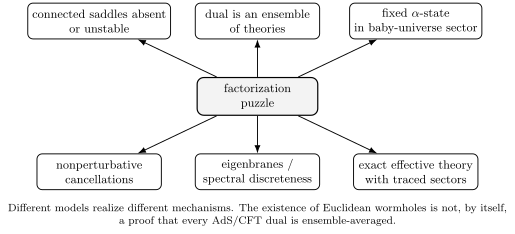
The factorization puzzle has several model-dependent resolution routes. In ensemble duals, connected wormholes compute covariance. In fixed theories, factorization can be restored by working in an -state, by including nonperturbative effects such as branes or half-wormhole-like contributions, or by recognizing that the wormhole arose in an exact effective theory after tracing over hidden sectors.
9.1 The connected saddle is absent or unstable
Section titled “9.1 The connected saddle is absent or unstable”In some settings, the proposed connected Euclidean geometry is simply not part of the correct contour or has an instability. It may fail boundary conditions, possess negative modes, or be excluded by topological or energy conditions. The Witten–Yau theorem is an important example of how geometric assumptions can forbid disconnected conformal boundaries for connected Einstein fillings.
This is the most conservative resolution: the problematic saddle does not contribute to the exact path integral.
9.2 The dual is an ensemble
Section titled “9.2 The dual is an ensemble”This is the JT gravity resolution. The bulk path integral computes ensemble-averaged quantities, so connected Euclidean wormholes compute connected ensemble correlators.
This is not a failure of quantum mechanics. It is simply not the partition function of one fixed boundary Hamiltonian.
9.3 The path integral prepares a fixed alpha state
Section titled “9.3 The path integral prepares a fixed alpha state”In baby-universe language, a general state gives ensemble-like averages, while an -state gives definite values of all boundary partition-function operators. If a fixed CFT corresponds to a fixed , factorization is restored.
The challenge is constructive: one needs to know how the exact bulk theory selects or prepares the appropriate -state, and whether this can be implemented in a controllable semiclassical calculation.
9.4 Nonperturbative sectors restore factorization
Section titled “9.4 Nonperturbative sectors restore factorization”The semiclassical wormhole may be only one term in an asymptotic expansion. Exact factorization can require contributions that are nonperturbative in , sensitive to discrete spectral data, or invisible in the naive saddle expansion.
Half-wormholes, eigenbranes, and related objects are concrete realizations of this idea in lower-dimensional or toy models.
9.5 Wormholes arise from exact effective theory
Section titled “9.5 Wormholes arise from exact effective theory”Another modern viewpoint is that wormhole-like couplings can appear after exactly integrating out hidden sectors of a more complete theory. In that case the effective description need not factorize by itself because it describes a reduced state or an averaged description. The underlying complete theory can still factorize.
This viewpoint is appealing because it connects wormholes, effective field theory, tracing over inaccessible degrees of freedom, and quantum error correction. But it also highlights a warning: sufficiently fine observables may distinguish the exact theory from its effective wormhole description.
10. What this does and does not prove
Section titled “10. What this does and does not prove”The factorization puzzle is important precisely because it is easy to overstate.
It does show that the gravitational path integral is not fully defined by the phrase “sum over all smooth Euclidean geometries.” One must specify the contour, the allowed topologies, the boundary interpretation, and the nonperturbative completion.
It does show that low-dimensional gravity can naturally compute ensemble-averaged observables. JT gravity is the cleanest example.
It does show that replica wormholes and islands raise questions about exact factorization, because the same connected-topology technology appears in entropy calculations.
It does not show that AdS/CFT is inconsistent.
It does not show that every holographic CFT is secretly an ensemble.
It does not show that Lorentzian wormholes connect decoupled boundary theories by a traversable channel.
It does not by itself solve the black-hole information problem in every UV-complete theory. It tells us where the nonperturbative microscopic information must enter.
A good working attitude is this:
Euclidean wormholes are powerful semiclassical saddles, but exact factorization is a microscopic constraint. The tension between them is not a bug to hide; it is a diagnostic of what the gravitational path integral still needs.
11. Connection to the next pages
Section titled “11. Connection to the next pages”The next frontier page, Ensemble Averaging, Baby Universes, and JT Gravity, will unpack the ensemble interpretation more systematically. We will treat JT gravity as a matrix integral, explain the role of baby-universe Hilbert spaces and parameters, and clarify the difference between annealed and quenched quantities.
After that, the page on Holography of Information and Asymptotic Observables will approach factorization from a different angle: gravitational Gauss laws, boundary dressings, and the idea that quantum gravity may encode bulk information more globally than ordinary local QFT suggests.
Exercises
Section titled “Exercises”Exercise 1: Exact factorization from tensor products
Section titled “Exercise 1: Exact factorization from tensor products”Let and . Show that
Then explain why this is an exact statement, not a large- approximation.
Solution
Because and commute,
Therefore
No approximation has been used. This follows from the tensor-product structure and the absence of coupling between the two systems.
Exercise 2: Connected terms from an ensemble
Section titled “Exercise 2: Connected terms from an ensemble”Let and be two random variables. Show that
Apply this identity to and in an ensemble of Hamiltonians.
Solution
The covariance is defined by
Expanding gives
Thus
For and , the connected part of the ensemble-averaged product is the covariance of the two partition functions across the ensemble. A connected Euclidean wormhole can naturally compute this covariance.
Exercise 3: Alpha states and factorization
Section titled “Exercise 3: Alpha states and factorization”Assume that the partition-function operators commute and that is a simultaneous eigenstate:
Show that factorizes.
Solution
Act first with :
Then
Taking the inner product with gives
Thus a fixed -state behaves like a fixed member of the ensemble.
Exercise 4: Why replica wormholes are not immediately a factorization violation
Section titled “Exercise 4: Why replica wormholes are not immediately a factorization violation”Explain why a replica wormhole contributing to is not the same object as a Euclidean wormhole contributing to for two decoupled CFTs.
Solution
The product is an observable of two independent physical systems. If the systems are decoupled, microscopic quantum mechanics requires exact factorization.
By contrast, is a nonlinear functional of a single density matrix. The replica trick introduces copies as a computational device, and the radiation region is glued cyclically between replicas. Thus the replicas are not independent physical boundary theories whose partition function must factorize. They are part of the path-integral representation of an entropy.
This does not eliminate all conceptual worries, because both problems involve connected gravitational saddles. But it explains why a replica wormhole is not automatically a violation of the ordinary product factorization .
Exercise 5: Diagnose a proposed resolution
Section titled “Exercise 5: Diagnose a proposed resolution”Suppose someone says: “Connected Euclidean wormholes exist, therefore AdS/CFT must be an ensemble average.” Identify the logical gap in this statement.
Solution
The existence of a connected semiclassical Euclidean geometry does not by itself determine the exact boundary interpretation. Several possibilities remain:
- the saddle may not lie on the correct integration contour;
- it may have an instability or fail boundary conditions;
- it may compute an ensemble covariance in an ensemble dual such as JT gravity;
- a fixed theory may require working in a fixed -state;
- additional nonperturbative sectors may cancel or complete the wormhole contribution;
- the wormhole may arise in an effective theory after tracing over hidden degrees of freedom.
Therefore “connected saddle exists” does not logically imply “all AdS/CFT duals are ensembles.” It implies that the nonperturbative definition of the gravitational path integral needs to explain factorization.
Further reading
Section titled “Further reading”- J. Maldacena and L. Maoz, Wormholes in AdS.
- E. Witten and S.-T. Yau, Connectedness Of The Boundary In The AdS/CFT Correspondence.
- P. Saad, S. H. Shenker, and D. Stanford, JT gravity as a matrix integral.
- D. Marolf and H. Maxfield, Transcending the ensemble: baby universes, spacetime wormholes, and the order and disorder of black hole information.
- P. Saad, S. H. Shenker, and S. Yao, Comments on wormholes and factorization.
- P. Saad, S. H. Shenker, D. Stanford, and S. Yao, Wormholes without averaging.
- A. Blommaert, T. G. Mertens, and H. Verschelde, Eigenbranes in Jackiw-Teitelboim gravity.
- S. Hernández-Cuenca, Wormholes and Factorization in Exact Effective Theory.