
Alternate Quantization and the BF Bound
The mass-dimension relation has two roots:
In standard quantization, a scalar in is usually dual to an operator of dimension . But for a range of negative masses, the same bulk scalar admits a second consistent quantization in which the dual operator has dimension . This is called alternate quantization.
The stability bound is the Breitenlohner–Freedman bound:
The clean alternate-quantization window is
or equivalently
This page explains why negative mass squared can be stable in AdS, why alternate quantization exists only near the BF bound, and how a choice of boundary condition becomes a choice of CFT data.
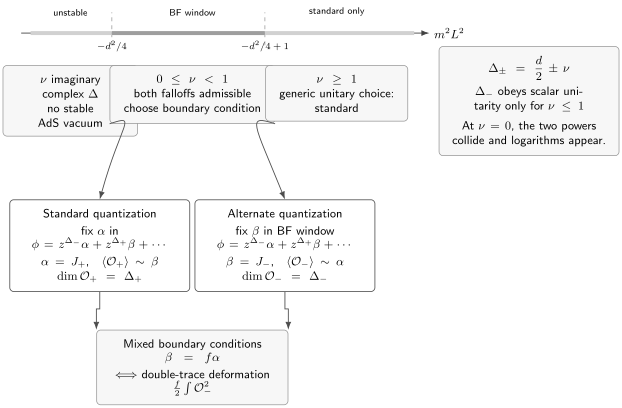
Scalar masses in AdS. Below the BF bound, is imaginary and the AdS vacuum is unstable. In the window , both asymptotic falloffs can be normalizable, so one may choose standard or alternate quantization. Above the window, the generic unitary choice is standard quantization with .
Why this matters
Section titled “Why this matters”The GKP/Witten prescription says that a CFT source is a bulk boundary condition. This page makes that sentence sharper: near the BF bound, there is more than one consistent choice of boundary condition.
For a scalar with expansion
standard quantization uses
while alternate quantization uses
This is not a semantic relabeling. It changes the variational principle, the generating functional, and the boundary CFT data. It is also the simplest arena in which double-trace deformations become mixed AdS boundary conditions.
The BF bound
Section titled “The BF bound”The two roots are real only when
Thus
This is the BF bound.
In flat spacetime, a negative mass squared generally means an instability because
becomes negative at small momentum. AdS is different. It has a timelike conformal boundary, and fields require boundary conditions there. It also behaves like a gravitational box. A negative local mass term can be compatible with a positive conserved energy if it is not too negative and if the boundary condition is chosen appropriately.
If the bound is violated, write
Then the falloffs are
The dimensions are complex,
which is incompatible with an ordinary unitary CFT spectrum. The bulk and boundary diagnoses agree: below the BF bound, the AdS background is sick.
Two falloffs and two coefficients
Section titled “Two falloffs and two coefficients”When the BF bound is obeyed, the scalar has the near-boundary expansion
where
The coefficients and are the two independent asymptotic data of the second-order radial equation. A choice of quantization tells us which coefficient is held fixed as a source and which one is determined dynamically as a response.
In standard quantization,
In alternate quantization,
The proportionality constants depend on conventions and counterterms. The source-response exchange does not.
Normalizability and the alternate window
Section titled “Normalizability and the alternate window”Why is alternate quantization not always allowed? The quickest answer is that the slower falloff is not always normalizable.
For a scalar mode behaving as
the Klein–Gordon norm near the boundary behaves schematically as
This converges near when
or
The faster falloff is normalizable above the BF bound. The slower falloff is normalizable only if
Using
we get
Therefore alternate quantization is possible only in the window
In terms of the mass,
so
The same window appears from the boundary scalar unitarity bound. A scalar primary in a unitary -dimensional CFT obeys
for , apart from the identity. The alternate dimension
satisfies this bound only when , with endpoint subtleties.
The variational principle
Section titled “The variational principle”The source-response interpretation is a statement about the bulk variational principle.
On shell, the scalar action varies as a boundary term. After holographic renormalization, the variation has the schematic form
for non-integer in common conventions.
This is naturally a functional of :
Holding fixed gives a well-posed Dirichlet-like variational problem. Holographically,
is the source for an operator of dimension .
To obtain alternate quantization, one adds a finite boundary term that performs a Legendre transform. Schematically,
with eliminated in favor of through the bulk solution. Then
Now is fixed at the boundary. Holographically,
is the source for an operator of dimension .
The sign and factor of are convention-dependent. The invariant statement is
Standard and alternate dictionaries
Section titled “Standard and alternate dictionaries”For a scalar in the alternate window, the same bulk mass can describe two possible CFT dimensions:
| choice | source | response | operator dimension |
|---|---|---|---|
| standard | |||
| alternate |
In standard quantization,
In alternate quantization,
Since
the faster coefficient has exactly the dimension required to source an operator of dimension .
Endpoint cases
Section titled “Endpoint cases”The BF point
Section titled “The BF point ν=0\nu=0ν=0”At the BF bound,
The two power-law solutions collide. The independent near-boundary solutions take the form
where is a renormalization scale introduced by the logarithm.
This case is stable, but it is not just the generic two-root story with inserted. The logarithm changes the counterterms, the variational principle, and the scale dependence.
The upper endpoint
Section titled “The upper endpoint ν=1\nu=1ν=1”At the upper edge,
The alternate dimension saturates the scalar unitarity bound. In a unitary CFT, a scalar primary saturating this bound is a free field. Bulk analyses at this endpoint often involve logarithmic or boundary-term subtleties. For a first pass, treat as the clean open window and handle separately.
Mixed boundary conditions and double-trace deformations
Section titled “Mixed boundary conditions and double-trace deformations”The standard and alternate choices are fixed points. More general boundary conditions correspond to deformations of the boundary theory.
A common mixed boundary condition is
Depending on which quantization and normalization one starts with, the same physics may be written as or with additional local terms. The invariant idea is that a deformation changes the relation between source and response.
In the alternate theory, the double-trace deformation
corresponds at large to a mixed boundary condition for the dual scalar. Since
this operator is relevant for . In the simplest large- story, the RG flow runs from alternate quantization in the ultraviolet to standard quantization in the infrared:
This is one of the cleanest examples of how boundary conditions in AdS encode RG data in the CFT.
Examples
Section titled “Examples”For , the boundary dimension is . If
then
Therefore
Since , both quantizations are allowed.
The expansion is
Standard quantization gives a dimension- operator:
Alternate quantization gives a dimension- operator:
For , . If
then
This is the BF bound in , and logarithms appear:
For and ,
The alternate dimension saturates the four-dimensional scalar unitarity bound,
This is an endpoint case, not the generic interior of the alternate window.
Lorentzian comments
Section titled “Lorentzian comments”The near-boundary expansion and the choice of quantization are the same in Euclidean and Lorentzian signature. What changes is the interior condition used to determine the relation between and .
In Euclidean AdS, one usually demands regularity in the interior. In Lorentzian global AdS, one specifies a state and an prescription. In a black-hole background, retarded correlators require incoming boundary conditions at the horizon.
These choices determine the response once the source is fixed. They do not replace the boundary choice between standard and alternate quantization.
Dictionary checkpoint
Section titled “Dictionary checkpoint”For
the BF bound is
The alternate-quantization window is
Standard quantization gives
Alternate quantization gives
Mixed boundary conditions correspond to multi-trace deformations, especially double-trace deformations at large .
Common confusions
Section titled “Common confusions”“The BF bound says negative masses are forbidden.”
Section titled ““The BF bound says negative masses are forbidden.””No. It says sufficiently negative masses are forbidden. Scalars with
can be stable in AdS.
“If there are two roots, both quantizations are always allowed.”
Section titled ““If there are two roots, both quantizations are always allowed.””No. The roots exist whenever the BF bound is satisfied, but alternate quantization requires the slower falloff to be normalizable and compatible with CFT unitarity. This restricts the mass to .
“Alternate quantization changes the bulk mass.”
Section titled ““Alternate quantization changes the bulk mass.””No. The mass is the same. The boundary condition and variational principle change. The same bulk equation can define different boundary CFT data.
“Both coefficients are vevs if both modes are normalizable.”
Section titled ““Both coefficients are vevs if both modes are normalizable.””No. Normalizability says what is allowed to fluctuate. The source/vev split is fixed by the chosen variational principle.
“Integer is harmless.”
Section titled ““Integer ν\nuν is harmless.””Integer often produces logarithms in the near-boundary expansion and contact-term ambiguities in correlation functions. The nonlocal part remains meaningful, but the local terms require a renormalization scheme.
Exercises
Section titled “Exercises”Exercise 1: The alternate window
Section titled “Exercise 1: The alternate window”Show that is equivalent to
Solution
By definition,
The condition is equivalent to
Therefore
Subtracting gives
Exercise 2: The scalar unitarity bound
Section titled “Exercise 2: The scalar unitarity bound”Use the scalar unitarity bound to show that is allowed only if .
Solution
Demanding the bound gives
Canceling gives
so
The endpoint saturates the bound and is subtle.
For and , compute , , and . Is alternate quantization allowed?
Solution
For ,
Thus
Because , alternate quantization is allowed.
Exercise 4: The BF logarithm
Section titled “Exercise 4: The BF logarithm”At the BF bound, what is and why does a logarithm appear?
Solution
At the BF bound,
so
Therefore
A second-order radial equation still needs two independent solutions. When the two indicial roots coincide, the second solution typically contains a logarithm:
Exercise 5: Double-trace relevance
Section titled “Exercise 5: Double-trace relevance”In alternate quantization with , show that the double-trace operator is relevant at large .
Solution
At large ,
Since
we get
For ,
Therefore is relevant.
Further reading
Section titled “Further reading”- P. Breitenlohner and D. Z. Freedman, Positive Energy in Anti-de Sitter Backgrounds and Gauged Extended Supergravity.
- P. Breitenlohner and D. Z. Freedman, Stability in Gauged Extended Supergravity.
- I. R. Klebanov and E. Witten, AdS/CFT Correspondence and Symmetry Breaking.
- E. Witten, Multi-Trace Operators, Boundary Conditions, and AdS/CFT Correspondence.
- M. Berkooz, A. Sever, and A. Shomer, Double-Trace Deformations, Boundary Conditions and Spacetime Singularities.
- K. Skenderis, Lecture Notes on Holographic Renormalization.