
Three-Point Functions and Bulk Couplings
Why this matters
Section titled “Why this matters”Two-point functions define the normalization and spectrum of a CFT. Three-point functions are the next layer of data: they determine OPE coefficients. For scalar primary operators, conformal symmetry fixes the position dependence of a three-point function completely:
The dynamical information is the number , after the two-point functions are normalized.
In AdS/CFT, the leading large- value of is computed by a cubic bulk coupling. This is one of the cleanest versions of the slogan:
This page derives that statement for scalar operators. It also explains the normalization caveats that often cause confusion when comparing formulas across papers.
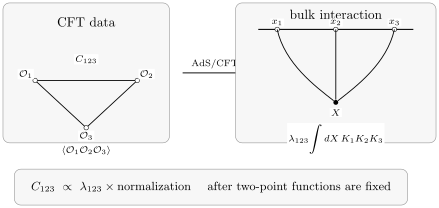
A local cubic coupling in AdS fixes the conformally allowed three-point structure of the dual scalar primaries. The raw bulk coefficient becomes a CFT OPE coefficient only after two-point normalizations and convention-dependent factors are included.
Consider three scalar bulk fields in Euclidean AdS, dual to scalar primary operators with dimensions . The masses satisfy
Work in Poincaré coordinates and set unless explicitly restored:
Take the interaction to be
If the fields are identical, one may instead write . The final three-point function is the same once the combinatorial convention is treated consistently.
The linear solution sourced by is
with
This is the Euclidean boundary-to-bulk propagator for standard quantization.
From the cubic action to the three-point diagram
Section titled “From the cubic action to the three-point diagram”At leading order in the cubic coupling, the interaction contribution to the on-shell action is obtained by substituting the linearized solutions into . Since
the cubic contribution to the connected generating functional is
Differentiating with respect to the three sources gives
up to the overall sign convention in the Euclidean action. This is the three-point contact Witten diagram.
The entire computation is therefore reduced to an AdS integral.
The AdS three-point integral
Section titled “The AdS three-point integral”Substitute the explicit propagators. Define
The integral is
Thus
Conformal symmetry already tells us the answer must have the form
The task is to compute the constant .
Evaluating the constant
Section titled “Evaluating the constant”Use Schwinger parameters:
For the three denominators
the exponent is
Let
Completing the square gives
The -integral is Gaussian:
The -integral is
valid initially for and then by analytic continuation in the dimensions.
After changing variables from to an overall scale and simplex variables, one obtains the standard coefficient
Therefore, with the Euclidean sign convention above,
This is the raw coefficient produced by the chosen bulk action and field normalization. To get the CFT OPE coefficient in normalized conventions, one must divide by the square roots of the two-point-function normalizations.
Normalizing the OPE coefficient
Section titled “Normalizing the OPE coefficient”Suppose the two-point functions are
Define normalized operators
Then
and the normalized three-point coefficient is
This step is essential. A bulk cubic coupling by itself is not yet a convention-independent OPE coefficient. It becomes one after the kinetic terms, propagator normalizations, and operator normalizations are fixed.
In many supergravity papers, fields are normalized by dimensional reduction from ten or eleven dimensions. In many CFT papers, operators are normalized so that their two-point functions are unity. Translating between these conventions is often the hardest part of comparing results.
Large- scaling
Section titled “Large-NNN scaling”For normalized single-trace operators in a large- gauge theory,
The bulk explanation is simple. The gravitational action has an overall factor
in the canonical AdS/CFT example. After rescaling fields so that the quadratic action is canonically normalized, a cubic vertex is suppressed by
Thus the Witten diagram reproduces the expected single-trace scaling.
If one uses unnormalized single-trace operators such as , the apparent -power changes. The invariant statement is that connected three-point functions are suppressed relative to two-point functions in exactly the way expected from a weakly interacting bulk theory.
Why the answer has the CFT form
Section titled “Why the answer has the CFT form”The result has the standard conformal three-point structure because the integral is invariant under AdS isometries. In Poincaré coordinates, the most transparent checks are translations, rotations, and dilations. The less obvious check is inversion or special conformal transformations. These also hold because they arise from AdS isometries acting on the boundary conformal group.
Under a dilation , each boundary-to-bulk propagator contributes while the AdS measure is invariant. Therefore
The conformal three-point structure has exactly this scaling. The exponents in the denominator are determined by requiring the correct scaling at each point.
For example, the power of is
This is not arbitrary. It is the unique value compatible with separate scaling weights , , and at the three insertion points.
OPE interpretation
Section titled “OPE interpretation”The scalar OPE has the schematic form
Taking the expectation value with and using the two-point function gives the three-point function. Thus the coefficient extracted from the Witten diagram is precisely the OPE coefficient once the operators are normalized.
On the bulk side, the same statement reads:
If because of a symmetry, then the corresponding leading large- OPE coefficient vanishes. If the coupling is allowed, the three-point diagram computes it.
Selection rules
Section titled “Selection rules”Bulk interactions inherit the symmetries of the background. In AdS, Kaluza–Klein modes carry quantum numbers. A cubic coupling is allowed only if the product of the corresponding representations contains a singlet:
The same condition appears in the CFT as an R-symmetry selection rule for
This is a good example of the difference between kinematics and dynamics. Conformal symmetry fixes the spacetime dependence. Internal symmetries restrict which coefficients can be nonzero. The actual numerical values of the allowed coefficients are dynamical data, computed from the bulk couplings in the gravity limit.
Derivative cubic couplings
Section titled “Derivative cubic couplings”Not every cubic interaction is simply . One may have terms such as
For a three-point function of scalar primaries, conformal symmetry still permits only one spacetime structure. Therefore a derivative cubic coupling changes only the overall coefficient, not the functional form.
Using integration by parts and the equations of motion,
one can relate the derivative vertex to a non-derivative one plus boundary/contact terms. For example,
provided the fields obey their linear equations and the boundary terms are treated carefully.
At four points and higher, derivative interactions are more consequential because conformal symmetry leaves nontrivial functions of cross ratios. There, derivative couplings change the cross-ratio dependence and encode genuine bulk effective-field-theory data.
Extremal and near-extremal cases
Section titled “Extremal and near-extremal cases”The gamma-function expression contains factors such as
If
this factor becomes , suggesting a divergence. Such correlators are called extremal. They occur naturally for certain protected operators in supersymmetric AdS/CFT examples.
The divergence does not mean the CFT correlator is ill-defined. It means the naive bulk contact integral needs a more careful treatment. In many supergravity examples, the corresponding cubic coupling vanishes in just the right way so that the product of coupling and divergent integral has a finite limit. Boundary terms and analytic continuation in dimensions can also be important.
For this foundations course, the main lesson is:
Generic non-extremal three-point functions are captured cleanly by the formula above.
Spinning operators
Section titled “Spinning operators”For currents and stress tensors, the same logic applies but the tensor structures are richer. A conserved current three-point function has vector indices and is constrained by conformal symmetry plus current conservation. A stress-tensor three-point function is constrained by conformal symmetry plus diffeomorphism Ward identities.
On the bulk side:
| Boundary three-point function | Bulk cubic interaction |
|---|---|
| scalar cubic vertex | |
| gauge-scalar-scalar vertex | |
| Yang–Mills and possible Chern–Simons vertices | |
| graviton-scalar-scalar vertex | |
| graviton cubic vertex and higher-derivative gravitational terms |
For spinning correlators, a bulk vertex determines not just a number but a linear combination of allowed tensor structures. Higher-derivative bulk terms correspond to additional CFT tensor structures, subject to Ward identities and consistency constraints.
Protected versus unprotected data
Section titled “Protected versus unprotected data”In SYM, many important scalar operators are protected chiral primaries. Their dimensions do not depend on the coupling. Certain three-point functions among protected operators are also protected, so their strong-coupling supergravity values agree with weak-coupling field-theory calculations after matching normalizations.
This protection is special. In a generic holographic CFT, dimensions and OPE coefficients depend on the coupling. The bulk computation gives their values in the regime where the CFT has a weakly curved gravity dual.
A good mental picture is:
while
Contact terms and scheme dependence
Section titled “Contact terms and scheme dependence”The nonlocal three-point structure at separated points is the universal data. Local terms supported when points coincide are different. For example, terms proportional to
are contact terms. They can be shifted by local counterterms in the generating functional.
The coefficient in the separated-point three-point function is physical CFT data. Contact terms are also meaningful in Ward identities and when sources are spacetime-dependent, but they are scheme-dependent unless fixed by symmetry, anomaly matching, or a precise renormalization prescription.
When computing Witten diagrams, always separate:
Dictionary checkpoint
Section titled “Dictionary checkpoint”The three-point dictionary is:
| Bulk quantity | Boundary meaning |
|---|---|
| scalar mass | dimension |
| boundary-to-bulk propagator | insertion of |
| cubic coupling | leading large- three-point/OPE data |
| AdS contact integral | conformally fixed three-point position dependence |
| two-point normalization | operator normalization convention |
| derivative cubic vertex | same scalar structure, different coefficient at three points |
| internal symmetry of bulk fields | CFT selection rule |
| bulk counterterm | contact-term ambiguity |
In one line:
with proportionality signs hiding only convention-dependent signs, radii, and field-normalization factors.
Common confusions
Section titled “Common confusions”“The three-point function is fixed, so there is no dynamics.”
Section titled ““The three-point function is fixed, so there is no dynamics.””The position dependence is fixed by conformal symmetry, but the coefficient is dynamical. The bulk cubic coupling computes that coefficient.
“The bulk coupling is directly the OPE coefficient.”
Section titled ““The bulk coupling is directly the OPE coefficient.””Not quite. The OPE coefficient is the bulk coupling times an AdS integral and divided by the square roots of the two-point-function normalizations. Field normalizations matter.
“A vanishing cubic coupling means the operator does not exist.”
Section titled ““A vanishing cubic coupling means the operator does not exist.””No. It means that particular leading three-point coefficient vanishes, usually because of a symmetry or selection rule. The operator can still appear in other correlators or at subleading order.
“Derivative couplings create new scalar three-point shapes.”
Section titled ““Derivative couplings create new scalar three-point shapes.””For scalar primaries, conformal symmetry allows only one three-point spacetime structure. Derivative couplings change its coefficient, not its position dependence, up to contact terms. New shape data first become unavoidable in scalar four-point functions.
“Divergent gamma functions always mean a mistake.”
Section titled ““Divergent gamma functions always mean a mistake.””They often signal a special kinematic case, such as extremal dimensions, where the naive bulk integral must be interpreted by analytic continuation, boundary terms, or a cancellation with a vanishing coupling.
Exercises
Section titled “Exercises”Exercise 1: Recover the conformal exponents
Section titled “Exercise 1: Recover the conformal exponents”Assume the scalar three-point function has the form
Use scaling at each point to solve for , , and .
Solution
Under a local scaling of the coordinates around , the operator has dimension . Equivalently, the powers of distances involving must add to :
Similarly,
Solving gives
and
Therefore
Exercise 2: Large- scaling of a cubic vertex
Section titled “Exercise 2: Large-NNN scaling of a cubic vertex”Suppose a bulk action has the schematic form
Rescale the field to make the kinetic term canonical. What is the -scaling of the cubic vertex?
Solution
Define the canonically normalized field
Then
The cubic term becomes
Thus the canonically normalized cubic vertex is of order . This matches the large- scaling of normalized single-trace three-point functions.
Exercise 3: Derivative coupling reduction
Section titled “Exercise 3: Derivative coupling reduction”Using integration by parts, show that on shell
Solution
Start from
Therefore
Multiply by and integrate:
Integrating the first term by parts twice gives
Using the on-shell equations
gives
if the Laplacian convention is as written. If the action is written with the operator , the equivalent reduction is often displayed with the opposite sign convention. The important lesson is that the derivative vertex is proportional on shell to a non-derivative vertex plus boundary terms, with the coefficient fixed by the masses and sign conventions.
Exercise 4: Normalize a raw coefficient
Section titled “Exercise 4: Normalize a raw coefficient”Suppose a Witten diagram gives
and the two-point functions are
What is the coefficient for normalized operators?
Solution
Define
Then
Therefore
Further reading
Section titled “Further reading”- D. Z. Freedman, S. D. Mathur, A. Matusis, and L. Rastelli, Correlation Functions in the CFT/AdS Correspondence.
- E. Witten, Anti de Sitter Space and Holography.
- S. S. Gubser, I. R. Klebanov, and A. M. Polyakov, Gauge Theory Correlators from Non-Critical String Theory.
- S. Lee, S. Minwalla, M. Rangamani, and N. Seiberg, Three-Point Functions of Chiral Operators in D=4, N=4 SYM at Large N.
- E. D’Hoker and D. Z. Freedman, Supersymmetric Gauge Theories and the AdS/CFT Correspondence.
- J. Penedones, TASI Lectures on AdS/CFT.