
Retarded Green Functions
Why this matters
Section titled “Why this matters”The previous page explained the real-time prescription at the level of principle: retarded correlators are computed by Lorentzian bulk fields that fall through the future horizon. This page turns that principle into a calculation.
The central boundary object is
It is the kernel that relates a small source to a causal response:
In holography, this response is not guessed. It is extracted from the renormalized radial canonical momentum of a bulk field whose boundary value is .
The short practical formula is
where is the boundary source and is the finite response after adding counterterms.
Linear response on the boundary
Section titled “Linear response on the boundary”Couple a source to an operator :
To first order in ,
The step function in is not decorative: it enforces causality. A source at time cannot affect an expectation value at an earlier time .
With Fourier convention
linear response becomes multiplication:
The spectral density is
For a stable thermal state and a Hermitian operator, measures physical spectral weight. In holography, its imaginary part is tied to absorption by the black-brane horizon.
Bulk setup
Section titled “Bulk setup”Use the planar AdS black-brane metric
with
For a scalar field dual to , take
The overall normalization depends on the ten-dimensional reduction, the five-dimensional Newton constant, and the convention used to normalize . For the logic of the prescription, it can be kept explicit.
For a Fourier mode
the wave equation is
The calculation has two ends:
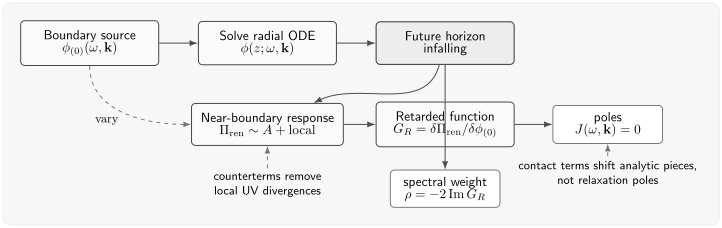
A holographic retarded two-point function is a linear-response computation. Specify the boundary source , solve the bulk equation with infalling behavior at the future horizon, extract the renormalized response , and differentiate. Poles occur when the source coefficient can vanish while the infalling response remains nonzero.
Boundary expansion and the response coefficient
Section titled “Boundary expansion and the response coefficient”Near the boundary, the scalar behaves as
where
In standard quantization, is the source. The coefficient is the nonlocal response data. After holographic renormalization,
for a scalar with no special logarithmic subtleties. The local terms are contact terms or scheme-dependent analytic pieces. They can change polynomial pieces of , but not its nonlocal singularities.
Thus the nonlocal part of the retarded correlator is schematically
where is computed using the infalling bulk solution.
Canonical momentum form
Section titled “Canonical momentum form”The more invariant way to write the prescription uses radial canonical momentum. Varying the scalar action gives a boundary term
with
up to the sign chosen for the outward normal. The renormalized momentum is
where the power of shown here is the schematic conversion to the source normalization. A careful calculation uses the precise Fefferman–Graham expansion and the variation of .
At linear order,
Therefore
when the solution has been normalized to the desired boundary source. For multiple fields, this equation becomes a matrix relation.
The infalling solution
Section titled “The infalling solution”Near the horizon,
The radial equation has two independent behaviors:
The retarded function uses the first behavior. In ingoing Eddington–Finkelstein time
an infalling mode is regular:
This condition says that the boundary perturbation may be absorbed by the future horizon. It does not allow independent radiation to emerge from behind the future horizon.
A step-by-step recipe
Section titled “A step-by-step recipe”For a scalar two-point function in a thermal state:
-
Choose the bulk field dual to and write its quadratic action.
-
Fourier transform along the boundary directions.
-
Solve the radial equation with infalling behavior at .
-
Normalize the solution near so that the source coefficient is .
-
Compute the on-shell boundary term or radial canonical momentum.
-
Add counterterms and take .
-
Read off
For numerical work, a common trick is to write
where is regular at the horizon. One integrates from the horizon to the boundary, then extracts the source and response coefficients.
Coupled fields and response matrices
Section titled “Coupled fields and response matrices”Many important correlators are not single-field problems. Metric and gauge perturbations can mix. For example, at finite density, and often couple. For stress-tensor correlators, diffeomorphism constraints mix metric components.
Suppose the independent sources are and the renormalized responses are . Linear response gives
In the bulk, one constructs a basis of infalling solutions labelled by boundary source data. In matrix notation,
after adding counterterms and projecting onto gauge-invariant source and response variables.
This is why gauge invariance matters. A pole of a gauge-dependent component is not necessarily a physical pole. The clean objects are gauge-invariant master fields or the full renormalized response matrix.
Flux and spectral weight
Section titled “Flux and spectral weight”For real , the scalar equation has a conserved radial flux
This flux is independent of when the coefficients of the radial equation are real. Evaluated near the boundary, it is related to the imaginary part of . Evaluated at the horizon, the infalling condition turns it into an absorption flux.
This gives the geometric meaning of dissipation:
The horizon is therefore not just a place where the bulk calculation ends. It is the bulk mechanism by which the thermal CFT loses memory of perturbations.
Hydrodynamic preview
Section titled “Hydrodynamic preview”Retarded functions encode transport. A conserved density with diffusion has a retarded correlator of the schematic form
where is the susceptibility and is the diffusion constant. The pole
is a hydrodynamic relaxation mode.
Similarly, shear viscosity is extracted from a stress-tensor retarded function by a Kubo formula,
The next pages develop the pole interpretation and the hydrodynamic limit more systematically.
Analytic structure
Section titled “Analytic structure”A retarded correlator is analytic in the upper half of the complex plane for a stable causal thermal state. Poles lie in the lower half plane:
In time domain, a pole at
contributes a late-time behavior
In holography, these poles are quasinormal modes of the black brane.
Dictionary checkpoint
Section titled “Dictionary checkpoint”| Boundary quantity | Bulk computation |
|---|---|
| source | non-normalizable boundary coefficient |
| response | renormalized radial canonical momentum |
| infalling linear solution differentiated at the boundary | |
| spectral density | absorption flux into the horizon |
| transport coefficient | small-, small- limit of |
| relaxation pole | infalling, source-free bulk mode |
| coupled correlator matrix | matrix of renormalized responses to independent sources |
The retarded prescription is a boundary-value problem with a causal horizon condition.
Common confusions
Section titled “Common confusions”“The retarded correlator is just the ratio .”
Section titled ““The retarded correlator is just the ratio A/ϕ(0)A/\phi_{(0)}A/ϕ(0).””That is only a useful shorthand. The correct object is the renormalized variation of the on-shell action. For simple scalars, the nonlocal part is often proportional to , but counterterms, logarithms, operator normalization, alternate quantization, and mixing can modify the precise formula.
“The imaginary part comes from the boundary.”
Section titled ““The imaginary part comes from the boundary.””The boundary expansion can display , but its physical origin at finite temperature is horizon absorption. The conserved radial flux lets one evaluate the same imaginary part at the horizon.
“Every pole is hydrodynamic.”
Section titled ““Every pole is hydrodynamic.””Hydrodynamic poles approach as because they are tied to conserved quantities. Generic quasinormal poles remain at complex frequencies of order and describe nonhydrodynamic relaxation.
“Gauge fields and metric perturbations can be treated component by component.”
Section titled ““Gauge fields and metric perturbations can be treated component by component.””Not safely. Gauge and diffeomorphism constraints can mix components. Use gauge-invariant variables or the full source-response matrix.
“The infalling condition is optional.”
Section titled ““The infalling condition is optional.””For the retarded correlator in a thermal state, it is the defining Lorentzian interior condition. Choosing outgoing behavior computes a different causal object.
Exercises
Section titled “Exercises”Exercise 1: Retarded analyticity and late-time decay
Section titled “Exercise 1: Retarded analyticity and late-time decay”Suppose a retarded Green function has a simple pole at
Show that this pole gives a decaying contribution to the response for .
Solution
For , the inverse Fourier transform contains
Closing the contour in the lower half plane picks up poles with . A simple pole at gives
Thus the imaginary part gives decay. A pole in the upper half plane would grow exponentially and signal an instability or an acausal prescription.
Exercise 2: Source and response from a normalized solution
Section titled “Exercise 2: Source and response from a normalized solution”Let an infalling scalar solution near the boundary behave as
Assume standard quantization and no logarithmic subtleties. What is the nonlocal part of ?
Solution
The source is . The nonlocal response is proportional to . For a scalar with normalization ,
Therefore the nonlocal part of the retarded two-point function is
The infalling condition is what makes this the retarded correlator rather than another Green function.
Exercise 3: Why coupled fields require a matrix
Section titled “Exercise 3: Why coupled fields require a matrix”Suppose two bulk fields have boundary expansions with sources and responses . Explain why computing only with accidentally nonzero does not give .
Solution
Linear response has the matrix form
If , then
The ratio is not unless or is known and subtracted. In practice one constructs independent infalling solutions, forms the source matrix , forms the response matrix , and computes
Further reading
Section titled “Further reading”- D. T. Son and A. O. Starinets, Minkowski-space correlators in AdS/CFT correspondence: recipe and applications.
- G. Policastro, D. T. Son, and A. O. Starinets, Shear viscosity of strongly coupled supersymmetric Yang–Mills plasma.
- C. P. Herzog and D. T. Son, Schwinger-Keldysh propagators from AdS/CFT correspondence.
- K. Skenderis and B. C. van Rees, Real-time gauge/gravity duality.
- D. T. Son, Viscosity, Black Holes, and Quantum Field Theory.