
Bulk Reconstruction
AdS/CFT says that the boundary CFT is a complete description of the bulk quantum gravity theory. But a sharp question remains:
If the CFT has no extra spatial dimension, how can it contain an operator that behaves like a local field at a point inside AdS?
Bulk reconstruction is the answer, at least perturbatively. It is the program of representing approximately local bulk observables as generally nonlocal CFT operators. In the simplest setting, a free scalar field in a fixed AdS background is reconstructed as a smeared boundary operator,
where is a bulk point, is a boundary point, is the CFT operator dual to , and is a smearing kernel. This formula is the beginning of the story, not the end. In an interacting gravitational theory, it must be corrected order by order in , dressed so that it is gauge-invariant, and interpreted inside a code subspace rather than on the entire CFT Hilbert space.
The slogan is:
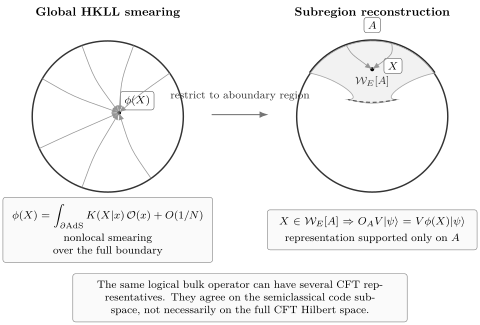
A perturbative bulk field is represented by a nonlocal boundary operator. In global reconstruction the smearing may use the full boundary. In subregion reconstruction the available boundary region is tied to the causal wedge at the simplest HKLL level and, more generally, to the entanglement wedge in the quantum-error-correcting interpretation.
Why this matters
Section titled “Why this matters”The previous pages explained how a large-, large-gap CFT produces a weakly coupled bulk effective field theory. A bulk EFT, however, contains local fields such as , while the exact CFT contains only boundary operators such as . Bulk reconstruction explains how these two descriptions are compatible.
There are three reasons this is foundational.
First, reconstruction makes precise what it means for a boundary theory to contain a radial direction. The bulk point is not an extra fundamental coordinate in the CFT. It is encoded in a pattern of nonlocal boundary data.
Second, reconstruction tests locality. If the reconstructed operators satisfy
then local bulk physics has emerged from boundary dynamics. The equality is approximate because bulk locality is an effective statement, corrected by interactions, gravitational dressing, and finite- effects.
Third, reconstruction leads directly to quantum error correction. A bulk operator may be reconstructable on more than one boundary region. This sounds paradoxical if one thinks of bulk information as copied into several places. It becomes natural if the boundary theory encodes the bulk like a quantum error-correcting code.
The setting: one scalar field in fixed AdS
Section titled “The setting: one scalar field in fixed AdS”Start with a scalar field in ,
The field obeys
Near the boundary in Poincare coordinates,
the normalizable part of a free field behaves as
more precisely in the operator sense,
up to normalization conventions. The mass and dimension obey
The reconstruction problem reverses this limiting relation: given the boundary operator , recover the bulk field .
Global-mode reconstruction
Section titled “Global-mode reconstruction”The cleanest conceptual derivation uses global AdS. For a free scalar, expand the bulk field in normal modes:
The normal-mode frequencies are
This spectrum is exactly what the CFT predicts from the state-operator correspondence. A primary of dimension gives a state of energy on the cylinder, and derivatives generate descendants with energies .
The boundary operator has a corresponding mode expansion,
Because the same oscillators and appear in both expansions, one can invert the boundary expansion and substitute back into the bulk field. This produces a smearing representation,
This is the simplest HKLL idea: bulk locality is reconstructed by combining infinitely many CFT modes in a very special nonlocal way.
Poincare smearing
Section titled “Poincare smearing”In the Poincare patch, for a free scalar satisfying suitable conditions on , one often writes a compact smearing formula of the form
Here
in a common normalization. The appearance of is not a typo. One convenient Lorentzian construction uses a complexified boundary spatial coordinate. Other versions use different regions or mode sums. The invariant lesson is not that this exact formula is universal; it is that a local bulk field is encoded in a nonlocal boundary operator with controlled support.
The smearing kernel is not arbitrary. It must solve the bulk wave equation in the bulk variable:
and reproduce the correct boundary behavior,
up to convention-dependent normalization.
What has been reconstructed?
Section titled “What has been reconstructed?”The formula reconstructs a free bulk field in a fixed background. That is already impressive, but it is not yet a fully nonperturbative local observable in quantum gravity.
There are several qualifications.
It is a code-subspace operator
Section titled “It is a code-subspace operator”The bulk field is meaningful in a semiclassical sector, such as states obtained by acting with a finite number of low-energy operators on a given background:
with total energy much smaller than the threshold where the background is significantly changed. The exact CFT Hilbert space also contains black-hole states, stringy states, and states that do not admit the same semiclassical geometry. A single fixed smearing formula cannot be expected to act as the same local bulk operator on all of them.
It is perturbative in
Section titled “It is perturbative in 1/N1/N1/N”The free formula is the leading term:
In the CFT, the corrections generally involve multi-trace operators. Schematic terms look like
These corrections are not decorative. They are required so that bulk commutators have the right causal behavior order by order in perturbation theory.
It must be gravitationally dressed
Section titled “It must be gravitationally dressed”In a theory with dynamical gravity, a strictly local gauge-invariant operator at a bulk point does not exist. Diffeomorphisms move points. A meaningful bulk operator must specify the point relationally or attach a gravitational dressing to the boundary. Schematically, one reconstructs a dressed operator
where indicates some choice of dressing or relational prescription. Different dressings agree at leading order in a weak-gravity limit but differ in their boundary charges and commutators.
This is the gravitational version of a familiar gauge-theory fact: a charged local field is not gauge-invariant unless it is dressed by a Wilson line or another dressing.
Reconstruction and bulk causality
Section titled “Reconstruction and bulk causality”A reconstructed field should reproduce bulk correlation functions. For example,
should give the bulk Wightman function in the appropriate state. Similarly, commutators should reproduce the bulk causal structure:
at leading order in the bulk EFT.
This is nontrivial. The boundary operator is local only on the boundary. The bulk notion of spacelike separation is emergent. The smearing kernel arranges many boundary contributions so that the unwanted boundary singularities cancel in the bulk spacelike region.
At finite , exact bulk locality cannot persist without modification. Quantum gravity has a finite entropy in finite regions, black holes form, and gravitational dressing produces long-range commutators. Thus reconstruction teaches a precise lesson:
Causal-wedge reconstruction
Section titled “Causal-wedge reconstruction”For a boundary spatial region , define its domain of dependence . The causal wedge is
It is the set of bulk points that can both receive signals from and send signals to . In favorable circumstances, HKLL-type methods reconstruct bulk fields in using operators supported in .
This is intuitive: if a point is in the causal wedge of , boundary observers in have enough causal access to probe it using boundary sources and responses.
But causal-wedge reconstruction is not the full story. The entanglement wedge is generally larger:
Modern subregion duality says that bulk operators in can be reconstructed on , at least within an appropriate code subspace. This stronger statement is one of the main motivations for the quantum-error-correction picture developed on the next page.
Entanglement-wedge reconstruction preview
Section titled “Entanglement-wedge reconstruction preview”Suppose is a bulk region inside the entanglement wedge of a boundary region :
Entanglement-wedge reconstruction says that for a bulk operator localized in , there exists a boundary operator supported only on such that
for all states in the chosen code subspace.
More carefully, if is the encoding map, then
This is different from saying that equals as an operator on the full exact Hilbert space. It only needs to reproduce the correct action on the semiclassical code subspace.
That small phrase, “on the code subspace,” saves bulk reconstruction from many fake paradoxes.
Why reconstruction is nonlocal on the boundary
Section titled “Why reconstruction is nonlocal on the boundary”A local bulk excitation is not dual to a local boundary excitation. The boundary imprint of a bulk particle is spread out. This is not a bug; it is holography doing its job.
One simple way to see this is from radial depth. A particle near the boundary creates a sharply localized boundary disturbance. A particle deep in AdS is more infrared from the CFT point of view and has a broader boundary representation. Radial position is encoded in scale, not in an extra local coordinate.
Another way to see it is from modes. A bulk point is specified by a coherent superposition of global normal modes. Each normal mode maps to a CFT energy-angular-momentum mode. Combining them to localize in the radial direction requires a nonlocal sum over boundary data.
Thus the dictionary is not
That formula is true only in the boundary limit. In the interior, the correct statement is closer to
Reconstruction behind horizons
Section titled “Reconstruction behind horizons”Bulk reconstruction is most subtle in black-hole geometries. Outside a horizon, one can often use HKLL-like reconstruction in the exterior region with appropriate boundary time support. Behind a horizon, reconstruction depends strongly on the state and on what boundary systems are available.
For an eternal two-sided AdS black hole, the thermofield-double state gives two CFTs:
The two-sided geometry has an Einstein–Rosen bridge, and interior reconstruction can use both boundaries in a way tied to the state. For a one-sided black hole formed by collapse, reconstruction is more subtle and may require very complicated CFT operators.
The important point for this foundations course is modest but essential: reconstruction is not a universal recipe that turns every point in every geometry into a simple boundary integral. It is a perturbative construction whose form depends on the background, the state, the chosen code subspace, and the region of the boundary allowed for reconstruction.
Relation to the extrapolate dictionary
Section titled “Relation to the extrapolate dictionary”There are two related but distinct statements.
The extrapolate dictionary says
up to normalization.
Bulk reconstruction says
The extrapolate dictionary extracts a boundary operator from the near-boundary limit of a bulk field. Reconstruction builds an interior bulk field from boundary operators. The two are compatible, but they answer opposite questions.
Dictionary checkpoint
Section titled “Dictionary checkpoint”| Bulk statement | Boundary interpretation |
|---|---|
| free bulk field | smeared single-trace operator |
| bulk interactions | multi-trace corrections to reconstruction |
| radial position | scale and nonlocal pattern of boundary support |
| causal wedge | region accessible by causal boundary probes in |
| entanglement wedge | region reconstructable from subregion in the code subspace |
| gravitational dressing | choice of relational/gauge-invariant boundary anchoring |
| finite | breakdown of exact local bulk fields as fundamental observables |
The most important takeaway is:
Common confusions
Section titled “Common confusions”“The boundary operator at is the bulk field at .”
Section titled ““The boundary operator at xxx is the bulk field at (z,x)(z,x)(z,x).””Only in the limit . At finite radial position, the bulk field is represented by a nonlocal boundary operator. The deeper the point, the more nonlocal the representation typically becomes.
“HKLL gives an exact operator in quantum gravity.”
Section titled ““HKLL gives an exact operator in quantum gravity.””No. HKLL gives a perturbative reconstruction of bulk fields in a chosen semiclassical background. The exact CFT exists nonperturbatively, but exact local bulk operators do not exist in the same simple way.
“Different reconstructions mean the bulk operator has been copied.”
Section titled ““Different reconstructions mean the bulk operator has been copied.””No. Different boundary operators can have the same action on a code subspace while acting differently outside that subspace. This is precisely the logic of quantum error correction.
“A local bulk field must commute exactly at spacelike separation.”
Section titled ““A local bulk field must commute exactly at spacelike separation.””In bulk EFT, yes, up to the expected perturbative precision. In quantum gravity, gravitational dressing, constraints, and finite entropy obstruct exact local commuting subalgebras in the naive sense.
“The entanglement wedge is just the causal wedge.”
Section titled ““The entanglement wedge is just the causal wedge.””Usually not. The entanglement wedge is often larger, especially for large boundary regions or black-hole geometries. The difference is one reason quantum error correction enters holography.
Exercises
Section titled “Exercises”Exercise 1: Near-boundary consistency
Section titled “Exercise 1: Near-boundary consistency”Suppose a smearing kernel satisfies
and
Show that the reconstruction formula is consistent with the extrapolate dictionary.
Solution
Multiply the reconstruction formula by and take :
Using the assumed boundary behavior of the kernel gives
This is the extrapolate dictionary, up to whichever normalization convention was chosen for and .
Exercise 2: Why multi-trace corrections are expected
Section titled “Exercise 2: Why multi-trace corrections are expected”A normalized single-trace operator has connected three-point functions of order :
Explain why an interacting bulk field cannot be reconstructed only as a linear smearing of .
Solution
A linear smearing of describes a generalized-free, leading large- bulk field. But connected three-point functions of order indicate cubic bulk interactions. A bulk field interacting through cubic vertices receives corrections that are quadratic in lower-order fields. In CFT language, these corrections are represented by smeared double-trace operators such as
Thus the interacting reconstruction has the schematic form
The multi-trace corrections are needed both to reproduce interacting correlators and to restore bulk locality order by order in .
Exercise 3: Redundant reconstructions
Section titled “Exercise 3: Redundant reconstructions”Let be the projector onto a code subspace. Suppose two boundary operators and satisfy
Show that all matrix elements inside the code subspace agree.
Solution
For any two code states and , we have
Therefore
So and may be different operators on the full CFT Hilbert space, but they represent the same logical bulk operator inside the code subspace.
Exercise 4: Causal wedge versus entanglement wedge
Section titled “Exercise 4: Causal wedge versus entanglement wedge”Why is it plausible that causal-wedge reconstruction is not the final answer for subregion duality?
Solution
The causal wedge only uses causal propagation between the boundary domain of dependence and the bulk. But quantum gravity also encodes information through entanglement. The RT/HRT surface and the entanglement wedge are determined by entropy, not just causal reachability. In many examples the entanglement wedge is larger than the causal wedge:
If bulk information in is encoded in the density matrix on , then causal propagation alone misses part of the reconstructable region. This motivates the stronger entanglement-wedge reconstruction statement and, ultimately, the quantum-error-correction interpretation.
Further reading
Section titled “Further reading”- A. Hamilton, D. Kabat, G. Lifschytz, and D. A. Lowe, Local Bulk Operators in AdS/CFT: A Boundary View of Horizons and Locality.
- A. Hamilton, D. Kabat, G. Lifschytz, and D. A. Lowe, Local Bulk Operators in AdS/CFT: A Holographic Description of the Black Hole Interior.
- D. Kabat, G. Lifschytz, and D. A. Lowe, Constructing Local Bulk Observables in Interacting AdS/CFT.
- T. De Jonckheere, Modave Lectures on Bulk Reconstruction in AdS/CFT.
- X. Dong, D. Harlow, and A. C. Wall, Reconstruction of Bulk Operators within the Entanglement Wedge in Gauge-Gravity Duality.
- D. Harlow, TASI Lectures on the Emergence of the Bulk in AdS/CFT.