
One-Point Functions and VEVs
The previous pages established the source side of the scalar dictionary. A bulk scalar of mass has two independent near-boundary behaviors,
and in standard quantization the leading coefficient is the source for a boundary operator .
This page explains the response side of the same statement. The coefficient is not just a decorative subleading term. After the correct counterterms are added, it determines the expectation value . The precise rule is not “read off the subleading coefficient by eye.” The precise rule is:
with the Euclidean source convention used in this course. The minus sign follows from
The short slogan is useful:
The radial canonical momentum is the safer concept. The subleading coefficient is often proportional to it, but local terms, logarithms, anomalies, and scheme choices can modify the naive relation.
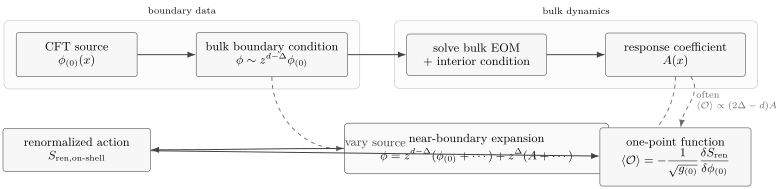
The one-point-function workflow. The source fixes the leading near-boundary behavior of a bulk field. The bulk equations plus an interior condition determine the response coefficient . The finite, renormalized variation of the on-shell action gives . The response is therefore a variational object, not merely a raw coefficient in the cutoff expansion.
Why this matters
Section titled “Why this matters”Correlation functions are obtained by differentiating the generating functional. But the first derivative is already extremely important. It tells us the expectation value of an operator in the state or ensemble being described.
In holography, one-point functions answer questions such as:
- What is the energy density of a black brane?
- What charge density is produced by a bulk electric field?
- Which scalar condensate is present in a deformed or symmetry-breaking state?
- Which Ward identities does the bulk solution obey?
- Which boundary state corresponds to a particular normalizable bulk deformation?
A two-point function tells us about linear response. A one-point function tells us what background we are responding around.
This is especially important because the same source can produce different expectation values in different states. The boundary condition at the AdS boundary specifies the QFT source. The interior condition specifies the state, saddle, ensemble, or real-time prescription. The vev is the response of that chosen state to the chosen source.
The QFT definition
Section titled “The QFT definition”Let be the boundary spacetime with metric representative . Suppose a source couples to an operator through the Euclidean convention
Then
The one-point function in the presence of the source is
For the metric source,
up to the usual Euclidean sign convention. For a background gauge field coupled as
the current is
These are field-theory definitions. Holography gives a way to compute the same derivatives from the bulk.
The bulk variational principle
Section titled “The bulk variational principle”Consider a scalar field in Euclidean asymptotically AdS with action
where is an overall normalization. For a canonically normalized supergravity field, typically contains a factor such as and therefore scales like a power of .
Varying the action gives
Here is the induced metric on the cutoff surface , and is the outward-pointing unit normal. On shell, the bulk term vanishes. The variation is a boundary term:
where
is the regulated radial canonical momentum. This object diverges as . The divergence is expected: the boundary is at infinite proper distance, and the dual QFT has UV divergences.
The renormalized action is
where is a local functional on the cutoff surface. After counterterms are included, the finite variation has the form
Using gives
with the source convention above.
Many authors absorb this sign by defining the source deformation with the opposite sign or by writing the Euclidean generating functional differently. The invariant statement is: the one-point function is the renormalized canonical momentum conjugate to the source, with the sign fixed by the chosen QFT convention.
Reading the scalar vev from the near-boundary expansion
Section titled “Reading the scalar vev from the near-boundary expansion”In Poincaré coordinates,
a scalar solution has the schematic expansion
The notation is conventional: it labels the coefficient by its relative power compared with the source branch. In simple non-resonant cases, the coefficients , , and so on are determined locally by the source and the boundary metric. The coefficient is the first genuinely response-like datum.
If there are no logarithmic terms and no subtle mixing with other fields, the scalar one-point function takes the form
The local terms are fixed by counterterms and finite scheme choices. They matter for Ward identities and contact terms. At separated points, the nonlocal dependence of on is the physical part that gives ordinary correlators.
A useful special case is a flat boundary, no source derivatives, no logarithmic terms, and vanishing source. Then the local terms often vanish, and one can simply say
But this is a special simplification, not the definition.
Source, response, and state
Section titled “Source, response, and state”The source and the vev play different roles.
A source deforms the QFT action or background:
A vev is an expectation value in a chosen state or ensemble:
In the bulk, the source is fixed at the conformal boundary. The state is encoded by normalizable data and by the interior condition. For example:
| Boundary situation | Bulk description |
|---|---|
| vacuum CFT on flat space | pure Poincaré AdS with regular Euclidean continuation |
| CFT on in the vacuum | global AdS with appropriate regularity |
| thermal state | Euclidean black-hole saddle or Lorentzian black brane |
| finite charge density | bulk gauge field with electric flux |
| scalar condensate | normalizable scalar response, possibly with vanishing source |
This distinction prevents a common mistake. A normalizable mode is not automatically a source. It can describe a state-dependent expectation value. Conversely, a source is not automatically a vev. It is a deformation or background field.
A simple scalar example
Section titled “A simple scalar example”Suppose and the scalar expansion is
If standard quantization is used and no local source terms contribute, then
This is how spontaneous or state-induced expectation values appear in many holographic solutions. A bulk field can be normalizable at the boundary while still being nonzero in the interior. In the boundary theory this corresponds to a state with a nonzero operator expectation value but no explicit source for that operator.
However, the phrase “spontaneous” requires care. To claim spontaneous symmetry breaking, the operator must be charged under a symmetry, the source for the charged operator must be set to zero, and the solution must choose a nonzero vev. Merely finding a subleading scalar coefficient is not enough.
Current expectation values
Section titled “Current expectation values”For a bulk Maxwell field,
the boundary value sources a conserved current :
In radial gauge , a massless gauge field often has the near-boundary expansion
with possible logarithms in special dimensions. The current expectation value is obtained from the renormalized electric flux:
For a static finite-density solution, one often writes near the boundary
Then is the chemical potential and is proportional to the charge density , with the proportionality fixed by the Maxwell normalization and by counterterms.
The phrase “proportional to” is doing real work. If the action normalization changes, the numerical value of changes. The boundary current normalization is part of the dictionary.
The stress tensor as a one-point function
Section titled “The stress tensor as a one-point function”The boundary metric sources the stress tensor. The holographic stress tensor is therefore
with our Euclidean convention. Many gravity references instead define a Brown–York tensor directly from with a sign chosen for Lorentzian signature. The next dedicated stress-tensor page will fix these conventions carefully.
The important conceptual point is simple:
For a planar AdS black brane, the normalizable part of the metric gives the thermal energy density and pressure of the boundary CFT. For global AdS, the holographic stress tensor gives the vacuum energy on , including the Casimir-energy contribution in even boundary dimensions.
Local terms, anomalies, and scheme dependence
Section titled “Local terms, anomalies, and scheme dependence”A counterterm is local in the sources. For a scalar, examples include terms such as
When varied, these counterterms contribute local functions of the source to . Finite local counterterms change these local terms without changing nonlocal separated-point correlators.
This is the holographic version of renormalization-scheme dependence. It is not a flaw. It is the same ambiguity present in ordinary QFT when one defines composite operators in the presence of background sources.
Logarithmic terms are especially important. When the near-boundary expansion contains
the renormalized action depends on a scale, and Weyl transformations can produce anomalies. In the stress-tensor sector, this is the holographic Weyl anomaly.
Thus the full response is better written as
where is fixed only after the renormalization scheme is specified.
Ward identities from the renormalized action
Section titled “Ward identities from the renormalized action”The one-point functions are not independent. They obey Ward identities because is invariant under boundary gauge transformations, diffeomorphisms, and Weyl transformations, up to anomalies.
For a scalar source and background metric , boundary diffeomorphism invariance gives schematically
If a background gauge field is present, the stress tensor Ward identity includes the Lorentz-force term:
Gauge invariance gives
when the charged-operator sources vanish. If charged scalar sources are present, the current Ward identity includes their variation under the symmetry.
Weyl transformations give the trace identity
where is the conformal anomaly, present in even boundary dimensions or in the presence of scale-dependent sources.
These identities are powerful checks on holographic calculations. If a proposed one-point function violates the correct Ward identity, either the counterterms, the signs, or the boundary conditions are wrong.
Vevs and spontaneous symmetry breaking
Section titled “Vevs and spontaneous symmetry breaking”A source explicitly breaks any symmetry under which it transforms. A vev can break the symmetry spontaneously if the source is absent.
Suppose is charged under a global symmetry and is dual to a charged bulk scalar . Near the boundary,
If
then the boundary source for vanishes but the expectation value can be nonzero. This is the holographic pattern behind many superfluid and superconducting models.
If instead , then the symmetry is explicitly broken by the source. The response may still be interesting, but it is not purely spontaneous.
The same logic applies more broadly. To diagnose a phase, do not simply look for a nonzero field. Identify which coefficient is the source, which coefficient is the response, and which symmetries those coefficients transform under.
Multi-trace deformations and mixed boundary conditions
Section titled “Multi-trace deformations and mixed boundary conditions”The clean source-response split above is simplest for single-trace sources in standard quantization. If the boundary theory is deformed by a multi-trace term, such as
then the boundary condition is no longer simply “fix .” Instead, the source and response are related by a mixed boundary condition. Schematically, if and denote the two independent scalar coefficients, one finds a condition of the form
or the inverse relation, depending on the quantization convention.
This is another reason why the variational definition is fundamental. Boundary conditions define which quantity is held fixed, and the vev is obtained by varying the correctly renormalized action appropriate to that boundary condition.
Practical recipe
Section titled “Practical recipe”For a scalar one-point function in standard quantization:
- Solve the bulk equations near the boundary.
- Identify the source coefficient .
- Keep the independent response coefficient .
- Regulate the on-shell action at .
- Add local counterterms.
- Vary the renormalized action with respect to .
- Only then remove the cutoff and read off .
When the simple formula applies,
When it does not apply, the recipe still does.
Dictionary checkpoint
Section titled “Dictionary checkpoint”| Boundary concept | Bulk concept |
|---|---|
| source | leading non-normalizable scalar coefficient |
| vev | renormalized radial canonical momentum |
| response coefficient | normalizable scalar datum |
| charge density | renormalized electric flux through the boundary |
| stress tensor | renormalized Brown–York metric response |
| QFT Ward identities | radial constraint equations and boundary gauge/diffeomorphism invariance |
| scheme-dependent contact terms | finite local counterterms |
| anomaly | logarithmic divergence and scale dependence of |
The safest sentence is:
Common confusions
Section titled “Common confusions”“The vev is always the coefficient of .”
Section titled ““The vev is always the coefficient of zΔz^\DeltazΔ.””Only in simple scalar examples, and only after a normalization choice. In general, the vev is obtained by varying . The coefficient contributes to it, but local counterterm pieces, logarithms, mixing with other fields, and finite scheme choices may also appear.
“A nonzero normalizable mode always means a new source.”
Section titled ““A nonzero normalizable mode always means a new source.””No. In standard quantization, normalizable data usually describe state-dependent expectation values. The source is the non-normalizable coefficient. Mixed boundary conditions and alternate quantization change the story, but they do so by changing the variational problem.
“If the source is zero, all one-point functions vanish.”
Section titled ““If the source is zero, all one-point functions vanish.””Not necessarily. A state can have nonzero expectation values even when sources vanish. Thermal states have nonzero stress tensors. Finite-density states have nonzero charge density. Symmetry-broken states can have condensates with zero explicit source.
“Counterterms only remove infinities, so they cannot affect finite vevs.”
Section titled ““Counterterms only remove infinities, so they cannot affect finite vevs.””Divergent counterterms remove infinities, but finite local counterterms are also allowed. They change scheme-dependent local terms in one-point functions. Physical nonlocal data and properly formulated Ward identities remain meaningful.
“The sign of the vev formula is universal.”
Section titled ““The sign of the vev formula is universal.””The physics is universal; the sign convention is not. The sign depends on whether the Euclidean source is written as or , and on the convention for versus the on-shell action. This course uses .
Exercises
Section titled “Exercises”Exercise 1: Source dimension
Section titled “Exercise 1: Source dimension”A scalar primary has scaling dimension in a -dimensional CFT. What is the scaling dimension of its source ?
Solution
The source term is
The measure has dimension , while has dimension . For the action to be dimensionless,
Thus
This matches the near-boundary behavior : the radial coordinate has length dimension, so the full bulk field has the appropriate scaling behavior under boundary dilatations.
Exercise 2: Deriving the scalar response factor
Section titled “Exercise 2: Deriving the scalar response factor”Assume a scalar expansion of the form
in Poincaré AdS and ignore all derivative and local counterterm pieces. Why should the vev be proportional to rather than simply to ?
Solution
The canonical momentum involves a radial derivative. The two independent powers differ by
After subtracting the divergent piece associated with the source branch, the finite part of the radial canonical momentum is proportional to this difference of exponents. More explicitly, the renormalized variation of the scalar action gives
with the sign depending on the convention for the outward normal and for . Therefore
The factor is not a mysterious CFT normalization. It comes from the radial canonical momentum.
Exercise 3: Chemical potential and charge density
Section titled “Exercise 3: Chemical potential and charge density”For a massless bulk gauge field in an asymptotically AdS black-brane geometry, suppose
Which coefficient is the source, and which coefficient is proportional to the charge density?
Solution
The leading boundary value is the source for the charge density operator . In thermodynamic language it is the chemical potential.
The subleading coefficient is proportional to the expectation value . More precisely, is the renormalized electric flux at the boundary, so the numerical proportionality factor depends on the Maxwell coupling and normalization conventions.
Exercise 4: Trace Ward identity with a relevant scalar source
Section titled “Exercise 4: Trace Ward identity with a relevant scalar source”A CFT is deformed by a scalar source for an operator of dimension . Ignoring anomalies, what trace Ward identity should you expect?
Solution
The source has dimension . A nonzero source introduces a scale unless . The trace Ward identity is
up to sign conventions and possible additional source terms. If , the deformation is relevant. If , the classical source term is marginal and this contribution vanishes, though anomalies or beta functions can still contribute in more general cases.
Further reading
Section titled “Further reading”- S. de Haro, K. Skenderis, and S. N. Solodukhin, Holographic Reconstruction of Spacetime and Renormalization in the AdS/CFT Correspondence.
- K. Skenderis, Lecture Notes on Holographic Renormalization.
- M. Bianchi, D. Z. Freedman, and K. Skenderis, Holographic Renormalization.
- I. R. Klebanov and E. Witten, AdS/CFT Correspondence and Symmetry Breaking.
- V. Balasubramanian and P. Kraus, A Stress Tensor for Anti-de Sitter Gravity.