
A Condensed-Matter Primer for Holographers
This page is a translation guide. It is written for readers who know AdS/CFT better than condensed matter, and for condensed-matter readers who want to see which pieces of their subject holography is trying to reorganize.
The goal is not to compress a full graduate course in condensed matter into one page. The goal is sharper: isolate the concepts that will recur throughout holographic quantum matter.
Those concepts are:
- quasiparticles and their failure;
- order parameters and the infrared meaning of symmetry breaking;
- quantum critical scaling;
- finite-density transport;
- the special role of momentum;
- Mott physics and strange metals;
- why linear-in- resistivity is a clue, not a theory.
The theme is that condensed matter is the art of finding simple infrared descriptions of complicated microscopic systems. Holography enters when the usual simple description — weakly interacting quasiparticles — is absent.
Microscopic systems and infrared descriptions
Section titled “Microscopic systems and infrared descriptions”A typical electronic model begins with a lattice Hamiltonian, for example the Hubbard model,
Here is the hopping amplitude, is the local repulsion, and fixes the density. This Hamiltonian is simple to write and hard to solve. The difficulty is not merely technical. At finite density, the Pauli principle, strong interactions, and many low-energy states combine into an enormous sign-sensitive many-body problem.
Condensed matter succeeds when it identifies an infrared description that is insensitive to most microscopic details. Examples include:
| Microscopic input | Infrared description | Organizing data |
|---|---|---|
| weakly interacting electrons | Fermi liquid | Fermi surface, quasiparticle residue, Landau parameters |
| broken global symmetry | ordered phase | order parameter, Goldstone modes, defects |
| Cooper instability | superconductor or superfluid | condensate, phase stiffness, vortices, gap |
| tuned continuous transition | quantum critical point | scaling exponents, relevant operators |
| strong local repulsion at commensurate filling | Mott insulator | charge gap, spin sector, local constraints |
| strongly scattered finite-density metal | strange metal | scaling, short relaxation times, broad spectra |
The same ultraviolet Hamiltonian can have several nearby infrared tendencies. A cuprate, heavy-fermion compound, pnictide, organic conductor, or cold-atom system is rarely “just” one of the entries in this table. The point of the table is to name the competing languages.
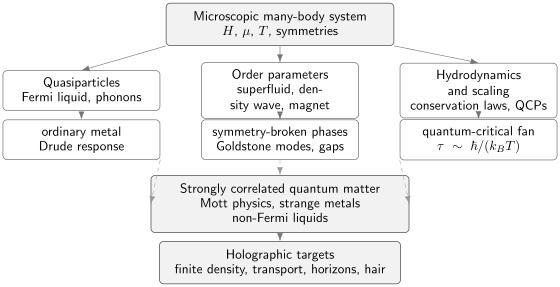
A schematic map of the condensed-matter ideas used in holographic quantum matter. The important message is not the literal geometry of the diagram, but the competition between quasiparticle phases, ordered phases, quantum critical scaling, Mott constraints, finite-density strange metals, and transport controlled by slow modes.
Quasiparticles: the conventional miracle
Section titled “Quasiparticles: the conventional miracle”A quasiparticle is not merely an excitation. It is an excitation that is long-lived enough to behave as a particle over the time and length scales of interest.
For a fermionic operator , the retarded Green function is
The spectral function measured by angle-resolved photoemission, in a simplified setting, is
A quasiparticle appears when has a pole close to the real axis:
with
The residue is the overlap between the microscopic operator and the emergent quasiparticle. The width is its decay rate. When is finite and is small, a complicated interacting system can be treated as a gas of weakly interacting emergent particles.
That is the conventional miracle. Holographic quantum matter is built for cases where the miracle fails.
The Fermi gas and the Fermi surface
Section titled “The Fermi gas and the Fermi surface”For noninteracting fermions with dispersion , the ground state at zero temperature fills all states below the chemical potential:
The Fermi surface is the locus
For a rotationally invariant system in spatial dimensions,
The key fact is that low-energy excitations live near the Fermi surface, not throughout the full Brillouin zone. Write
Then
Thus each small patch of a smooth Fermi surface looks like a one-dimensional chiral problem in the direction normal to the surface. This is why the Fermi surface is more than a geometric surface: it is an infrared manifold of gapless modes.
The low-temperature thermodynamics follows immediately. Only states within energy of the Fermi surface are thermally active, so the entropy density and specific heat are linear in :
where is the density of states at the Fermi surface.
This is already an important contrast with a relativistic CFT at zero density, where dimensional analysis gives
A Fermi surface behaves as though only one dimension is thermally scaled: the radial direction perpendicular to the surface. This intuition will return when we discuss hyperscaling violation.
Landau Fermi liquid theory
Section titled “Landau Fermi liquid theory”Landau’s insight was that weak interactions are not necessary for quasiparticles to exist. A Fermi liquid is an interacting phase adiabatically connected to the free Fermi gas. It has the same low-energy kinematics — a Fermi surface and long-lived fermionic quasiparticles — but with renormalized parameters.
The energy functional for small changes in the quasiparticle distribution is
The are Landau interaction parameters. They do not destroy the quasiparticles; they tell us how one quasiparticle energy shifts in the presence of others.
The defining lifetime estimate in a clean Fermi liquid is
up to dimensionless angular factors and interaction strengths. Therefore
for thermal excitations with . Quasiparticles become sharper at low temperature.
This is the standard against which strange metals look strange. In a strange metal, the decay rate inferred from transport or spectroscopy is often of order , not . There is no parametrically long quasiparticle lifetime.
Drude theory and the first transport trap
Section titled “Drude theory and the first transport trap”The Drude model treats charge carriers as particles with density , charge , mass , and relaxation time . In an electric field,
For ,
so the current gives
This formula is useful, but it hides two different physical processes under the single symbol .
The first is local equilibration. Electron-electron scattering can rapidly redistribute energy and momentum among carriers. This can be very fast in a strongly coupled system.
The second is momentum relaxation. The total momentum of a perfectly translation-invariant system cannot decay. Momentum can relax through impurities, phonons, Umklapp scattering, explicit lattices, disorder, boundaries, or coupling to external baths.
At finite density, electric current often overlaps with momentum. If momentum is conserved, a DC electric field accelerates the fluid forever. The clean DC conductivity is then infinite even if the system equilibrates locally very rapidly.
A clean hydrodynamic metal has the schematic conductivity
where is the charge density and is the momentum susceptibility. With weak momentum relaxation rate ,
This formula is one of the most important pieces of condensed-matter grammar for holography. A black hole horizon can produce strong dissipation, but finite DC resistivity at finite density also requires a channel that relaxes momentum, or an incoherent current that does not overlap with momentum.
Order parameters and broken symmetry
Section titled “Order parameters and broken symmetry”Many phases are simple because a symmetry is broken. A ferromagnet chooses a spin direction; a crystal chooses an origin and lattice; a superfluid chooses a phase; a charge-density wave chooses a spatial modulation.
An order parameter is an operator whose expectation value distinguishes the phase:
A simple Ginzburg—Landau free energy is
For , the minimum is . For , the minimum has
If the broken symmetry is continuous, there are low-energy Goldstone modes. If the broken symmetry is discrete, the ordered phase has domain walls but no Goldstone boson.
In holography, order usually appears as bulk hair. A boundary order parameter is dual to a bulk field. A source-free normalizable mode of that field is the gravitational signal of spontaneous symmetry breaking.
Superconductors and superfluids
Section titled “Superconductors and superfluids”A superconductor or superfluid breaks a global symmetry. In a neutral superfluid the is particle number. In a charged superconductor, electromagnetism is dynamical, so the would-be Goldstone mode is reorganized by the Anderson—Higgs mechanism.
The BCS mechanism begins with a Fermi surface. An attractive interaction in the Cooper channel makes the Fermi liquid unstable. The order parameter is schematically
The low-energy quasiparticle spectrum becomes
For an -wave superconductor this opens a full gap. For a -wave superconductor, nodes can remain, and the low-energy excitations are not fully gapped.
Holographic superconductors are not usually BCS superconductors. The simplest holographic mechanism is a charged scalar instability near a charged horizon. Nevertheless, the condensed-matter language remains the same: identify the broken , the condensate, the superfluid density, the optical conductivity, vortices, and collective modes.
Quantum phase transitions
Section titled “Quantum phase transitions”A classical thermal phase transition is driven by temperature. A quantum phase transition occurs at zero temperature as a nonthermal control parameter is tuned:
Near a continuous transition, the correlation length diverges:
The correlation time diverges as
where is the dynamical critical exponent. At finite temperature, imaginary time is compact with size
so temperature cuts off the quantum critical scaling. The thermal correlation length is
The simplest scaling form for the singular part of the free-energy density is
assuming no hyperscaling violation. Therefore the entropy density at criticality scales as
For a relativistic CFT, , and so
Holographic black branes reproduce this scaling geometrically: the horizon radius sets the thermal scale. Later we will generalize this to geometries with hyperscaling violation, where
Why quantum critical transport is hard
Section titled “Why quantum critical transport is hard”Thermodynamic scaling is only the beginning. Transport is harder because it depends on currents, conserved quantities, and relaxation mechanisms.
The conductivity is determined by a Kubo formula:
up to possible contact terms fixed by conventions.
A critical system has no long-lived quasiparticles, but it still has conservation laws. Charge, energy, and momentum can dominate the response. In a relativistic quantum critical system at zero density, charge transport can be finite because charge current need not overlap with momentum. At finite density, charge current generally does overlap with momentum, producing the momentum bottleneck described above.
This is why holographic transport is not just “compute a black hole conductivity.” A serious calculation must say:
- Which symmetries are present?
- Which quantities are conserved?
- Is momentum relaxed, and how?
- Is the measured current coherent, incoherent, or a mixture?
- Is the result controlled by horizon data, UV data, or both?
Mott physics: not just a large effective mass
Section titled “Mott physics: not just a large effective mass”A band insulator is insulating because all available bands are either full or empty. A Mott insulator can occur even when band theory predicts a partially filled band. The obstruction is local repulsion.
At half filling in the Hubbard model, large makes double occupancy expensive. Charge motion is frozen, but spin degrees of freedom can remain active. The low-energy spin exchange scale is
Thus a Mott insulator is not simply a bad metal with a heavy mass. It is a phase in which local constraints reorganize the Hilbert space. Doping a Mott insulator introduces mobile charge into a strongly constrained background, and this is one route to strange-metal and high-temperature-superconducting phenomenology.
Holography does not literally start from a Hubbard model. Its ultraviolet theories are usually large- gauge theories, often with matrix degrees of freedom. This mismatch matters. A responsible holographic comparison to Mott-based materials should therefore focus on robust infrared observables, not microscopic identification.
Strange metals
Section titled “Strange metals”“Strange metal” is not a single microscopic theory. It is a name for metallic behavior that is hard to reconcile with conventional quasiparticle transport.
Common clues include:
- resistivity approximately linear in temperature over a wide range;
- broad single-particle spectra;
- absence of a clear quasiparticle peak;
- anomalous optical conductivity;
- unusual thermoelectric response;
- proximity to superconductivity, density waves, magnetism, or Mott physics;
- relaxation rates of order .
A compact phenomenological statement is
This is often called Planckian dissipation. But the phrase must be used carefully. A Planckian time scale by itself does not explain a resistivity. To get resistivity, one must also know what current is being measured, what relaxes it, and how charge density, entropy density, susceptibilities, and irrelevant deformations enter.
In a simple Drude estimate,
If , , and are treated as constants and , then . But in a strongly coupled quantum critical metal, the Drude variables may not be meaningful. Linear resistivity can arise from several distinct mechanisms: momentum relaxation by critical modes, incoherent transport, umklapp, disorder, fluctuating order, semi-holographic baths, or horizon dynamics.
Compressibility and finite density
Section titled “Compressibility and finite density”A metal is compressible: changing the chemical potential changes the charge density. The charge susceptibility is
Compressibility is one reason finite-density matter is more difficult than zero-density critical matter. At finite density, a system can carry current by dragging momentum. It can have Fermi surfaces, emergent gauge fields, charge-density waves, superconducting instabilities, and collective sound modes.
In holography, finite density is introduced by a bulk gauge field:
and the charge density is encoded in radial electric flux. Charged black branes are therefore natural gravitational models of compressible quantum matter. They are not automatically models of ordinary metals; they are controlled large- examples of finite-density states whose infrared may have no quasiparticle description.
What condensed matter teaches holography
Section titled “What condensed matter teaches holography”Condensed matter gives holography discipline. It insists that a model be judged by observables, not by slogans.
| Condensed-matter question | Holographic translation |
|---|---|
| Is the system compressible? | Does the bulk have electric flux or charged matter? |
| Are there quasiparticles? | Are there long-lived poles near the real axis, or only broad QNMs? |
| Is DC conductivity finite? | Is momentum relaxed, or is an incoherent current isolated? |
| What symmetry is broken? | Which bulk field condenses without a source? |
| What are the slow modes? | Which bulk fluctuations become hydrodynamic or pseudo-hydrodynamic? |
| What is the IR fixed point? | What is the near-horizon geometry? |
| What is the model status? | Is this top-down, a consistent truncation, bottom-up, or phenomenological? |
A holographic model becomes useful when it answers these questions cleanly.
Common pitfalls
Section titled “Common pitfalls”Pitfall 1: confusing strong scattering with finite resistivity. Strong electron-electron scattering can equilibrate a fluid without relaxing total momentum. At finite density, this gives a clean metal with infinite DC conductivity unless momentum is relaxed.
Pitfall 2: treating all linear-in- resistivity as the same phenomenon. The same exponent can emerge from different mechanisms. Exponents are clues, not fingerprints.
Pitfall 3: forgetting the lattice. Real solids are not translation invariant continua. A lattice allows Umklapp, changes momentum conservation, introduces Brillouin zones, and can stabilize commensurate order.
Pitfall 4: identifying a holographic black brane with a specific material too quickly. Holographic models are often large- quantum systems with different microscopic degrees of freedom from electrons in a solid. The safest comparisons use robust infrared structures and multiple observables.
Pitfall 5: assuming every ordered phase is weak coupling. Symmetry breaking can happen out of a strongly coupled normal state. Holographic superconductors are the canonical example.
Exercises
Section titled “Exercises”Exercise 1 — Drude conductivity
Section titled “Exercise 1 — Drude conductivity”Starting from
derive the optical conductivity for .
Solution
Use . The equation becomes
Therefore
so
Since ,
Exercise 2 — Why a clean finite-density metal has infinite DC conductivity
Section titled “Exercise 2 — Why a clean finite-density metal has infinite DC conductivity”Assume a translation-invariant system at finite charge density . Explain why exact momentum conservation generically produces an infinite DC conductivity.
Solution
In a finite-density system, the electric current generally has an overlap with the total momentum. A uniform electric field exerts a force on the charge density, so in linear response
If is exactly conserved in the absence of the external field, there is no internal mechanism that can dissipate the momentum injected by the field. The current component proportional to momentum therefore grows without bound in time. In frequency space, this appears as
By the Kramers—Kronig relation, the imaginary pole corresponds to a delta function in the real part:
Thus the DC conductivity is infinite. Strong interactions can make local equilibration fast, but they cannot relax a conserved total momentum.
Exercise 3 — Fermi-liquid entropy scaling
Section titled “Exercise 3 — Fermi-liquid entropy scaling”Use the fact that only fermions within energy of the Fermi surface are thermally excited to estimate the low-temperature entropy density of a Fermi liquid.
Solution
Let be the density of states per unit volume at the Fermi surface. The number of thermally active states is of order
Each active state contributes an entropy of order one in units where . Hence
More carefully, for a conventional Fermi liquid,
with proportional to the renormalized density of states at the Fermi surface. Since , this also gives .
Exercise 4 — Quantum critical entropy
Section titled “Exercise 4 — Quantum critical entropy”Assume a scale-invariant quantum critical point in spatial dimensions with dynamical exponent and no hyperscaling violation. Use dimensional analysis to derive
Solution
At the critical point there is no intrinsic length scale. Temperature sets the thermal correlation length
A correlated thermal volume has size
The entropy per correlated volume is order one, so the entropy density scales as the inverse correlated volume:
Equivalently, the free-energy density has dimension energy per volume, so
and therefore
Exercise 5 — Mott insulator versus band insulator
Section titled “Exercise 5 — Mott insulator versus band insulator”A half-filled single band would be metallic in noninteracting band theory. Explain how strong local repulsion can nevertheless make it insulating, and identify the low-energy scale for spin exchange in the large- Hubbard model.
Solution
At half filling, every lattice site has on average one electron. In the large- Hubbard model, moving an electron to a neighboring occupied site creates a doubly occupied site and an empty site, costing energy . Charge motion is therefore suppressed even though band theory would predict a metal.
The remaining low-energy degrees of freedom are spins. Virtual hopping processes are still possible: an electron can hop to a neighbor and back, temporarily paying the energy cost . Second-order perturbation theory in gives the antiferromagnetic exchange scale
Thus the Mott insulator has a charge gap controlled by but spin dynamics controlled by the much smaller scale .
Further reading
Section titled “Further reading”For a condensed-matter-facing introduction to holographic quantum matter, see Zaanen, Liu, Sun, and Schalm, Holographic Duality in Condensed Matter Physics. For the transport and non-quasiparticle perspective used throughout this group, see Hartnoll, Lucas, and Sachdev, Holographic Quantum Matter. For standard condensed-matter background, the natural companions are Landau Fermi-liquid theory, Ginzburg—Landau theory, BCS theory, and quantum critical scaling.