
Ward Identities and Anomalies
The previous pages made the on-shell action finite and showed how to vary it. We now extract one of the main rewards of holographic renormalization: the Ward identities of the boundary theory.
A Ward identity is the equation that follows when a generating functional is invariant under a symmetry. In holography the same equation has a second life: it is a radial constraint equation of the bulk theory. Gauge invariance gives current conservation. Boundary diffeomorphism invariance gives stress-tensor conservation, possibly modified by external sources. Weyl transformations give the trace Ward identity, including conformal anomalies.
The useful slogan is
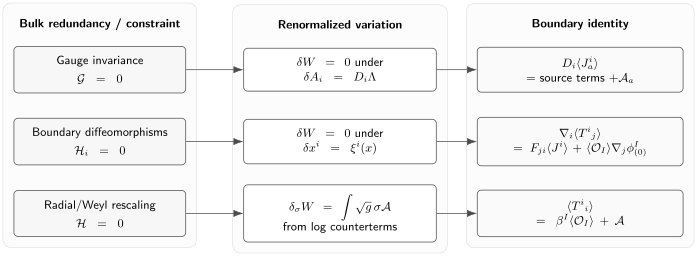
The three basic holographic Ward identities. Gauge transformations, boundary diffeomorphisms, and Weyl transformations act on the sources in . In the bulk, the same statements are the Gauss, momentum, and Hamiltonian constraints. Logarithmic counterterms produce the local anomaly density .
Why this matters
Section titled “Why this matters”Ward identities are not optional consistency checks. They are part of the dictionary.
If a holographic computation gives a stress tensor that is not conserved in a background where it should be conserved, something is wrong: perhaps the counterterms are incomplete, the boundary variation was not performed at fixed source, the gauge choice hid a constraint, or the sign convention for the outward normal was changed halfway through the calculation.
Ward identities also explain why holographic renormalization is local. The divergent terms in the on-shell action are constrained by covariance, gauge invariance, and Weyl scaling. The same local terms that cancel divergences also know about trace anomalies and scheme dependence.
The most important practical lesson is this:
This is why one-point functions are best defined by varying , not by reading off a single coefficient from a near-boundary expansion without checking counterterms.
Setup: sources and one-point functions
Section titled “Setup: sources and one-point functions”Let the boundary generating functional depend on a metric source , background gauge fields , and scalar sources coupled to scalar operators :
The variation convention on this page is
In the classical Euclidean gravity approximation,
Thus, if one differentiates directly instead of , one must insert the corresponding minus sign. Most apparent sign disagreements in the holographic Ward identities trace back to this choice.
For compactness, we now suppress the subscript on boundary sources and write
Gauge Ward identity
Section titled “Gauge Ward identity”Start with a background gauge transformation with parameter . The gauge field transforms as
where is the background gauge-covariant derivative. If the scalar sources transform in a representation of the symmetry group,
Gauge invariance of the generating functional gives . Using the variational formula,
After integrating by parts, and using that is arbitrary, we obtain
For neutral scalar sources, or when the charged sources are set to zero, this reduces to
Bulk interpretation
Section titled “Bulk interpretation”The bulk version is the radial Gauss constraint. Consider a bulk gauge field with radial canonical momentum
The radial component of the gauge-field equation is not a dynamical evolution equation. It is a constraint. Schematically,
After adding counterterm contributions and taking the cutoff away, becomes the renormalized current . The Gauss constraint becomes the gauge Ward identity.
This is the cleanest example of the general idea: a bulk gauge redundancy becomes a boundary conservation law.
Diffeomorphism Ward identity
Section titled “Diffeomorphism Ward identity”Now consider an infinitesimal boundary diffeomorphism generated by a vector field . The sources transform by Lie derivatives:
and
The last expression writes the Lie derivative of a gauge field as a gauge-covariant piece plus a gauge transformation. Using the gauge Ward identity to remove the pure gauge part, diffeomorphism invariance gives
This equation is not saying that energy-momentum is mysteriously nonconserved. It says that the CFT is exchanging energy and momentum with external background sources.
If the scalar sources are constant and no background gauge field strength is turned on, then
If the theory is placed in an external electromagnetic field, the term
is the Lorentz-force density exerted by the background field on the charged degrees of freedom. If a coupling varies in spacetime, the term
is the force density due to the explicit spacetime dependence of the coupling.
Bulk interpretation
Section titled “Bulk interpretation”The bulk version is the momentum constraint. In radial Hamiltonian language, it is generated by diffeomorphisms tangent to the cutoff surface .
For pure gravity plus matter, the momentum constraint has the schematic form
Here is the canonical momentum conjugate to the induced metric , is the momentum conjugate to the scalar, and is the momentum conjugate to the gauge field. After renormalization,
The momentum constraint becomes the diffeomorphism Ward identity.
Weyl Ward identity
Section titled “Weyl Ward identity”A conformal field theory has a special response to Weyl transformations of the background metric. Let
A scalar source for an operator of dimension has Weyl weight :
near a conformal fixed point. If the renormalized generating functional were exactly Weyl invariant, the variation would vanish. Quantum mechanically, in even boundary dimension, it may instead produce a local anomaly:
Using the variational formula, we get
Therefore
This is the trace Ward identity.
If all scalar sources vanish and there is no Weyl anomaly, then
If a relevant deformation is turned on, , then the source explicitly introduces a scale and the trace is nonzero even in flat space:
For a marginal coupling, the classical source term vanishes. Away from an exact fixed point, the local RG form replaces by the beta function :
In the canonical SYM example, the gauge coupling is exactly marginal, so this beta-function term vanishes.
Where the anomaly comes from
Section titled “Where the anomaly comes from”The Weyl anomaly is the finite memory of a logarithmic divergence. Suppose the regulated on-shell action contains a term of the form
Here is the radial cutoff and is the renormalization scale introduced to make the logarithm dimensionless. The counterterm cancels the divergence as , but the scale remains. Equivalently, changing changes the finite renormalized action by a local functional.
This local functional is the anomaly.
A quick way to remember the logic is
Power-law divergences can be subtracted without leaving an invariant finite trace. Logarithmic divergences are different because changes by an additive constant under rescaling. That additive constant is physical up to the usual scheme-dependent local terms.
Examples of trace anomalies
Section titled “Examples of trace anomalies”In a two-dimensional CFT on a curved Euclidean background, the trace anomaly takes the form
up to sign conventions for the Euclidean effective action and curvature. In holographic AdS/CFT, the Brown–Henneaux central charge is
In a four-dimensional CFT, the purely gravitational trace anomaly is usually written as
Here is the Weyl tensor of the boundary metric and is the Euler density. The coefficient of is scheme dependent: it can be shifted by adding a finite local counterterm. The coefficients and are genuine CFT data. For CFTs dual to two-derivative Einstein gravity in AdS,
For SYM at large , this gives , with the precise finite- field-theory answer depending on the choice of versus gauge group.
Anomalies are local, vevs are not
Section titled “Anomalies are local, vevs are not”A common structural point is worth emphasizing. The anomaly density is local in the sources:
It is determined by the asymptotic expansion. It does not depend on the choice of thermal state, the presence of a black hole horizon, or other deep-interior data.
By contrast, one-point functions such as
usually contain nonlocal state-dependent data. For example, the energy density of a black brane is not fixed by the boundary metric alone. It is determined by the normalizable part of the bulk solution, which knows about the horizon.
Thus holographic renormalization separates two kinds of data:
| Data | Character | Determined by |
|---|---|---|
| Divergences | local | near-boundary sources |
| Counterterms | local | covariance and asymptotic equations |
| Anomalies | local | logarithmic terms |
| Vevs | generally nonlocal | full bulk solution and interior condition |
This separation is one reason the formalism is so powerful.
Ward identities as consistency conditions
Section titled “Ward identities as consistency conditions”Suppose a bulk solution is claimed to describe a boundary state with sources , , and . After holographic renormalization, its one-point functions must satisfy
and
These equations are especially useful in numerical holography. They are gauge-invariant checks on the solution and on the boundary extraction of physical quantities.
For example, in a static black brane with flat boundary metric, constant scalar sources, and a time component whose boundary value is a constant chemical potential , the boundary field strength vanishes:
The diffeomorphism Ward identity then says
The state may have nonzero energy density, pressure, charge density, and entropy density, but a constant chemical potential does not by itself apply a force.
If instead one turns on an electric field , the Ward identity includes the work done by the electric field on the current.
Scheme dependence
Section titled “Scheme dependence”Finite local counterterms can shift one-point functions by local functions of the sources. For instance, in four boundary dimensions a finite counterterm
shifts the stress tensor by a local curvature expression. It also shifts the coefficient of the term in the trace anomaly.
This is not a bug. It is the usual renormalization-scheme dependence of local contact terms. Nonlocal separated-point correlators and scheme-independent anomaly coefficients such as and are not changed by these local redefinitions.
The practical rule is:
This point will reappear when we compute correlation functions beyond two points.
Dictionary checkpoint
Section titled “Dictionary checkpoint”The Ward-identity dictionary is:
| Boundary statement | Bulk statement |
|---|---|
| gauge Ward identity | radial Gauss constraint |
| stress-tensor Ward identity | radial momentum constraint |
| trace/local RG identity | radial Hamiltonian constraint |
| conformal anomaly | logarithmic counterterm |
| explicit source breaking | nonzero source term in Ward identity |
| scheme dependence | finite local counterterm ambiguity |
The central lesson is that holographic renormalization does not merely make quantities finite. It organizes the boundary symmetries of the CFT as constraints of the bulk gravitational system.
Common confusions
Section titled “Common confusions”“The stress tensor is always conserved.”
Section titled ““The stress tensor is always conserved.””The correct statement is that the total system is conserved. If the QFT is coupled to nondynamical external sources, the QFT stress tensor alone can exchange energy and momentum with those sources. This is why
is perfectly consistent.
“A conformal field theory always has traceless stress tensor.”
Section titled ““A conformal field theory always has traceless stress tensor.””In flat space with no dimensionful sources and no anomaly, yes. On curved backgrounds in even dimension, a Weyl anomaly can make the trace nonzero. Relevant deformations also give a nonzero trace through explicit breaking.
“The anomaly depends on the state.”
Section titled ““The anomaly depends on the state.””The anomaly is local in the sources. It is not determined by the black hole horizon, the temperature, or other normalizable data. The vev can be state dependent; the anomaly is not.
“All anomaly terms are scheme independent.”
Section titled ““All anomaly terms are scheme independent.””No. Some local terms can be shifted by finite local counterterms. In four dimensions, the term in the trace anomaly is scheme dependent, while the and coefficients are invariant CFT data.
“The Hamiltonian constraint is just another equation of motion.”
Section titled ““The Hamiltonian constraint is just another equation of motion.””It is more special. In radial Hamiltonian language it generates radial reparametrizations. Near the boundary, it becomes the local Weyl/RG identity of the boundary theory.
Exercises
Section titled “Exercises”Exercise 1: Gauge Ward identity with a charged source
Section titled “Exercise 1: Gauge Ward identity with a charged source”Assume
The variation of the generating functional contains
Derive the Ward identity.
Solution
Substitute the transformations:
Integrating the first term by parts gives
Gauge invariance for arbitrary gives
If the charged source vanishes, this reduces to current conservation.
Exercise 2: Diffeomorphism Ward identity without gauge fields
Section titled “Exercise 2: Diffeomorphism Ward identity without gauge fields”Set and consider one scalar source . Using
show that
Solution
The diffeomorphism variation is
Since is symmetric,
Integrating by parts,
Diffeomorphism invariance for arbitrary gives
Exercise 3: Trace identity for a relevant deformation
Section titled “Exercise 3: Trace identity for a relevant deformation”A -dimensional CFT is deformed by
where has dimension . Ignore the Weyl anomaly. What is the trace Ward identity?
Solution
The source has Weyl weight :
Weyl invariance of the deformed generating functional gives
Therefore
The deformation explicitly breaks scale invariance because has positive mass dimension .
Exercise 4: Integrated two-dimensional anomaly
Section titled “Exercise 4: Integrated two-dimensional anomaly”For a two-dimensional CFT on a compact Euclidean surface with no boundary,
Use the Gauss–Bonnet theorem
to compute the integrated trace.
Solution
Integrating the anomaly gives
Using Gauss–Bonnet,
For a sphere, , so the integrated trace is .
Further reading
Section titled “Further reading”- S. de Haro, K. Skenderis, and S. N. Solodukhin, Holographic Reconstruction of Spacetime and Renormalization in the AdS/CFT Correspondence.
- K. Skenderis, Lecture Notes on Holographic Renormalization.
- M. Henningson and K. Skenderis, The Holographic Weyl Anomaly.
- M. Bianchi, D. Z. Freedman, and K. Skenderis, Holographic Renormalization.
- D. Martelli and W. Mueck, Holographic Renormalization and Ward Identities with the Hamilton–Jacobi Method.