
Computing Holographic Observables
The previous pages used many holographic answers: entropy densities from horizons, retarded Green functions from infalling waves, conductivities from Kubo formulae, quasinormal modes from source-free fluctuations, and DC transport from horizon data. This page turns those examples into a working algorithm.
The point is not to memorize a dozen recipes. The point is to know what must be specified before a holographic answer is meaningful:
A surprisingly large fraction of mistakes in applied holography are not difficult physics mistakes. They are bookkeeping mistakes: using inconsistent source conventions, forgetting a counterterm, treating a gauge mode as a physical pole, imposing the wrong horizon boundary condition, or reading a DC conductivity from a clean finite-density system where momentum conservation already guarantees a delta function. The workflow below is designed to make those mistakes loud.
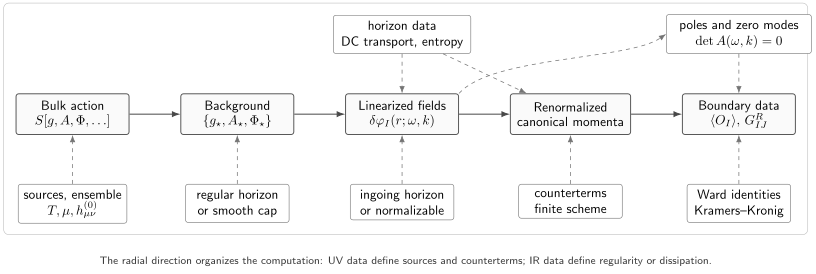
A practical workflow for holographic observables. The UV boundary fixes sources and counterterms. The IR interior fixes regularity, dissipation, or normalizability. The middle of the computation is mostly classical boundary-value analysis: solve the background, linearize, renormalize canonical momenta, and then extract one-point functions, retarded correlators, poles, and transport coefficients.
Throughout this page, denotes the boundary spacetime dimension and the number of boundary spatial dimensions. The bulk dimension is . I use a radial coordinate with the boundary at when discussing asymptotically AdS backgrounds. If your favorite convention puts the boundary at , invert the radial coordinate and translate powers carefully.
The computational contract
Section titled “The computational contract”Every holographic calculation starts with an agreement between boundary and bulk data. A bulk field is dual to a boundary operator . The leading asymptotic coefficient is usually a source, and the subleading coefficient is usually a response. The word “usually” is doing real work: gauge fields, metrics, spinors, alternative quantization, multi-trace deformations, anomalies, and logarithmic terms all add details.
At the level of the generating functional, the large- classical limit says schematically
The source is the boundary condition for the classical bulk solution. Functional derivatives of the renormalized on-shell action give expectation values and correlators:
and, around a background state,
This is the whole computation in one line. The rest of the page explains how to make each word precise.
That agreement should answer five questions before any numerics begin.
- Which ensemble? Is the chemical potential fixed, or the charge density? Is the boundary metric fixed, or are you varying it? Are you imposing Dirichlet, Neumann, or mixed boundary conditions?
- Which state? Is the background a black brane, soliton, domain wall, electron star, probe-brane embedding, striped geometry, or time-dependent geometry?
- Which operators? Are you computing , , a scalar order parameter, a fermionic Green function, or a mixed correlator?
- Which IR condition? At a Lorentzian horizon, retarded functions use infalling boundary conditions. In Euclidean signature, fields are regular at the cigar tip. In a horizonless geometry, fields are regular or normalizable in the interior.
- Which finite terms? Counterterms remove divergences, but finite local counterterms can shift contact terms and susceptibilities. These choices are scheme data, not invisible decorations.
If a result cannot be traced back to these choices, it is not yet a physical result.
Step 1: choose the bulk model and the ensemble
Section titled “Step 1: choose the bulk model and the ensemble”A flexible bottom-up model for many pages in this group is
possibly with charged scalars, Chern—Simons terms, higher-derivative terms, or probe branes added. The boundary terms are just as important:
Here is the Gibbons—Hawking term for a well-posed metric variational problem, cancels UV divergences, and records scheme choices. For gauge fields or gravity, changing ensemble can require a Legendre transform by adding a boundary term. For example, fixing is grand canonical. Fixing the electric flux, and therefore the charge density , is canonical.
The model should be read as an effective theory. Its couplings encode operator dimensions, symmetries, anomalies, explicit translation breaking, and relevant deformations. Before solving anything, ask what the dual QFT claim is. A Maxwell field means a conserved global current. A bulk scalar with boundary source means a deformation . Linear axions mean explicit translation breaking by sources for neutral scalar operators, not literal random impurities. A Chern—Simons term means a boundary anomaly or contact-term structure.
Units and scaling symmetries
Section titled “Units and scaling symmetries”Black-brane equations often have scaling symmetries. Use them deliberately. A common planar ansatz has
One scaling may set the horizon radius to one during the numerical solve. Another may set the boundary speed of light by requiring . After solving, restore dimensionful quantities using , , , or the lattice scale. Do not compare dimensionful conductivities or frequencies across solutions until this rescaling is done.
The safest output variables are dimensionless ratios:
The exact powers depend on the scaling geometry.
Step 2: solve the background
Section titled “Step 2: solve the background”The background is the state of the boundary system. At finite temperature it is usually a black brane. At zero temperature it may be an extremal horizon, a smooth domain wall, a soliton cap, or a singular scaling region that needs a completion.
A standard static homogeneous problem reduces the bulk equations to ODEs. The integration data are fixed by UV boundary conditions and IR regularity. For a black brane, the horizon is a regular singular point. In Euclidean signature, regularity of the cigar fixes the temperature:
The entropy density is
For a Maxwell field, the regular Euclidean gauge usually sets
In Lorentzian signature this condition is best understood as regularity of the one-form in coordinates smooth at the future horizon.
The near-boundary expansion tells you the thermodynamic variables. In asymptotically AdS, a scalar of mass has
with
In standard quantization, is the source and determines the vev. If is an integer, logarithmic terms can appear; these encode conformal anomalies or running couplings. If the mass lies in the alternative-quantization window, source and vev can be exchanged, possibly with mixed boundary conditions for double-trace deformations.
For a Maxwell field in AdS,
up to normalization and possible logarithms in special dimensions. More invariantly, the density is the radial electric flux,
For the metric, the Fefferman—Graham expansion gives the boundary metric and the stress tensor . In practice, many numerical gauges are not Fefferman—Graham. Then one either transforms asymptotically or uses covariant holographic renormalization in the chosen radial gauge.
Background diagnostics
Section titled “Background diagnostics”A background solution should pass more tests than “the equations were solved.” Useful checks include:
- the first law, such as in a homogeneous charged state;
- the appropriate Ward identities, including when sources are present;
- regularity of curvature invariants at the horizon or smooth cap;
- vanishing source for spontaneous order parameters;
- independence of observables under residual gauge or coordinate choices;
- numerical convergence under grid refinement or increased spectral order.
When a model has a singular IR scaling geometry, do not merely report the singular solution. Ask whether the singularity is acceptable, whether it is resolved by finite temperature, whether extra fields become important, and whether the observable is controlled by the singular region or by a UV completion.
Step 3: linearize around the background
Section titled “Step 3: linearize around the background”Most observables are two-point functions. To compute them, perturb the classical background:
The linearized equations usually split into channels according to the little group that preserves . In an isotropic background with momentum along , fluctuations can be classified as transverse, longitudinal, scalar, vector, or tensor channels. This classification is more than aesthetic: different channels compute different physical responses.
For example, at zero charge density, a transverse gauge perturbation computes . At finite density, often mixes with metric perturbations and because charge current overlaps with momentum. In a superconducting phase, gauge perturbations mix with the phase of the charged scalar. In a modulated phase, momenta can mix by reciprocal lattice vectors.
The correct variables are often gauge-invariant combinations. If you compute with gauge-dependent fields, you must handle constraints and residual gauge modes carefully. A pure gauge mode can masquerade as a zero-frequency pole; it is not a physical excitation.
Horizon boundary condition
Section titled “Horizon boundary condition”For retarded correlators, impose infalling boundary conditions at the future horizon. Near a nonextremal horizon,
and a fluctuation behaves as
for the infalling solution, in the convention. The outgoing solution has the opposite exponent.
The cleanest way to remember the sign is to use ingoing Eddington—Finkelstein time
A mode regular at the future horizon depends on , not separately on and :
That is the retarded prescription. Advanced correlators use outgoing boundary conditions. Euclidean correlators use smoothness at the Euclidean horizon instead.
At an extremal horizon, the near-horizon region is often or a related scaling geometry. The infalling solution is not a simple power in ; it may be an oscillatory or exponential function of the near-horizon coordinate. This is where many numerical errors enter. Matching to the exact IR solution is usually safer than imposing a naive nonextremal formula and taking too early.
Step 4: read off sources and responses
Section titled “Step 4: read off sources and responses”For a single scalar fluctuation in standard quantization, the near-boundary solution has the form
After adding counterterms, the retarded Green function is schematically
where the contact terms are local in and . The overall normalization depends on the bulk action normalization.
The word “schematically” matters. The precise coefficient can change with conventions, logarithms, finite counterterms, and field redefinitions. In a serious calculation, derive the canonical radial momentum from the quadratic action,
The response is the finite renormalized momentum:
Then differentiate with respect to the source.
Coupled fields: the matrix method
Section titled “Coupled fields: the matrix method”For coupled fluctuations, the near-boundary data are vectors. Write
where is a vector of sources. The practical method is:
- Choose independent regular infalling solutions at the horizon.
- Integrate all of them to the boundary.
- Assemble the source matrix and response matrix .
- Compute
with the normalization matrix determined by the renormalized quadratic action.
This is not just a numerical trick. It is the statement that arbitrary boundary sources are linear combinations of a basis of regular bulk solutions.
A pole occurs when the source matrix fails to be invertible:
At such a frequency, there exists an infalling solution with no source. That is precisely a quasinormal mode.
Step 5: renormalize the on-shell action
Section titled “Step 5: renormalize the on-shell action”The on-shell action diverges because the asymptotic AdS volume is infinite. Cut off the spacetime at , evaluate the action, and add local boundary counterterms:
For a scalar, the leading counterterm often begins as
with signs and coefficients depending on the convention for the action and outward normal. The ellipsis includes derivative counterterms, curvature counterterms, gauge-field terms, logarithmic anomaly terms, and nonlinear terms when sources interact.
Counterterms have three roles.
First, they cancel divergences and make the variational problem finite. Second, they determine the correct one-point functions. Third, they fix contact terms in correlators. Nonlocal spectral data are usually insensitive to finite local counterterms, but static susceptibilities, pressures, magnetization currents, and Ward identities can be sensitive to them.
For the metric, holographic renormalization gives
For a current,
For a scalar,
The signs are fixed by the convention in the deformation of the QFT action. If you write
you may get a different sign from someone who writes . This is why every serious calculation should state the convention for linear response.
Ward identities as renormalization checks
Section titled “Ward identities as renormalization checks”Holographic renormalization is not complete until the Ward identities work. With scalar sources and gauge fields, the diffeomorphism Ward identity takes the schematic form
The trace Ward identity takes the schematic form
where is the conformal anomaly when present. These equations are invaluable. If your stress tensor violates them, the problem is usually not mysterious physics; it is a missing counterterm, a wrong normalization, or an inconsistent boundary condition.
Spectral functions
Section titled “Spectral functions”The spectral function is the anti-Hermitian part of the retarded correlator:
For a single bosonic operator,
with the sign depending on Fourier conventions. A healthy bosonic spectral density satisfies positivity conditions for . In holography this positivity is often a consequence of positive flux into the horizon, provided the bulk theory has a healthy kinetic term.
Near a horizon, the radial flux associated with a scalar fluctuation is
The imaginary part of the retarded correlator is essentially the absorbed flux divided by the source amplitude squared. This is the clean physical reason horizons generate dissipation.
A sharp peak in may indicate a pole close to the real axis. It does not automatically mean a quasiparticle. A quasiparticle requires a parametrically long lifetime:
Generic holographic quasinormal modes have real and imaginary parts of comparable size.
Quasinormal modes
Section titled “Quasinormal modes”A quasinormal mode is an eigenfrequency satisfying two conditions:
Equivalently, QNMs are poles of the retarded Green function. In coupled systems, the condition is
Hydrodynamic modes are special QNMs whose frequencies vanish as . Examples include
for diffusion, and
for sound. Goldstone modes, pinned phasons, superconducting phase modes, and Fermi-surface-related poles are also QNMs, but their smallness is protected by symmetry, conservation laws, or special IR structure.
Numerically, QNM computations are more delicate than ordinary real-frequency response. For complex , the infalling solution can become exponentially large near the horizon while the outgoing contamination is exponentially small. Common methods include shooting with high precision, pseudospectral generalized eigenvalue problems, determinant methods, continued fractions, and matched IR expansions for extremal horizons.
A QNM spectrum should satisfy basic consistency checks:
- retarded poles lie in the lower half-plane for stable equilibria;
- time-reversal-invariant systems have the appropriate reflection symmetry of poles;
- hydrodynamic poles agree with Kubo formulae and thermodynamic susceptibilities;
- gauge modes and constraint-violating modes are absent from physical spectra;
- increasing numerical resolution does not move genuine poles appreciably.
A pole in the upper half-plane is not a numerical nuisance. If real, it is an instability of the background.
Kubo formulae and transport
Section titled “Kubo formulae and transport”Linear response relates sources to expectation values:
For conductivity at zero spatial momentum,
up to possible diamagnetic or contact terms. For shear viscosity,
For diffusion,
where is the appropriate static susceptibility. This relation is not a holographic miracle; it is hydrodynamics. Holography supplies the microscopic retarded functions from which and are computed.
DC transport from horizon data
Section titled “DC transport from horizon data”Sometimes the transport coefficient can be obtained without solving a full radial fluctuation problem. The reason is a radially conserved current.
Consider a probe Maxwell field with action
Apply a constant electric field in the direction:
The Maxwell equation implies that
is independent of . Since it is radially conserved, it may be evaluated at the horizon. Regularity in ingoing Eddington—Finkelstein coordinates fixes the near-horizon relation between and . The result is the horizon formula
In translationally invariant finite-density systems, this formula computes the incoherent part only if the current channel decouples from momentum. In general, finite density mixes charge and momentum, and the DC electric conductivity is infinite unless momentum relaxes. With explicit momentum relaxation, horizon formulae become matrix formulae involving electric, heat, and axion perturbations. In inhomogeneous lattices, the horizon problem can become a forced Stokes flow on the black-hole horizon.
The moral is simple: horizon DC formulae are powerful, but they are not magic. They work when the zero-frequency bulk equations have radially conserved quantities and regularity conditions that close the problem.
Euclidean correlators and analytic continuation
Section titled “Euclidean correlators and analytic continuation”Euclidean calculations impose regularity in the interior rather than infalling Lorentzian boundary conditions. They are natural for thermodynamics, static susceptibilities, and lattice-like comparisons. Matsubara frequencies are
for bosonic operators. The Euclidean correlator is related to the retarded correlator by analytic continuation,
when the continuation is well-defined.
In practice, analytic continuation from discrete Euclidean data is ill-conditioned. Holography avoids this problem when we solve the Lorentzian bulk equation directly with infalling boundary conditions. But if one is comparing to Monte Carlo data, Euclidean correlators and sum rules are often the right bridge.
Numerical methods in practice
Section titled “Numerical methods in practice”The difficulty of a holographic computation is usually determined by the background.
For homogeneous backgrounds, the equations are ODEs. Shooting works when the system is not stiff and the correct number of horizon data can be matched to the correct number of boundary conditions. Spectral collocation is often more stable for high-precision QNMs and coupled systems. Relaxation/Newton methods are useful when shooting is unstable.
For periodic lattices or striped phases, the background depends on one boundary coordinate and the radial coordinate, so the equations are PDEs. For genuinely disordered or two-dimensional lattices, the problem can depend on two or more boundary directions. At that point the computation is no longer a minor extension of the homogeneous case; it is numerical relativity in AdS.
For stationary gravitational PDEs, one common strategy is the Einstein—DeTurck method. One solves
with
where is the connection of a reference metric with the same asymptotic and horizon structure. A true Einstein solution has
The method is valuable because, for suitable stationary ansätze, it turns the gravitational boundary-value problem into an elliptic problem. But it also introduces a new diagnostic: after solving, verify that converges to zero. Otherwise you may have found a Ricci soliton rather than the desired Einstein solution.
Practical numerical checklist
Section titled “Practical numerical checklist”A robust numerical paper or notebook usually records:
- the action and all normalizations;
- the ansatz and residual gauge choices;
- near-boundary and near-horizon expansions;
- which shooting data or collocation variables are solved for;
- the counterterms and finite scheme choices;
- convergence tests;
- Ward identity checks;
- thermodynamic consistency checks;
- how poles were distinguished from gauge modes and numerical artifacts.
This is not bureaucracy. This is how one makes a holographic result reproducible.
A worked miniature: scalar two-point function
Section titled “A worked miniature: scalar two-point function”Take a neutral scalar in a fixed black-brane background,
The fluctuation equation for
is
At the horizon impose infalling behavior. At the boundary expand
The canonical momentum is
The quadratic on-shell action is a boundary term,
The horizon term is fixed by the infalling condition and is responsible for dissipation. The boundary term is divergent; add counterterms, take , and differentiate. Up to normalization and contact terms,
If for some complex , there is a normalizable infalling solution: a QNM and a pole of .
This miniature contains the entire logic of the subject.
Common pitfalls
Section titled “Common pitfalls”Confusing source-free with field-free. A normalizable mode does not mean the bulk fluctuation vanishes at the boundary. It means its source coefficient vanishes.
Using Euclidean regularity for a Lorentzian retarded correlator. Smoothness in Euclidean signature gives Matsubara data. Retarded real-time response needs infalling Lorentzian boundary conditions.
Forgetting mixing at finite density. A gauge perturbation alone rarely computes electric conductivity at finite density. Metric perturbations matter because current overlaps with momentum.
Calling every spectral peak a quasiparticle. A holographic peak can be a damped QNM, a hydrodynamic mode, a pinned collective mode, or a numerical artifact. A quasiparticle requires a parametrically narrow pole.
Dropping contact terms when they matter. Contact terms may not affect dissipative spectral weight, but they can affect static susceptibilities, Hall conductivities, magnetization subtractions, and Ward identities.
Trusting a singular IR too much. Scaling geometries are often intermediate regimes. If the observable probes the unresolved singularity, the answer may depend on the completion.
Ignoring constraints. In gravitational perturbation theory, some equations are constraints. A solution of only the dynamical equations can still be unphysical if the constraints are violated.
Exercises
Section titled “Exercises”Exercise 1: source and response for a scalar
Section titled “Exercise 1: source and response for a scalar”For a scalar in AdS with mass , show that the two independent near-boundary powers are and , with
Why is the coefficient of interpreted as the source in standard quantization?
Solution
Near the boundary, the metric is approximately
Ignore boundary derivatives because radial scaling dominates. The Klein—Gordon equation becomes
Try . Then
The two roots are
where . In standard quantization the less rapidly decaying coefficient is fixed as boundary data. It multiplies the deformation of the boundary theory, so it is the source. The faster coefficient is dynamically determined by IR regularity and gives the response, after counterterms and normalization.
Exercise 2: horizon derivation of probe DC conductivity
Section titled “Exercise 2: horizon derivation of probe DC conductivity”Starting from
and the perturbation , derive the horizon expression
Solution
The Maxwell equation for the component implies radial conservation of
Use ingoing Eddington—Finkelstein time , with near the horizon. A regular gauge potential is proportional to , so near the horizon
Therefore
Substitute into the conserved current and divide by :
Since and , this becomes
The apparent singular factors cancel at a regular nonextremal horizon.
Exercise 3: why QNMs are poles
Section titled “Exercise 3: why QNMs are poles”For a single field with near-boundary coefficients and , suppose
Explain why a frequency satisfying is a pole of the Green function, and state the corresponding bulk boundary conditions.
Solution
The coefficient is the source. If while is nonzero, the bulk has a nontrivial solution with no boundary source. Because the solution was constructed with the retarded IR condition, it is infalling at the future horizon. Therefore it is an eigenmode of the dissipative black-brane problem: a quasinormal mode.
In the Green function, appears in the denominator because the response is divided by the source. Unless the numerator vanishes at the same frequency in a way that cancels the zero, has a pole. The required boundary conditions are infalling in the IR and normalizable in the UV.
Exercise 4: matrix source method
Section titled “Exercise 4: matrix source method”Consider two coupled fluctuations with two independent infalling solutions. Near the boundary their source and response matrices are
Why is the correlator matrix proportional to rather than simply ?
Solution
The two numerical solutions are a basis of regular infalling bulk solutions, not a basis of unit boundary sources. A general solution is a linear combination of the two basis solutions. Its source vector is , where is the vector of combination coefficients, and its response vector is .
Given a desired source vector , choose
Then the response is
Since the Green function is the linear map from sources to responses, , with normalization and contact terms supplied by the renormalized quadratic action.
Exercise 5: momentum conservation and DC conductivity
Section titled “Exercise 5: momentum conservation and DC conductivity”Explain why a clean finite-density translationally invariant state has an infinite DC electric conductivity, even if it has strong local dissipation into a horizon.
Solution
At finite density, the electric current generally overlaps with momentum. If translations are exact, momentum is conserved. An applied electric field accelerates the conserved momentum rather than relaxing it. Therefore the current has a component that cannot decay, producing a delta function in and a pole in .
The horizon still gives local equilibration and an incoherent conductivity, but it cannot relax a globally conserved momentum. To obtain a finite DC conductivity, one must either work at zero density, compute an incoherent current orthogonal to momentum, or introduce momentum relaxation by lattices, disorder, axions, impurities, boundaries, or other explicit translation-breaking mechanisms.
Further reading
Section titled “Further reading”For the real-time prescription and infalling boundary conditions, see Son and Starinets and the linear-response chapters of standard gauge/gravity texts. For holographic renormalization, the classic entry points are de Haro—Solodukhin—Skenderis and Skenderis’s lecture notes. For QNMs and transport in holographic quantum matter, the most useful practical overview is Hartnoll—Lucas—Sachdev. For stationary gravitational PDEs and the Einstein—DeTurck method, see Dias—Santos—Way. For broad textbook background, Ammon—Erdmenger and Natsuume are especially useful.