
Chemical Potential and Charged Black Branes
The previous section studied transport in a neutral quantum critical state. The bulk gauge field was only a probe fluctuation: it computed current correlators, but it did not change the background geometry. Finite density is different. Once the boundary theory has a nonzero charge density,
the dual bulk solution must contain a background electric field. That electric field gravitates. The geometry is no longer the neutral AdS-Schwarzschild black brane; the simplest answer is a charged AdS black brane.
The finite-density dictionary is one of the most useful parts of holographic quantum matter:
This page builds that statement carefully. The slogan is easy; the details matter. In holography, the chemical potential is a boundary source, the density is a radial canonical momentum, Gauss’s law tells us where the charge is stored, and the horizon may carry charge that is invisible to ordinary gauge-invariant quasiparticle counting. That last point is the beginning of the holographic theory of compressible matter.
Throughout this page, is the number of boundary spatial dimensions,
is the boundary spacetime dimension, and the bulk has dimension . We use the radial coordinate , with the AdS boundary at and a planar horizon at . We set
The boundary problem: finite density
Section titled “The boundary problem: finite density”A quantum system with a conserved charge
can be studied in the grand canonical ensemble,
The chemical potential is the source conjugate to the density . In a generating functional language, a background gauge field couples as
For a homogeneous static chemical potential, the source is simply
The density is the response:
where is the grand potential.
A state is compressible if
is nonzero. In ordinary condensed matter, the canonical compressible state is a metal. In holography, the first compressible states one encounters are charged horizons. They are metallic in several senses, but one must be careful: they are large- strongly coupled quantum fluids, not literal electron gases.
The bulk gauge field
Section titled “The bulk gauge field”A conserved boundary current is dual to a bulk Maxwell field . The finite-density ansatz is
Near the AdS boundary, a massless bulk gauge field behaves as
up to convention-dependent signs and finite counterterms. The two pieces have distinct meanings:
The power is the vector-field analogue of the source/response split for scalars. The leading term is the source. The subleading normalizable coefficient is proportional to the expectation value.
A cleaner, normalization-independent statement uses the radial canonical momentum. From
the electric flux through a constant- slice is
The holographic dictionary says
For the near-boundary expansion above, this gives exactly with our chosen normalization. This is the finite-density version of the source/vev dictionary:
| Boundary quantity | Bulk quantity |
|---|---|
| chemical potential | boundary value or potential difference of |
| density | radial electric flux |
| finite density | nonzero background |
| charge susceptibility | response of flux to boundary value |
| current correlators | fluctuations of around the charged background |
This is the first big conceptual jump. In the neutral transport page, the Maxwell field was a wave in a fixed geometry. Here the Maxwell field is part of the background itself.
Chemical potential as a potential difference
Section titled “Chemical potential as a potential difference”It is tempting to say simply that
That is often true in a convenient gauge, but the gauge-invariant statement is slightly sharper. At finite temperature the Euclidean time circle shrinks smoothly at the horizon. A one-form
is regular at the tip of the Euclidean cigar only if the component along the shrinking circle vanishes there, in a regular gauge:
After analytic continuation back to Lorentzian signature, one usually chooses
Then the chemical potential is the potential difference between the boundary and the horizon:
In the gauge , this reduces to .
This point is not just pedantic. Gauge transformations that approach a nonzero constant at the AdS boundary act as global transformations of the boundary theory. Boundary values of are physical sources. Gauge transformations that are regular in the interior and vanish at the boundary are redundancies.
Bulk Gauss law: where is the charge?
Section titled “Bulk Gauss law: where is the charge?”The Maxwell equation with charged bulk matter is schematically
For a homogeneous static electric field, this becomes a radial Gauss law:
with signs depending only on radial orientation conventions. Integrating from the boundary to the horizon gives the important decomposition
Here
is the electric flux entering the horizon, while
is the cohesive charge carried by explicit charged fields outside the horizon.
The interpretation is standard in holographic quantum matter:
- Fractionalized charge is carried by the horizon. The electric flux continues through the horizon. Boundary gauge-invariant probes do not see all the charge as ordinary visible charged particles.
- Cohesive charge is carried by charged bulk matter outside the horizon: a charged scalar condensate, charged fermion fluid, branes, or other explicit matter fields.
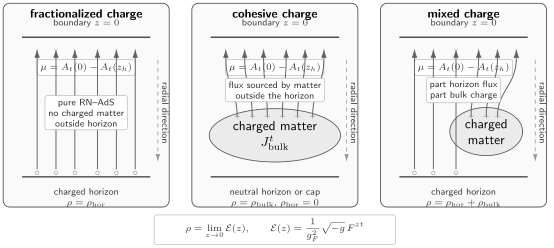
Radial Gauss law in finite-density holography. When no charged bulk matter is present, the electric flux dual to is constant in and enters a charged horizon; the charge is fractionalized. When charged bulk matter is present, some or all of the boundary charge can be sourced outside the horizon; the charge is cohesive. Mixed phases contain both horizon flux and charge carried by bulk matter.
This is one of the reasons charged black branes are not just a gravitational curiosity. They give a controlled, computable large- model of compressible quantum matter in which some charge can be hidden behind a dissipative horizon.
Einstein-Maxwell-AdS theory
Section titled “Einstein-Maxwell-AdS theory”The minimal bottom-up model for a charged black brane is Einstein-Maxwell theory with a negative cosmological constant:
Here
The equations of motion are
and
This theory is useful because it has exactly the ingredients required by the finite-density dictionary:
- a metric, dual to the stress tensor;
- a Maxwell field, dual to the conserved current;
- a negative cosmological constant, producing an AdS boundary and a UV CFT;
- a charged black-brane solution, dual to a thermal state at finite density.
It is also limited. Unless embedded in a top-down construction or consistent truncation, it is a bottom-up effective model. Even when embedded, the charged black brane may be unstable at low temperature to scalar hair, fermion matter, spatial modulation, or other phases. Those instabilities are not defects of the dictionary; they are the holographic version of the fact that finite-density matter often wants to order.
The planar Reissner–Nordström AdS black brane
Section titled “The planar Reissner–Nordström AdS black brane”A homogeneous, isotropic finite-density state is described by the ansatz
The planar Reissner–Nordström AdS solution can be written as
with
The horizon is at , where
The dimensionless charge parameter is related to by
where
for the normalization of the action above. Different authors absorb these constants into , , or ; the physical content is the same.
The temperature follows from Euclidean smoothness:
The entropy density is the horizon area density:
The charge density is the radial electric flux:
with the sign fixed by the convention for and charge orientation.
These formulas show explicitly what changed relative to the neutral black brane. The neutral brane had and . The charged brane has a radial electric field and a charge contribution to .
Thermodynamics
Section titled “Thermodynamics”For a homogeneous equilibrium state, the grand potential density is
In a translationally invariant system,
where is the pressure. The first law in the grand canonical ensemble is
Equivalently,
For a conformal theory at finite density, dimensional analysis gives
or, at zero temperature if the limit is smooth,
The conformal Ward identity implies
The enthalpy density is
This combination will appear constantly in finite-density transport. It is the momentum susceptibility of a relativistic fluid:
That fact is why finite density changes DC conductivity so dramatically. At , electric current overlaps with conserved momentum.
Extremality and the residual entropy puzzle
Section titled “Extremality and the residual entropy puzzle”The temperature vanishes when
At this extremal point, has a double zero at the horizon. The entropy density remains
which is nonzero at for fixed .
This feature is both useful and suspicious. It is useful because the extremal horizon creates a universal low-energy region, , which controls many finite-density correlators. It is suspicious because a macroscopic zero-temperature entropy density is not expected for a generic stable ground state of ordinary quantum matter.
The right attitude is not to throw away the solution, and not to worship it. The RN-AdS black brane is a clean saddle of a simple large- theory. It often describes an intermediate-energy quantum critical regime or the parent state from which more stable low-temperature phases descend. In many models the extremal brane is unstable to charged scalar condensation, fermion fluid formation, spatial modulation, or dilaton-driven scaling geometries.
The next page studies the most important piece of the extremal geometry: the throat.
Fractionalized charge and horizon flux
Section titled “Fractionalized charge and horizon flux”In the pure Einstein-Maxwell RN-AdS solution, there is no charged bulk matter outside the horizon:
Gauss’s law then gives
so
All of the boundary charge is represented by electric flux entering the horizon. This is the simplest example of a fully fractionalized holographic charge density.
Why use the word fractionalized? The terminology comes from the boundary interpretation. The horizon is a deconfined large- sector. Charge hidden behind the horizon is not accounted for by a sum over gauge-invariant Fermi surfaces or ordinary visible charged particles. It is charge carried by the strongly coupled bath itself.
Once charged matter appears outside the horizon, Gauss’s law becomes
Examples include:
| Bulk charge carrier | Boundary interpretation |
|---|---|
| charged scalar hair | superfluid or superconducting condensate |
| charged fermion fluid | electron star or cohesive fermionic matter |
| probe brane electric displacement | flavor charge density |
| charged horizon flux | fractionalized charge in the deconfined sector |
This decomposition is not just vocabulary. It affects Luttinger counts, spectral functions, low-energy transport, and the possible instabilities of the charged state.
A useful mental picture
Section titled “A useful mental picture”At zero density, the Maxwell field computes linear response:
At finite density, the background already contains
So perturbations of the gauge field mix with perturbations of the metric. Physically this is because charge, energy, and momentum are coupled in a charged fluid. Mathematically, the background stress tensor of the electric field backreacts on the geometry, and linearized Maxwell perturbations can source metric perturbations.
This is why finite-density transport is harder than neutral quantum-critical transport. It is also why it is richer.
The clean finite-density conductivity has a schematic hydrodynamic form
in a translation-invariant relativistic fluid. The pole means that the real part contains a delta function at . Momentum cannot decay, and the electric field keeps accelerating the charged fluid. Later pages will explain how momentum relaxation turns this pole into a Drude-like peak.
Common pitfalls
Section titled “Common pitfalls”Pitfall 1: confusing chemical potential with density. The source is the leading boundary value of in a regular gauge. The density is the subleading coefficient or, more invariantly, the radial electric flux.
Pitfall 2: forgetting the horizon regularity condition. At finite temperature, is the natural regular gauge. The chemical potential is a potential difference, not a gauge-invariant absolute value of at one point.
Pitfall 3: treating RN-AdS as a literal electron metal. It is a large- charged quantum fluid. It can mimic metallic features, but it does not begin from electron quasiparticles.
Pitfall 4: ignoring the ensemble. Dirichlet boundary conditions for fix . Neumann-like conditions fix . The on-shell action computes different thermodynamic potentials in the two cases.
Pitfall 5: thinking all charge must be outside the horizon. Holography allows charge to be carried by horizon flux. Whether charge is fractionalized, cohesive, or mixed is a dynamical question.
Pitfall 6: overinterpreting the extremal entropy. The residual entropy of the simplest RN-AdS brane is a warning sign and a useful computational handle. In many models it is removed or modified by an instability or by a different IR geometry.
Exercises
Section titled “Exercises”Exercise 1: Charge density from radial flux
Section titled “Exercise 1: Charge density from radial flux”Consider pure AdS near the boundary,
and a static gauge potential
Using
show that is independent of and find in terms of .
Solution
For the AdS metric,
The field strength is
Therefore
Thus
This is independent of , as expected from Gauss’s law with no bulk charge. Setting gives
So
Exercise 2: Horizon regularity and the chemical potential
Section titled “Exercise 2: Horizon regularity and the chemical potential”The Euclidean near-horizon geometry of a nonextremal black brane is locally a smooth disk in polar coordinates,
Explain why a regular one-form must have at . Translate this into the Lorentzian statement in a regular gauge.
Solution
At the origin of polar coordinates, the angular coordinate is not well-defined. The one-form is singular there: in Cartesian coordinates,
For to be regular at , its coefficient along the shrinking circle must vanish sufficiently fast. In particular, a constant nonzero at the origin is not regular.
The Euclidean time circle is the thermal circle. At a nonextremal horizon it shrinks just like the angular circle of a disk. Therefore the Euclidean gauge potential must vanish along that shrinking direction in a regular gauge:
After analytic continuation, this is the standard Lorentzian gauge choice
The chemical potential is then the regular potential difference
Exercise 3: Temperature of the charged black brane
Section titled “Exercise 3: Temperature of the charged black brane”For
show that
Find the extremal value of .
Solution
Differentiate :
At the horizon ,
For a nonextremal horizon,
In the physical range , this gives
Extremality means , so
At this value the blackening factor develops a double zero at the horizon.
Exercise 4: Gauss law and fractionalized charge
Section titled “Exercise 4: Gauss law and fractionalized charge”Suppose there is no charged bulk matter outside the horizon. Use the radial Maxwell equation to show that all boundary charge is horizon charge.
Solution
With no charged bulk matter,
The radial Maxwell equation is
Therefore
The flux is independent of , so its value at the boundary equals its value at the horizon:
Thus all of the boundary charge is represented by electric flux entering the horizon. This is the fully fractionalized case.
Exercise 5: Cohesive charge from a charged scalar
Section titled “Exercise 5: Cohesive charge from a charged scalar”A charged scalar field has covariant derivative
The associated bulk current contains the term
For a static configuration with real in a convenient gauge and , show that is proportional to . Explain the boundary meaning.
Solution
If is real and depends only on , then
Also
Substituting into the current,
up to the sign convention for the metric component in .
The important point is that a charged scalar condensate outside the horizon sources radial electric flux. Therefore some of the boundary charge is carried by explicit bulk matter rather than by horizon flux. In boundary language, this is cohesive charge, and in the symmetry-broken phase it is associated with a charged condensate.
Exercise 6: Why finite density produces a clean DC delta function
Section titled “Exercise 6: Why finite density produces a clean DC delta function”Use the relativistic hydrodynamic constitutive relation
and momentum conservation to explain why a translation-invariant finite-density state has an infinite DC conductivity.
Solution
A uniform electric field exerts a force on the charge density:
If translations are unbroken, total momentum cannot relax. Therefore a constant electric field continually increases the momentum density.
The current contains a convective contribution,
and the momentum density is proportional to the velocity,
Thus a growing momentum density produces a growing current. In frequency space this appears as
which implies a delta function in the real part:
This is not superconductivity. It is perfect conduction caused by exact momentum conservation.
Further reading
Section titled “Further reading”For the finite-density dictionary, charged horizons, fractionalized versus cohesive charge, and the role of radial electric flux, see Hartnoll, Lucas, and Sachdev, Holographic Quantum Matter, especially the sections on compressible quantum matter and charged horizons. For a textbook derivation of the planar AdS Reissner–Nordström black brane and its thermodynamics, see Ammon and Erdmenger, Gauge/Gravity Duality, section 15.2. For the condensed-matter-oriented narrative around the RN strange metal, Einstein-Maxwell-dilaton generalizations, and scaling phases, see Zaanen, Liu, Sun, and Schalm, Holographic Duality in Condensed Matter Physics, chapter 8.