
Probe Branes, Flavor, and DBI Transport
The previous two pages studied fermionic operators and fermionic charge in the bulk. We first treated a probe spinor moving in a fixed charged geometry; then we let a finite density of bulk fermions backreact, producing electron stars, Dirac hair, and holographic Luttinger counts. This page changes the problem in a different direction.
Instead of adding a single bulk spinor field by hand, we now add a whole flavor sector in a way that can be derived from string theory:
The result is called probe-brane holography. It is one of the cleanest bridges between top-down string constructions and condensed-matter-style observables. Its workhorse is the Dirac—Born—Infeld action, usually abbreviated DBI. The DBI action is not just a Maxwell action with decorative string-theory clothing. It is a nonlinear action for the worldvolume gauge field, and that nonlinearity is precisely what makes probe branes useful for finite-density transport, nonlinear conductivity, meson melting, and flavor-sector collective modes.
The key slogan is:
This is also why the interpretation requires care. Probe branes can give finite DC conductivities even in a translationally invariant setup, but not because translations have been broken. Momentum is being lost from the flavor sector into a parametrically larger adjoint bath. If the probe brane were fully backreacted, total momentum conservation would reappear in the full theory.
Throughout this page, denotes the number of boundary spatial dimensions. The boundary spacetime dimension is . Worldvolume indices on a D-brane are , while bulk spacetime indices are . The radial coordinate is denoted by when no convention matters.
Why flavor branes are needed
Section titled “Why flavor branes are needed”The canonical AdS/CFT example is built from coincident D3-branes. The low-energy open strings with both endpoints on the D3 stack produce super Yang—Mills theory with fields in the adjoint representation of :
Adjoint matter is natural from the large- viewpoint, but it is not how quarks or electrons transform in ordinary gauge theories. Quarks in QCD are fundamentals of color. Electrons in many condensed-matter effective theories are not adjoints of a large matrix gauge group. To add degrees of freedom that transform as fundamentals, introduce another brane on which one endpoint of an open string can land:
If there are flavor branes, the flavor symmetry is typically or a subgroup. In the boundary theory this is a global symmetry, not a dynamical gauge symmetry, because the worldvolume gauge field on the flavor brane is a bulk field. The usual holographic rule applies:
The worldvolume gauge field is therefore the natural tool for computing flavor charge density, flavor susceptibility, and flavor conductivity.
The large- scaling is essential. With fixed while ,
The flavor sector is large enough to have classical dynamics, but small enough not to deform the geometry at leading order. This is the probe limit:
Here is the ‘t Hooft coupling of the color sector. The geometry is controlled by the adjoint bath, while the flavor brane is a test object moving through that geometry.
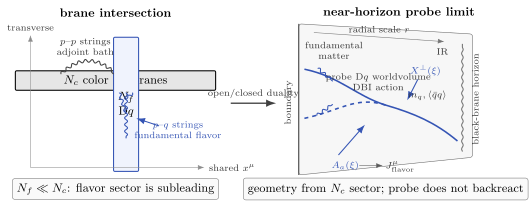
Probe-brane holography starts from an intersecting color D/ flavor D configuration. In the limit , the color branes generate the closed-string geometry, while the flavor branes remain probes. The — strings give fundamental flavor matter, and the D worldvolume gauge field is dual to the flavor current .
The D3/D7 example
Section titled “The D3/D7 example”The standard example is the D3/D7 system. The color branes fill the four boundary directions,
while a D7-brane fills those directions plus four additional transverse directions,
The two remaining directions measure the separation between the D3 and D7 stacks. A string stretched between them has energy proportional to its length, so the separation gives the flavor mass:
In the near-horizon geometry of the D3-branes, the D7-brane wraps an internal and extends along the AdS radial direction. The D7 embedding is described by scalar fields telling us where the brane sits in the transverse space. Near the boundary, an embedding scalar has an expansion of the schematic form
In the D3/D7 language this means
and
up to conventional powers and supersymmetric normalization details. The same brane therefore carries both the flavor current and the flavor mass/condensate data.
The D3/D7 theory is not QCD. It is a supersymmetric large- gauge theory with additional fundamental hypermultiplets. Still, it is a powerful controlled laboratory: it has adjoint degrees of freedom, flavor degrees of freedom, meson-like bound states, finite-density phases, and a DBI action whose nonlinearities are known from string theory.
The DBI action
Section titled “The DBI action”For a single probe D-brane, the bosonic worldvolume action is
with
Here:
is the induced metric on the brane, is the pullback of the Kalb—Ramond two-form, is the dilaton, and
is the worldvolume gauge-field strength. The Wess—Zumino term is
where are Ramond—Ramond potentials. Many basic transport computations set , keep a constant dilaton, and ignore Wess—Zumino terms. That is not because those terms are unimportant in principle, but because the DBI square root already captures the universal nonlinear gauge dynamics of the probe sector.
The action has two kinds of fields:
The embedding scalars describe flavor masses, condensates, and meson fluctuations. The worldvolume gauge field describes flavor currents and charge dynamics.
Maxwell theory is the first term, not the whole story
Section titled “Maxwell theory is the first term, not the whole story”At small field strength, DBI reduces to Maxwell theory. Set and expand around a fixed embedding. Then
where . The DBI action becomes
The first term is the brane tension. The second is a Maxwell action on the brane. But at finite density, finite electric field, or strong gradients, the higher powers of are not optional. They encode:
A common beginner mistake is to replace DBI by Maxwell theory too early. Maxwell theory is correct near the boundary and in weak-field linear response, but the interesting finite-density IR physics often lives precisely where the square root matters.
Source, vev, and electric displacement
Section titled “Source, vev, and electric displacement”To introduce a flavor chemical potential, turn on
Near the boundary,
so is the source for the flavor charge density. The response is the radial canonical momentum conjugate to :
Because the DBI action depends on only through in a homogeneous static background, this quantity is radially conserved:
This conserved electric displacement is the flavor charge density. This is exactly the same source/response logic as in Einstein—Maxwell finite-density holography, but now the Maxwell field lives on the probe brane rather than in the full bulk spacetime.
For a simplified massless embedding with no -field, the effective radial Lagrangian often has the form
where and are determined by the induced metric, dilaton, and internal volume wrapped by the brane. Then
Solving for gives
The detailed powers depend on the brane embedding and coordinate convention, but the structural lesson is robust:
The chemical potential is obtained by integrating the electric field:
with signs determined by the convention for and . Regularity usually fixes at a horizon.
Minkowski embeddings and black-hole embeddings
Section titled “Minkowski embeddings and black-hole embeddings”Probe-brane embeddings have a vivid geometric interpretation. At finite temperature the background has a black-brane horizon. A flavor brane can behave in two qualitatively different ways.
Minkowski embedding
Section titled “Minkowski embedding”The brane caps off smoothly outside the horizon. In the D3/D7 example, the wrapped shrinks to zero size before the brane reaches the horizon. The flavor excitations are then discrete and stable at leading large :
The name “Minkowski embedding” is historical: the induced brane geometry has no horizon.
Black-hole embedding
Section titled “Black-hole embedding”The brane reaches the horizon. Fluctuations can fall into the horizon, so meson-like excitations become dissipative resonances:
The transition between these embeddings is often called meson melting. It is not a sharp universal concept like a symmetry-breaking transition in all models, but it captures a useful physical distinction: horizonless branes support stable normal modes; horizon-crossing branes support quasinormal modes.
At nonzero flavor density, the electric flux must go somewhere. In a simple DBI setup without explicit charged sources on the brane, a nonzero density typically forces the brane to connect to the horizon, because the flux lines need an endpoint in the IR. More elaborate constructions can include baryon vertices, strings, or other charged sources that allow different endings.
Mesons as brane fluctuations
Section titled “Mesons as brane fluctuations”The brane is not merely a source of charge. Its small fluctuations are themselves boundary operators. Let be a small embedding fluctuation or a small gauge-field fluctuation on a fixed probe brane. Expanding DBI to quadratic order gives an effective wave equation on the induced worldvolume geometry:
The boundary conditions determine the spectrum.
For a Minkowski embedding, one imposes regularity at the smooth cap. Normalizable modes have real frequencies:
These are stable mesons in the large- probe limit.
For a black-hole embedding, one imposes infalling boundary conditions at the induced horizon. The modes are quasinormal:
These are melted mesons or flavor-sector resonances with finite lifetime. This is the same horizon logic used for retarded correlators earlier in the course, now applied to fields living on the brane.
Open-string metric and worldvolume horizons
Section titled “Open-string metric and worldvolume horizons”DBI fluctuations do not always propagate in the closed-string metric . In a background worldvolume field strength , the natural causal structure for open-string fluctuations is governed by the open-string metric
This metric becomes especially important when an external electric field is applied. Even if the background black-brane horizon sits at , the probe fluctuations may see an effective worldvolume horizon at some determined by the electric field. In many calculations, is where the DBI square root would otherwise become imaginary.
The physical meaning is sharp. The electric field drives the flavor sector out of equilibrium. The nonlinear DBI dynamics creates an effective horizon for open strings, and this horizon controls current noise and the effective temperature of flavor fluctuations.
This is one of the great virtues of probe branes: they let us study a stationary nonequilibrium conducting state without immediately solving a fully time-dependent Einstein problem. The price is that the adjoint bath is treated as infinitely large and absorbs energy without backreacting at leading order.
Linear response: flavor conductivity
Section titled “Linear response: flavor conductivity”In linear response, the flavor conductivity is obtained from the retarded current-current correlator:
On the brane, perturb
The DBI action is expanded to quadratic order in around the background . The resulting equation has the usual holographic structure:
But the coefficients of the ODE are DBI-dressed by the background density. Equivalently, fluctuations propagate in the open-string metric and with effective couplings determined by the DBI determinant.
At zero density and weak fields, this reduces to the Maxwell calculation. At finite density, it does not. The conductivity contains information about charge carriers represented by strings stretching between color and flavor branes, and about charge-neutral pair creation in the strongly coupled bath.
Why probe branes can have finite DC conductivity without a lattice
Section titled “Why probe branes can have finite DC conductivity without a lattice”In the fully translationally invariant finite-density hydrodynamic system discussed earlier, DC conductivity is singular because current overlaps with conserved momentum:
So why do probe-brane calculations often give a finite leading DC conductivity in a translationally invariant background?
Because the probe limit is not a closed finite-density fluid. The flavor sector is immersed in a much larger adjoint sector. Flavor charge is conserved, but flavor momentum need not be conserved by itself. The flavor carriers can transfer momentum to the adjoint bath:
At leading order in , the bath is infinitely large and its response is not included. Thus the flavor current relaxes even when the full theory remains translationally invariant.
Large- counting makes this precise. For fixed ,
The momentum-drag term in the total conductivity is suppressed relative to the leading probe conductivity. The DBI result computes the leading flavor-sector response, not the full closed-system conductivity including the exact conserved total momentum.
Nonlinear DC conductivity: the Karch—O’Bannon logic
Section titled “Nonlinear DC conductivity: the Karch—O’Bannon logic”The nonlinear power of DBI becomes visible when we apply a finite electric field. Use the ansatz
The DBI action now depends on and , but not directly on or . Therefore two radial momenta are conserved:
The boundary interpretation is immediate:
The conductivity is
The clever step is that one often does not need the full embedding solution to determine . The DBI square root must remain real for all . Typically a factor in the numerator and a factor in the denominator change sign at the same radial point . Regularity imposes simultaneous vanishing conditions there. These algebraic conditions determine in terms of , , temperature, and embedding data at .
Schematically,
The two pieces have different physical origins.
The pair-creation term is present even at zero density. It represents charged flavor pairs produced by the electric field from the strongly coupled medium.
The density term is proportional to the pre-existing charge density. It describes the response of the finite-density flavor carriers.
The point is often an open-string horizon. In linear response , it approaches the background horizon . At finite , it moves and sets the effective temperature of fluctuations in the driven state.
A scaling lesson from DBI transport
Section titled “A scaling lesson from DBI transport”Probe-brane transport gives a useful scaling example. Suppose the adjoint bath has a Lifshitz-like scaling exponent . In a large-density regime where the density term dominates the DBI conductivity, many probe-brane models give the scaling
Equivalently,
For , this gives
This is a good example of how holography can produce linear-in- resistivity. It is also a good example of why linear-in- resistivity is not, by itself, a microscopic explanation of strange metals. The mechanism here is probe-sector heat-bath dissipation governed by DBI nonlinearities and the scaling geometry of the adjoint bath. It is not Landau quasiparticle scattering, and it is not ordinary impurity momentum relaxation.
The scaling result is useful because it teaches the architecture of a mechanism:
But every comparison to experiment must ask what the charged carriers are, what bath they dissipate into, and whether the probe limit is physically appropriate.
Holographic zero sound on probe branes
Section titled “Holographic zero sound on probe branes”At zero temperature and finite density, longitudinal fluctuations of the probe-brane gauge field have a linearly dispersing collective mode. In a common massless conformal probe model,
The constant is a density-dependent chemical-potential scale whose precise normalization depends on the brane model. This mode is called holographic zero sound by analogy with Landau Fermi-liquid zero sound.
The analogy is useful but not literal. In a Landau Fermi liquid, zero sound is a coherent distortion of a Fermi surface. In a probe-brane DBI system, the mode is a collective density excitation of the flavor sector. There need not be a sharp gauge-invariant Fermi surface carrying the charge.
At nonzero temperature, the probe zero-sound poles move in the complex frequency plane. Since the probe sector does not backreact on the metric at leading order, the mode does not simply become ordinary energy-momentum sound. Instead, one pole eventually becomes the hydrodynamic charge diffusion mode:
while another remains non-hydrodynamic. This pole motion is one reason probe-brane optical conductivities can show a Drude-like low-frequency peak even though the peak is not the ordinary momentum-conservation Drude peak.
Optical conductivity and the mysterious probe Drude peak
Section titled “Optical conductivity and the mysterious probe Drude peak”Probe-brane optical conductivity can display a narrow low-frequency peak at finite density. At very low temperature, in some models, this peak sharpens dramatically and may become a delta function at zero temperature.
The important warning is:
In ordinary hydrodynamics, a Drude peak appears when current overlaps with a slowly relaxing momentum. In the probe-brane limit, flavor momentum is not a conserved hydrodynamic variable of the leading theory. The peak is instead tied to a long-lived probe-sector mode, closely related to holographic zero sound and to emergent conservation in the zero-temperature probe dynamics.
This is both interesting and dangerous. It gives a strongly coupled model with metal-like optical response without quasiparticles. But the interpretation is not the same as the Drude model of a weakly disordered Fermi liquid.
Defects and impurities
Section titled “Defects and impurities”A probe brane does not have to fill all boundary spatial directions. It can be localized in one or more of them. Then it describes a defect, interface, or impurity coupled to a higher-dimensional strongly interacting bath.
For example,
This is holographically natural. The defect has its own localized degrees of freedom, while the ambient large- theory supplies a strongly coupled bath. Such models are useful analogues of Kondo-like problems, where an impurity spin is screened by surrounding degrees of freedom. The geometric version of screening can be a reduction of electric flux, brane recombination, or a transition in the probe embedding.
Defect branes are not the main subject of this page, but they highlight a strength of probe-brane methods: by changing how the brane sits in the geometry, one changes the dimensionality and structure of the boundary flavor sector.
Probe branes versus electron stars
Section titled “Probe branes versus electron stars”The previous page and this page both discuss charge outside a horizon, but the mechanisms are different.
| Feature | Electron star / Dirac hair | Probe flavor brane |
|---|---|---|
| Charged object | Bulk fermion matter | D-brane worldvolume gauge sector |
| Backreaction | Usually important | Neglected at leading order |
| Boundary charge | Cohesive fermionic charge | Flavor charge in fundamental sector |
| Action | Einstein—Maxwell—Dirac/fluid | DBI plus Wess—Zumino terms |
| Transport | Full momentum conservation if homogeneous | Heat-bath dissipation at leading probe order |
| Typical large- scaling | Order set by bulk matter sector | probe response in bath |
In both cases, one can have charge outside the horizon. But electron stars are about replacing horizon flux by backreacted fermion matter. Probe branes are about adding a flavor sector whose charge can be studied without changing the background at leading order.
Top-down control and bottom-up temptation
Section titled “Top-down control and bottom-up temptation”Probe-brane models are attractive because DBI is not invented to fit transport data. It is a genuine string-theory effective action. In favorable examples, the boundary field theory can be identified precisely: field content, symmetries, masses, and flavor currents all descend from the brane intersection.
That top-down control is valuable, but it comes with constraints:
Condensed-matter applications often use DBI in a more bottom-up way. This can be useful, especially for nonlinear response and probe-sector dissipation, but one should remember what is being assumed. A DBI action is not a generic nonlinear electrodynamics action. It encodes the special causal and charge structure of open strings ending on branes.
A reliable interpretation should therefore say which of the following is being claimed:
These are all legitimate, but they are not the same claim.
A compact dictionary
Section titled “A compact dictionary”| Brane object | Boundary interpretation |
|---|---|
| color D stack | Large- adjoint gauge sector |
| Near-horizon closed-string geometry | Strongly coupled adjoint bath |
| probe D branes | Fundamental flavor sector |
| — open strings | Flavor fields in fundamental representation |
| D worldvolume gauge field | Global flavor current |
| Boundary value of | Flavor chemical potential |
| DBI electric displacement | Flavor charge density |
| Embedding scalar source | Flavor mass or defect data |
| Embedding scalar response | Flavor condensate or meson operator vev |
| Minkowski embedding | Stable mesons / gapped flavor sector |
| Black-hole embedding | Melted mesons / dissipative flavor sector |
| Open-string horizon | Effective horizon for flavor fluctuations |
This dictionary is one of the reasons probe branes are so pedagogically useful: geometry, field theory representation, and transport are tied together in a concrete way.
Worked example: density from a DBI electric field
Section titled “Worked example: density from a DBI electric field”Consider the simplified DBI Lagrangian
The canonical momentum is
Squaring gives
Rearrange:
Therefore
and
This little derivation is a useful sanity check. For small density, the result linearizes and looks Maxwell-like. For large density, the DBI square root changes the radial electric field qualitatively. This is why finite-density probe-brane transport is not just Maxwell transport in disguise.
Common pitfalls
Section titled “Common pitfalls”Confusing the flavor symmetry with a dynamical boundary gauge symmetry. The worldvolume gauge field is a bulk field. Its boundary value sources a global flavor current.
Calling probe-brane finite DC conductivity momentum relaxation. The leading finite DC result comes from flavor momentum leaking into a large bath, not from explicit breaking of translations.
Replacing DBI by Maxwell everywhere. The Maxwell term is the weak-field expansion. It misses the nonlinear electric displacement, worldvolume horizon, and nonlinear conductivity.
Taking zero sound too literally. Holographic zero sound is a density collective mode. It does not automatically imply a Landau Fermi surface.
Ignoring the probe limit. If is not small, the brane backreacts. Then the adjoint bath cannot be treated as an infinite sink, and the leading transport interpretation changes.
Over-reading top-down models as material models. D3/D7 and related systems are controlled large- theories, not microscopic models of cuprates, graphene, or heavy fermion compounds.
Forgetting embedding physics. The same DBI gauge field can describe very different spectra depending on whether the brane caps off or reaches a horizon.
Exercises
Section titled “Exercises”Exercise 1: DBI expands to Maxwell
Section titled “Exercise 1: DBI expands to Maxwell”Let and assume is small. Show that
for antisymmetric .
Solution
Use
For any matrix ,
Since is antisymmetric with one index raised, . The first nontrivial term is
Taking the square root gives
With ,
Therefore
The sign follows from antisymmetry and Lorentzian index conventions.
Exercise 2: Electric displacement as density
Section titled “Exercise 2: Electric displacement as density”For
show that is radially conserved and solve for in terms of .
Solution
The Euler—Lagrange equation for is
The Lagrangian depends on but not on , so
Thus
is a constant. Solving gives
This conserved canonical momentum is the boundary flavor charge density.
Exercise 3: Why finite probe DC conductivity does not violate momentum conservation
Section titled “Exercise 3: Why finite probe DC conductivity does not violate momentum conservation”Explain why a translationally invariant probe-brane system can have a finite leading DC conductivity, even though a closed translationally invariant finite-density system has a delta function in .
Solution
In a closed translationally invariant system, total momentum is conserved. If the electric current has overlap with total momentum, the DC conductivity contains a singular term,
In the probe-brane limit, the flavor sector is not a closed system. It is coupled to a much larger adjoint bath. Flavor charge is conserved, but flavor momentum can be transferred to the adjoint sector. Since the probe computation neglects the bath’s backreaction, that transferred momentum is effectively lost.
Thus the leading probe conductivity is a heat-bath conductivity. It does not contradict total momentum conservation of the full theory. The exact total-momentum delta function is subleading in the probe expansion and would be recovered only after including backreaction.
Exercise 4: Linear resistivity from probe scaling
Section titled “Exercise 4: Linear resistivity from probe scaling”Assume the large-density probe-brane conductivity scales as
Find the resistivity scaling and determine which gives linear-in- resistivity.
Solution
The resistivity is
Therefore
Linear-in- resistivity requires
so
This is a scaling result. It does not by itself prove that a real material has a holographic bath or DBI flavor carriers.
Exercise 5: Holographic zero sound versus ordinary hydrodynamic sound
Section titled “Exercise 5: Holographic zero sound versus ordinary hydrodynamic sound”List two reasons why probe-brane zero sound should not be identified blindly with ordinary first sound.
Solution
First, ordinary first sound is a hydrodynamic mode involving conserved energy, momentum, and density. In the probe limit, the flavor gauge-field fluctuation does not backreact on the metric at leading order, so it is not a full energy-momentum sound mode.
Second, Landau zero sound is a coherent oscillation of a Fermi surface. Probe-brane zero sound is a collective density mode of the DBI flavor sector. It can exist without a visible gauge-invariant Fermi surface carrying the charge.
At finite temperature, the probe zero-sound poles do not simply cross over into ordinary sound. One pole becomes charge diffusion, while another remains non-hydrodynamic.
Exercise 6: Interpreting embeddings
Section titled “Exercise 6: Interpreting embeddings”A probe D7-brane in a finite-temperature background either caps off smoothly above the black-brane horizon or reaches the horizon. What are the boundary interpretations of these two possibilities?
Solution
If the brane caps off smoothly outside the horizon, the induced worldvolume has no horizon. Fluctuations obey regularity conditions at the cap and have real normal-mode frequencies. The boundary interpretation is a stable meson spectrum or a gapped flavor sector. This is a Minkowski embedding.
If the brane reaches the horizon, fluctuations can fall into the horizon. The appropriate IR boundary condition is infalling, and the modes become quasinormal with complex frequencies. The boundary interpretation is dissipative flavor dynamics: mesons are melted into the thermal bath, and the flavor sector can conduct.
Further reading
Section titled “Further reading”For the broad review perspective, see Hartnoll, Lucas and Sachdev, Holographic Quantum Matter, especially section 7.1 on probe branes, zero sound, nonlinear conductivity, and defects. For a condensed-matter-facing account with Dp/Dq intersections and DBI transport, see Zaanen, Liu, Sun and Schalm, Holographic Duality in Condensed Matter Physics, chapter 13. For textbook background on D-branes as flavor degrees of freedom, the D3/D7 dictionary, DBI actions, and meson fluctuations, see Ammon and Erdmenger, Gauge/Gravity Duality, chapters 4, 10, and 13. For string-theory foundations of Born—Infeld dynamics and electromagnetic fields on D-branes, see Zwiebach, A First Course in String Theory, chapters 19 and 20.