
Quantum Extremal Surfaces
RT and HRT tell us to extremize an area. FLM tells us that the entropy is not just area: the bulk quantum fields in the entanglement wedge contribute their own von Neumann entropy. The natural next step is therefore unavoidable:
Do not extremize the classical area and then merely decorate the answer. Extremize the generalized entropy itself.
A quantum extremal surface is a codimension-two bulk surface for which the generalized entropy is stationary under local deformations of :
For two-derivative Einstein gravity, the generalized entropy has the schematic form
Here is a bulk region bounded by the boundary region and the candidate surface , while denotes the counterterms and possible higher-derivative gravitational entropy terms required to make finite. In pure Einstein gravity with a simple cutoff scheme, one often suppresses in notation, but the invariant object is the complete renormalized generalized entropy.
The quantum-corrected holographic entropy prescription is
where means that is homologous to the boundary region in the appropriate bulk sense.
In one sentence: a QES is the surface where the classical tendency to reduce area is balanced against the quantum tendency to reduce bulk entropy.
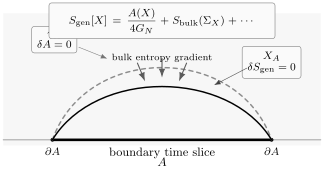
A quantum extremal surface extremizes the generalized entropy, not the area alone. The classical HRT surface obeys , while the QES obeys . In ordinary perturbative situations the shift is , but in evaporating black-hole problems the dominant QES can be macroscopically different from the no-island surface.
This page explains the prescription, its relation to RT/HRT and FLM, the quantum expansion, the order of operations in , and why QESs are the immediate precursor of islands.
Guiding question
Section titled “Guiding question”How should holographic entropy be computed when the bulk quantum state is important enough that its entropy competes with the classical area?
FLM answered the first-order version of this question. If the classical geometry is fixed and the bulk entropy is only an correction to an area term, then one can evaluate the bulk entropy on the classical RT/HRT surface:
But this expression hides a deeper principle. The correct object is the generalized entropy of a candidate surface. When the bulk entropy changes significantly as the surface moves, or when several classical saddles have comparable generalized entropy, the surface itself must be selected quantum mechanically.
That selection rule is the QES prescription.
From RT and HRT to QES
Section titled “From RT and HRT to QES”The progression is worth keeping explicit:
where is the classical RT/HRT surface.
At first sight QES may look like a small correction to HRT. In many ordinary large- states, it is. Let . Since extremizes the area,
The QES condition is schematically
If and the area Hessian is nonsingular, then
This is why FLM could use the classical surface at order .
But there are three common situations where the QES prescription is much more than a tiny shift.
First, there may be multiple extremal surfaces whose classical areas are close enough that the bulk entropy changes which one dominates.
Second, the bulk entropy may become large. In evaporating-black-hole settings, the Hawking radiation entropy can grow like the Bekenstein-Hawking entropy of the remaining black hole, so it is no longer a harmless order-one correction.
Third, the relevant boundary system may include a nongravitating bath. Then the candidate generalized entropy can involve an island inside the gravitating region, and the dominant QES can appear where no classical RT surface of the radiation alone would have been expected.
The island formula is therefore not a separate idea bolted onto holography. It is the QES prescription applied to radiation regions in evaporating geometries.
The generalized entropy functional
Section titled “The generalized entropy functional”For a candidate surface homologous to , define a bulk region such that
The generalized entropy is
For two-derivative Einstein gravity,
For higher-derivative gravity, is replaced by the appropriate gravitational entropy functional. In stationary black-hole thermodynamics this begins with Wald entropy. For holographic entanglement entropy in higher-derivative theories, there are also extrinsic-curvature and anomaly-like contributions. The safest notation is therefore
The second term,
is the von Neumann entropy of the bulk effective theory associated with the region . More precisely, because gauge theories and gravity do not factorize sharply across a surface, this entropy is an algebraic entropy with the appropriate edge-mode, center, and counterterm structure. In many practical semiclassical computations, especially in two-dimensional matter CFTs coupled to simple gravity, it is computed using ordinary QFT entanglement formulas and then combined with the gravitational term.
The important lesson is that and are not separately sacred. The split depends on regulator and scheme. The renormalized sum is the physical quantity.
Quantum extremality and the quantum expansion
Section titled “Quantum extremality and the quantum expansion”Classically, a codimension-two surface in Lorentzian spacetime is extremal when its two null expansions vanish. Let and be future-directed null normals to the surface . The classical expansions and measure the fractional rate of change of the area density under deformations along these null directions.
For QESs, the area is replaced by generalized entropy. The quantum expansion is the functional derivative of with respect to a local null deformation of the surface. Schematically,
where is the determinant of the induced metric on and labels points on the surface. A quantum extremal surface obeys
for every point on .
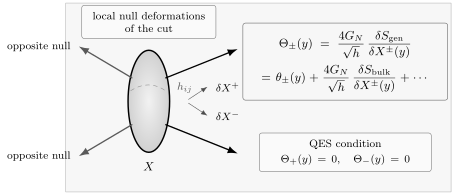
The QES condition can be stated locally using the quantum expansions . A classical extremal surface has vanishing null expansions . A quantum extremal surface instead has vanishing variation of the full generalized entropy under both independent null deformations.
This local viewpoint is useful because it connects QESs to the generalized second law, the quantum focusing conjecture, and quantum versions of classical area theorems. One should not, however, reduce the QES prescription to a local equation alone. The entropy is obtained by solving the local extremality equations and then choosing the globally minimal generalized entropy among the allowed extrema.
Extremize first, minimize second
Section titled “Extremize first, minimize second”The notation
is intentionally ordered.
First, find all admissible quantum extremal surfaces satisfying the homology condition and the quantum extremality equation:
Second, evaluate the generalized entropy on each candidate:
Third, choose the candidate with smallest generalized entropy:
This is not the same as minimizing over all surfaces without imposing extremality. In the gravitational replica derivation, the relevant saddle must solve the equations of motion, and the location of the entangling surface is determined by a saddle-point condition. The final minimization chooses among saddles, not among arbitrary off-shell surfaces.
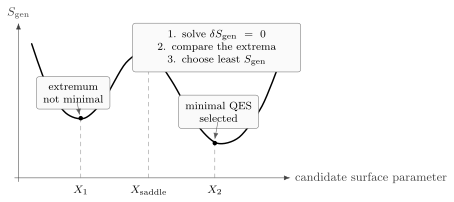
The QES prescription first finds stationary points of and then selects the one with least generalized entropy. When two candidate QESs exchange dominance, the entropy can undergo a phase transition. The Page transition in island computations is the most famous example.
This order of operations is the source of many qualitative effects:
- mutual-information phase transitions in RT/HRT,
- entanglement-wedge jumps,
- island transitions in evaporating black holes,
- changes in which bulk region is reconstructable from a given boundary region.
At finite , the transition is smoothed by subleading effects and by the fact that the exact boundary entropy is not literally a minimum over classical saddles. But in the semiclassical expansion, the sharp saddle transition is the correct leading description.
Quantum entanglement wedge
Section titled “Quantum entanglement wedge”Given the minimal QES , the quantum entanglement wedge of is the bulk domain of dependence of a region satisfying
Classically this reduces to the HRT entanglement wedge. Quantum mechanically, the wedge is shifted because is chosen by generalized entropy. More importantly, the wedge should be thought of as a region whose operator algebra is encoded in the boundary region , rather than merely as a geometric submanifold.
This is the point where QES touches bulk reconstruction. If a bulk operator lies inside the quantum entanglement wedge of , the expectation is that it can be reconstructed on within the appropriate code subspace. Later pages on JLMS, entanglement wedge reconstruction, and operator-algebra quantum error correction will make this precise.
For the black hole information problem, the crucial possibility is that the entanglement wedge of the Hawking radiation can contain part of the black hole interior after the Page time. That interior region is then called an island.
The island formula as a QES formula
Section titled “The island formula as a QES formula”For a nongravitating radiation region coupled to a gravitating region, the entropy of is computed by allowing an additional gravitating region to be included in the bulk side of the entropy calculation:
This is the island formula. It is the same QES rule written in a form adapted to radiation in a nongravitating bath. The surface is the QES. The region is included in the entanglement wedge of .
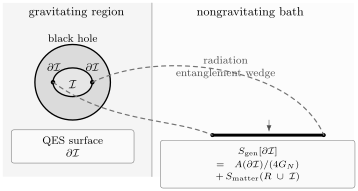
For a radiation region in a nongravitating bath, the QES prescription can select a surface inside the gravitating region. The entropy is then computed using the generalized entropy of . The island is not a place where radiation locally travels; it is part of the entanglement wedge of the radiation.
The no-island saddle corresponds to . At early times this usually dominates, reproducing the Hawking result that the radiation entropy grows. At late times, an island saddle can dominate. The area term then gives roughly the remaining black hole entropy, while is arranged so that the fine-grained radiation entropy follows a Page curve.
This is why QESs are the conceptual hinge of the modern story. RT and HRT are about entropy in a classical bulk. QESs are about entropy in semiclassical quantum gravity. Islands are what QESs look like when the region whose entropy we ask about is the Hawking radiation.
Causal properties and QES barriers
Section titled “Causal properties and QES barriers”A classical HRT surface has strong causal properties: it is spacelike separated from the boundary domain of dependence and from , and it lies deeper than the causal wedge. Quantum extremal surfaces obey analogous but more subtle restrictions.
The intuitive reason is simple. If a candidate QES could be moved by a causal influence from , then the entropy of would be acausally sensitive to choices made inside its own domain of dependence. Holographic entropy must respect boundary causality.
There are also barrier phenomena. Certain hypersurfaces prevent extremal or quantum extremal surfaces anchored outside them from crossing. In classical settings, extremal-surface barriers are related to the signs of null expansions and focusing. In quantum settings, the relevant condition is expressed in terms of quantum expansions and generalized entropy. Such barriers are one reason QESs can avoid regions where semiclassical control breaks down, such as singularities, in many examples.
This statement should be used carefully. A barrier theorem is not a magic shield against all quantum gravity effects. It is a semiclassical statement under assumptions. But it explains why QESs often sit in controlled regions even when the spacetime contains an interior singularity.
Relation to the generalized second law
Section titled “Relation to the generalized second law”For a causal horizon, the generalized entropy is
The generalized second law states that does not decrease along the future horizon:
A QES is not usually a causal horizon. Nevertheless, the same quantity appears. The generalized second law says that generalized entropy behaves monotonically along certain causal horizons. The QES prescription says that subregion entropy in quantum gravity is computed by extremizing generalized entropy over codimension-two surfaces.
This shared structure is not accidental. Both black hole thermodynamics and holographic entanglement are governed by the fact that quantum gravity assigns an entropy to cuts of spacetime. QESs are the subregion-duality version of that principle.
Simple model: a one-parameter family of surfaces
Section titled “Simple model: a one-parameter family of surfaces”It is useful to reduce the functional problem to a one-dimensional cartoon. Suppose candidate surfaces are labeled by a coordinate . Let
The QES condition is
If has a stable classical extremum at , then near we can write
with . If
then the QES shifts to
This is the small-shift regime.
But suppose there are two candidate extrema, and , with generalized entropies
where is a time parameter. If
then the dominant QES jumps at . This is not a small displacement. It is a saddle transition.
The Page transition in island calculations is of this second type. The early-time no-island saddle and the late-time island saddle are different generalized-entropy extrema. The Page time is approximately when their generalized entropies cross.
What QESs do and do not say
Section titled “What QESs do and do not say”QESs do say that the surface defining holographic entropy is selected by the generalized entropy, not by area alone.
QESs do say that bulk entanglement can change the entanglement wedge and, in black-hole evaporation setups, can cause the radiation wedge to include an island.
QESs do say that the classical RT/HRT formula is the leading term in a quantum-gravitational entropy expansion.
QESs do not by themselves provide the microscopic Hilbert-space mechanism of black hole unitarity. They compute fine-grained entropy in semiclassical gravity, and in favorable holographic settings this matches the unitary boundary answer.
QESs do not mean that a surface is a material membrane storing bits. The area term is a gravitational entropy contribution. Its microscopic interpretation depends on the UV completion.
QESs do not imply that information travels locally from the island to the radiation. The island belongs to the entanglement wedge of the radiation in a fine-grained entropy calculation. It is an encoding statement, not a new causal channel.
QESs do not remove the need to define the correct algebra of observables. In gravity, the Hilbert space does not factorize naively across a spatial cut. This is why operator-algebra quantum error correction will be essential later.
Common pitfalls
Section titled “Common pitfalls”Pitfall 1: “QES means RT plus a small correction.”
Section titled “Pitfall 1: “QES means RT plus a small correction.””Sometimes yes, often no. In a perturbative large- state with a unique well-separated HRT surface, the QES is a small shift. In evaporating black holes, the dominant QES can be a different saddle altogether.
Pitfall 2: “The QES is found by minimizing over all surfaces.”
Section titled “Pitfall 2: “The QES is found by minimizing SgenS_{\rm gen}Sgen over all surfaces.””The prescription is to extremize first and then minimize among extrema. This distinction matters because the gravitational entropy calculation is a saddle-point calculation.
Pitfall 3: “Bulk entropy is regulator-independent by itself.”
Section titled “Pitfall 3: “Bulk entropy is regulator-independent by itself.””It is not. The area term, local gravitational entropy terms, and bulk entropy term combine into a finite generalized entropy.
Pitfall 4: “An island is a physical subsystem added to the radiation.”
Section titled “Pitfall 4: “An island is a physical subsystem added to the radiation.””No. The island is a gravitating region included in the entanglement wedge of the radiation by the QES prescription. It is not an extra laboratory subsystem and not a local communication channel.
Pitfall 5: “QES solves every version of the information paradox.”
Section titled “Pitfall 5: “QES solves every version of the information paradox.””QESs give a powerful semiclassical rule for fine-grained entropy and explain Page curves in many controlled models. They do not automatically settle all questions about factorization, microscopic state counting, asymptotically flat evaporation, cosmology, or the experience of infalling observers.
Exercises
Section titled “Exercises”Exercise 1: Recovering FLM from QES
Section titled “Exercise 1: Recovering FLM from QES”Let
and suppose is a nondegenerate classical extremal surface of . Show that evaluating on the QES agrees with evaluating on up to order .
Solution
Write
Since extremizes ,
The QES equation has the schematic form
Because , the displacement is
Now expand the entropy:
The last two displayed correction terms are , since . Therefore
which is precisely the FLM formula through order .
Exercise 2: A one-dimensional QES shift
Section titled “Exercise 2: A one-dimensional QES shift”Consider
with and . Find the QES and the entropy through order .
Solution
The extremality equation is
Thus
Evaluate the generalized entropy:
The correction from the shift is
which is . Therefore through order ,
Again, the FLM answer is obtained by evaluating the bulk entropy on the classical surface .
Exercise 3: Extremize versus minimize
Section titled “Exercise 3: Extremize versus minimize”Suppose two QES candidates have generalized entropies
with and . Which candidate dominates, and what is the transition time?
Solution
The entropy is the smaller of the two generalized entropies:
For early times,
so candidate 1 dominates. For late times,
so candidate 2 dominates. The transition occurs when
or
This is the simplest cartoon of a Page transition: an entropy that would have grown forever is replaced after a saddle transition by a different generalized-entropy saddle.
Exercise 4: Quantum expansion in a simple limit
Section titled “Exercise 4: Quantum expansion in a simple limit”Assume a null deformation of a surface changes the area density as
and changes the bulk entropy as
Write the quantum expansion and the QES condition in this direction.
Solution
The generalized entropy is
Therefore
Multiplying by gives the quantum expansion
The QES condition in this null direction is
or
The analogous equation must hold for the other independent null deformation.
Exercise 5: Island entropy as a QES entropy
Section titled “Exercise 5: Island entropy as a QES entropy”In a two-dimensional evaporating-black-hole model, suppose the no-island entropy and island entropy are approximated by
and
where is the extremal entropy and models the growing Hawking radiation entropy. Estimate the Page time in this cartoon.
Solution
The dominant entropy is
The transition occurs when the two saddles are equal:
Thus
up to the corrections hidden in the island entropy. The precise coefficient depends on the model and on the radiation region, but the lesson is robust: the Page time is controlled by the crossing of the no-island and island generalized entropies.
Further reading
Section titled “Further reading”- Netta Engelhardt and Aron C. Wall, “Quantum Extremal Surfaces: Holographic Entanglement Entropy beyond the Classical Regime,” arXiv:1408.3203.
- Thomas Faulkner, Aitor Lewkowycz, and Juan Maldacena, “Quantum corrections to holographic entanglement entropy,” arXiv:1307.2892.
- Aitor Lewkowycz and Juan Maldacena, “Generalized gravitational entropy,” arXiv:1304.4926.
- Aron C. Wall, “Maximin Surfaces, and the Strong Subadditivity of the Covariant Holographic Entanglement Entropy,” arXiv:1211.3494.
- Chris Akers, Netta Engelhardt, Geoff Penington, and Mykhaylo Usatyuk, “Quantum Maximin Surfaces,” arXiv:1912.02799.
- Ahmed Almheiri, Netta Engelhardt, Donald Marolf, and Henry Maxfield, “The entropy of bulk quantum fields and the entanglement wedge of an evaporating black hole,” arXiv:1905.08762.
- Ahmed Almheiri, Thomas Hartman, Juan Maldacena, Edgar Shaghoulian, and Amirhossein Tajdini, “The entropy of Hawking radiation,” arXiv:2006.06872.
The next page develops the replica and cosmic-brane technology behind holographic entropy. That technology will later reappear as replica wormholes in the derivation of the island formula.