
Relative Entropy and Linearized Gravity
The RT and HRT formulas say that boundary entanglement knows about bulk geometry. Relative entropy says something sharper: the consistency conditions of boundary quantum information know about the bulk equations of motion.
The basic chain is
Here is the modular Hamiltonian of a boundary region , and denotes the bulk gravitational equations linearized around AdS. The result is not a slogan about “gravity equals entanglement.” It is a precise statement, in a controlled regime, that the CFT entanglement first law for all ball-shaped regions is equivalent to the linearized Einstein equations in the bulk.
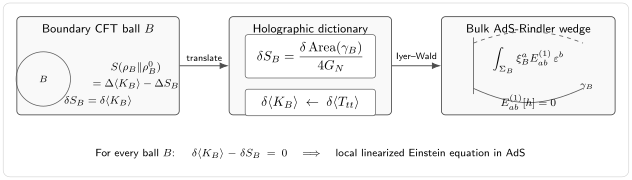
For a vacuum CFT ball , modular flow is generated by a conformal Killing vector. In pure AdS this lifts to an AdS-Rindler Killing vector that vanishes on the RT surface . The difference is a bulk integral of the linearized gravitational equations over .
Why this matters
Section titled “Why this matters”The previous pages introduced entanglement wedges: the bulk regions associated with boundary reduced density matrices. This page goes one step deeper. It explains why the RT/HRT area formula is tied not only to bulk geometry, but also to bulk dynamics.
A gravitational theory is not specified by geometry alone. It also needs equations of motion. In AdS/CFT, those equations are not extra data appended to the boundary theory. They are encoded in consistency conditions of CFT observables. Relative entropy is one of the cleanest observables for seeing this because it is exact, positive, monotonic, and defined purely in quantum-mechanical terms.
The central lesson is
The assumptions are important. We work near the vacuum of a holographic CFT, use ball-shaped boundary regions, and keep the leading classical RT contribution to entropy. Quantum corrections lead to generalized entropy and quantum extremal surfaces, which are introduced on the next page.
Relative entropy and modular Hamiltonians
Section titled “Relative entropy and modular Hamiltonians”Let and be two density matrices on the same region . Their relative entropy is
Define the modular Hamiltonian of the reference state by
The relative entropy can then be written as
where
and
Relative entropy has two essential properties:
and, if ,
The second property is monotonicity under restriction: a larger region contains at least as much information for distinguishing two states as a smaller region.
The entanglement first law
Section titled “The entanglement first law”Consider a one-parameter family of states
Since has a minimum at , its first variation vanishes:
Using
we obtain the entanglement first law:
This is a kinematic identity in quantum mechanics. It does not require holography. Holography enters when we translate both sides into bulk quantities.
Why balls are special
Section titled “Why balls are special”For a general region , the modular Hamiltonian is highly nonlocal. For a ball-shaped region in the vacuum of a CFT, it is local.
Let be a ball of radius centered at on the boundary time slice :
For the CFT vacuum on flat space,
The additive constant normalizes and drops out of variations. Therefore
This formula makes the modular-energy variation a weighted integral of the stress-tensor one-point function.
On the bulk side, in Poincaré AdS,
the RT surface for the vacuum ball is the hemisphere
This ball/hemisphere pair is the cleanest laboratory for seeing dynamics from entanglement.
The AdS-Rindler Killing vector
Section titled “The AdS-Rindler Killing vector”The causal development of the boundary ball is generated by a conformal Killing vector. In pure AdS, this lifts to an exact bulk Killing vector. For a ball centered at , , one convenient expression is
This vector has three important features.
First, near the boundary it becomes the conformal Killing vector that generates modular flow in .
Second, on the RT surface
it vanishes:
Third, it generates an AdS-Rindler horizon for the entanglement wedge of the ball. This is why the entanglement first law has the same mathematical structure as a gravitational first law.
Translating the first law into gravity
Section titled “Translating the first law into gravity”Now perturb the CFT vacuum. In the bulk, this corresponds to a small metric perturbation
The boundary stress tensor expectation value is read from the near-boundary behavior of . Thus becomes a gravitational charge associated with .
The entropy variation is computed using RT:
Because is extremal in the unperturbed geometry, the first-order change in area can be computed by varying the metric on the original surface. The first-order shift of the surface does not contribute.
The remarkable identity is that
Here is the bulk region bounded by and , is the natural volume-form vector on , and denotes the linearized equations of motion. For Einstein gravity with cosmological constant and no bulk matter perturbation,
With matter, the equation is instead schematically
This identity is a version of the Iyer–Wald relation: the difference between a boundary charge variation and a horizon-area variation is controlled by the equations of motion in the region between them.
From integral constraints to local equations
Section titled “From integral constraints to local equations”The CFT entanglement first law says
Therefore
for every ball .
A single such integral would not imply a local equation. But the family of all balls, with arbitrary centers, radii, and times, is powerful enough to probe the perturbation throughout the bulk. Under appropriate regularity and boundary assumptions, these integral constraints imply
For Einstein gravity, this is the linearized Einstein equation around AdS:
Thus, for a holographic CFT whose leading entropy is computed by RT, the entanglement first law for all vacuum balls is equivalent to linearized classical gravity in the bulk.
Relative entropy beyond first order
Section titled “Relative entropy beyond first order”The first law comes from the first variation of relative entropy. The second variation is nonzero and positive:
In holography, this second-order quantity is related to canonical energy in the bulk. Schematically, for perturbations around the vacuum,
This is more than a curiosity. Positivity and monotonicity of boundary relative entropy impose positivity constraints on the bulk theory. In this way, ordinary quantum-information inequalities become consistency conditions for gravitational effective field theory.
The JLMS relation
Section titled “The JLMS relation”The modern form of the story is the JLMS relation. For a boundary region with entanglement wedge , the boundary modular Hamiltonian has the schematic code-subspace form
Here is the HRT surface, is the modular Hamiltonian of bulk quantum fields in the entanglement wedge, and the ellipsis hides subtleties involving gauge constraints, edge modes, operator ordering, and higher-order corrections.
The relative-entropy statement is even cleaner:
In the appropriate semiclassical code subspace, boundary relative entropy is matched by relative entropy in the entanglement wedge. This is one of the strongest pieces of evidence for entanglement wedge reconstruction.
What has been assumed?
Section titled “What has been assumed?”The clean derivation of linearized Einstein equations assumes:
- a CFT state close to the vacuum;
- ball-shaped boundary regions;
- a bulk geometry close to pure AdS;
- the classical RT formula at leading order;
- the standard holographic stress-tensor dictionary;
- suitable regularity and boundary conditions.
It does not by itself prove full nonlinear quantum gravity. Extensions use higher-order relative entropy, canonical energy, bulk quantum corrections, and modular-flow technology. The foundational result is already deep: local bulk dynamics can be read from boundary entanglement consistency.
Dictionary checkpoint
Section titled “Dictionary checkpoint”| Boundary statement | Bulk statement |
|---|---|
| modular Hamiltonian of a vacuum ball | AdS-Rindler charge generated by |
| entanglement first law | gravitational first law for |
| relative entropy positivity | positivity of bulk canonical energy |
| first law for all balls | linearized Einstein equations around AdS |
| boundary modular Hamiltonian in a code subspace | area operator plus bulk modular Hamiltonian |
| boundary relative entropy | bulk relative entropy in the entanglement wedge |
The new moral is
Common confusions
Section titled “Common confusions”“The entanglement first law is dynamical.”
Section titled ““The entanglement first law is dynamical.””The first law is kinematic. It follows from the definition of relative entropy. The dynamics appears only after the holographic translation of both sides.
“One ball is enough to derive Einstein’s equations.”
Section titled ““One ball is enough to derive Einstein’s equations.””No. One ball gives one integral constraint. The local equations follow from imposing the first law for all balls.
“This proves full nonlinear gravity.”
Section titled ““This proves full nonlinear gravity.””No. The basic argument gives linearized equations around AdS. Nonlinear and quantum extensions require additional input.
“Relative entropy is just entanglement entropy.”
Section titled ““Relative entropy is just entanglement entropy.””No. Entanglement entropy is a property of one state. Relative entropy compares two states and combines modular energy with entropy:
Exercises
Section titled “Exercises”Exercise 1: Derive the entanglement first law
Section titled “Exercise 1: Derive the entanglement first law”Let with . Use
to show that .
Solution
Relative entropy is nonnegative and has a minimum at :
Therefore its first variation around vanishes:
Using
we get
so
Exercise 2: Deepest point of the ball RT surface
Section titled “Exercise 2: Deepest point of the ball RT surface”For the hemisphere
find the deepest radial point.
Solution
The deepest point has , so
Thus
A larger boundary ball probes deeper into the bulk.
Exercise 3: Why the surface shift does not contribute at first order
Section titled “Exercise 3: Why the surface shift does not contribute at first order”Explain why the first-order variation of the RT entropy can be computed on the unperturbed extremal surface.
Solution
Let the area functional be . Its first variation is
Since is extremal in the background geometry,
Therefore the first-order area change comes only from the metric perturbation evaluated on the original surface.
Exercise 4: Why all balls matter
Section titled “Exercise 4: Why all balls matter”Why does
for a single ball not imply pointwise?
Solution
A single integral constraint only fixes one weighted average of . A nonzero function can have a vanishing weighted integral over one region. The local equation follows only after imposing such constraints for a sufficiently rich family of regions and weights, here all boundary balls.
Further reading
Section titled “Further reading”- N. Lashkari, M. B. McDermott, and M. Van Raamsdonk, Gravitational Dynamics From Entanglement “Thermodynamics”.
- T. Faulkner, M. Guica, T. Hartman, R. C. Myers, and M. Van Raamsdonk, Gravitation from Entanglement in Holographic CFTs.
- D. L. Jafferis, A. Lewkowycz, J. Maldacena, and S. J. Suh, Relative entropy equals bulk relative entropy.
- H. Casini, M. Huerta, and R. C. Myers, Towards a derivation of holographic entanglement entropy.
- V. Iyer and R. M. Wald, Some properties of Noether charge and a proposal for dynamical black hole entropy.