
Brown–Henneaux central charge
The Brown–Henneaux central charge is one of the most important formulas in holography:
It turns the geometric ratio into the central charge of a two-dimensional conformal field theory. In higher-dimensional AdS/CFT, the statement “large means classical gravity” is often expressed by formulas such as . In AdS/CFT, the corresponding statement is sharper:
The goal of this page is to explain what is being computed, why a classical central charge can appear at all, and how the result fits into the holographic dictionary.
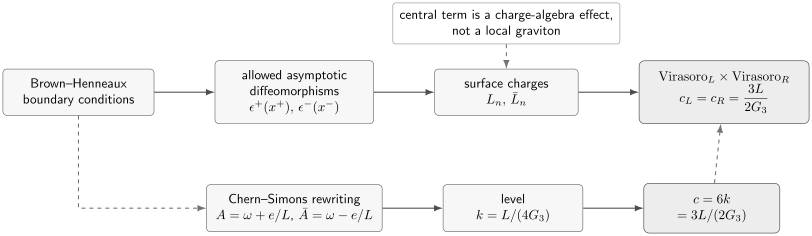
Brown–Henneaux boundary conditions allow two functions of one light-cone coordinate, producing two Virasoro algebras. The canonical charge algebra has central charge , where is the Chern–Simons level.
The problem Brown and Henneaux solved
Section titled “The problem Brown and Henneaux solved”Start with three-dimensional Einstein gravity with negative cosmological constant:
The global AdS metric is
The conformal boundary is the cylinder . Introduce light-cone coordinates
The exact isometry group of AdS is
This is finite-dimensional. Brown and Henneaux asked a more subtle question:
What is the algebra of diffeomorphisms that preserve asymptotically AdS boundary conditions and have well-defined canonical charges?
The answer is not merely . It is two copies of the Virasoro algebra.
Boundary conditions
Section titled “Boundary conditions”A convenient large-radius form of asymptotically AdS metrics is
where run over the two boundary directions. Brown–Henneaux boundary conditions allow the leading boundary metric to be fixed while permitting certain finite subleading fluctuations.
In light-cone coordinates, a standard schematic version of the falloffs is
The precise numerical factors depend on coordinate conventions. The essential point is that the leading boundary conformal class is fixed, while the components and are allowed to fluctuate. These subleading pieces encode the boundary stress tensor.
Asymptotic diffeomorphisms
Section titled “Asymptotic diffeomorphisms”The diffeomorphisms preserving these falloffs are parameterized by two arbitrary functions,
Their leading action near the boundary is
The first two components are boundary conformal transformations. The radial component is forced on us: it compensates the boundary Weyl rescaling so that the metric remains in the allowed asymptotically AdS form.
Choosing Fourier modes
the corresponding vector fields obey two copies of the Witt algebra:
This is the classical algebra of conformal vector fields before central extension.
Why a central charge can appear
Section titled “Why a central charge can appear”At first sight, a central charge in a classical gravity calculation sounds strange. Central charges are often introduced in quantum CFT. Brown–Henneaux central charge is different in origin: it appears in the classical Poisson-bracket algebra of canonical surface charges.
In a gauge theory on a noncompact space, a gauge transformation with nonzero behavior at infinity can carry a boundary charge. Schematically, the generator has the form
where are constraints and is a boundary term required for a well-defined variation.
On shell, the constraints vanish, but the boundary charge remains:
The Poisson brackets of these charges can contain a field-independent term:
The cocycle is the classical central extension. It cannot be removed by redefining the charges if it is cohomologically nontrivial.
This is what happens for AdS with Brown–Henneaux boundary conditions.
The Virasoro charge algebra
Section titled “The Virasoro charge algebra”The quantum version of the resulting algebra is
For parity-invariant Einstein gravity,
The form is the cylinder convention in which the global subalgebra generated by has no central term. In a classical Poisson-bracket convention one often sees an central term; the two forms differ by a shift of the zero mode, which corresponds physically to the Casimir energy of the CFT on the cylinder.
A stress-tensor way to see the answer
Section titled “A stress-tensor way to see the answer”Holographic renormalization gives a boundary stress tensor by varying the renormalized gravitational action with respect to the boundary metric:
In Fefferman–Graham coordinates for AdS,
with
In two boundary dimensions, contains the stress tensor data. For a flat boundary cylinder and no additional sources, the left- and right-moving components are functions of one variable:
Under an infinitesimal conformal transformation generated by , a CFT stress tensor transforms as
up to conventional factors of depending on the normalization of . The same transformation can be computed from the asymptotic diffeomorphism acting on the Fefferman–Graham coefficient . Comparing the coefficient of gives
This route is conceptually useful because it shows that the central charge is also the coefficient of the two-dimensional Weyl anomaly.
A Chern–Simons way to remember the answer
Section titled “A Chern–Simons way to remember the answer”Three-dimensional AdS gravity can be written as
where
and the gauge group is
The Chern–Simons level is
With Brown–Henneaux boundary conditions, the boundary symmetry obtained from the Chern–Simons theory is Virasoro with
Therefore
This derivation is compact and memorable. It also explains why a bulk topological theory can produce a boundary conformal symmetry: Chern–Simons theory has no local bulk propagating modes, but it induces boundary degrees of freedom when the manifold has a boundary.
Why the answer is finite
Section titled “Why the answer is finite”The central charge is dimensionless, as it must be. In three bulk dimensions,
so is dimensionless. This is special to AdS/CFT. In higher dimensions the analogous dimensionless measure of gravitational coupling is .
The formula
also tells us when the classical gravity approximation is reliable:
At finite , quantum-gravity effects are not suppressed. In stringy AdS backgrounds, there may also be string-scale corrections and additional light degrees of freedom. The Brown–Henneaux formula is still a robust asymptotic statement for Einstein gravity, but the full spectrum of the dual CFT depends on the complete theory.
Relation to the Weyl anomaly
Section titled “Relation to the Weyl anomaly”In a two-dimensional CFT, the trace anomaly on a curved background is
in a common Lorentzian convention. Holographic renormalization of AdS gravity gives precisely this anomaly with
This is another way to see that measures the coefficient of the stress-tensor sector. It appears in:
- the Virasoro algebra;
- the stress-tensor two-point function;
- the Weyl anomaly;
- the Cardy density of states;
- the BTZ black-hole entropy.
This unity is one reason AdS/CFT is so powerful.
Global AdS and the cylinder vacuum
Section titled “Global AdS3_33 and the cylinder vacuum”The plane and cylinder descriptions of a CFT differ by a conformal transformation. The stress tensor is not a primary operator; it transforms with a Schwarzian derivative. As a result, the vacuum on the plane maps to a state on the cylinder with Casimir energy.
In cylinder Virasoro conventions, the global AdS vacuum corresponds to
before shifting to the standard CFT Hamiltonian convention in which the vacuum state has and the cylinder Hamiltonian includes Casimir energy. Different gravity papers distribute this constant in slightly different ways, so one must always check the zero-mode convention.
The invariant lesson is this:
It is not a mysterious extra black-hole contribution.
Boundary conditions matter
Section titled “Boundary conditions matter”The Brown–Henneaux result is not independent of boundary conditions. It follows from a specific, physically natural set of asymptotically AdS falloffs that fix the boundary conformal class and allow finite stress-tensor excitations.
Other consistent boundary conditions can produce different asymptotic symmetry algebras, such as Virasoro–Kac–Moody structures or enhanced algebras. These are important in modern three-dimensional gravity, warped holography, and chiral boundary-condition studies.
For this foundations course, however, “AdS/CFT” means the Brown–Henneaux setup unless stated otherwise.
What the central charge does for holography
Section titled “What the central charge does for holography”The Brown–Henneaux formula is not only an elegant symmetry result. It is the number that makes the rest of the AdS/CFT dictionary work.
Stress-tensor normalization
Section titled “Stress-tensor normalization”The two-point function of the CFT stress tensor is fixed by :
On the gravity side, this normalization is controlled by .
Entanglement entropy
Section titled “Entanglement entropy”For an interval of length in the CFT vacuum,
The RT geodesic calculation gives
Using makes the two answers match.
BTZ entropy
Section titled “BTZ entropy”The Cardy formula for a high-energy CFT state is controlled by . With the Brown–Henneaux value, it reproduces the Bekenstein–Hawking entropy of the BTZ black hole:
This is the central payoff of the next two pages.
Dictionary checkpoint
Section titled “Dictionary checkpoint”The Brown–Henneaux page refines the dictionary as follows:
| Gravity quantity | CFT quantity |
|---|---|
| central charge | |
| large- limit | |
| Brown–Henneaux diffeomorphisms | local conformal transformations |
| canonical surface charges | Virasoro generators |
| classical central extension | CFT central charge |
| global isometries | global conformal subgroup |
| Chern–Simons level |
Common confusions
Section titled “Common confusions”“The central charge is quantum, so it cannot appear classically.”
Section titled ““The central charge is quantum, so it cannot appear classically.””The Brown–Henneaux central charge appears in the classical Poisson-bracket algebra of surface charges. The corresponding quantum algebra is the Virasoro algebra. Classical central extensions are common in systems with boundaries and nontrivial charge algebras.
“The Virasoro algebra is generated by exact Killing vectors.”
Section titled ““The Virasoro algebra is generated by exact Killing vectors.””Only the global subalgebra corresponds to exact AdS Killing vectors. The full Virasoro algebra comes from asymptotic Killing vectors that preserve the boundary conditions but generally change the state.
“Changing coordinates can create physical gravitons.”
Section titled ““Changing coordinates can create physical gravitons.””A small diffeomorphism with zero charge is gauge. A large diffeomorphism with nonzero Brown–Henneaux charge creates a distinct physical boundary-graviton state. The distinction is not local curvature; it is the boundary charge.
“Every AdS theory has .”
Section titled ““Every AdS3_33 theory has cL=cRc_L=c_RcL=cR.””Parity-invariant Einstein gravity has . Theories with gravitational Chern–Simons terms, such as topologically massive gravity, can have . The Brown–Henneaux formula here is for pure Einstein gravity with negative cosmological constant.
Exercises
Section titled “Exercises”Exercise 1: The global conformal subalgebra
Section titled “Exercise 1: The global conformal subalgebra”Show that the central term
vanishes for . Why is this physically expected?
Solution
For ,
Therefore the central term vanishes on the modes . These modes generate the global conformal group , which is the exact isometry subgroup of AdS in one chiral sector. It is physically expected that the exact finite-dimensional isometry algebra is represented without a central extension in these cylinder conventions.
Exercise 2: Central charge from the Chern–Simons level
Section titled “Exercise 2: Central charge from the Chern–Simons level”Use
to derive the Brown–Henneaux central charge.
Solution
Substitute the gravitational Chern–Simons level into :
Thus the Chern–Simons normalization of AdS gravity gives exactly the Brown–Henneaux central charge.
Exercise 3: Semiclassical gravity and large central charge
Section titled “Exercise 3: Semiclassical gravity and large central charge”Suppose . What is the Brown–Henneaux central charge? Is the bulk expected to be semiclassical?
Solution
The central charge is
This is large compared with one, so quantum fluctuations of the metric are parametrically suppressed. Whether the bulk is accurately described by pure Einstein gravity also depends on the absence of additional light stringy or matter degrees of freedom, but is the basic semiclassical condition in the gravitational sector.
Exercise 4: Why the zero-mode shift matters
Section titled “Exercise 4: Why the zero-mode shift matters”The plane Virasoro algebra is often written with central term proportional to , while the cylinder algebra is often written with . Explain the origin of the difference.
Solution
The difference comes from shifting the zero mode by a constant. The conformal map from the plane to the cylinder produces a Schwarzian derivative in the stress-tensor transformation. This creates the cylinder Casimir energy. In Virasoro language, the shift changes
or the inverse, depending on convention. The and forms are the same central extension expressed with different zero-mode normalizations. The cylinder form is useful because the global subalgebra has no central term.
Further reading
Section titled “Further reading”- J. D. Brown and M. Henneaux, Central Charges in the Canonical Realization of Asymptotic Symmetries: An Example from Three-Dimensional Gravity.
- M. Henneaux and C. Teitelboim, Asymptotically anti-de Sitter Spaces.
- M. Bañados, Three-Dimensional Quantum Geometry and Black Holes.
- O. Coussaert, M. Henneaux, and P. van Driel, The Asymptotic Dynamics of Three-Dimensional Einstein Gravity with a Negative Cosmological Constant.
- V. Balasubramanian and P. Kraus, A Stress Tensor for Anti-de Sitter Gravity.
- K. Skenderis and S. N. Solodukhin, Quantum Effective Action from the AdS/CFT Correspondence.
- E. Witten, Three-Dimensional Gravity Revisited.