
Radial Quantization and the Cylinder
A conformal field theory has a remarkable trick that ordinary quantum field theories do not usually have: it can turn scale into time.
On flat Euclidean space, write a point as
The logarithm of the radius,
is a time coordinate on the cylinder. After a Weyl rescaling, the punctured space becomes
This is the geometric origin of radial quantization. In radial quantization, spheres centered at the origin play the role of equal-time slices, the dilatation operator becomes the Hamiltonian, and local operators become states.
For AdS/CFT, this is not optional decoration. The conformal boundary of global is precisely a cylinder,
So radial quantization is the CFT construction that makes the boundary Hilbert space match the natural Hilbert space of global AdS.
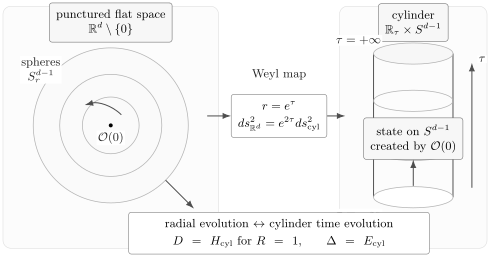
Radial quantization replaces the radius on by Euclidean cylinder time . Dilatations become translations in , so a scaling dimension becomes a cylinder energy. This is why the CFT state-operator correspondence is the boundary version of the global AdS energy spectrum.
Why this matters for holography
Section titled “Why this matters for holography”The previous page explained conformal symmetry as a spacetime symmetry. This page explains the corresponding Hilbert-space picture.
The conceptual leap is:
This is the state-operator correspondence. It is one of the central facts that makes CFT much more rigid than a generic QFT.
In AdS/CFT, it becomes the statement that a boundary operator creates a state in the bulk. For a scalar single-trace operator of dimension , the corresponding bulk field has normal modes in global AdS whose lowest energy is . Later we will derive the mass-dimension relation
but radial quantization already explains why should be read as an energy.
The dictionary preview is:
where is the AdS radius. In units , the dimension is the energy.
Flat space as a cylinder
Section titled “Flat space as a cylinder”Begin with Euclidean flat space in polar coordinates:
Now set
Then
The metric inside the parentheses is the metric on the Euclidean cylinder:
Therefore
A conformal field theory is designed to tolerate Weyl rescalings of the metric. Up to possible Weyl-anomaly terms on curved backgrounds, the physics on can therefore be described on the cylinder .
The origin is not a point on the cylinder. It is pushed to
Infinity in flat space is pushed to
So a local insertion near the origin becomes an initial condition in the far past of cylinder time.
What is being quantized?
Section titled “What is being quantized?”In ordinary equal-time quantization, one chooses slices of constant time. In radial quantization, one chooses spheres of constant radius:
Evolution from one sphere to another is generated by scale transformations. If the radius changes by
then the cylinder time shifts by
Thus dilatations in flat space become translations along the cylinder.
A useful way to remember the construction is:
Let denote the dilatation generator. In radial quantization, acts as the Euclidean Hamiltonian on the cylinder. More precisely, for a cylinder of radius ,
If we set , then
This equality is one of the most useful pieces of CFT technology for AdS/CFT.
Primary operators become energy eigenstates
Section titled “Primary operators become energy eigenstates”A scalar primary operator of scaling dimension transforms under dilatations as
or equivalently, at the origin, it has dilatation eigenvalue .
In radial quantization, inserting at the origin creates a state on a surrounding sphere:
This state is an eigenstate of the cylinder Hamiltonian:
For a cylinder of radius , this becomes
This is the state-operator correspondence in its most compact form:
The descendants of a primary are obtained by acting with translations on the primary operator. Since translations raise the scaling dimension by one unit, descendant states have energies
with angular-momentum structure determined by how the translation generators are combined.
For a scalar primary, one can organize descendants into representations of the rotation group on . The angular momentum on the sphere is the boundary counterpart of orbital angular momentum in global AdS.
The path-integral picture of a state
Section titled “The path-integral picture of a state”The formula is compact, but the path-integral picture is often clearer.
Take a ball in Euclidean space whose boundary is a sphere . Perform the Euclidean path integral over fields inside the ball, with an operator insertion at the origin. The path integral produces a wavefunctional of the boundary values of the fields on . That wavefunctional is a state.
Schematically,
The state lives on the sphere. Different local operators create different states.
The vacuum state is created by the path integral over the ball with no operator insertion. A primary operator creates a lowest-energy state in a conformal multiplet; its descendants are obtained by acting with momentum generators.
This construction is the CFT version of something very familiar in ordinary quantum mechanics: specifying data in the Euclidean past prepares a state, then Euclidean time evolution transports it forward.
Cylinder correlators from flat-space correlators
Section titled “Cylinder correlators from flat-space correlators”The Weyl map also tells us how correlation functions on the cylinder are related to correlation functions on flat space.
For a scalar primary of dimension , define the cylinder operator by
Assume the flat-space two-point function is normalized as
Using
we obtain
where
For large Euclidean time separation,
the correlator behaves as
This is exactly what one expects from Euclidean time evolution by a Hamiltonian whose lowest state in this channel has energy .
So the exponential falloff of cylinder correlators is another way to see the state-operator correspondence:
Radial ordering
Section titled “Radial ordering”In ordinary quantum field theory, time-ordered products order operators by time. In radial quantization, the natural ordering is by radius.
The radial-ordered product is denoted by
For two bosonic operators,
On the cylinder, this is ordinary Euclidean time ordering in .
This is why radial quantization is especially natural for CFT: the radial variable is not just a coordinate; it is the time with respect to which the conformal Hilbert space is built.
The OPE as a Hilbert-space expansion
Section titled “The OPE as a Hilbert-space expansion”The operator product expansion says that, as two operators approach one another, their product can be expanded in local operators:
In a generic QFT, one often treats such expansions as short-distance asymptotic statements. In a unitary CFT, radial quantization gives a sharper interpretation.
Place inside a sphere of radius with
The product creates some state on that sphere. The Hilbert space on the sphere has a basis of states created by primary operators and their descendants. Expanding the state in that basis gives the OPE.
The OPE converges inside correlation functions when the two operators being expanded are separated from the other insertions by a sphere. In practice, this is why conformal block decompositions are honest expansions in appropriate regions, not merely formal mnemonics.
For holography, this matters because OPE data become bulk interaction data. The operator algebra of the boundary theory is the algebraic shadow of bulk dynamics.
Reflection positivity and adjoints
Section titled “Reflection positivity and adjoints”Radial quantization also gives the natural notion of Hermitian conjugation in Euclidean CFT.
In ordinary time quantization, Hermitian conjugation is tied to time reflection. In radial quantization, time reflection on the cylinder is
In flat-space coordinates, this is inversion through the unit sphere:
For a scalar primary, the adjoint operation is therefore tied to inversion. Schematically,
for a Hermitian scalar primary, up to spin and internal-symmetry refinements.
This is the origin of reflection positivity constraints in Euclidean CFT. In Lorentzian language, these constraints become unitarity constraints. For example, unitary CFTs impose lower bounds on allowed scaling dimensions. These bounds will matter later because impossible CFT dimensions would correspond to inconsistent bulk masses or spins.
From the cylinder to global AdS
Section titled “From the cylinder to global AdS”Global AdS has a natural time coordinate whose constant-time slices are balls. A convenient form of the global metric is
At large ,
After the usual conformal rescaling at the boundary, the boundary metric is
Thus global AdS is naturally dual to the CFT quantized on the Lorentzian cylinder
The bulk energy conjugate to global time matches the cylinder Hamiltonian of the CFT. Therefore a primary operator of dimension creates a bulk state of energy
For a free scalar field in global AdS, the normal-mode spectrum is
This spectrum looks exactly like a primary state plus descendants. The primary corresponds to the lowest mode. Angular momentum on and radial excitations in AdS generate the higher states in the conformal multiplet.
This is one of the cleanest early checks that the CFT Hilbert-space organization is the right language for global AdS.
Euclidean cylinder versus Lorentzian cylinder
Section titled “Euclidean cylinder versus Lorentzian cylinder”So far the cylinder time came from the Euclidean radius:
This gives the Euclidean cylinder metric
To obtain the Lorentzian cylinder, analytically continue
Then
The Euclidean cylinder is the natural setting for radial quantization and reflection positivity. The Lorentzian cylinder is the natural setting for the real-time Hilbert space and for matching to global AdS time.
One should not confuse this cylinder with the thermal cylinder. A thermal QFT has Euclidean time periodically identified:
Radial quantization uses an infinite cylinder, not a periodic one. Temperature enters only if we deliberately identify Euclidean time.
What happens to the vacuum energy?
Section titled “What happens to the vacuum energy?”There is a small convention trap here.
The state-operator correspondence says that the identity operator creates the vacuum state, and in radial quantization we usually normalize
Thus the identity has dimension
However, when a CFT is placed on a curved cylinder , the expectation value of the stress tensor may include a Casimir-energy contribution, especially in even boundary dimensions or in two-dimensional CFTs with nonzero central charge.
This does not invalidate the state-operator correspondence. It means one must distinguish:
from
In most AdS/CFT dictionary statements, is the energy of the excitation above the vacuum in units of the cylinder radius. Holographic stress-tensor computations may also keep track of the vacuum Casimir energy, depending on the subtraction scheme and boundary geometry.
Dictionary checkpoint
Section titled “Dictionary checkpoint”The central translations from this page are:
| CFT statement | Bulk/global AdS interpretation |
|---|---|
| Weyl maps to | global AdS has boundary |
| dilatation generator | global Hamiltonian |
| primary operator | lowest-energy single-particle bulk mode, when is single-trace |
| scaling dimension | global energy |
| descendants of | higher modes in the same conformal multiplet |
| OPE expansion | Hilbert-space expansion on a sphere |
| radial ordering | Euclidean time ordering on the cylinder |
The most important takeaway is:
and the global AdS boundary is exactly the cylinder on which those energies live.
Common confusions
Section titled “Common confusions”“Radial time is physical time in flat space.”
Section titled ““Radial time is physical time in flat space.””No. In Euclidean flat space, radial time is a quantization device. It becomes the natural time on the cylinder after the conformal map. Lorentzian physical time appears after analytic continuation to the Lorentzian cylinder.
“The origin is a boundary of the theory.”
Section titled ““The origin is a boundary of the theory.””No. The origin is an ordinary point of flat space. Under the map , it is sent to . An operator inserted at the origin prepares a state in the far Euclidean past of the cylinder.
“Every operator creates an independent particle in the bulk.”
Section titled ““Every operator creates an independent particle in the bulk.””No. In holographic large- theories, single-trace primary operators are the ones that usually correspond to single-particle bulk fields. Multi-trace operators correspond to multiparticle states, and generic operators are linear combinations of many components.
“The cylinder automatically means finite temperature.”
Section titled ““The cylinder automatically means finite temperature.””No. The radial-quantization cylinder has infinite Euclidean time. Finite temperature requires a periodic Euclidean time circle of circumference .
“The Weyl anomaly destroys the map.”
Section titled ““The Weyl anomaly destroys the map.””No. Weyl anomalies affect the partition function and stress tensor on curved backgrounds, and they can produce Casimir terms. They do not erase the local state-operator correspondence or the relation between scaling dimensions and cylinder energies.
“The OPE is just a formal small-distance expansion.”
Section titled ““The OPE is just a formal small-distance expansion.””In a unitary CFT, radial quantization gives the OPE a Hilbert-space interpretation. In appropriate regions inside correlation functions, the expansion is convergent. This is one of the reasons CFT is so powerful.
Exercises
Section titled “Exercises”Exercise 1: Derive the cylinder metric
Section titled “Exercise 1: Derive the cylinder metric”Start from
Set . Show that flat space is Weyl equivalent to the cylinder.
Solution
Since
we have
Therefore
The factor is a Weyl factor. Hence is conformally equivalent to .
Exercise 2: Derive the scalar two-point function on the cylinder
Section titled “Exercise 2: Derive the scalar two-point function on the cylinder”Let
on flat space, and define
Show that
Solution
Write
Then
Factor out :
Using
we get
Therefore
Exercise 3: Why does a scaling dimension become an energy?
Section titled “Exercise 3: Why does a scaling dimension become an energy?”Suppose a primary operator has scaling dimension . Explain why the state has cylinder energy for a unit-radius cylinder.
Solution
In radial quantization, Euclidean time translation on the cylinder is the same as scale transformation in flat space. The generator of scale transformations is the dilatation operator . For a unit-radius cylinder,
A primary operator of dimension creates a state with dilatation eigenvalue :
Hence
So the scaling dimension is the cylinder energy.
Exercise 4: Restore the cylinder radius
Section titled “Exercise 4: Restore the cylinder radius”The page mostly used a unit-radius sphere. Suppose instead the cylinder is
where the sphere has radius . What is the energy of the state created by a primary of dimension ?
Solution
The cylinder Hamiltonian has dimensions of inverse length. The dimensionless dilatation generator is related to the physical Hamiltonian by
If
then
Thus
For AdS/CFT on global AdS with boundary sphere radius , this is often written as
Exercise 5: Match descendants to global AdS excitations
Section titled “Exercise 5: Match descendants to global AdS excitations”A scalar primary has descendants with dimensions schematically
A scalar field in global AdS has normal-mode energies
Explain qualitatively why these statements are compatible.
Solution
The descendants of a scalar primary are obtained by acting with translation generators . Each raises the dimension by one. Multiple translation generators can be decomposed into irreducible representations of the rotation group on the sphere.
For a scalar conformal multiplet, the descendants organize into angular momentum on plus additional radial excitations. The global AdS scalar spectrum packages these descendants as
The lowest state has and , giving . Higher values of and correspond to descendants in the same conformal multiplet, organized by angular momentum and radial excitation number.
Further reading
Section titled “Further reading”- Slava Rychkov, EPFL Lectures on Conformal Field Theory in Dimensions. Especially useful for radial quantization, the OPE, and the higher-dimensional CFT viewpoint.
- David Simmons-Duffin, TASI Lectures on the Conformal Bootstrap. A clear modern treatment of radial quantization, reflection positivity, and the bootstrap perspective.
- Duccio Pappadopulo, Slava Rychkov, Johnny Espin, and Riccardo Rattazzi, OPE Convergence in Conformal Field Theory. A focused reference on why OPE and conformal-block expansions converge in appropriate regions.
- Philippe Di Francesco, Pierre Mathieu, and David Sénéchal, Conformal Field Theory. The standard textbook for two-dimensional CFT.
- Edward Witten, Anti de Sitter Space and Holography. A foundational AdS/CFT reference emphasizing how CFT data appear in AdS.
- Ofer Aharony, Steven S. Gubser, Juan Maldacena, Hirosi Ooguri, and Yaron Oz, Large Field Theories, String Theory and Gravity. The classic review of the correspondence and its regimes.