
The Ryu–Takayanagi Formula
The Ryu–Takayanagi formula is one of the cleanest bridges between geometry and quantum information in AdS/CFT. It says that, in a static classical bulk dual, the entanglement entropy of a boundary spatial region is computed by the area of a bulk minimal surface anchored on the boundary of :
At first sight this looks like a pleasing analogy with the Bekenstein–Hawking entropy formula. In fact it is much more than an analogy. The formula turns entanglement into a geometric observable, makes precise a subregion version of holography, and provides the classical ancestor of the quantum extremal surface and island prescriptions.
The goal of this page is to understand exactly what the RT formula says, how it works in its simplest example, and why it is the right starting point for modern black hole information.
Guiding question
Section titled “Guiding question”Why should the entropy of a quantum field theory region be measured by the area of a surface in one higher-dimensional spacetime?
In an ordinary local quantum field theory, the entanglement entropy of a spatial region is
This definition is simple, but in an interacting strongly coupled theory it is usually very hard to compute. The RT formula says that for a CFT state with a weakly curved, static Einstein-gravity dual, the leading large- entropy is a classical geometric quantity:
The surface must satisfy three conditions:
- is a codimension-two surface in the bulk.
- is anchored on the entangling surface of the boundary region:
- is homologous to , meaning that there exists a bulk spatial region such that with the appropriate orientation.
The word “minimal” is important. On a static time-reflection-symmetric slice, one first considers surfaces on that bulk time slice satisfying the anchoring and homology conditions, and then chooses the one with least area.
A precise notation is
where denotes the homology condition.
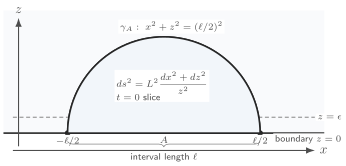
On a static AdS time slice, the RT surface for a single boundary interval is a bulk geodesic anchored at . The UV divergence of the CFT entropy appears geometrically as the infinite length of the geodesic near the asymptotic boundary, regulated by the cutoff .
The formula is often introduced as if it were merely a computational trick. That misses the point. The formula says that a boundary density matrix knows about a bulk surface. Conversely, a bulk area knows about how many boundary quantum degrees of freedom are entangled across . The rest of the subject is a long exploration of this statement.
The static setting
Section titled “The static setting”The original RT prescription applies most directly to static states, where the bulk has a preferred time-reflection-symmetric Cauchy slice. Suppose the boundary theory lives on a spatial slice and is a spatial subregion. The bulk dual has a corresponding spatial slice with asymptotic boundary .
The surface has codimension two in the full Lorentzian bulk and codimension one in the spatial slice . For a -dimensional boundary CFT spacetime, is a spatial region of dimension , its entangling surface has dimension , and the RT surface also has dimension in the bulk spatial slice.
For example:
- In AdS/CFT, is an interval and is a geodesic curve.
- In AdS/CFT, is a two-dimensional spatial region and is a two-dimensional minimal surface.
- In AdS/CFT, is a three-dimensional spatial region and is a three-dimensional minimal hypersurface.
The leading scaling is also exactly what holography predicts. Since
the area term is of order the number of boundary degrees of freedom. In a large- gauge theory, this is typically order for adjoint matter.
The RT formula is therefore a leading semiclassical statement:
The correction is the bulk entanglement entropy across the RT surface. That correction is the subject of the FLM page, and it is the first step toward quantum extremal surfaces.
Why the homology constraint matters
Section titled “Why the homology constraint matters”The anchoring condition is not enough. The homology constraint requires and together to bound a bulk region :
This condition has several important roles.
First, it ensures that for a pure boundary state. If the whole boundary state is pure, then and its complement must have equal entropy. In a simply connected static bulk, the same minimal surface separates from , so RT naturally gives
Second, in geometries with horizons or nontrivial topology, the homology constraint chooses the physically correct surface. A surface that is locally smaller but not homologous to is not allowed. This matters, for example, in thermal states dual to AdS black holes. The entropy of a sufficiently large boundary region can involve a surface plus a horizon component. That horizon component is not an accident; it is how the RT prescription knows about the thermal entropy of the state.
Third, the homology region is the precursor of the entanglement wedge. At leading classical order, the entanglement wedge of is roughly the bulk domain of dependence of :
Later pages will refine this statement using HRT surfaces, quantum extremal surfaces, and operator-algebra quantum error correction. But already at the RT level, the homology region tells us that the entropy formula is secretly a statement about a bulk subregion dual to the boundary density matrix .
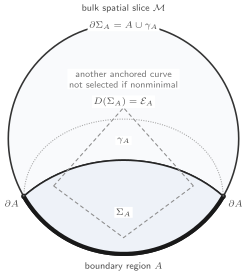
The RT surface is not just any minimal surface ending on . It must be homologous to , so that bounds a bulk region . The domain of dependence of is the classical entanglement wedge of .
A common mistake is to think that is the dual of . It is better to say that the entanglement wedge is the candidate bulk dual of the reduced density matrix , while is the surface whose area contributes to the entropy of that density matrix.
The AdS/CFT interval calculation
Section titled “The AdS3_33/CFT2_22 interval calculation”The simplest and most important check is a single interval in the vacuum of a two-dimensional CFT. The answer in the CFT is universal:
where is the interval length, is a UV cutoff, and is the central charge.
Let us reproduce this from geometry.
Take Poincare AdS:
On the static slice , the metric is the hyperbolic plane
Choose the interval
on the boundary . The geodesic anchored at the endpoints is a semicircle:
Introduce the parameter
with a cutoff . Then
The cutoff condition is
The regulated geodesic length is
Using
we find
RT gives
Using the Brown–Henneaux relation
we obtain
which matches the universal CFT result.
This calculation is worth internalizing. The CFT UV divergence comes from the geodesic approaching the AdS boundary. Entanglement at short distances near becomes area near the asymptotic boundary. The finite part depends on the global geometry and therefore on the state.
Area law, divergence, and renormalization
Section titled “Area law, divergence, and renormalization”In a local QFT in more than two spacetime dimensions, the entanglement entropy across a smooth entangling surface has a leading area-law divergence:
The coefficient is not universal. It depends on the UV regulator and microscopic theory. In holography this divergence is geometrized: the RT surface stretches to the asymptotic boundary, and its area diverges as the cutoff surface is moved outward.
For an asymptotically AdS metric in Fefferman–Graham form,
the cutoff is the bulk version of the boundary UV cutoff. The minimal surface has an asymptotic area divergence of the same structure as the QFT entanglement divergence.
This is a powerful check but also a warning. The entanglement entropy of a continuum subregion is not a finite observable by itself. Universal quantities are obtained from cutoff-independent coefficients, mutual informations, relative entropies, shape derivatives, or renormalized entanglement entropies.
For black hole information, the most important lesson is that area divergences and geometric entropy are inseparable in gravity. In the quantum-corrected formula, the divergence of the bulk entanglement entropy is absorbed into the renormalization of gravitational couplings, including . This is why the generalized entropy
is the natural finite object.
Thermal states and horizons
Section titled “Thermal states and horizons”A thermal state of a holographic CFT is dual, at sufficiently high temperature, to an AdS black hole. RT then relates ordinary thermal entropy to horizon area.
Suppose the boundary region is the entire boundary component. If the boundary state is thermal rather than pure, the entropy is the thermal entropy:
In the bulk, the corresponding RT surface is the black hole horizon. Therefore
which is precisely the Bekenstein–Hawking entropy.
This is one of the conceptual strengths of the RT formula. It unifies:
as two cases of the same geometric rule.
There is a subtlety. For a CFT on a single connected boundary in a thermal mixed state, one often computes the entropy using a Euclidean black hole saddle or by purifying the state as a thermofield double. In the two-sided eternal black hole, the entropy of one entire boundary is computed by the bifurcation horizon. For a pure state of both boundaries together,
This simple example foreshadows entanglement wedge reconstruction. The two exterior CFTs are entangled, and the horizon area measures that entanglement at leading order.
Mutual information and phase transitions
Section titled “Mutual information and phase transitions”The RT prescription is especially revealing for mutual information. For two disjoint boundary regions and , the mutual information is
In any quantum theory,
In holography, is computed by the minimal surface homologous to . There may be multiple candidate topologies. For two intervals in a holographic CFT, the two basic candidates are:
- a disconnected surface, approximately ;
- a connected surface that links the two intervals through the bulk.
The RT prescription chooses the smaller area. Therefore
At large separation, the disconnected surface dominates:
at leading order in . At small separation, the connected surface can dominate and the mutual information becomes order .
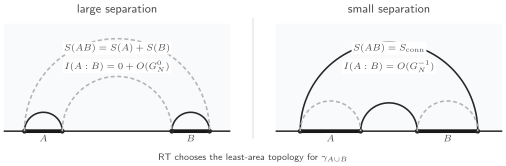
For two separated boundary regions, the RT surface for can change topology. At large separation the disconnected surface dominates and the leading large- mutual information vanishes. At smaller separation the connected surface dominates, giving order mutual information.
This sharp transition is a large- artifact. At finite , mutual information is not exactly zero at large separation; it is merely order or smaller, while the leading RT contribution is order .
These surface transitions are the ancestors of Page transitions. In both cases, an entropy is computed by minimizing over competing saddles:
A Page transition is not mysterious from the RT viewpoint. It is another dominance transition between candidate generalized-entropy saddles, except that the relevant surfaces are quantum extremal surfaces rather than purely classical minimal surfaces.
Entropy inequalities from geometry
Section titled “Entropy inequalities from geometry”The RT formula makes some quantum entropy inequalities look almost obvious. The most famous example is strong subadditivity:
In ordinary quantum information, strong subadditivity is a deep theorem. In the static RT setting, it has a geometric proof. One draws the minimal surfaces for and , cuts them at their intersections, and reglues the pieces to form candidate surfaces for and . Since the actual RT surfaces for and are minimal, their total area cannot exceed the area of these candidate reglued surfaces. Dividing by gives the inequality.
The same geometric logic gives subadditivity:
and, at leading classical order, the holographic entropy cone satisfies additional inequalities not obeyed by arbitrary quantum states. A particularly important one is monogamy of mutual information:
or equivalently
Generic quantum states do not obey this inequality. Classical holographic states do, at leading order. This is a strong constraint on the kind of entanglement structure that admits a simple geometric dual.
One should not overinterpret this. Once bulk quantum entropy is included, the entropy vector is no longer purely given by classical areas, and subleading corrections need not obey all leading-order holographic inequalities in the same form. The classical inequalities are best understood as statements about the leading large- geometric component of entropy.
Replica logic and the origin of area
Section titled “Replica logic and the origin of area”The RT formula was originally proposed as a prescription and checked in many examples. A deeper derivation comes from the gravitational replica method.
In quantum field theory, the entropy is obtained from Renyi entropies:
The quantity is computed by gluing copies of the path integral cyclically along region . In a holographic theory, this replicated boundary path integral is evaluated by a bulk gravitational saddle whose boundary is the replicated geometry.
The key idea of the Lewkowycz–Maldacena derivation is that, near , the bulk replica symmetry has a fixed locus. In the quotient geometry, this fixed locus behaves like a small conical defect. Requiring regularity of the full replicated geometry implies that the fixed locus is an extremal surface. Evaluating the gravitational action near produces precisely an area contribution:
This derivation explains why the coefficient is the same as in black hole entropy. Both black hole entropy and RT entropy arise from the response of the gravitational action to a conical defect.
For the present page, the important moral is not the full technical derivation. It is this:
This will reappear in the replica-wormhole story. Replica wormholes are not a random extra ingredient added to black hole information; they are a later, more subtle use of the same gravitational replica logic.
RT and black hole information
Section titled “RT and black hole information”The RT formula enters black hole information in at least five ways.
First, it makes the Bekenstein–Hawking formula part of a broader entanglement formula. Horizon area is not an isolated thermodynamic miracle; it is one instance of a rule that computes boundary entropies by bulk surfaces.
Second, RT introduces the minimization principle that later becomes central to Page curves. A holographic entropy can change behavior when the dominant surface changes. The Page transition in island calculations is a quantum version of this familiar RT phenomenon.
Third, RT leads to entanglement wedges. The homology region suggests that the reduced density matrix is dual not merely to the surface , but to a bulk region. This is the seed of entanglement wedge reconstruction.
Fourth, RT already hints at quantum error correction. The same bulk point can lie in the entanglement wedge of different boundary regions, so bulk operators may have multiple boundary reconstructions. This redundancy is not a bug of AdS/CFT; it is the mechanism by which bulk locality emerges from boundary quantum information.
Fifth, RT is the classical limit of the quantum extremal surface prescription:
When is neglected and the state is static, this reduces to RT. When the boundary region is the Hawking radiation and is allowed to surround an island, this becomes the island formula.
So the RT formula is not just an early chapter in holographic entropy. It is the conceptual prototype of the modern resolution of the Page-curve problem.
What RT does not say
Section titled “What RT does not say”Because the formula is so beautiful, it is easy to say too much. Here are several common pitfalls.
The RT surface is not a physical membrane
Section titled “The RT surface is not a physical membrane”The surface is not a material object in the bulk. It is a geometric saddle that computes an entropy. In some contexts cosmic branes appear in replica derivations of Renyi entropies, but the RT surface should not be imagined as a literal membrane sitting in spacetime.
RT is not the full entropy formula at finite
Section titled “RT is not the full entropy formula at finite NNN”The classical RT formula gives the leading area term. The corrected formula includes bulk entanglement:
At finite , there are further perturbative and nonperturbative corrections. These corrections are precisely what one must understand in black hole information.
The minimal surface is not always on a preferred time slice
Section titled “The minimal surface is not always on a preferred time slice”RT is a static prescription. In time-dependent spacetimes one must use the Hubeny–Rangamani–Takayanagi prescription, where the surface is extremal in the Lorentzian bulk rather than minimal on a static slice.
Entanglement entropy is not always a direct measure of spatial connectivity
Section titled “Entanglement entropy is not always a direct measure of spatial connectivity”Large mutual information often correlates with connected entanglement wedges, and vanishing leading mutual information often correlates with disconnected wedges. But entanglement entropy is a coarse diagnostic. Bulk geometry, operator reconstruction, and causal propagation involve more structure than a single entropy number.
The homology constraint is not optional
Section titled “The homology constraint is not optional”Dropping homology gives wrong answers in black hole geometries and destroys the connection between entropy and a bulk region. The homology condition is part of the physical content of the formula.
Summary
Section titled “Summary”The RT formula states that for a static holographic state with a classical Einstein-gravity dual,
where is the minimal codimension-two bulk surface anchored on and homologous to .
Its core lessons are:
- boundary entanglement is geometrized as bulk area;
- the UV divergence of entanglement entropy comes from the asymptotic region of AdS;
- the homology region foreshadows the entanglement wedge;
- competing minimal surfaces produce entropy phase transitions;
- black hole entropy and subregion entanglement entropy are part of the same geometric framework;
- RT is the classical limit of the quantum extremal surface and island formulas.
The formula is simple enough to fit on one line, but it reorganizes the whole subject. Once one accepts that entropy is computed by extremizing an area functional, it becomes natural to ask what happens when the area is replaced by generalized entropy. That question leads directly to FLM, QES, and islands.
Exercises
Section titled “Exercises”Exercise 1. Geodesic length for a CFT interval
Section titled “Exercise 1. Geodesic length for a CFT2_22 interval”Starting from the Poincare AdS metric on a constant-time slice,
compute the regulated length of the geodesic anchored on an interval of length and show that RT gives
Solution
Place the interval endpoints at
The geodesic is the semicircle
Parametrize it by
Then
so the line element is
The cutoff gives
The full geodesic length is twice the integral from to :
Using
we obtain
Therefore
Using Brown–Henneaux,
we find
Exercise 2. Why the homology constraint gives
Section titled “Exercise 2. Why the homology constraint gives S(A)=S(Aˉ)S(A)=S(\bar A)S(A)=S(Aˉ)”Assume the boundary state is pure and the bulk time slice has no horizon or additional boundary. Explain geometrically why the RT prescription gives
Solution
The entangling surface of is the same as the entangling surface of its complement:
A surface anchored on and homologous to separates the bulk spatial slice into two regions, one ending on and the other ending on . The same geometric surface can therefore be viewed as the RT surface for :
Since the area is the same,
This matches the quantum-information fact that the two subsystems of a pure bipartite state have equal entanglement entropy.
Exercise 3. Mutual information phase transition for two intervals
Section titled “Exercise 3. Mutual information phase transition for two intervals”For two disjoint intervals and in the vacuum of a holographic CFT, with , the two candidate RT contributions for are schematically
and
where for . Determine when the connected surface dominates.
Solution
The connected surface dominates when
Using the expressions in the problem, this becomes
Equivalently,
It is often more useful to express this in terms of the conformal cross-ratio
For ordered points on a line,
Thus the connected surface dominates when
or
Equivalently, when the separation is large compared with the interval sizes, the disconnected surface dominates and the leading mutual information vanishes; when the separation is small enough, the connected surface dominates and the mutual information is order .
Exercise 4. Strong subadditivity from cutting and gluing
Section titled “Exercise 4. Strong subadditivity from cutting and gluing”Give the geometric idea behind the RT proof of strong subadditivity:
Solution
Let and be the minimal RT surfaces for and . Draw them on the same static bulk slice. Where the corresponding homology regions overlap, cut the two surfaces into pieces and reglue those pieces so that they form candidate surfaces for and .
The total area of the reglued candidate surfaces equals the total area of the original surfaces:
But the actual RT surfaces for and are minimal, so
and
Adding these inequalities and dividing by gives strong subadditivity.
Exercise 5. Thermal entropy from RT
Section titled “Exercise 5. Thermal entropy from RT”Explain why the entropy of one side of the thermofield double state is computed by the horizon area of the two-sided AdS black hole.
Solution
The thermofield double state is pure on the product Hilbert space
but the reduced density matrix on one side is thermal:
Therefore the entropy is the thermal entropy of the right CFT.
In the two-sided AdS black hole, the RT surface homologous to the entire right boundary is the bifurcation horizon. The homology region stretches from the right boundary to the horizon. Thus RT gives
which agrees with the Bekenstein–Hawking entropy of the black hole.
Exercise 6. RT as the classical limit of QES
Section titled “Exercise 6. RT as the classical limit of QES”The quantum extremal surface prescription has the schematic form
Explain why RT is recovered in the classical static limit.
Solution
In the classical large- limit, the area term scales as
while the bulk matter entropy is usually
Therefore the leading saddle is determined by extremizing and minimizing the area term alone. In a static time-reflection-symmetric geometry, the relevant extremal surface lies on the static slice and becomes a minimal surface there. Thus the quantum extremal surface prescription reduces to
with the usual anchoring and homology conditions. This is the RT formula.
Further reading
Section titled “Further reading”- S. Ryu and T. Takayanagi, “Holographic Derivation of Entanglement Entropy from AdS/CFT,” Physical Review Letters 96 (2006), 181602. arXiv:hep-th/0603001.
- S. Ryu and T. Takayanagi, “Aspects of Holographic Entanglement Entropy,” Journal of High Energy Physics 08 (2006), 045. arXiv:hep-th/0605073.
- M. Headrick and T. Takayanagi, “A Holographic Proof of the Strong Subadditivity of Entanglement Entropy,” Physical Review D 76 (2007), 106013. arXiv:0704.3719.
- A. Lewkowycz and J. Maldacena, “Generalized Gravitational Entropy,” Journal of High Energy Physics 08 (2013), 090. arXiv:1304.4926.
- T. Nishioka, S. Ryu, and T. Takayanagi, “Holographic Entanglement Entropy: An Overview,” Journal of Physics A 42 (2009), 504008. arXiv:0905.0932.
- M. Rangamani and T. Takayanagi, Holographic Entanglement Entropy, Lecture Notes in Physics 931 (2017). arXiv:1609.01287.
The RT formula is static. Real black holes evaporate, collapse, thermalize, and evolve in time. The next page introduces the covariant Hubeny–Rangamani–Takayanagi prescription, where minimal surfaces on a time slice are replaced by extremal surfaces in Lorentzian spacetime.