
Retarded Green Functions and Horizons
The previous page treated the black brane as an equilibrium thermodynamic saddle. This page turns the same geometry into a real-time measuring device. The basic question is:
If we perturb a strongly coupled thermal state by a small source, how does it respond?
In field theory the answer is a retarded Green function. In the bulk the answer is a wave equation with two pieces of boundary data: a prescribed source near the AdS boundary and an infalling condition at the future horizon. The horizon is not just a place where entropy sits. It is the object that makes the real-time response dissipative.
Throughout this page, is the number of boundary spatial dimensions and
is the boundary spacetime dimension. The bulk has dimension . We use mostly-plus Lorentzian signature and units
The physical problem
Section titled “The physical problem”Let be a boundary operator. Add a weak time-dependent source :
To first order in , the response of the thermal state is
where the retarded Green function is
With Fourier convention
linear response becomes multiplication:
This is the quantity that transport, spectroscopy, and relaxation are built from. Conductivity is a current-current retarded correlator. Viscosity is a stress-tensor retarded correlator. Fermion spectral functions are retarded correlators of fermionic operators. The holographic recipe below is therefore not a side calculation; it is the real-time core of holographic quantum matter.
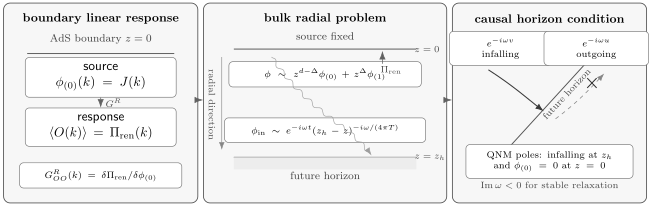
Real-time holography is a Lorentzian boundary-value problem. The AdS boundary supplies source and response data; the future horizon supplies the causal condition. Infalling regularity selects , while source-free infalling solutions give quasinormal-mode poles in the lower half of the complex plane.
Why Euclidean continuation is not enough
Section titled “Why Euclidean continuation is not enough”Equilibrium thermodynamics was Euclidean: impose smoothness of the cigar, evaluate , and compute . Real-time response is more delicate.
Euclidean correlators compute time-ordered data at imaginary time. Retarded correlators know about causality:
In a theory with a discrete spectrum, one can often reconstruct real-time correlators by analytic continuation from Euclidean frequencies. But in an interacting thermal quantum field theory, especially one with branch cuts, transport peaks, and hydrodynamic poles, the continuation is subtle. Holography handles this by imposing the causal condition directly in Lorentzian signature.
The rule is:
The advanced correlator would instead be associated with the opposite causal condition. The difference is not a sign convention. It is the difference between an absorber and an emitter.
The scalar prototype
Section titled “The scalar prototype”The cleanest example is a scalar operator dual to a bulk scalar field . Take the quadratic bulk action
The equation of motion is
In the neutral black-brane background
with
take a Fourier mode
The scalar equation becomes a radial ordinary differential equation:
For homogeneous backgrounds this is an ODE. For lattices, disorder, or spatially modulated phases it becomes a coupled PDE problem. The idea is unchanged: solve with boundary data in the UV and causal data in the IR.
Near-boundary data: source and response
Section titled “Near-boundary data: source and response”Near the AdS boundary, , the blackening function approaches one and the scalar behaves as in pure AdS. The two independent falloffs are
where
In standard quantization, is the source for and is proportional to the expectation value:
More precisely, after holographic renormalization,
where is the renormalized canonical momentum conjugate to the radial evolution of . For a simple scalar in standard quantization and away from logarithmic special cases, the nonlocal part is proportional to :
The local contact terms depend on the renormalization scheme. The pole structure and dissipative imaginary part do not.
The horizon condition
Section titled “The horizon condition”The black brane horizon is at
Near the horizon, define
Then
The radial wave equation near the horizon reduces to a two-dimensional wave equation in the part of the geometry. Introduce a tortoise coordinate such that near the horizon
Since , this gives . The two local wave behaviors are
In terms of , these are
The infalling solution is regular as a function of the ingoing Eddington-Finkelstein coordinate
Indeed,
The outgoing solution is instead naturally associated with the opposite null coordinate and is not regular on the future horizon in the retarded problem.
This is the physical content of the prescription. A retarded perturbation may be absorbed by the horizon, but the horizon is not allowed to send out a signal before it has been perturbed.
The Son-Starinets prescription
Section titled “The Son-Starinets prescription”For a classical bulk fluctuation dual to a bosonic operator, the real-time prescription is:
- Solve the linearized bulk equation in Lorentzian signature.
- Near the horizon, impose the infalling condition.
- Near the AdS boundary, identify source and response coefficients.
- Renormalize the on-shell action or canonical momentum.
- Differentiate the response with respect to the source.
Schematically,
for a solution normalized by the boundary source .
A more invariant statement is
For a linear equation, if one solves with , then this functional derivative is just the response coefficient.
Canonical radial momentum
Section titled “Canonical radial momentum”The bulk action evaluated on a solution reduces to a boundary term. Vary the scalar action:
where, up to the outward-normal sign convention,
The bare canonical momentum diverges near the boundary. Holographic renormalization adds local counterterms and defines
The one-point function is
The two-point function is the linearized map from source to renormalized momentum:
This canonical-momentum form is extremely useful. It generalizes directly to gauge fields and metric perturbations, where the response is a radial electric flux or a radial gravitational momentum.
Spectral density and absorption
Section titled “Spectral density and absorption”The spectral density is
For , positivity of the spectral density is a statement that the perturbation can inject positive energy into the thermal state. In the bulk, the same fact is horizon absorption.
For a real-frequency scalar solution, define the radial flux
The scalar equation implies
for real and real . Thus the flux evaluated near the boundary equals the flux entering the horizon. The imaginary part of the boundary Green function is fixed by this conserved flux:
The proportionality depends on normalization conventions, but the lesson is universal: dissipative spectral weight in the boundary theory is the classical absorption of a wave by the horizon.
This is one of the sharpest places where the geometry earns its keep. A horizon turns a unitary microscopic theory into an effectively open system for exterior classical fields. Boundary dissipation is not added by hand; it is encoded in regularity at the future horizon.
Quasinormal modes are poles
Section titled “Quasinormal modes are poles”A quasinormal mode is a bulk fluctuation satisfying two homogeneous conditions:
For a scalar, start from the infalling solution and expand near the boundary:
The retarded correlator has the schematic form
Therefore poles occur when
while remains nonzero. These are precisely source-free infalling excitations.
Because the retarded Green function is causal, it is analytic in the upper half of the complex frequency plane:
Stable equilibrium states have quasinormal frequencies in the lower half-plane:
A perturbation then decays like
The imaginary part sets the relaxation time.
At nonzero temperature, holographic retarded correlators often organize themselves as sums over such poles:
The word “often” is doing real work: at zero temperature, poles may condense into branch cuts, and at finite the exact analytic structure can be more intricate. But in the classical black-brane limit, quasinormal modes are the practical language of relaxation.
QNMs are not automatically quasiparticles
Section titled “QNMs are not automatically quasiparticles”A quasiparticle pole is close to the real axis:
It describes a long-lived excitation with a reasonably sharp energy. Most holographic quasinormal modes are not like this. Typically
Such a pole is a relaxation channel, not a particle. It is the strongly coupled analogue of a damped ringdown mode.
There are important exceptions. Hydrodynamic modes become long-lived at small momentum because conservation laws force
For example, diffusion has
Sound has
Goldstone modes, Fermi-surface modes, and other protected or emergent low-energy structures can also produce sharp poles. But generic black-brane QNMs are damped collective modes, not Landau quasiparticles in disguise.
Gauge fields and metric perturbations
Section titled “Gauge fields and metric perturbations”The scalar example is the template, but the observables of quantum matter are often currents and stress tensors.
A conserved current is dual to a bulk gauge field . The near-boundary data are
where sources the current and is related to . The radial canonical momentum is the electric flux:
Thus
The conductivity follows from the current-current correlator. For example, at zero spatial momentum,
up to possible contact-term conventions.
The stress tensor is dual to a metric perturbation . The response is the renormalized Brown-York momentum, and transport coefficients such as viscosity come from stress-tensor correlators. Gauge choices and constraints become important, but the causal horizon rule is unchanged:
A practical algorithm
Section titled “A practical algorithm”A typical holographic two-point function calculation looks like this.
- Choose the operator. Decide whether the boundary observable is a scalar operator, current, stress tensor, fermion, or a gauge-invariant mixture.
- Choose the background. For this section, the background is the neutral black brane. Later it may be charged, hairy, anisotropic, or translation-breaking.
- Linearize. Expand the bulk equations to first order in the fluctuation.
- Build gauge-invariant variables. This is essential for gauge fields and metric perturbations.
- Impose infalling behavior. Near the future horizon use or work directly in ingoing Eddington-Finkelstein coordinates.
- Integrate to the boundary. Read off source and response coefficients.
- Renormalize. Add counterterms and extract .
- Differentiate. Compute .
- Interpret. Poles, residues, spectral densities, diffusion constants, and conductivities have different physical meanings.
The step that beginners most often skip is renormalization. The step that experts most often argue about is interpretation.
Working in ingoing Eddington-Finkelstein coordinates
Section titled “Working in ingoing Eddington-Finkelstein coordinates”Near a horizon, Schwarzschild-like coordinates make infalling fields look singular because the coordinate itself is bad at the future horizon. A cleaner approach is to use
where is the tortoise coordinate. In coordinates, the metric is regular at the future horizon. An infalling field simply behaves as
This is often the best numerical implementation. Instead of factoring out a singular-looking power
one solves for a field that is smooth at the horizon.
This also clarifies the physical meaning. Retarded response is regular on the future horizon. Advanced response is regular on the past horizon.
Contact terms and scheme dependence
Section titled “Contact terms and scheme dependence”The Green function can be shifted by local counterterms. In momentum space, these shifts are polynomials in and :
These terms affect the real analytic part of the correlator. They do not move nonlocal poles, branch cuts, or dissipative spectral weight.
This is why transport calculations often focus on quantities such as
When comparing formulas across papers, contact-term conventions are one of the first things to check.
What happens at zero temperature?
Section titled “What happens at zero temperature?”At nonzero temperature, the horizon is nonextremal and the infalling exponent is a simple power. At zero temperature, the horizon may become extremal. Then the near-horizon geometry often develops an infinite throat, and the infalling condition can become more subtle.
For example, charged Reissner-Nordström AdS black branes have a near-horizon region
at extremality. The IR Green function can develop branch cuts and nontrivial scaling powers:
This is one reason throats are so important in finite-density holographic matter. The nonzero-temperature prescription remains the conceptual ancestor, but the low-temperature limit may not be analytic in a naive way.
Control and caveats
Section titled “Control and caveats”The calculation described here is usually performed in the classical bulk limit. In boundary terms, that means large and strong coupling with stringy and quantum-gravity corrections suppressed. At leading order, retarded correlators of single-trace operators are computed by classical linearized bulk equations.
Corrections come from several sources:
- Bulk loops, corresponding to corrections.
- Higher-derivative terms, corresponding to finite-coupling or stringy corrections.
- Operator mixing, especially for currents and stress tensors in charged or symmetry-broken backgrounds.
- Backreaction, when the fluctuation or probe sector cannot be treated as small.
- IR subtleties, especially near extremal horizons or in geometries with singular scaling regions.
The infalling prescription itself is robust. What changes from model to model is the equation being solved, the renormalization scheme, and the physical interpretation of the resulting poles and spectral weights.
Common pitfalls
Section titled “Common pitfalls”Pitfall 1: using Euclidean regularity to compute a retarded correlator. Euclidean smoothness fixes thermal equilibrium. Retarded response requires Lorentzian causal data.
Pitfall 2: imposing regularity in a bad coordinate without checking what it means. In Schwarzschild coordinates, infalling fields can look singular. In ingoing Eddington-Finkelstein coordinates, they are regular.
Pitfall 3: confusing QNMs with quasiparticles. A quasinormal mode is a pole of a retarded correlator. It is a quasiparticle only if it is long-lived in the appropriate low-energy sense.
Pitfall 4: forgetting counterterms. The response coefficient is not always simply the raw subleading coefficient. Holographic renormalization defines the finite answer.
Pitfall 5: ignoring constraints. Gauge fields and metric perturbations contain gauge redundancy. Physical correlators must be extracted from gauge-invariant combinations or from a properly gauge-fixed variational problem.
Pitfall 6: treating the horizon as a material surface in the boundary theory. The horizon is a bulk geometric representation of coarse-grained thermal physics. The boundary theory remains unitary.
Exercises
Section titled “Exercises”Exercise 1: Linear response and the retarded correlator
Section titled “Exercise 1: Linear response and the retarded correlator”Starting from
show that the first-order response is
with
Solution
In the interaction picture, the time-evolution operator to first order in the perturbation is
The perturbed expectation value is
Keeping first order terms,
Using
we find
Since
this becomes
Therefore
Exercise 2: Derive the infalling exponent
Section titled “Exercise 2: Derive the infalling exponent”For the planar black brane, near the horizon set
Show that an infalling scalar mode behaves as
Solution
Near the horizon,
and
Use the tortoise-coordinate convention in which at the horizon. Since the coordinate increases inward, this convention is
With , we have , and therefore
The ingoing Eddington-Finkelstein coordinate is
A regular infalling wave is
Using
we get
Thus the radial part of the infalling mode is
Exercise 3: Source and response for a scalar
Section titled “Exercise 3: Source and response for a scalar”A scalar field in has near-boundary behavior
Show that
Then identify the source and response in standard quantization.
Solution
Near the boundary, use the pure AdS metric
For the leading radial behavior, ignore boundary derivatives and set
The scalar equation reduces near the boundary to
Substitute :
This gives
so
The two roots are
Therefore
In standard quantization,
is the source and
is proportional to the response , after holographic renormalization.
Exercise 4: Green function from canonical momentum
Section titled “Exercise 4: Green function from canonical momentum”For the quadratic scalar action, show that the on-shell variation takes the form
Use this to explain why
Solution
The scalar action is
Varying gives
up to the sign convention for the outward normal. On shell, the bulk term vanishes. Define
Then
After adding counterterms and taking ,
The one-point function is the variation of the renormalized action with respect to the source:
Therefore the two-point function is
The retarded prescription enters because is evaluated on the solution satisfying infalling horizon boundary conditions.
Exercise 5: Why QNMs are poles
Section titled “Exercise 5: Why QNMs are poles”Normalize the infalling solution near the horizon and write its boundary expansion as
Explain why quasinormal modes are poles of .
Solution
For a linear scalar problem, the retarded Green function has the schematic form
A quasinormal mode is a solution that is infalling at the horizon and has no source at the boundary. The no-source condition is
At such a frequency, the response coefficient is generally nonzero. Thus the ratio diverges:
Therefore quasinormal-mode frequencies are poles of the retarded Green function.
Exercise 6: Flux and spectral weight
Section titled “Exercise 6: Flux and spectral weight”For a real-frequency scalar solution, define
Show that and explain why this relates spectral weight to horizon absorption.
Solution
For real and , the scalar wave equation has real coefficients. The equation for and the complex conjugate equation for imply a conserved Wronskian. More explicitly, subtract times the equation for from times the equation for :
This is
Multiplying by gives
Thus the flux may be evaluated at any radial slice. Near the boundary, the flux is proportional to the imaginary part of the source-response ratio, hence to the spectral density. At the horizon, the infalling solution carries flux into the black brane. Therefore boundary spectral weight is the same conserved quantity as horizon absorption.
Further reading
Section titled “Further reading”- Son and Starinets, real-time prescription for Minkowski AdS/CFT correlators.
- Iqbal and Liu, membrane paradigm and holographic response from radial canonical momenta.
- Makoto Natsuume, AdS/CFT Duality User Guide, sections on real-time correlators and black-brane response.
- Martin Ammon and Johanna Erdmenger, Gauge/Gravity Duality, chapters on finite temperature, linear response, hydrodynamics, and quasinormal modes.
- Sean Hartnoll, Andrew Lucas, and Subir Sachdev, Holographic Quantum Matter, sections on holographic spectral functions, infalling boundary conditions, quantum critical transport, and quasinormal modes.