
Euclidean AdS and Thermal Circles
The previous page introduced AdS black holes and black branes as Lorentzian geometries dual to thermal states of the boundary theory. This page explains why the same physics can often be read from a Euclidean geometry in which time is periodic.
The short version is this:
The boundary field theory sees a thermal circle . The bulk must fill this boundary circle in some smooth way. If the bulk saddle has a horizon in Lorentzian signature, then in Euclidean signature the horizon is not a boundary. It is the place where the thermal circle smoothly contracts to zero size. Requiring this contraction to be smooth fixes the temperature.
That one sentence is the geometric origin of Hawking temperature.
Why this matters
Section titled “Why this matters”Euclidean methods are not just a computational convenience. They explain several features of thermal holography at once:
- the relation between horizon regularity and temperature;
- the interpretation of black holes as thermal states;
- the gravitational calculation of the free energy;
- the competition between different bulk saddles with the same boundary data;
- the Hawking–Page transition;
- the origin of black-hole entropy from the Euclidean action.
The key shift is conceptual. In Lorentzian signature, a black-hole horizon is a causal surface. In Euclidean signature, the same horizon becomes a smooth origin of polar coordinates. The thermal circle is the angular coordinate around that origin.
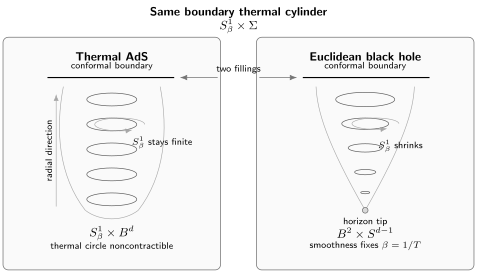
The same boundary thermal data can be filled by different Euclidean bulk saddles. In a black-hole or black-brane saddle, the Euclidean time circle smoothly contracts at the horizon, fixing by regularity.
Thermal states from Euclidean time
Section titled “Thermal states from Euclidean time”For an ordinary quantum system with Hamiltonian , the thermal partition function is
In Euclidean quantum field theory, this trace is represented by a path integral on a Euclidean time circle:
Bosonic fields are periodic around this circle, while fermionic fields are antiperiodic in the thermal ensemble:
This is why finite temperature breaks supersymmetry in most thermal applications: supersymmetry would want bosons and fermions to be treated symmetrically, while the thermal trace gives them different spin structures around .
In AdS/CFT, the boundary thermal path integral becomes a boundary condition for the bulk gravitational path integral. Schematically,
At large , the bulk path integral is approximated by saddle points:
where each is a smooth Euclidean bulk geometry whose conformal boundary is the prescribed thermal boundary geometry. The dominant saddle is the one with the smallest renormalized Euclidean action.
The free energy is then
or equivalently
for the dominant saddle.
Wick rotation and the Euclidean metric
Section titled “Wick rotation and the Euclidean metric”For a static Lorentzian metric, one often writes
A simple example is pure Poincare AdS. In Lorentzian signature,
After Wick rotation,
If we impose
then the boundary geometry is . Locally this is still Euclidean AdS, but globally it has a thermal circle.
For global AdS, the Lorentzian metric can be written as
The Euclidean continuation is
At large , the metric is conformal to
If has period , the boundary is
This geometry is usually called thermal AdS. It is locally the same as Euclidean AdS, but with Euclidean time periodically identified.
The horizon as a smooth Euclidean origin
Section titled “The horizon as a smooth Euclidean origin”Now consider a static black hole metric of the form
where the horizon is at
Assume the horizon is nonextremal, so
After Wick rotation ,
Near the horizon,
Define a new radial coordinate by
Then the part of the metric becomes
This is just the flat plane in polar coordinates if the angular coordinate
has period . Therefore must have period
The Hawking temperature is
This is the smoothness derivation of the Hawking temperature. No quantum field theory in curved spacetime was needed at this stage. The temperature is forced by the requirement that the Euclidean geometry be regular at the place where the Lorentzian horizon used to be.
More generally, if the near-horizon Lorentzian metric is
then the Euclidean metric is
Smoothness requires
where is the surface gravity.
Planar AdS black brane
Section titled “Planar AdS black brane”The planar AdS black brane is
The boundary is at , and the horizon is at .
After Wick rotation,
Near the horizon,
The same smoothness analysis gives
This formula is one of the most frequently used results in finite-temperature holography. It relates the location of the black-brane horizon to the boundary temperature.
For AdS, where ,
The horizon is deeper in the bulk at lower temperature and closer to the boundary at higher temperature.
Global AdS-Schwarzschild black holes
Section titled “Global AdS-Schwarzschild black holes”For a spherical horizon, the global AdS-Schwarzschild metric is
with
The horizon radius satisfies
so
The temperature is
This function has a minimum. Small AdS black holes behave thermodynamically like asymptotically flat black holes and have negative specific heat. Large AdS black holes have positive specific heat and can dominate the canonical ensemble.
This is already a major difference between AdS and flat space. The AdS boundary acts like a gravitational box. Large black holes can be in stable thermal equilibrium with their own radiation.
Thermal AdS versus Euclidean black holes
Section titled “Thermal AdS versus Euclidean black holes”For boundary topology
there are at least two important Euclidean fillings.
The first is thermal AdS. Its topology is roughly
The thermal circle is noncontractible. The spatial shrinks smoothly in the interior.
The second is the Euclidean AdS black hole. Its topology is roughly
Here the Euclidean time circle is contractible. It shrinks smoothly at the horizon.
The boundary data are the same, but the bulk fillings are topologically different. Therefore the gravitational path integral should sum over both:
At low temperature, thermal AdS dominates. At high temperature, the large AdS black hole dominates. This exchange of dominance is the Hawking–Page transition.
On the boundary, for a large- gauge theory on , this transition is interpreted as a confinement/deconfinement-type transition. The details depend on the theory and ensemble, but the rough scaling is simple:
The black hole carries the entropy of order degrees of freedom.
The Euclidean gravitational action
Section titled “The Euclidean gravitational action”The Euclidean gravitational path integral has the schematic form
In the saddle-point approximation,
For Einstein gravity, the renormalized Euclidean action has the schematic structure
The precise sign of the Gibbons–Hawking–York term depends on the convention for the outward normal and for . What matters physically is that the boundary term is needed for a well-posed Dirichlet variational problem, and the counterterms are needed to make the AdS on-shell action finite.
Once is known, the thermodynamic quantities follow from
and
Equivalently,
For an AdS black hole or black brane, this entropy agrees with the Bekenstein–Hawking area law:
The Euclidean derivation is especially elegant because the entropy comes from the geometry of the smooth cap. If one changes the period away from the smooth value while holding the horizon area fixed, the Euclidean geometry develops a conical defect. The response of the gravitational action to this conical defect gives precisely in two-derivative Einstein gravity.
Smoothness versus arbitrary temperature
Section titled “Smoothness versus arbitrary temperature”A common question is: if the boundary circle has arbitrary length , why can a black hole only have a special value of ?
The answer is that the boundary condition specifies the length of the thermal circle at infinity, but a smooth black-hole filling exists only when that boundary period matches the horizon regularity condition. For a family of black holes labeled by , the regularity condition determines as a function of .
For example, the planar black brane satisfies
Thus for any boundary temperature , there is a corresponding horizon location
For global AdS-Schwarzschild black holes, the relation is not one-to-one. Above a minimum temperature, there are usually two black holes: a small unstable one and a large stable one. The large one is the relevant saddle at sufficiently high temperature.
If one insists on the wrong period for a given horizon radius, the Euclidean geometry is not smooth. It has a conical singularity at the horizon. Such geometries are useful in entropy derivations, but they are not ordinary smooth saddles of the vacuum Einstein equations.
Euclidean preparation of states
Section titled “Euclidean preparation of states”The full thermal circle computes a trace:
A Euclidean path integral over half of the thermal circle prepares a state. In an ordinary QFT, cutting the circle open at two times prepares the thermofield-double state
In holography, the Lorentzian continuation of the corresponding Euclidean black-hole saddle gives the eternal two-sided AdS black hole. This is a first glimpse of a powerful idea: Euclidean geometry can prepare Lorentzian states.
This course will return to this point when discussing real-time holography, entanglement wedges, and black-hole information.
Charged and rotating previews
Section titled “Charged and rotating previews”Although this page focuses on neutral static black holes, the Euclidean method generalizes.
For a conserved charge, the grand canonical partition function is
In the bulk, the chemical potential is encoded in the boundary value of a Euclidean gauge field. A useful regularity condition is that the one-form should be smooth at the place where the circle contracts. In a convenient gauge this means
so the chemical potential is the gauge-invariant difference between the boundary and the horizon:
For rotating black holes, the Euclidean identification mixes time with angular variables. The boundary ensemble then includes angular potentials. These refinements are conceptually straightforward but technically richer, so they are deferred to later applications.
Dictionary checkpoint
Section titled “Dictionary checkpoint”The main translations from this page are:
| Boundary thermal field theory | Euclidean AdS gravity |
|---|---|
| thermal partition function | bulk path integral with boundary |
| inverse temperature | circumference of Euclidean boundary time circle |
| thermal state | smooth Euclidean filling of the thermal boundary |
| black-hole temperature | smoothness condition at Euclidean horizon |
| free energy | |
| entropy | , equal to for Einstein gravity |
| phase transition | exchange of dominance between Euclidean saddles |
| horizon in Lorentzian signature | smooth cap of the thermal circle in Euclidean signature |
The essential lesson is that temperature is boundary data, but a black-hole saddle can fill that boundary data only when the thermal circle closes smoothly in the interior.
Common confusions
Section titled “Common confusions”“The Euclidean horizon is another boundary.”
Section titled ““The Euclidean horizon is another boundary.””No. For a smooth nonextremal Euclidean black hole, the horizon is the origin of polar coordinates in the plane. The thermal circle shrinks there. One should not impose independent boundary data at the Euclidean horizon.
“The thermal circle period can be chosen independently of the black hole.”
Section titled ““The thermal circle period can be chosen independently of the black hole.””Not for a fixed smooth black-hole geometry. The period is fixed by regularity at the horizon. Equivalently, the black-hole size determines the temperature. In some families, such as planar black branes, this relation is one-to-one. In global AdS, it can be many-to-one or have a minimum temperature.
“Thermal AdS and the AdS black hole have different boundary theories.”
Section titled ““Thermal AdS and the AdS black hole have different boundary theories.””No. They are different bulk saddles with the same boundary thermal geometry. They contribute to the same boundary partition function. Their competition is precisely what makes the Hawking–Page transition possible.
“Euclidean methods automatically give real-time correlators.”
Section titled ““Euclidean methods automatically give real-time correlators.””Euclidean correlators determine many equilibrium quantities, but real-time retarded correlators require additional analytic continuation and horizon boundary conditions. In holography, infalling boundary conditions at Lorentzian horizons are essential for retarded response.
“Extremal black holes are obtained by the same smoothness argument with .”
Section titled ““Extremal black holes are obtained by the same smoothness argument with T=0T=0T=0.””Extremal horizons are subtle. The near-horizon Euclidean geometry is not a smooth disk in the same way as a nonextremal horizon. The Euclidean time circle does not simply cap off with a finite opening angle. Many zero-temperature limits must be taken with care.
Exercises
Section titled “Exercises”Exercise 1: Euclidean Rindler smoothness
Section titled “Exercise 1: Euclidean Rindler smoothness”Consider the two-dimensional Euclidean metric
Show that the geometry is smooth at only if has period .
Solution
Flat polar coordinates are
where has period . In the given metric,
Therefore implies
If the period is different, the origin has a conical excess or deficit. Thus a smooth Euclidean horizon fixes
Exercise 2: Temperature of the planar black brane
Section titled “Exercise 2: Temperature of the planar black brane”For
derive the temperature
Solution
After Wick rotation,
Near the horizon, write
Then
The two-dimensional part is
Define
Then
Smoothness requires
to have period . Therefore
Exercise 3: Minimum temperature of global AdS-Schwarzschild
Section titled “Exercise 3: Minimum temperature of global AdS-Schwarzschild”For the global AdS-Schwarzschild black hole,
Find the horizon radius at which the temperature is minimized and compute .
Solution
Differentiate:
Setting this to zero gives
so
At this radius,
Therefore
Exercise 4: Thermodynamics from the Euclidean action
Section titled “Exercise 4: Thermodynamics from the Euclidean action”Suppose a saddle has renormalized Euclidean action and partition function
Show that
Solution
The thermal energy is
Since
we get
The free energy is
Using
we find
Further reading
Section titled “Further reading”- G. W. Gibbons and S. W. Hawking, Action Integrals and Partition Functions in Quantum Gravity.
- S. W. Hawking and D. N. Page, Thermodynamics of Black Holes in Anti-de Sitter Space.
- E. Witten, Anti de Sitter Space, Thermal Phase Transition, and Confinement in Gauge Theories.
- O. Aharony, S. S. Gubser, J. Maldacena, H. Ooguri, and Y. Oz, Large Field Theories, String Theory and Gravity.
- K. Skenderis, Lecture Notes on Holographic Renormalization.